[FX Reporting Before Overseas Transfers, Part 2] Should You Wait for the December Amendment Before Filing?
BySangjin Ji, Administrative Attorney3 years of embassy visa practiceLinkedIn
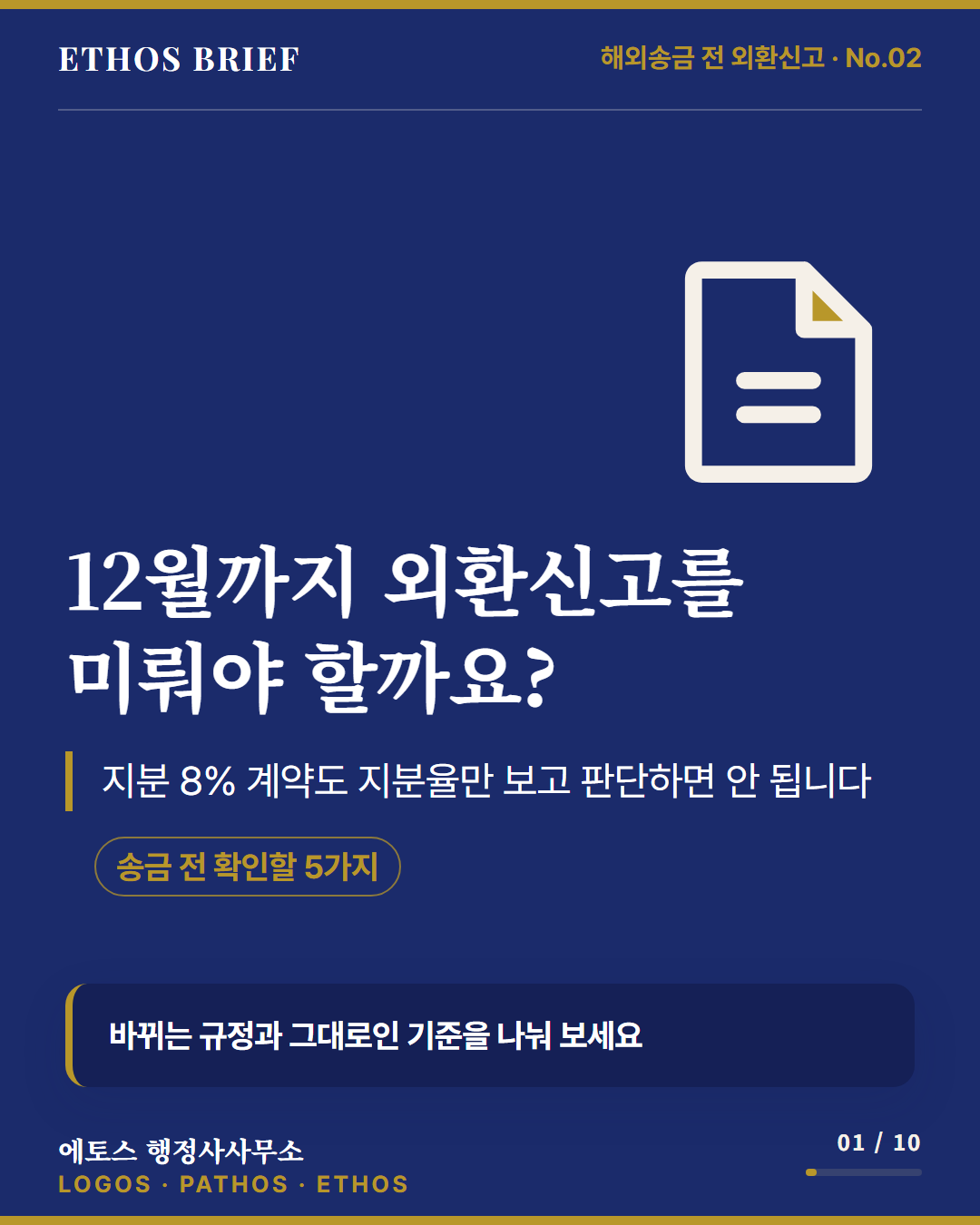


A Korean company plans to acquire 8% of a Vietnamese manufacturing partner. The agreement also provides for an officer assignment and a two-year supply arrangement. The company now needs to prepare its overseas direct investment report and set the payment schedule.
One question may delay the process: should the company wait because the Foreign Exchange Transactions Act will be amended on December 3, 2026?
The amendment is not, by itself, a reason to postpone the overseas direct investment filing. It does not change the basic statutory provisions defining overseas direct investment and requiring reports. If the acquisition qualifies under the current rules, the company can begin preparing the report around the actual agreement and payment schedule.
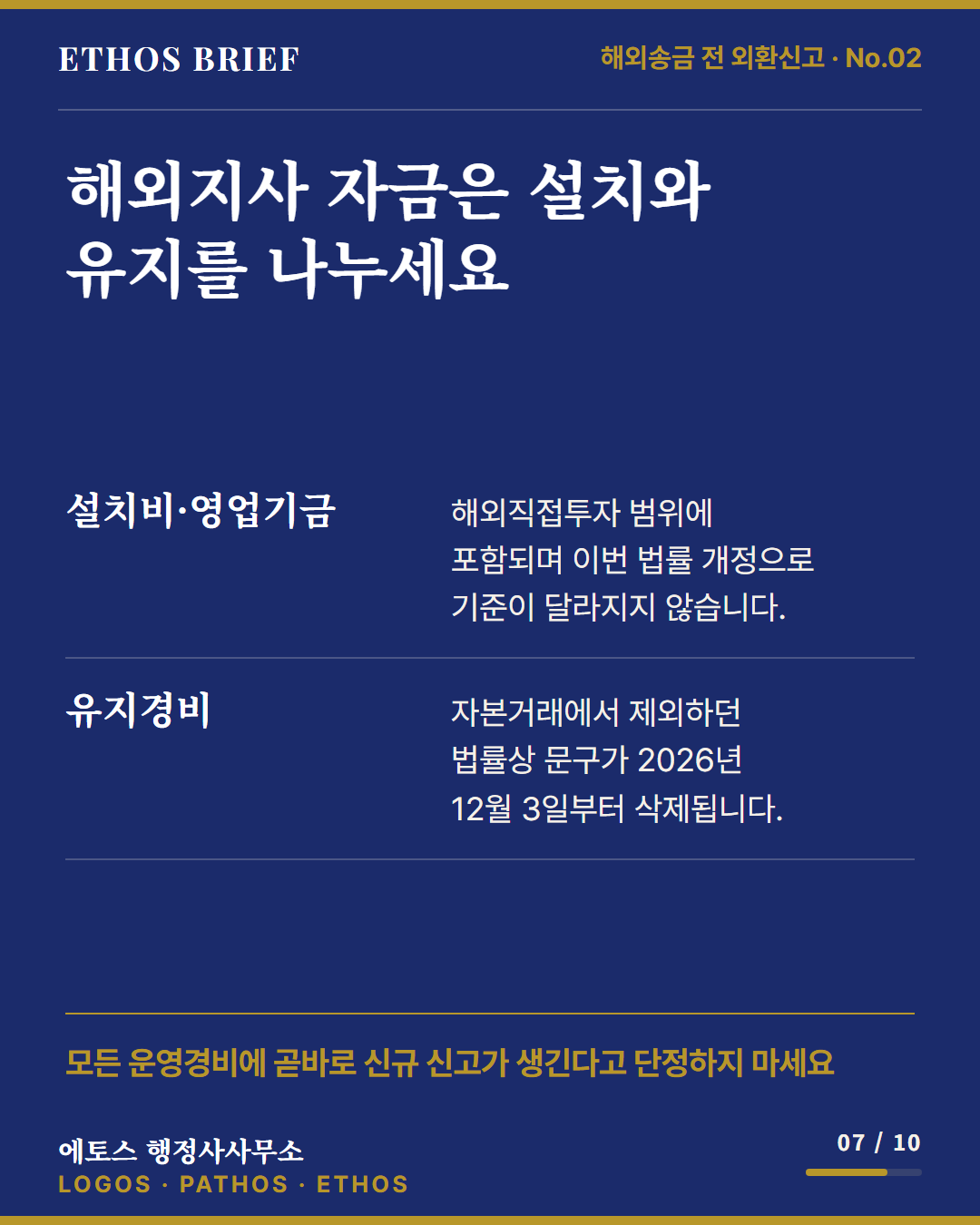
The amendment does not affect every overseas transaction in the same way. Overseas-office maintenance expenses require separate attention because their treatment under the statutory definition of capital transactions is changing.
An 8% stake cannot be assessed by percentage alone
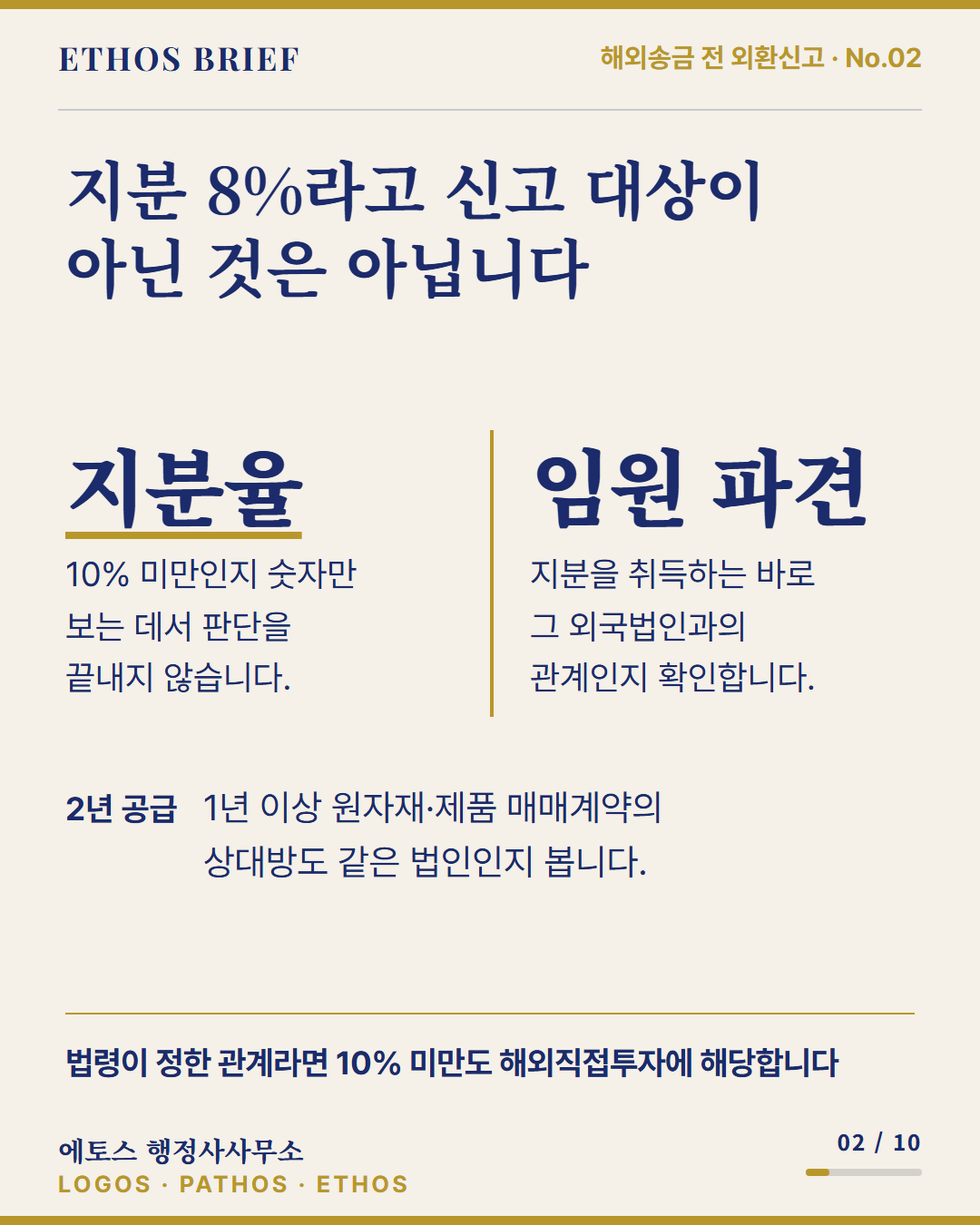
Article 8(1)(2) of the Enforcement Decree of the Foreign Exchange Transactions Act (「외국환거래법 시행령」) includes certain below-10% equity acquisitions in overseas direct investment when the investor establishes a relationship specified by law with the foreign company.
The listed relationships include assigning an officer and entering into a raw-material or goods purchase-and-sale agreement lasting at least one year.
Return to the proposed acquisition of 8% of Vietnamese Company A. The presence of an officer-assignment clause and a two-year supply agreement is not enough by itself. The parties to those relationships matter.
The company should establish:
- whether the officer will serve at Company A;
- whether Company A is also party to the two-year supply agreement; and
- whether the written terms match the transaction that will actually be carried out.
If the shares are acquired in Company A but the supply agreement is with an unrelated Company B, the agreement with B does not automatically establish the required relationship with A. Conversely, if the investor establishes an officer-assignment relationship or a qualifying one-year-or-longer goods contract with the same foreign company, an acquisition below 10% may still constitute overseas direct investment.
The December 3 amendment does not change this test.
Reporting and payment need their own timetable
Once a transaction qualifies as overseas direct investment, the next issue is when the funds must be sent. The agreement may specify separate dates for a deposit and the remaining purchase price.
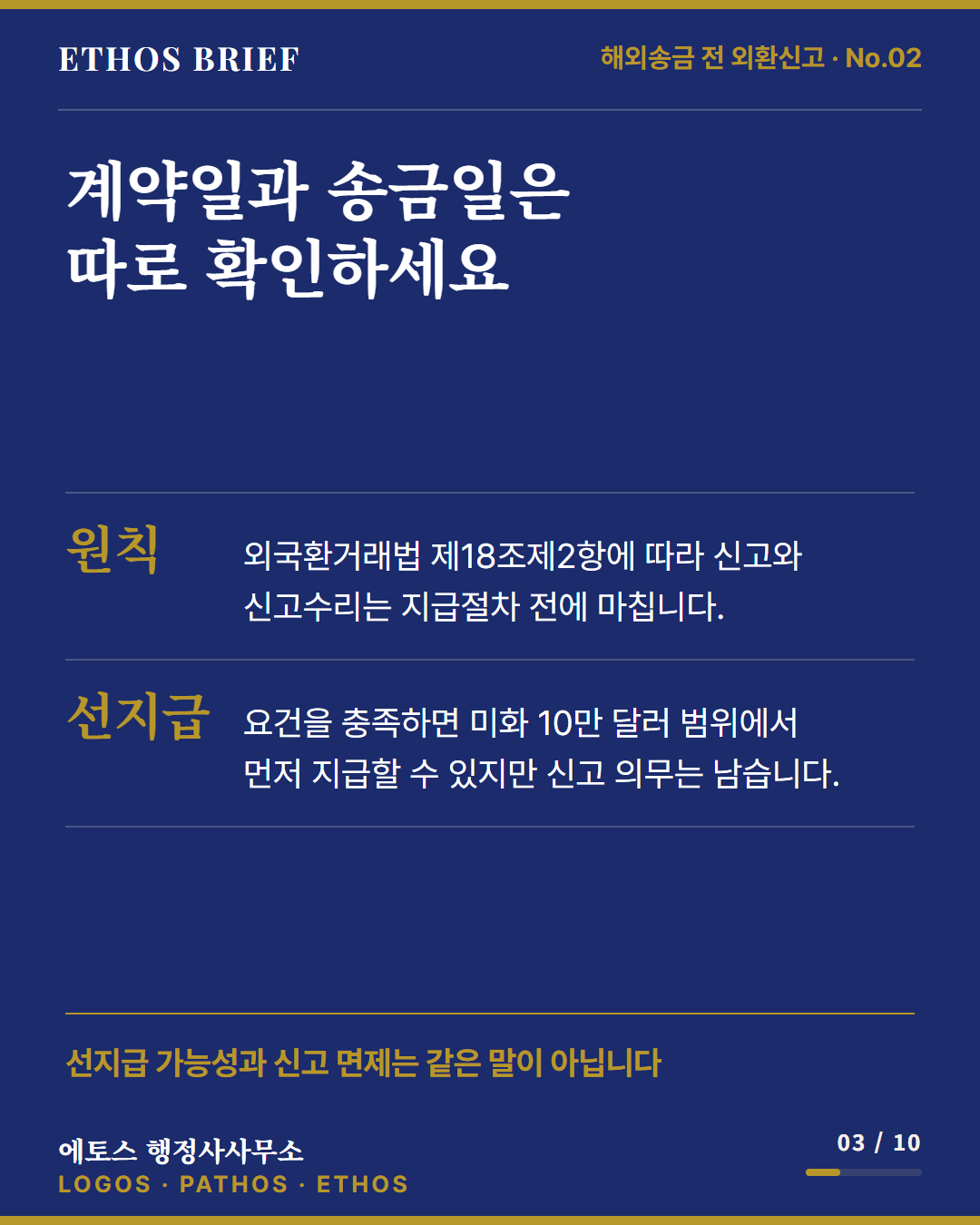
Article 18(2) of the Foreign Exchange Transactions Act (「외국환거래법」) requires the relevant reporting or acceptance procedure to be completed before the payment procedure. The Foreign Exchange Transaction Regulations, Article 9-1(2), provide a limited route under which funds of up to USD 100,000 may be paid before the required procedure if the stated conditions are satisfied.
This is not a general permission to send money through any bank and deal with the filing later. Payment must be made through the designated foreign exchange bank prescribed in the relevant section of Chapter 9. The required report or other procedure must then be completed within one year from formation of the transaction contract.
Two distinctions are essential.
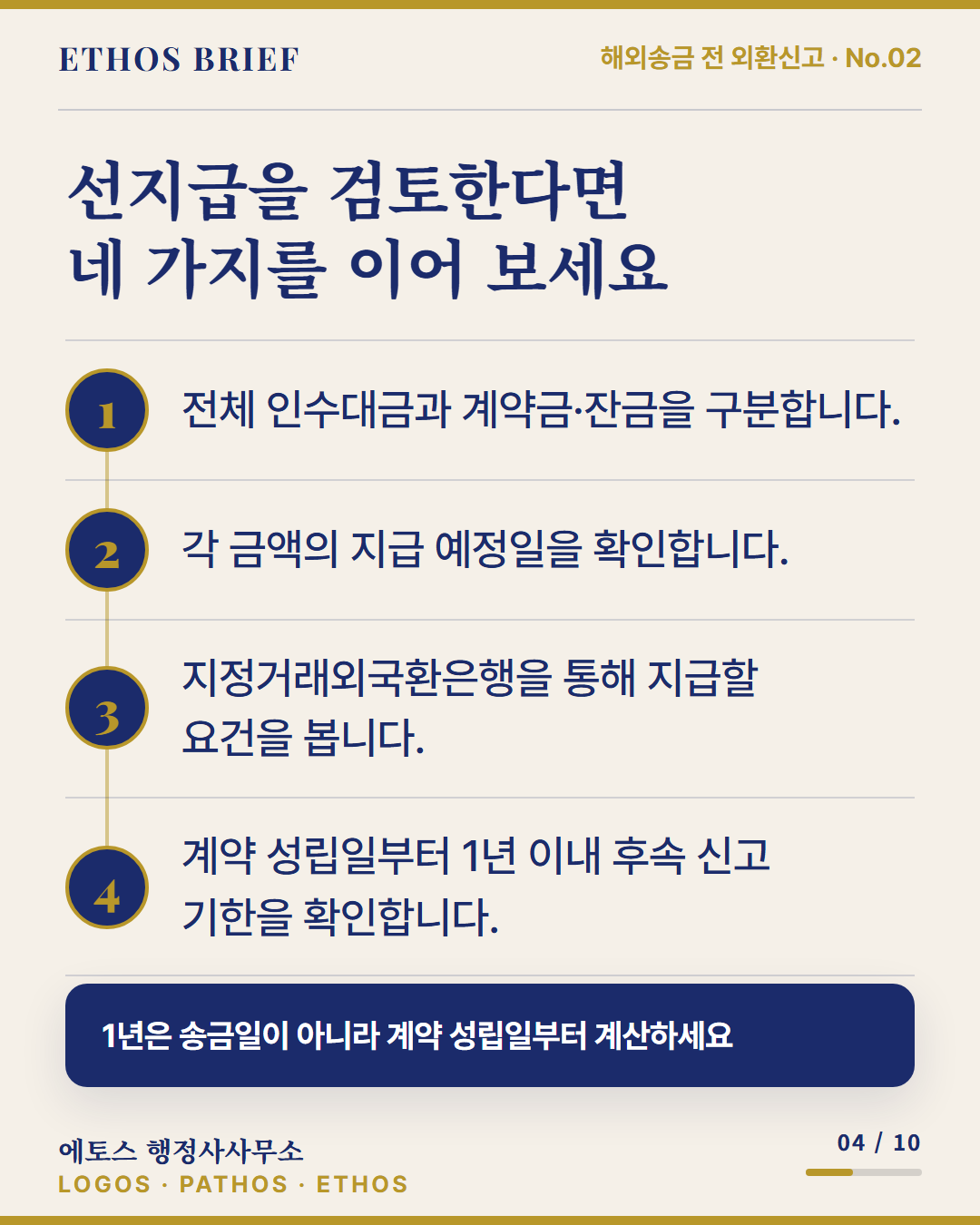
First, the one-year period begins when the contract is formed, not when the money is sent. If the signing date differs from the effective date, or if the agreement contains conditions precedent, the company needs to identify when the contract was formed for this purpose.
Second, permission to pay up to USD 100,000 first is not an exemption from reporting. The follow-up procedure remains necessary.
Before paying a deposit, the company should therefore place the total purchase price, the deposit and balance, each scheduled payment date, the contract-formation date and the designated foreign exchange bank on one timeline.
The agreement and transfer application must describe the same transaction
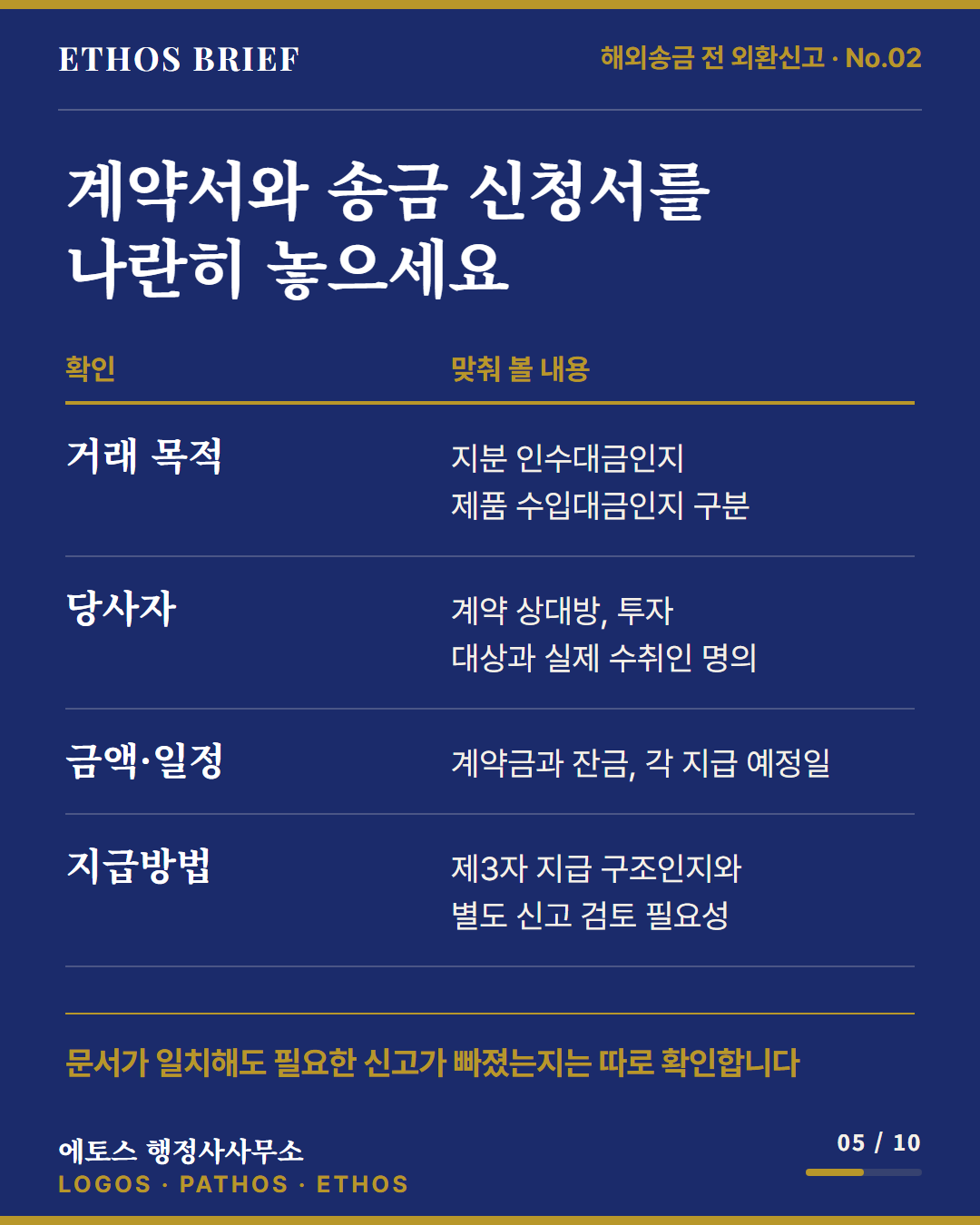
Payments to the same Vietnamese company may have different legal purposes. A payment for imported goods under a supply contract is not the same transaction as payment for shares under an equity acquisition agreement.
The equity agreement, overseas direct investment documents and transfer application should be compared for:
- transaction purpose;
- contracting party and investment target;
- deposit, balance and scheduled payment dates;
- the name on the receiving account; and
- whether payment will be made to a person other than the transaction party.
Suppose the equity agreement requires payment to Company A, but the receiving account is held by Company B. The documents should explain why payment is directed to a different entity. A third-party payment structure may also require review under Article 16 of the Foreign Exchange Transactions Act, which governs specified payment methods.
Document consistency is important, but consistent documents do not prove that every required report has been made. The company must check both the documents and the applicable reporting duty.
For overseas real estate, begin with the acquiring party
The December amendment does not comprehensively replace the existing reporting framework for overseas real-estate acquisitions. The correct procedure may still differ according to the buyer, the purpose of the property, the right being acquired and the funding structure.
If Korean headquarters directly purchases property overseas, the rules for a Korean resident's overseas real-estate acquisition must be reviewed. If an established local company acquires the property in its own name and with its own funds, the transaction should be understood through that company's ownership and funding structure.
Another issue arises if Korean headquarters contributes additional capital or lends money to the local company so that it can buy the property. The real-estate purchase and the cross-border funding transaction may require separate analysis.
Calling a property “employee housing” does not identify the reporting authority or procedure. The company should examine the buyer named in the purchase agreement, the nature of the acquired right, who bears the purchase price and who will hold title.
Overseas-office setup funds and maintenance expenses are different
Setup costs and operating capital sent to establish an overseas branch or liaison office fall within overseas direct investment. The December amendment does not change that basic treatment.
Maintenance expenses for an office that has already been established require a separate analysis. The current Foreign Exchange Transactions Act excludes specified overseas-office maintenance expenses from capital transactions. The statutory wording creating that exclusion is scheduled to be deleted from December 3, 2026.
That change does not establish that every existing overseas office must submit a new establishment report or that every monthly rent or operating payment automatically requires a separate new report. Procedures for payment and management through a designated foreign exchange bank already exist.
A company operating an overseas office should first assemble:
- the existing establishment report;
- details of the designated foreign exchange bank;
- the lease and recurring operating-payment records; and
- evidence showing the actual purpose of furniture, equipment or other individual payments.
Costs paid to establish an office may require different documents and explanations from expenses incurred while operating it. The company should not infer a new duty from the amended statutory wording alone. The final promulgated Enforcement Decree and related regulations must be checked to determine the detailed procedure after the amendment.
An advance notice of legislation is not the final rule
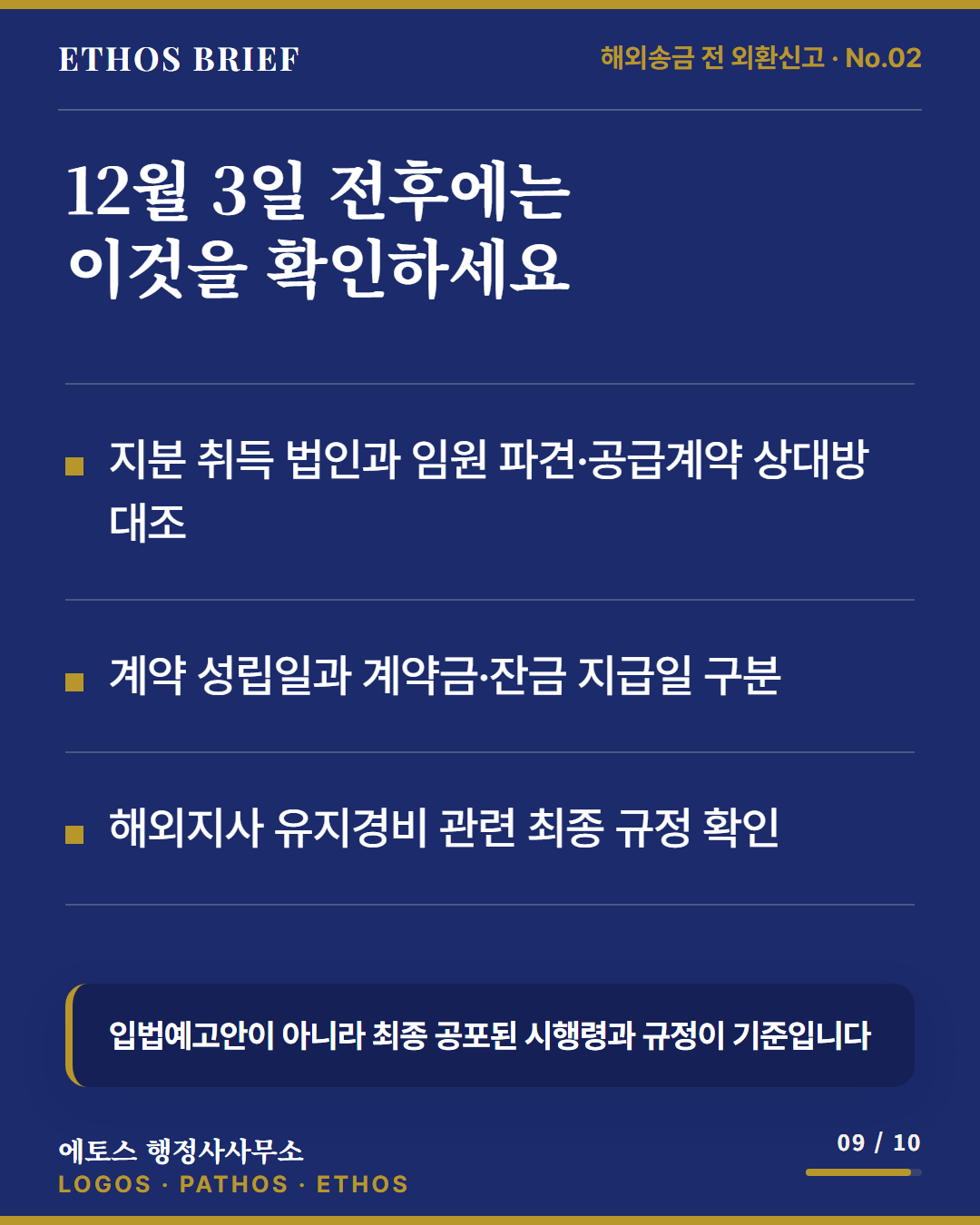
On October 7, 2026, the Ministry of Economy and Finance issued an advance notice of a proposed amendment to the Enforcement Decree. The proposal addressed overseas-office maintenance expenses and the scope of inspections by the Korea Customs Service.
An advance notice is a proposal published for comment. The applicable procedure must be determined from the final promulgated decree and related regulations.
A company preparing an overseas direct investment report does not need to suspend the current process simply because the proposal has not yet been finalized. It should also avoid assuming that every part of the proposal will be promulgated without change.
The practical course is to organize the agreement and payment records, prepare the filing under the rules currently in force, and compare the final subordinate legislation around the effective date.
What the company can organize and what needs integrated review
The company's own team can identify the transaction party, investment target, amount, contract-formation date and scheduled payments. If an overseas office already exists, it can also collect the establishment report, designated-bank information and maintenance-expense records.
The more difficult questions require the documents and the applicable rules to be read together. These include whether a below-10% acquisition meets the overseas direct investment test, whether a particular deposit qualifies for the advance-payment provision, and which reporting and payment procedures apply to overseas real estate or overseas-office funds.
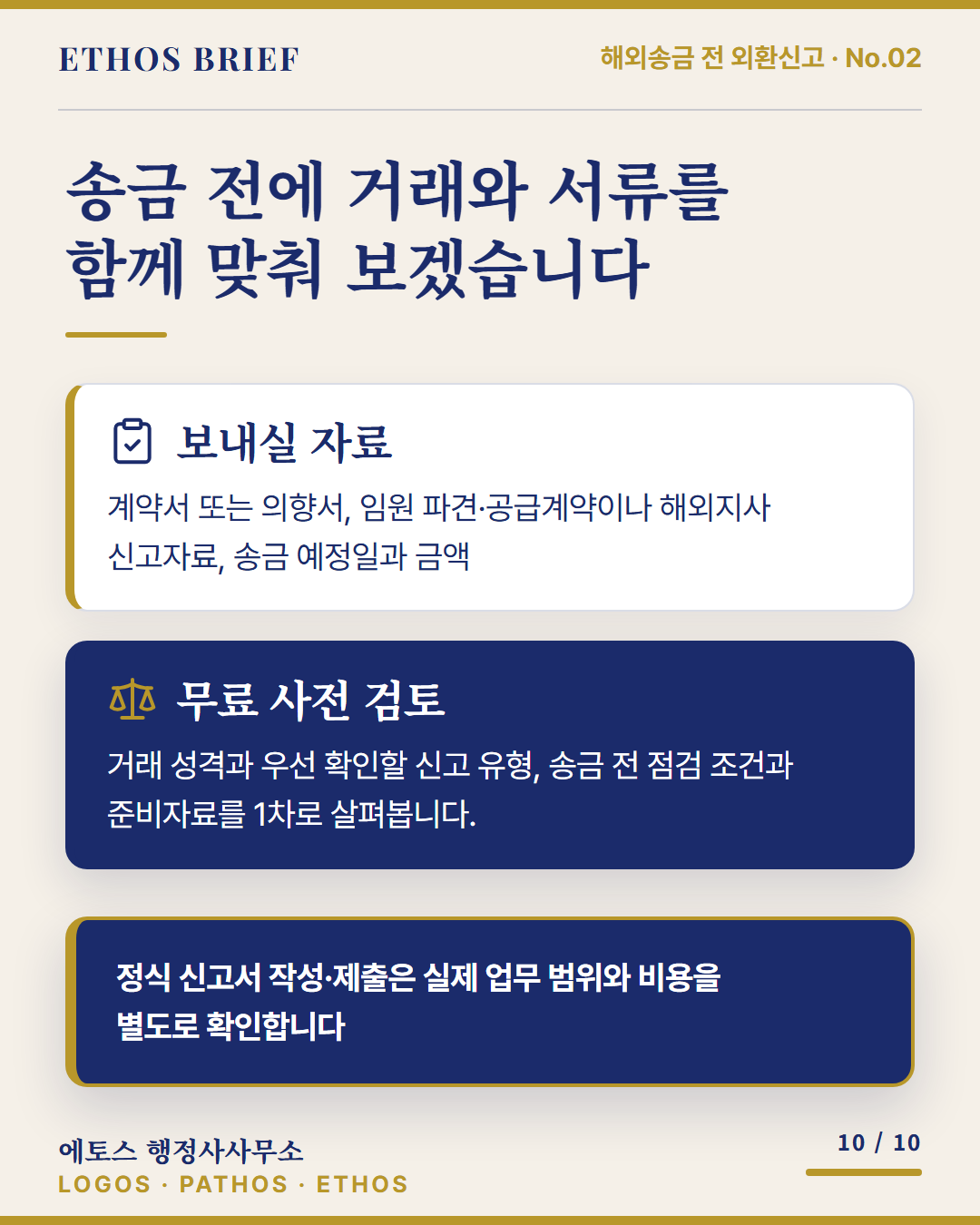
If your company is preparing an overseas equity acquisition, overseas real-estate acquisition or overseas-office establishment, you may send the principal agreement or letter of intent, officer-assignment or supply terms, existing overseas-office filing records, and the planned transfer amount and date. In a free preliminary review, Ethos Administrative Attorney Office first identifies the transaction type, reporting route, pre-transfer conditions and preparation documents; formal report preparation and filing are scoped and priced separately after the work that may be performed is confirmed.
Three-point summary
A below-10% equity acquisition may still be overseas direct investment when the investor establishes an officer-assignment relationship or a qualifying one-year-or-longer goods contract with the same foreign company.
The advance-payment provision for up to USD 100,000 is not a reporting exemption, and the required follow-up procedure must be completed within one year from contract formation.
The December amendment does not change every overseas transaction, so distinguish the transaction type, contracting party and payment purpose and check the final promulgated rules.