
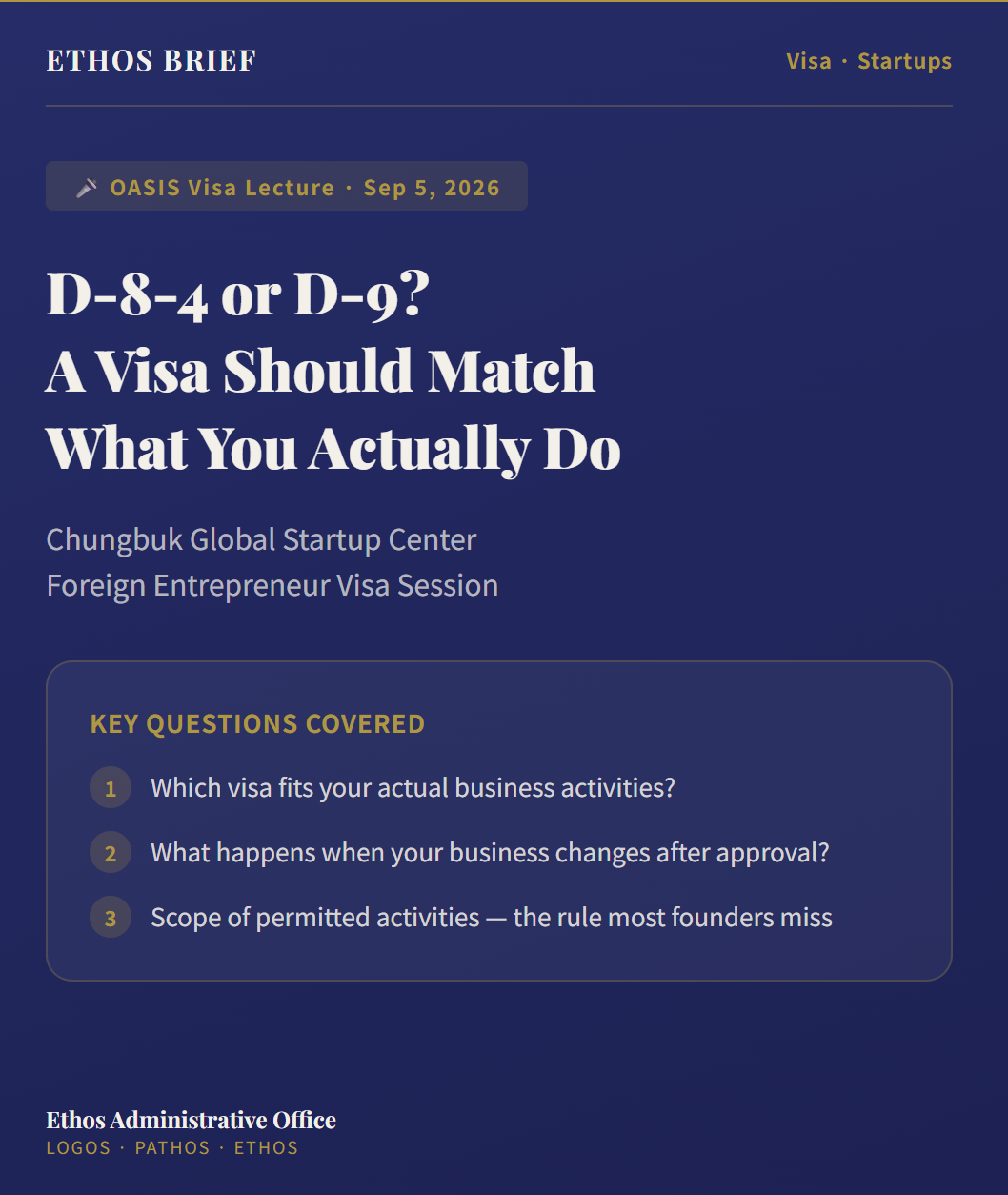
D-8-4 or D-9: Which Visa Fits Your Business in Korea? — OASIS Visa Lecture for Foreign Entrepreneurs
Hello, I’m Administrative Agent Sangjin Ji.
On September 5, I delivered an OASIS visa lecture for foreign entrepreneurs at the Chungbuk Global Startup Center.
Among the questions I received during the lecture, two stood out in particular.
“Between D-8-4 and D-9, which visa is easier or more advantageous to obtain?”
And:
“If I hold a D-9 trade visa, can I trade different products from the ones I initially planned?”
After the lecture, I realized that these two questions captured the main point I wanted to emphasize better than many of the slides I had prepared.
They may look like different questions, but they lead to the same issue.
Before asking, “What visas are available?”
you should first ask, “Does this visa actually match what I plan to do in Korea?”
This is also one of the reasons visa work can be difficult.
D-8 and D-9: Which Visa Is Easier to Obtain?
The short answer is that it is difficult to say that one visa is categorically better or easier based on the visa name alone.
Korea’s immigration system separates D-8 categories related to corporate investment, venture businesses, and technology startups from D-9 categories related to trade, company management, and other profit-making business activities.
So instead of beginning with:
“Which visa is easier to get?”
I suggested beginning with:
“What do I actually plan to do in Korea?”
Recent policy developments have made technology-based entrepreneurship, including AI-related startups, more prominent, and the D-8-4 framework has also continued to evolve.
However, a founder building a technology-based startup and a person operating an import-export trading business have fundamentally different business structures.
When comparing visa options, it is important to look at factors such as:
- your current status of stay
- your actual business activities
- how your business will generate revenue
- how your business may change in the future
The last point is especially important.
The visa you may be able to obtain now and the status of stay that will remain suitable for you later are not always the same thing.
A visa does not end on the day it is issued.
You start the business.
Revenue begins to come in.
Your products or services may change.
You may add new business activities.
Eventually, you may also need to extend your stay or change your status of stay.
That is why a visa should be considered not only in terms of “Can I obtain it now?” but also “What will I actually do after I receive it?”
Why the Question “Can I Change My Trade Items?” Matters
The second question raised during the lecture followed the same logic.
“If I am operating under D-9 and later change the products I trade, is that okay?”
At first glance, this may seem like a simple question about trading items.
In practice, however, it may be necessary to review how much the business has changed, whether the form of the business has changed, and whether there is a meaningful difference between the activity originally presented when the status of stay was granted and the activity currently being carried out.
That is why it is often better not to answer too quickly with:
“Yes, you can.”
or
“No, you cannot.”
The facts should come first.
Again, the principle is the same:
Look at the actual activity before focusing on the visa label.
I Updated the Lecture Materials Again
For this OASIS lecture, I did not simply reuse my previous materials.
I focused on two major updates.
1. Making the Visa Explanations Clearer
Rather than stopping at statements such as:
“This visa exists.”
“These are the requirements.”
I revised the materials so that participants could better understand when a particular visa might be considered and when their individual circumstances need to be reviewed more carefully.
Simply introducing visa categories and general requirements is no longer enough.
AI can already explain a significant amount of basic visa information.
So during the lecture, I placed more emphasis on which factors need to be examined together in an actual case.
I also explained that completing an OASIS program does not automatically mean that a person will qualify for D-8-4.
OASIS participation may form part of the evaluation framework, while other factors such as Korean-language qualifications, educational background, and other scoring elements may also be relevant.
2. Showing Participants Where to Check Updated Information
Visa policies continue to change.
For that reason, it is important not only to learn the current rules but also to know where to check again when those rules change.
For example, the Ministry of Justice reviewed 22 immigration and visa policy proposals submitted by industry, labor, education, and other sectors between June 2025 and May 2026, and adopted 14 of them.
Among the measures already reflected in policy was an expansion of exemptions from the D-8-4 technology startup points system.
Source: Ministry of Justice, June 8, 2026, “Supporting Economic Recovery and Regional Development Through Innovation in Immigration Policy”
In other words, even when teaching D-8-4, the latest D-8-4 policies need to be checked again.
That is why I regard visa lecture materials not as a finished textbook, but as something that needs continuous updating.
Knowing Where to Check Again Matters More Than Memorizing Visa Names
During this lecture, I also introduced official channels where participants can verify visa and immigration information, including:
- HiKorea
- Korea Visa Portal
- Ministry of Justice Immigration Service
- Immigration Contact Center 1345
The 1345 Immigration Contact Center currently provides immigration-related information in multiple languages, including Korean, English, Chinese, and Arabic.
Basic information about D-8, D-9, and general status-of-stay requirements can be checked through these official sources.
AI can also explain much of the basic framework.
The harder part begins after the information has been found.
For example:
“Both D-8-4 and D-9 seem possible. Which one actually fits my business?”
“My business has changed since I first applied. Does my current status of stay still match what I am doing?”
“I completed business registration, but can I actually conduct this activity under my current visa?”
At this stage, the issue is no longer just finding information.
It is about whether that information applies to your actual situation.
The two questions raised during the lecture were exactly at that point.
Why I Used the Case of 734 Foreign Delivery Riders in a Startup Visa Lecture
One of the topics I emphasized during the lecture was the scope of permitted activities under a status of stay.
To explain this, I introduced a recent Ministry of Justice enforcement case involving foreign delivery riders.
Between January and May 2026, authorities identified 734 foreign delivery riders and 16 delivery businesses in a crackdown on unauthorized delivery work.
According to the Ministry of Justice, this was about 11 times the 67 foreign delivery riders identified during all of 2025.
Among those identified, 68 were subject to departure measures, including deportation, while 643 were subject to monetary penalties.
One of the legal provisions cited by the Ministry of Justice was Article 17 of the Immigration Act concerning the scope of stay and activities of foreign nationals.
For more information on this topic, see:
Foreigners and Delivery Work — Part 1
However, I did not use this example simply to say:
“Do not work as a delivery rider.”
The more important issue is scope of permitted activity.
For a foreign entrepreneur, the same principle can raise questions such as:
What if your business item changes?
What if you add a new revenue-generating activity?
What if the way you actually operate the business becomes different from what was originally presented?
At that point, the key question becomes:
“Does what I am doing now still fit within my current status of stay?”
That is why I explained during the lecture that the period after receiving a visa is much longer than the day you receive it.
If a Problem Has Already Arisen, Start With the Disposition Notice
The lecture also covered what should be checked first when a visa-related problem has already occurred.
Suppose someone says:
“My visa was denied.”
“My extension was refused.”
“I was told to leave Korea.”
It is difficult to discuss a concrete response based on those statements alone.
The first step is to review the actual disposition notice or official notification.
You need to check:
- what kind of decision was issued
- when it was issued
- what reasons were stated
A person may describe all of these situations simply as “a visa problem,” but they may involve very different administrative situations.
And depending on those differences, the next questions may also be different.
You may need to determine whether additional documents are required, whether the grounds for the decision need to be examined further, or whether information disclosure or an administrative remedy should be considered.
In the end, the actual disposition must be the starting point.
That is why I summarized the process during the lecture as follows:
Before applying, look at the activity.
After receiving the visa, look at the permitted scope of activity.
After a problem occurs, look at the disposition notice first.
This was one of the most important decision-making frameworks I wanted participants to remember.
Why Overly Simple Answers From Brokers Can Be Dangerous
I also discussed the issue of visa brokers.
The more complex the visa system becomes, the more attractive simple answers can sound.
“It is possible.”
“There is no problem.”
“Everyone does it this way.”
“I have done this before.”
When someone is anxious, those answers may feel reassuring.
However, as discussed above, visa issues may require consideration of the person’s current status of stay, actual activities, business structure, immigration history, and, if a problem has already occurred, the content of the administrative decision.
The fact that something worked for another person does not automatically mean it will work in your case.
So what should be treated with caution is not only an obviously suspicious broker.
Overly simple answers to individualized visa questions should also be treated carefully.
Likewise, living in Korea for a long time or having personal experience with visa applications does not automatically mean that someone can take responsibility for another person’s application, document preparation, or arrangement of immigration work.
Providing general information and taking on another person’s immigration matter are different things.
Are the Visas Shown in Today’s Lecture the Only Options?
No.
This was another point I emphasized.
For example, the digital nomad / workation visa, which had been operated as a pilot program since 2024, transitioned to a regular program on June 30, 2026.
More information is available here:
Regional visa programs are also continuing to evolve.
From May 2026, new employment exceptions were introduced in certain population-decline areas, allowing qualifying small businesses and agricultural corporations to employ F-2-R regional specialized talent under specified conditions.
See:
Regional Specialized Visa Article
D-8-4 policies have also changed this year.
In only a few years, new immigration pathways have emerged while the conditions and practical use of existing programs have continued to change.
That is why I told participants:
“Do not assume that the visas shown on today’s screen are the entire immigration system.”
New pathways may appear.
Existing rules may change again.
A visa that previously had little relevance to you may later become a possible option.
So the important skill is not simply memorizing as many visa names as possible.
It is knowing which制度 to look for in your situation and verifying the latest rules again.
Using AI Interpretation Also Made Me Think About the Future of Visa Work
An AI interpretation system was also used during this lecture.
As I spoke in Korean, interpretation was provided in real time in languages including English and Mongolian.
Watching this naturally raised another question:
“Will AI eventually replace a significant part of visa work?”
I think the answer may be yes.
AI will likely become better at finding visa categories, comparing basic requirements, organizing documents, and translating official materials.
But the questions I received during this lecture were one step further.
The question was not simply:
“What is the difference between D-8-4 and D-9?”
It was:
“Which one actually fits my business?”
Likewise,
“What can I do after a visa denial?”
is a different question from:
“What should be examined in the specific decision I received?”
AI can explain the immigration system.
But connecting a person’s actual business, activities, immigration status, future plans, and an existing administrative decision is a different stage of analysis.
This lecture gave me another opportunity to think about that distinction.
If I Had to Summarize the Lecture in Three Sentences
During the lecture, I discussed D-8-4, D-9, recent policy changes, permitted activities, brokers, and what to do when a visa problem has already occurred.
But the main point can be reduced to three sentences:
Before applying, determine what you actually plan to do.
After receiving the visa, check whether your actual activities continue to fit within the permitted scope.
If a problem occurs, review the actual disposition notice before choosing a response.
The two questions raised during the lecture ultimately led to the same conclusion.
The real question is not simply whether D-8-4 or D-9 is “better.”
It is:
Which immigration pathway fits my actual business?
The question is not only whether you can change a trading item.
It is:
If the business changes, does the current status of stay still match the activities being carried out?
And if a visa has been denied, the question is not simply:
“My visa was rejected. What should I do?”
It is:
What decision was actually issued, and for what reason?
Changing the question changes the way the visa issue should be analyzed.
What Can You Check Yourself, and When Is Individual Review Useful?
There are many things you can check on your own.
You can confirm your current status of stay, clearly organize what you plan to do in Korea, and review basic requirements and recent policy changes through HiKorea, the Korea Visa Portal, official Ministry of Justice materials, or the 1345 Immigration Contact Center.
If a problem has already occurred, you can also begin by checking the type of decision, date, and stated grounds in the disposition notice or official notification you received.
However, general visa requirement tables may not be enough in situations such as:
- comparing two or more possible statuses of stay
- changes between the business originally approved and the business actually being operated
- adding new profit-making or income-generating activities
- cases where immigration status, startup activities, trade, corporate structure, licensing, and visa extension are connected
- cases involving visa denial, extension refusal, departure-related measures, or other immigration decisions
If an official decision has already been issued, the next step should normally be considered after first identifying what decision was made and why.
Visa Education for Foreign Entrepreneurs Should Connect Immigration With Real Business Operations
Preparing this lecture reminded me once again that visa education for foreign entrepreneurs should go beyond simply listing visa categories and application documents.
What a founder often needs is not only an explanation that:
“D-8 is this type of visa.”
They also need to understand:
- which immigration pathway may fit their business
- what activities are permitted after the visa is issued
- where to check updated rules when policies change
- which documents should be reviewed first when a problem occurs
For that reason, I plan to continue structuring foreign entrepreneur and visa lectures around real questions that arise during business operations, recent immigration policy changes, permitted activity issues, and practical risks, rather than limiting them to basic visa introductions.
For startup support organizations and other institutions working with foreign entrepreneurs, lecture content can also be structured according to the participants and program objectives by connecting startup activities, immigration status, residence issues, and actual business operations in Korea.
A visa is not simply a correct answer to memorize.
It is a matter of finding a path that fits the person, the activity, and the next stage of the business.
If you would like to check whether there is a possible immigration pathway based on your current status of stay, planned activities, or an administrative decision you have already received, you can request a free initial review.