
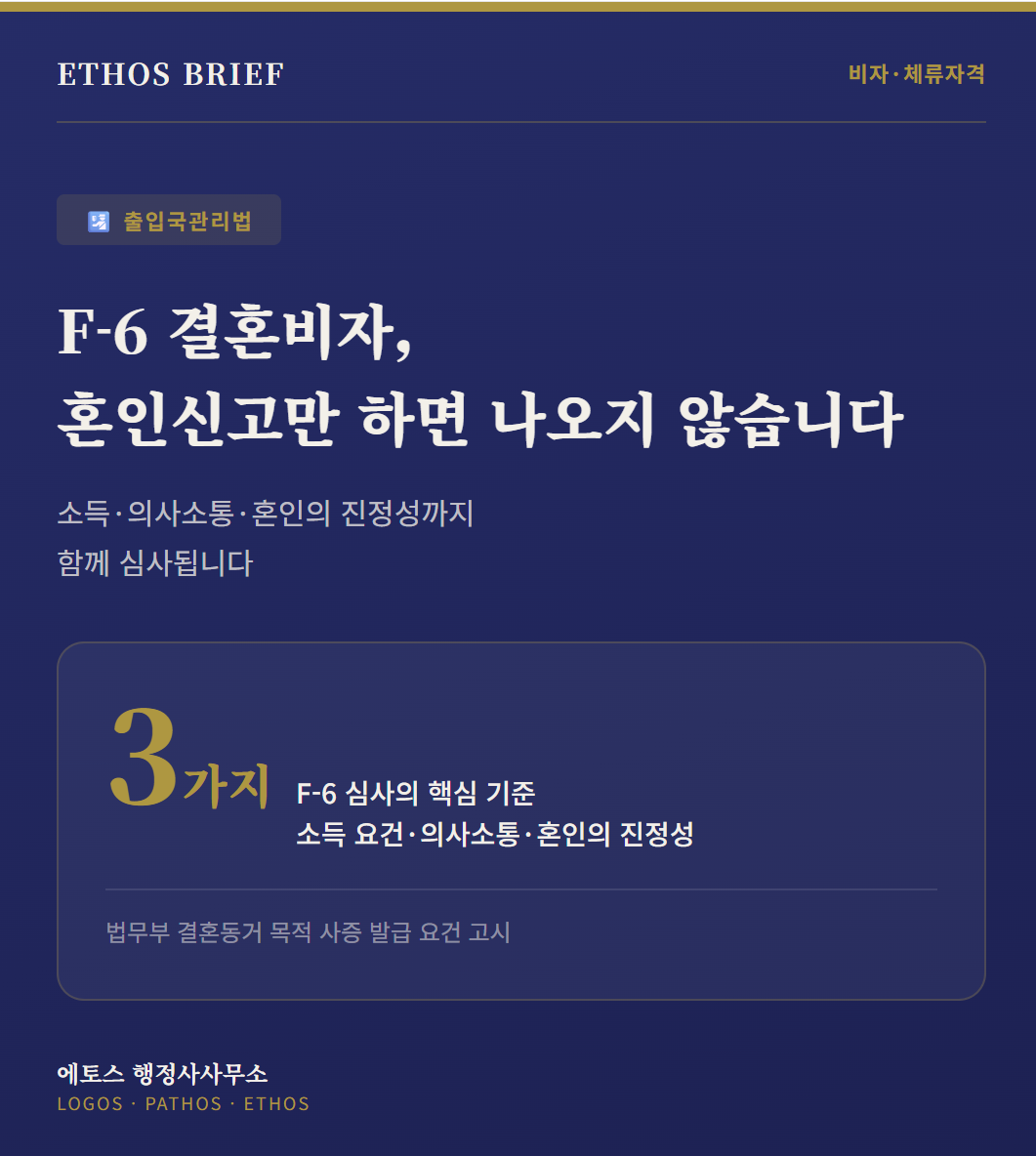
F-6 Marriage Visa — Marriage Registration Alone Does Not Guarantee Approval
Hello, this is Administrative Agent Jean.
A while ago, I heard this question:
“If we get married, shouldn’t we naturally be able to live together in Korea? We already registered the marriage. How can the visa still be refused?”
It can happen.
The F-6 marriage immigration visa is not issued automatically just because the marriage has been registered.
The fact that the Korean spouse and foreign spouse are legally married is an important starting point. But immigration review goes further.
- Is the Korean inviter’s income sufficient?
- Can the couple communicate with each other?
- Is the marriage genuine?
- Is there a stable place to live together?
- Are there any invitation restriction grounds?
- Are the documents valid as of the application date?
If you apply without preparation and receive a refusal, reapplication may be restricted for a certain period unless there is a special reason. During that time, the couple may have to live apart.
That is why the key to the F-6 marriage visa is preparing carefully from the first application.
Today, let’s organize the types, requirements, documents, and cautions for the F-6 marriage visa from the beginning.
What Is the F-6 Visa? Start With the Type
F-6 is a marriage immigration status of stay for foreign nationals who wish to stay in Korea based on marriage to a Korean national, child custody, or the need to remain after the marital relationship has ended.
However, F-6 is not only one category.
| Type | Target Applicant | Key Point | |---|---|---| | F-6-1 | Spouse of a Korean national | The most common type for a foreign spouse married to a Korean national | | F-6-2 | Child custody | Foreign parent raising a child born from a marital relationship with a Korean national | | F-6-3 | Marriage breakdown | Foreign national who cannot maintain the marriage due to death, disappearance, or reasons not attributable to them |
This article focuses mainly on F-6-1, spouse of a Korean national, the most common application type.
Why Marriage Registration Is Not Enough
Marriage registration is a necessary condition for the F-6 visa.
But it is not a sufficient condition.
In other words, the marriage must be legally registered for F-6 to be reviewed, but registration alone does not guarantee visa issuance.
Immigration also reviews questions such as:
- Do the two people genuinely intend to live as a married couple?
- Was the meeting and marriage process natural?
- Is there an economic basis for living in Korea?
- Can the couple communicate?
- Is there a stable residence?
- Are there invitation restriction grounds?
- Do the submitted documents contradict one another?
Especially in international marriage cases, a marriage certificate alone may not be enough.
The relationship should be explained as one connected story: how the couple met, how the relationship developed, family introductions, wedding or marriage registration, cohabitation or visits, and future settlement plans in Korea.
Three Core Review Criteria for F-6
The F-6 review focuses mainly on three areas.
- Income requirement
- Communication requirement
- Genuineness of marriage
Housing conditions and invitation restrictions are also reviewed together.
1. Income Requirement
For F-6-1, the income of the Korean spouse, the inviter, is important.
As of 2026, the income standards required for marriage immigrant visa issuance are as follows.
| Household Size | Annual Income Standard | |---:|---:| | 2 persons | KRW 25,195,752 | | 3 persons | KRW 32,154,216 | | 4 persons | KRW 38,968,428 | | 5 persons | KRW 45,340,314 | | 6 persons | KRW 51,335,712 | | 7 persons | KRW 57,090,900 |
For households of 8 or more, an additional amount is added for each extra household member.
If the Korean inviter has no cohabiting family members, the case is usually reviewed under the 2-person household standard: Korean spouse plus foreign spouse.
If lineal family members are listed in the same household on the resident registration record, that can affect household size calculation.
If Income Is Insufficient, Is It Automatically Refused?
Not necessarily.
If income is insufficient, possible supplementation should be reviewed.
For example, the following may be relevant:
- Bank deposits
- Insurance
- Securities
- Bonds
- Real estate
- Income of cohabiting lineal family members
- Domestic income or assets of the foreign spouse
- Income requirement exemption grounds
Certain assets may be converted into income at a recognized rate, and in some cases, income of lineal family members living in the same household may be combined.
However, sibling income is generally not lineal family income, so caution is needed.
The income requirement is not simply about the salary amount.
Certificate of Income Amount, withholding receipt, certificate of employment, business income documents, and tax payment documents should be consistent.
If the employment contract says the salary is sufficient but the Certificate of Income Amount shows a lower amount, that can become a problem.
2. Communication Requirement
F-6 also reviews whether the couple can actually communicate.
A marriage immigrant generally proves communication ability through one of the following:
- TOPIK Level 1 or higher
- Certificate of completion of beginner Korean course at a designated institution
- Social Integration Program or related education completion
- Evidence of communication in a common language used by the couple
However, the requirement may be exempted or relaxed in certain cases, such as:
- The couple has a child born between them
- The foreign spouse previously stayed in Korea under F-6 status
- The couple proves that they can communicate in a third-country language
- The couple lived together overseas for a certain period and communication ability is recognized
The important point is not “no Korean means automatic refusal.”
The important point is being able to explain how the couple actually communicates.
For example, even if Korean ability is limited, if the couple naturally communicates in English, Chinese, Vietnamese, Thai, or another shared language, that evidence should be organized.
3. Genuineness of Marriage
The most sensitive part of F-6 review is the genuineness of the marriage.
Immigration takes sham marriage concerns seriously.
Therefore, submitting only a marriage certificate may not be enough.
The following materials can help show that the relationship developed naturally.
- Photos together
- Photos organized by period
- Photos with family members
- Wedding or family meeting photos
- Flight tickets
- Entry and exit records
- Call records
- Messenger chat history
- Remittance records
- Gifts or anniversary records
- Travel records together
- Marriage background statement
- Foreign spouse invitation letter
- Statements from family or acquaintances
The key is not the quantity of materials.
The flow should be natural: first meeting → relationship development → family introduction → marriage decision → marriage registration → settlement plan in Korea.
Submitting 20 photos arranged by date with explanations may be more persuasive than submitting 100 photos without context.
Housing Conditions Matter Too
F-6 also requires a normal residence where the couple can live together continuously.
Common documents include:
- Lease agreement
- Real estate registry
- Resident registration record
- Residence confirmation
- Letter of consent to use family-owned housing
- Evidence showing actual residence feasibility
Goshiwons, motels, or temporary lodging facilities may be viewed as unsuitable for stable married life.
The housing requirement does not simply mean having an address.
The key question is whether the couple can actually live there together as a married couple.
Invitation Restriction Grounds Must Be Checked First
F-6 is not finished once income, communication, and genuineness are prepared.
If the Korean inviter has restriction grounds, problems may arise even if other requirements are met.
Representative items to check include:
- History of inviting another foreign spouse within the last five years
- Whether enough time has passed after acquiring Korean nationality through marriage naturalization
- Domestic violence history
- Certain criminal history such as sexual crimes or crimes against children
- History of false invitation or sham marriage
- Tax arrears
- Credit information problems
- Past marriage visa refusal history
If there have been multiple international marriages or repeated marriage and invitation attempts within a short period, the review may become stricter.
International Marriage Guidance Program
When inviting spouses from certain countries, the Korean spouse may need to complete the International Marriage Guidance Program.
The countries mentioned in the source text are:
- China
- Vietnam
- Philippines
- Cambodia
- Mongolia
- Uzbekistan
- Thailand
However, target countries and exemption grounds may change, so the latest criteria must be checked before application.
Failure to complete the program can cause problems at filing or review.
Main Required Documents — F-6-1
F-6 documents can differ depending on the country, consulate, and personal circumstances.
In general, many documents must be issued within three months of the visa application date.
Documents Prepared by the Foreign Spouse
- Visa application form
- Passport photo
- Passport original and copy
- Foreign spouse’s marriage background statement
- Marriage relationship document from home country
- Criminal record certificate
- Health examination certificate
- Tuberculosis certificate
Depending on country or consulate requirements - Communication evidence
- TOPIK score report or Korean course completion certificate
- Family or identity relationship documents
- Translation and notarization documents
- Apostille or consular confirmation documents
Documents Prepared by the Korean Spouse
- Invitation letter for foreign spouse
- Letter of guarantee
- Basic certificate, detailed
- Marriage relationship certificate, detailed
- Family relationship certificate, detailed
- Resident registration record
- Copy of passport
- Certificate of Income Amount
- Withholding receipt
- Certificate of employment
- Business registration certificate
If self-employed - Tax payment certificate
- Credit information report
- Housing evidence
- Lease agreement or real estate registry
- Relationship evidence
- International Marriage Guidance Program completion certificate
If applicable
The important thing is not simply collecting the list.
The documents must match one another.
For example, if the marriage date on the marriage certificate, visit dates in entry records, photo dates, messenger chat history, and explanation in the invitation letter contradict one another, supplementary requests or refusal may result.
Procedure After Entry
When a foreign spouse first enters Korea with an F-6-1 or F-6-2 visa, the initial period of stay is often 90 days.
Within 90 days of entry, the following procedures must be completed:
- Alien registration
- Application for extension of stay
- Visit or reserve with the immigration office for the place of residence
- Submit residence evidence
- Submit documents related to cohabitation and continued marriage
If this is missed, overstay issues can arise.
Receiving the visa and entering Korea is not the end.
Alien registration and extension of stay after entry must be handled.
Frequently Asked Questions
Q. Does Marriage Registration Automatically Lead to Visa Issuance?
No.
Marriage registration is only a necessary condition for F-6.
Income, communication, genuineness of marriage, housing, and invitation restriction grounds are reviewed together.
Q. When Can We Reapply After Refusal?
In general, reapplication may be restricted for a certain period after refusal.
In practice, a six-month restriction is often an issue, so it is important to prepare thoroughly from the first application.
However, this may differ depending on the refusal reason, consulate, and special circumstances, so the refusal notice should be reviewed individually.
Q. If Income Is Slightly Insufficient, Is There No Option?
There may be options.
Asset conversion, income combination with cohabiting lineal family members, or income requirement exemption grounds can be reviewed.
But simply saying “my parents will help us” is not enough. Household registration, lineal family relationship, income documents, and asset documents must match the rules.
Q. If the Foreign Spouse Cannot Speak Korean, Will the Visa Be Refused?
Not necessarily.
TOPIK Level 1 or Korean course completion is a common route, but it may also be possible to prove that the couple communicates in another common language.
However, if communication cannot be explained at all, the genuineness of the marriage may also be questioned.
Q. Is There a Housing Requirement?
Yes.
There must be a normal residence where the Korean spouse and foreign spouse can live together continuously.
Goshiwons, motels, or temporary lodging facilities may generally be difficult to recognize as stable housing.
Q. If the Relationship Period Is Short, Is It Automatically Refused?
No, not automatically.
But if the relationship period is short, the genuineness of marriage must be explained more carefully.
How the couple met, whether family members were introduced, actual visit history, conversation records, decision process for marriage, and future living plan should be prepared more thoroughly.
Where Do People Get Stuck When Preparing Alone?
F-6 is not difficult simply because there are many documents.
It is difficult because the documents must connect logically.
Common practical problems include:
- Filing immediately after marriage registration
- Misunderstanding income based on the Certificate of Income Amount
- Misunderstanding asset conversion or family income combination rules
- Insufficient communication evidence
- Relationship evidence not organized by date
- Invitation letter and marriage background statement contradict each other
- Housing is not stable
- Missing International Marriage Guidance Program completion
- Apostille or notarized translation of criminal record certificate is delayed
- Reapplication restriction after refusal is not considered
F-6 is not a visa where more documents automatically help.
The couple’s relationship and settlement plan in Korea must be explained naturally through the documents.
What Changes When You Work With an Administrative Agent?
The important part of F-6 marriage visa preparation is not merely receiving a document checklist.
The key is structuring the couple’s situation according to immigration review standards.
An administrative agent can review the following flow:
- F-6 subtype
- Marriage registration status
- Invitation restriction grounds
- Income requirement calculation
- Possibility of asset conversion or family income combination
- Method of proving communication ability
- Chronological organization of relationship evidence
- Invitation letter and marriage background statement
- Housing requirement
- Alien registration and extension schedule after entry
Relationship evidence is not simply collecting photos.
It should explain in one flow when and how the couple met, how the relationship developed, why they decided to marry, and how they plan to live in Korea.
If You Are Preparing an F-6 Marriage Visa
The F-6 marriage visa is extremely important for couples.
But it does not end with marriage registration.
Before applying, check at least the following questions:
- Has marriage registration been completed both in Korea and, if necessary, in the foreign spouse’s country?
- Does the Korean inviter’s income meet the 2026 standard?
- If income is insufficient, can asset conversion or family income combination apply?
- Can the couple prove what language they use to communicate?
- Can the relationship history be explained chronologically?
- Do the invitation letter and marriage background statement match?
- Is the planned residence stable enough for married life?
- Is the International Marriage Guidance Program required?
- Can the criminal record certificate and health certificate be prepared?
- Can the couple handle the risk of a reapplication restriction if refused?
If you file before answering these questions, supplementary requests or refusal may follow.
For F-6, the logic of the document structure matters more than the number of documents.
When the flow from first meeting, family introduction, marriage registration, visa application, and settlement plan in Korea is naturally connected through documents, the review is more likely to proceed smoothly.
If income is close to the minimum, the relationship period is short, or there are issues such as remarriage, international marriage brokerage, age gap, or language concerns, preparation becomes even more important.