
Can E-9 Foreign Workers Do Delivery Work After Their Regular Job?
Hello, this is Administrative Agent Jean.
When you are hungry but do not feel like cooking, delivery is often the first thing that comes to mind.
These days, not only Koreans but also many foreign nationals are working in delivery-related jobs.
However, when a foreign national works in Korea, the first question should not simply be:
“Can I earn money from this?”
It should be:
“Does my status of stay allow me to do this work?”
Delivery work is no exception.
Platform delivery, parcel services, and side jobs are particularly easy to start because a worker may only need to sign up through an app. As a result, some foreign nationals begin working without first checking whether the activity is permitted under their visa status, only to face immigration-related problems later.
Consider an E-9 worker employed at a factory.
The worker finishes at 5:00 p.m. and then does delivery work for two or three hours in the evening.
On weekends, the worker occasionally does a few more deliveries.
The side job does not interfere with the regular factory work, and the employer says:
“What you do after work is up to you.”
Would that make the delivery work permissible?
No.
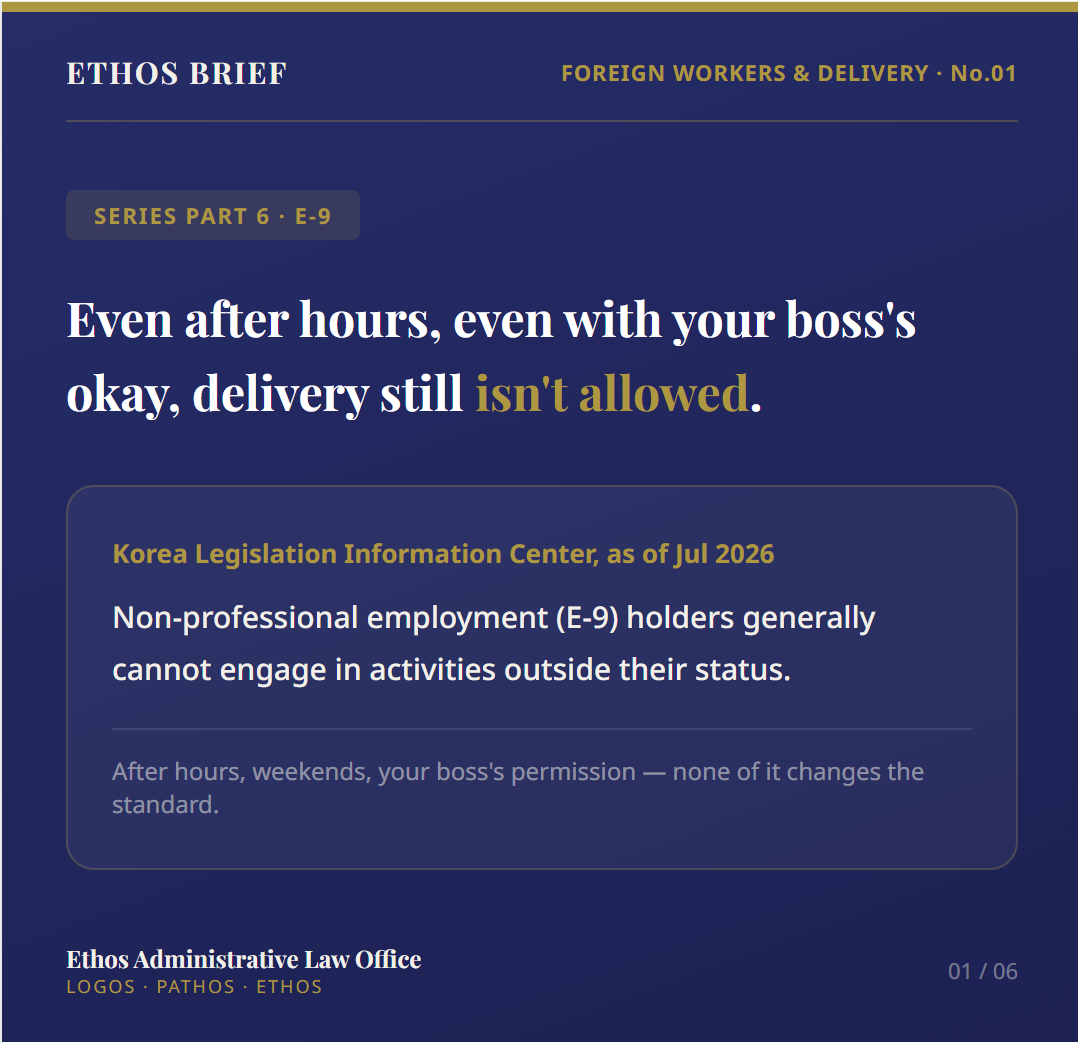
An ordinary E-9 foreign worker cannot treat platform delivery riding after work as a permitted side job simply because it takes place outside regular working hours.
It does not become permissible because it is after work.
It does not become permissible because it is on the weekend.
It does not become permissible because the employer agreed.
It does not become permissible because it is only two hours a day.
As of July 2026, Korea’s official legal information service also explains that persons holding a Non-Professional Employment (E-9) status of stay are, in principle, not permitted to engage in activities outside the scope of that status.
There is, however, one point that often causes confusion.
In 2026, parcel-service businesses are in fact included among certain industries that may employ E-9 workers.
This leads to an obvious question:
“If E-9 workers can work in parcel services, doesn’t that mean they can also do delivery work?”
The answer is still no.
The permitted E-9 occupations in parcel services are limited to loading and unloading work and cargo sorting.
They do not include platform delivery riders who receive orders through services such as Baemin or Coupang Eats and transport food directly to customers.
The core principle is simple:
For E-9 workers, the important question is not whether the work is done after hours, but whether the workplace and the occupation are actually authorized.
E-9 Is Not a General Work Visa Allowing Any Job in Korea
Holding an E-9 status means that a foreign national may work in Korea.
But it does not mean that the person may freely choose any employer or perform any type of paid work.
E-9 is closely connected to Korea’s Employment Permit System.
Under this system, employers who are unable to recruit sufficient domestic workers may obtain government authorization to employ non-professional foreign workers.
The process is structured.
Domestic recruitment efforts
→ Application for permission to employ foreign workers
→ Issuance of an employment permit
→ Employment contract
→ E-9 visa and entry into Korea
→ Employment at the authorized workplace
In other words, E-9 is not simply a government statement saying:
“This person may earn money in Korea.”
It is a system in which the industry, employer, foreign worker, job duties, and workplace are all connected.
For 2026, the Korean government set the number of new E-9 workers at 80,000.
The government allocates foreign workers by sector, including manufacturing, agriculture and livestock, construction, fisheries, and certain service industries.
This is because E-9 employment is managed from the beginning within an industry- and workplace-based structure.
“But E-9 Workers Can Work in Parcel Services in 2026, Right?”
Yes.
In 2026, parcel service business (49401) is included among the industries that may employ E-9 workers.
But the key point is that the government did not authorize every type of work within the parcel-service industry.
It also specifies which occupations are permitted.
For E-9 workers in parcel services, the permitted occupations include:
- Simple loading and unloading workers (92111)
- Cargo sorting workers (92120)
In practical terms, these are workers who load, unload, and sort parcels at logistics or parcel facilities.
They are not platform riders who log into an app, accept delivery orders, and transport food or goods directly to customers by motorcycle or car.
The more accurate statement is therefore:
E-9 workers may work in certain approved occupations within the parcel-service industry, but this does not mean that platform delivery riding is a permitted side job.
What If an E-9 Worker Is Already Employed at a Restaurant?
The answer does not change.
In 2026, certain Korean and foreign-style restaurants that satisfy the required conditions may employ E-9 workers.
However, the permitted occupations are again limited.
Examples include:
- Food-service workers
- Kitchen assistants
Suppose an E-9 worker is lawfully employed as a kitchen assistant at a Korean restaurant.
If that worker finishes the shift, opens a delivery app, and begins delivering orders from multiple restaurants, this does not become lawful merely because both jobs are connected to food.
Working in an approved restaurant occupation and working as a platform delivery rider are different activities.
Therefore, when reviewing whether an E-9 worker may perform a certain job, checking only the industry name is not enough.
The next question must be:
“Is the exact job I plan to perform also permitted under E-9?”
E-9 Delivery Side Jobs Face Two Separate Legal Questions
To understand the issue clearly, it helps to separate two different questions.
First: Is the activity itself permitted under E-9?
Korea’s Immigration Act regulates activities that fall outside the scope of a foreign national’s current status of stay.
For E-9 workers, the government guidance is particularly clear.
E-9 status holders are, in principle, not permitted to engage in activities outside the scope of their status of stay.
Therefore, if platform delivery riding is not included in the permitted activities or occupations under E-9, the problem arises at the level of the activity itself.
Second: Is the worker authorized to work at that particular workplace?
Even if the type of work is permitted, the analysis does not end there.
For E-9 workers, the workplace is also important.
Changing workplaces may require procedures through the employment center, a new employment permit, and immigration authorization to change the place of employment.
That means at least two questions must be answered:
1. Can this work be performed under E-9?
and
2. Have the required employment and immigration procedures been completed for this workplace?
For after-hours platform delivery riding, the problem already appears at the first stage.
“My Employer Said It Was Fine” — Employer Consent Is Not Immigration Authorization
Suppose the current employer says:
“As long as you do your work here properly, I do not care if you do delivery work after hours.”
That does not expand the scope of the E-9 status.
The employer’s consent may mean that the company itself does not object to outside work.
But it does not create a new immigration-authorized activity or a new authorized workplace.
Put simply:
Employer consent ≠ Government employment authorization
The employer’s ability to hire an E-9 worker in the first place is based on government approval under the Employment Permit System.
Therefore, an employer’s personal approval does not legalize a separate platform delivery side job.
“There Is an Additional Workplace System. Can’t Delivery Be Added as a Second Job?”
Certain E-9 sectors have operated additional workplace arrangements in limited circumstances.
Examples include agriculture and forestry, where seasonal labor demand can vary significantly.
Under such arrangements, the government may allow a worker to maintain the original employment relationship while temporarily working at another workplace under specified conditions.
But this does not mean:
“E-9 workers are free to register any second job they want.”
The better interpretation is the opposite.
Where additional employment is necessary, the government creates specific rules identifying the sectors, periods, conditions, and procedures under which it is allowed.
Platform delivery riding does not fall within those special arrangements.
An Actual Administrative Appeal Shows Why the Workplace Requirement Matters
There is an administrative appeal decision that illustrates the importance of workplace authorization.
It is Central Administrative Appeals Commission Case 2012-14016, decided January 22, 2013.
A Cambodian E-9 worker left the original workplace and applied to change workplaces.
The employment center introduced several agricultural workplaces.
However, before completing the required procedures, the worker began working independently at another agricultural workplace.
This point is important.
The worker had previously worked in agriculture, and the new workplace was also in the agricultural sector.
In other words, the issue did not arise because the worker suddenly changed to a completely unrelated industry.
The worker was working in another workplace within the same general industry, but without completing the required procedures.
The Central Administrative Appeals Commission ultimately dismissed the challenge against the refusal to extend the workplace-change application period.
The worker had also been given a job-seeker registration document in the worker’s own language explaining that:
- Employment had to be arranged through the employment center
- Required employment authorization and workplace-change permission had to be obtained in advance
- Unauthorized employment could lead to disadvantages
This decision should be described carefully.
It was not a case directly challenging a sanction imposed solely because the worker had worked at another farm.
Rather, it concerned a refusal to extend the workplace-change application period after the worker had already begun unauthorized employment.
Even so, the decision clearly illustrates one principle:
Working in the same industry does not mean that an E-9 worker may freely work at another workplace.
If even another agricultural workplace required the proper procedure, it is even more difficult to argue that a manufacturing-sector E-9 worker may freely take up an unrelated platform delivery job after finishing the regular shift.
The Constitutional Court Has Also Reviewed E-9 Workplace Restrictions
The workplace restrictions applicable to E-9 workers have also been reviewed by the Constitutional Court of Korea.
In Constitutional Court Decision 2020Hun-Ma395, December 23, 2021, E-9 workers from countries including Cambodia, Mongolia, Vietnam, Uzbekistan, and Myanmar challenged restrictions on changing workplaces.
The workers raised serious workplace problems, including:
- Unilateral changes to working hours
- Overtime pay issues
- Additional deductions for accommodation
- Pressure to operate construction machinery without a proper license
- Failure to provide protective equipment
- Threatening statements
Nevertheless, the majority of the Constitutional Court held that limiting workplace changes to certain statutory grounds did not violate constitutional rights.
The Court considered the structure of the Employment Permit System and the concern that unrestricted workplace changes could make it difficult for employers to secure stable labor and operate their businesses.
The decision does not mean:
“An E-9 worker can never change workplaces.”
The law does provide lawful grounds for workplace changes.
The important point is this:
For E-9 workers, the workplace is not simply an address. It is a core part of the Employment Permit System.
That is why an E-9 worker’s side job cannot be analyzed in the same way as an ordinary second job taken by a Korean employee.
“It Was Only a Small Side Job” Is Not Enough
Unauthorized delivery work by an E-9 worker is not simply a question of violating an internal company rule on outside employment.
It may become an immigration matter involving work outside the permitted scope of the status of stay and employment authorization.
If delivery work has already been performed, facts such as the following may become important:
- How long the work continued
- How often deliveries were made
- How much income was earned
- Which platform was used
- Whose account was used
- Whether there were previous immigration violations
- What statements were made during an immigration investigation
The important point is that working only for a short period does not make the activity lawful.
A short duration may later be relevant when describing the scope or seriousness of an already completed violation.
But it does not transform unauthorized delivery work into an authorized E-9 side job.
If the work has already been done, the question should change from:
“Was I allowed to do it?”
to:
“What exactly did I do, for how long, and what records now exist?”
How Does This Apply to Common Situations?
The rules can be summarized as follows.
Manufacturing E-9 + platform delivery after work
→ Not permitted.
Agriculture or livestock E-9 + weekend platform delivery
→ Not permitted.
Restaurant E-9 + platform delivery after work
→ Not permitted.
E-9 + delivery for only two hours a day
→ The short duration does not make the activity permissible.
E-9 + current employer’s approval + delivery work
→ Employer consent alone does not make the activity permissible.
E-9 + authorized parcel-service workplace + approved loading, unloading, or cargo-sorting occupation
→ This may fall within permitted E-9 employment if the required employment authorization and related conditions are satisfied.
In short:
Was it after work? → Not the key question.
Did the employer agree? → Not the key question.
Was it only a few hours? → Not the legal test for whether the activity is permitted.
The real questions are:
“Can this occupation be performed under E-9?”
and
“Have the required employment and immigration procedures been completed for this workplace?”
If You Already Did Delivery Work, Check the Records Before Saying “It Was Only a Few Times”
If the work has already started, simply searching whether E-9 workers may have a side job is no longer enough.
The actual records should be reviewed.
It is useful to organize the following chronologically:
- Current status of stay
- Current authorized workplace
- Duties written in the standard employment contract
- Actual duties at the main job
- Date delivery work began
- Date of the last delivery
- Total period of activity
- Weekly or monthly frequency
- Delivery platform used
- Settlement records
- Bank account receiving the payments
- Whether another person’s account was used
- Whether the current employer was involved
- Whether immigration or the employment center has already contacted the worker
- Whether an extension of stay or workplace-change procedure is currently pending
For example, a worker may remember doing delivery work for only one month.
But if platform records show repeated payments over four months, the case may look very different.
The opposite is also possible: the records may support the worker’s explanation.
For that reason, once an immigration investigation or official contact has already begun, objective records are more important than memory alone.
If the Current Workplace Is the Real Problem, the Question Should Change
Some E-9 workers look for delivery work because they simply want additional income.
Others do so because they are experiencing problems at the current workplace.
Examples include:
- Unpaid wages
- Actual working conditions that differ from the contract
- Suspension or closure of the business
- Unfair treatment
- Difficulty continuing employment with the current employer
In those situations, the better question may be:
“Do I have lawful grounds to change workplaces?”
rather than:
“Can I secretly do delivery work?”
Korea’s Act on the Employment of Foreign Workers allows E-9 workers to apply for a workplace change in certain circumstances.
Examples may include:
- The employer terminating the employment contract or refusing renewal
- Business suspension or closure
- Cancellation or restriction of the employer’s authorization to hire foreign workers
- Certain accommodation-related problems
- Violations of employment conditions
- Unfair treatment
- Other circumstances not attributable to the foreign worker that make continued employment difficult
Problems at the current workplace do not automatically make unauthorized side work lawful.
Where statutory grounds for a workplace change exist, the proper workplace-change procedure should generally be examined before starting unauthorized work elsewhere.
Being Eligible to Change Workplaces Does Not Mean You Can Start Working Somewhere Else First
Workplace changes are also subject to procedures and deadlines.
As a general rule, an E-9 worker must apply for a workplace change within one month after the employment relationship ends.
After applying, the worker generally must obtain the required immigration permission to change the place of employment within three months.
Different rules may apply in situations involving work-related injury, illness, pregnancy, childbirth, or other circumstances specifically recognized by law.
This means an E-9 workplace change does not follow this sequence:
Leave the current company
→ Find another company
→ Start working immediately
→ Report it later
Instead, the employment-center procedure, new employment authorization, and immigration workplace-change process are connected.
The 2012-14016 administrative appeal discussed above illustrates precisely why starting the new job first and fixing the paperwork later can create problems.
If You Are Reading This Article, Your Situation Usually Falls Into One of Three Categories
1. You Have Not Started Delivery Work Yet
This is the easiest stage to resolve.
Check your current E-9 employment permit and employment contract, and confirm whether the job you want to perform is actually an approved E-9 occupation.
If the proposed work is platform delivery riding, do not start based only on the assumption that it is a normal side job.
In particular, do not rely only on the statement:
“E-9 workers can work in parcel services in 2026.”
Approved parcel-service occupations such as loading, unloading, and cargo sorting are different from platform delivery riding.
2. You Have Already Done Delivery Work
At this point, the question is no longer simply:
“Can an E-9 worker do delivery work?”
You should identify:
- When the activity started
- How long it continued
- Which platform and account were used
- How much was paid
- Whether immigration or the employment center has already taken any action
If your memory differs from the platform or bank records, the factual history should be reconstructed using objective documents.
If immigration has already contacted or investigated you, consistency between your previous statements and the objective records may also become important.
3. You Are Looking for Delivery Work Because of Problems at Your Current Workplace
In this situation, the possibility of a lawful workplace change should be reviewed before considering delivery work.
If there are unpaid wages, violations of employment conditions, business closure, unfair treatment, or another statutory workplace-change ground, a formal procedure may be available.
Problems with the current employer do not legalize an unauthorized second job.
The better sequence is:
Identify the problem at the current workplace
→ Determine whether it qualifies as a workplace-change ground
→ Proceed through the proper workplace-change procedure
What Can You Check Yourself, and When Is Individual Review Needed?
There are several things an E-9 worker can check independently.
You can confirm:
- Whether your current status of stay is E-9
- Which workplace is listed under your employment authorization
- What duties appear in your employment contract
- Whether the government’s permitted E-9 industries and occupations actually include the work you intend to perform
If there are problems at the current workplace, you can also organize materials such as:
- Employment contract
- Pay statements
- Bank deposit records
- Work instructions or messages
- Documents concerning the workplace
However, once platform delivery work has already been performed, the matter becomes more case-specific.
It may be necessary to review what the actual delivery and settlement records show, how the activity relates to the existing employment permit, whether previous statements made during an immigration investigation match the objective records, and whether the issue affects an extension of stay or a workplace-change procedure.
In Summary — E-9 Does Not Have an “After Work, So It Is Fine” Exception
The conclusion is straightforward.
An ordinary E-9 foreign worker cannot treat platform delivery riding after leaving the authorized workplace as a permitted E-9 side job.
It does not become permissible because it happens after work.
It does not become permissible because it happens on weekends.
It does not become permissible because the employer agreed.
It does not become permissible because the worker only did it for two hours a day.
And the statement:
“E-9 workers can work in parcel services.”
does not change that conclusion.
For E-9 workers, the permitted parcel-service occupations are loading, unloading, and cargo sorting—not platform delivery riding.
An actual administrative appeal has also shown that even work at another workplace within the same agricultural sector can create legal problems when the required procedures are not followed.
The Constitutional Court has likewise reviewed E-9 workplace-change restrictions and confirmed the structural importance of the relationship between the worker, workplace, and Employment Permit System.
So the right question for an E-9 worker is not:
“Can I do delivery work because it is after my regular job?”
It is:
“Under my E-9 employment authorization and status of stay, am I permitted to earn money from this specific job at this specific workplace?”
If you have not started yet, confirm that first.
If you have already done delivery work, review the actual work period and payment records.
If you are looking for another job because of problems at your current workplace, first examine whether a lawful workplace change may be available.
If you have already performed delivery work or are considering another job because of problems at your current workplace, you can request a free initial review of your E-9 employment authorization, employment contract, and actual work records to determine what procedures may be available in your situation.