
E-7 Specially Designated Activities Visa — What Companies Must Check Before Hiring Foreign Professionals
Hello, this is Administrative Agent Jean.
A while ago, I heard this story.
“A Korean company said they wanted to work with me, but when they asked how to prepare the visa, I had no idea where to start.”
This is a concern that both Korean companies wanting to hire foreign professionals and foreigners wanting to work professionally in Korea often face.
The visa most commonly reviewed in this situation is the E-7 Specially Designated Activities visa.
E-7 is one of the representative work visas used by Korean companies to employ foreign nationals. But it is not issued simply because a company says it wants to hire someone.
For E-7, the following three points must align at the same time:
- Whether the foreign national has the education, experience, or qualifications required for the job
- Whether the company meets the requirements to hire a foreign national
- Whether the actual duties match an E-7 job code designated by the Ministry of Justice
In particular, from February 1, 2026, the wage requirements differ by E-7 subtype. A salary that was sufficient under last year’s standard may no longer be enough this year.
This article summarizes the key points for companies and foreign nationals reviewing E-7 for the first time under 2026 standards.
What Is the E-7 Visa?
The E-7 Specially Designated Activities visa is a status of stay granted to foreign nationals who intend to engage in activities specially designated by the Minister of Justice under an employment contract with a public institution, private organization, or company in Korea.
Simply put, it is a work visa used when a Korean company hires a foreign national with specialized or skilled abilities.
However, not every job qualifies for E-7.
The job must fall within designated occupations set by the Ministry of Justice.
So the starting point is not “our company wants to hire a foreigner.” The starting point is whether this job falls under an E-7 job code.
For example, IT developers, engineers, researchers, designers, interpreters and translators, certain chefs, and some skilled occupations may be reviewed under E-7.
On the other hand, simple office assistance, general sales, or basic manual labor are often difficult to fit under E-7.
Four Types of E-7 Visa — 2026 Standards
E-7 is divided into four main types depending on the level of specialization and skill.
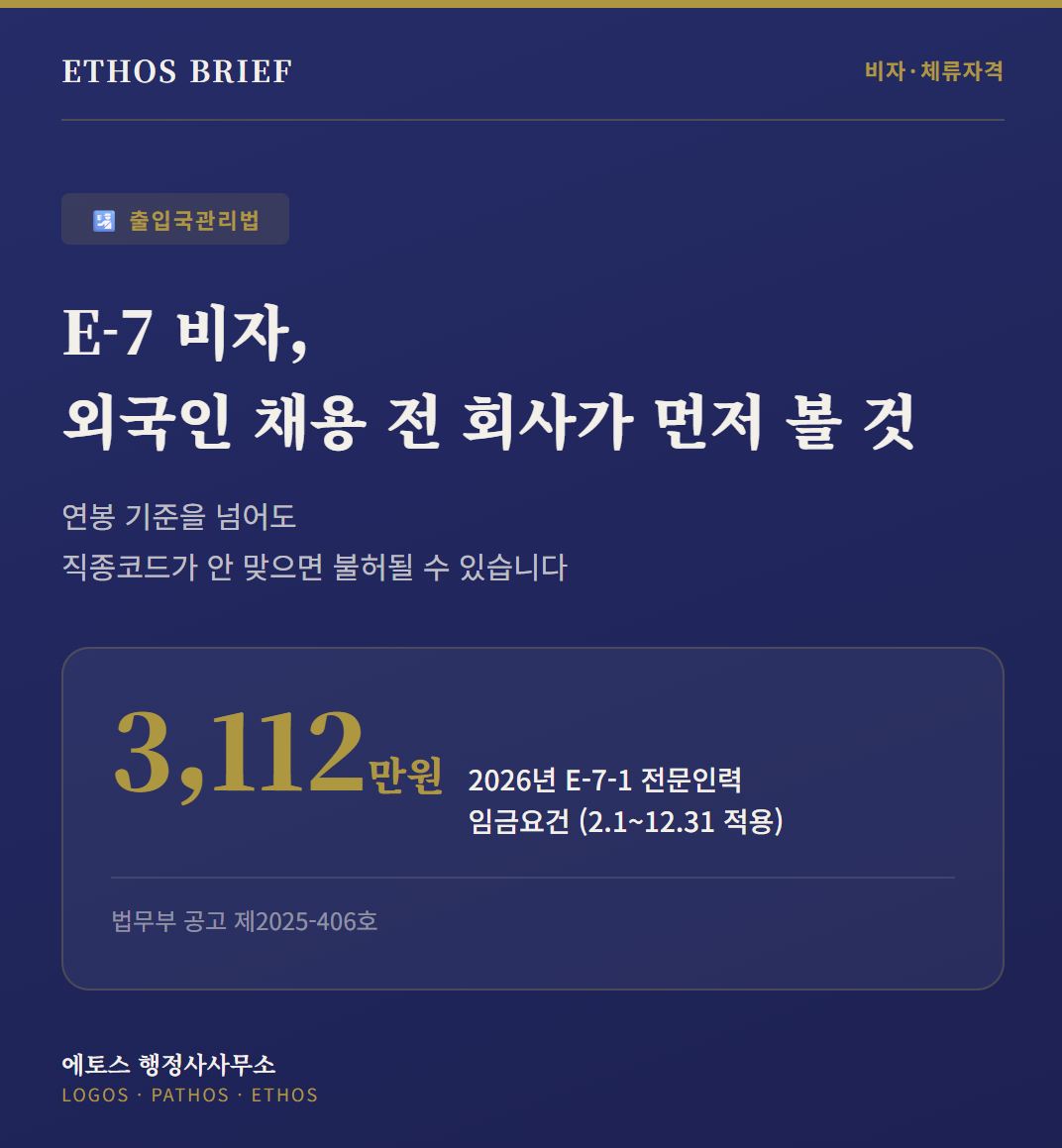
| Type | Target | Basic 2026 Wage Requirement | Examples | |---|---|---:|---| | E-7-1 Professional Personnel | Highly specialized or professional technical workers | At least KRW 31.12 million per year | IT developers, engineers, researchers, professionals | | E-7-2 Semi-Professional Personnel | Semi-professional or specialized service workers | At least KRW 25.89 million per year | Designers, marketers, interpreters/translators, certain service specialists | | E-7-3 General Skilled Workers | General skilled workers | At least KRW 25.89 million per year | Chefs, manufacturing or skilled occupations, etc. | | E-7-4 Skilled Workers | Long-term resident skilled worker conversion | At least KRW 26 million per year | Conversion from E-9, E-10, H-2, etc. |
The wage requirements above are based on Ministry of Justice Public Notice No. 2025-406 for 2026 E-7 wage requirements.
The application period is February 1, 2026 to December 31, 2026.
However, please note:
This table shows the basic standard.
Separate standards or exceptions may apply depending on job type, industry, or company category. If the Minister of Justice separately sets a wage requirement for a specific occupation for reasons such as protection of Korean employment, that separate standard takes priority.
The final standard should always be checked through HiKorea, Ministry of Justice notices, or the competent immigration office.
The Most Important Issue in E-7 Is the Job Code
The point where E-7 applications most often get stuck is not salary. It is the job code.
The foreign national’s actual duties must match an E-7 job code designated by the Ministry of Justice.
For example, suppose a company wants to hire a foreign national as a “marketing manager.”
Not all marketing work qualifies for E-7.
The result may differ depending on whether the work is:
- Overseas market research
- Foreign-language content planning
- Translation and interpretation as the core duty
- Simple SNS management
- Advertising operation assistance
- Overseas client management
- A role requiring specialized knowledge
The actual duties determine the possibility.
If the job code is selected incorrectly, the following problems can occur:
- Higher risk of refusal
- Repeated requests for supplementary documents
- Lower reliability in later reapplication by the same company
- Risk of the foreign national’s stay period expiring
- Delay in the company’s hiring schedule
- Inconsistency between employment contract and employment justification letter
For E-7, job design comes before the visa application form.
The company should first define the actual duties and then match those duties to the correct E-7 job code.
Foreign Applicant Requirements — Education, Experience, and Qualifications Must Match the Job
E-7 is not something the company can prepare alone.
The foreign national must also prove qualifications relevant to the job.
Generally, the following are reviewed:
- Degree
- Major
- Work experience
- Professional licenses or certificates
- Previous employment history
- Current status of stay
- Residence history in Korea
- Immigration violation history
- Criminal history
- Tax or insurance arrears
The most important point is relevance to the job.
For example, if applying as an IT developer, a degree or experience in computer science, software, or information and communications should connect convincingly to the job.
For a designer, a design-related major, portfolio, and work experience may be important.
For a chef, work history, qualifications, actual menu, and restaurant structure may all need to be reviewed.
Simply “graduating from university” is not enough.
The degree and experience must match the requested occupation.
Company Requirements — The Company Is Reviewed Too
E-7 is not a visa that the foreign national applies for alone.
The hiring company is reviewed together.
The company should especially check the following:
- Business registration status
- Whether the company is actually operating
- Period of operation after business start
- Sales and business scale
- Number of Korean employees
- Foreign employee ratio
- National and local tax arrears
- Four major insurance enrollment
- Ability to pay wages
- Connection between company business and the foreign national’s duties
In general, companies with very few Korean employees and mainly domestic-market operations may face limitations when inviting foreign workers. Companies applying immediately after business registration may also be reviewed more strictly for actual operation and hiring necessity.
Commonly reviewed company-side items include:
- Number of Korean workers on the employment insurance list
- Whether the foreign employee ratio is appropriate
- Whether there are tax arrears
- Whether the workplace actually exists
- Why a foreign national is necessary for the role
- Whether the company can pay the salary
The important question is not “we want to hire a foreigner.”
It is why this specific job requires a foreign national.
The document explaining this is the employment justification letter or utilization plan.
Why Is the Employment Justification Letter Important?
The employment justification letter is very important in E-7 applications.
Immigration does not only review the employment contract. It reviews why the company needs to hire a foreign national.
The letter usually needs to include:
- Company introduction
- Business description
- Position to be hired
- Why the position connects to the E-7 job code
- Why the foreign national’s education, experience, and expertise are needed
- Why the role is difficult to replace with Korean personnel
- Specific duties the foreign national will perform
- Future utilization plan
- Salary and working conditions
- Company workforce structure
If the letter is written vaguely, the following problems can occur:
- The job appears to be simple work
- The need to hire a foreign national appears weak
- The job code and actual duties appear inconsistent
- The hiring need does not match the company size
- Supplementary document requests are issued
- Refusal risk increases
An E-7 employment justification letter is not a company promotional brochure.
It must clearly show, from the immigration examiner’s perspective, why this company needs to hire this foreign national for this specific job.
Basic Required Documents
E-7 documents vary depending on the job, company, foreign national’s current status, and whether the application is filed in Korea or through overseas visa issuance.
Generally, the following documents are prepared.
Company Documents
- Copy of business registration certificate
- Corporate registry certificate
- Employment insurance subscriber list
- National tax payment certificate
- Local tax payment certificate
- VAT taxable base certificate or financial documents
- Company introduction materials
- Employment justification letter or utilization plan
- Employment contract
- Office lease agreement or workplace proof
- Foreign employee status
- Additional documents by occupation
Foreign Applicant Documents
- Passport
- Photo
- Alien registration card
- Degree certificate or graduation certificate
- Transcript
- Employment certificate
- Professional license or certificate
- Resume
- Certificate of employment or previous career evidence
- Criminal record-related documents
- Application form for change of status or visa issuance
- Additional documents by occupation
Overseas degrees or career documents may require apostille, consular confirmation, or notarized translation.
Therefore, documents should not be gathered at the last minute.
They should be prepared as soon as the job code is determined.
E-7 Pre-Application Checklist
The company and the foreign national should check at least the following before applying.
- Does the job fall within an E-7 designated occupation?
- Does the job code match the actual duties?
- Does the foreign national’s education and experience match the occupation requirements?
- Is the 2026 wage requirement satisfied?
- Does the employment contract salary match the actual payment structure?
- Does the company have any tax arrears?
- Are there enough Korean employees on the employment insurance list?
- Does the foreign employee ratio exceed limits?
- Is the company’s business connected to the foreign national’s duties?
- Is the employment justification letter consistent with the job code?
- Is there enough time before the foreign national’s current stay expires?
- Is family accompaniment needed?
If any of these are uncertain, it is better to check the structure before filing documents.
Frequently Asked Questions
Q. What Happens If the Job Code Is Selected Incorrectly?
If the job code is selected incorrectly, refusal risk increases.
The bigger issue is reapplication by the same company for the same foreign national. If the first job description and the later changed job description are inconsistent, the immigration examiner may question the reliability of the application.
That is why selecting the correct job code from the beginning is critical.
Q. Can Family Members Come to Korea Together?
Yes.
The spouse and minor children of an E-7 holder can generally be reviewed for F-3 dependent status.
However, family invitation may require income, employment, residence, and family relationship documents. If family members plan to come together, it is better to prepare their documents alongside the main E-7 application.
Q. When Can an E-7 Holder Apply for F-5 Permanent Residence?
After legally staying under E-7 for the required period, F-5 permanent residence may be reviewed.
However, F-5 is not automatic. Residence period, income, assets, Korean language, social integration, conduct, tax and insurance payment, and criminal history are separately reviewed.
A route through F-2-7 points-based residence before F-5 may also be considered.
Q. Is Meeting the Salary Requirement Enough for E-7 Approval?
No.
Salary is only one basic requirement.
Job code, applicant qualifications, company requirements, hiring necessity, document reliability, and residence history are reviewed together. Even with sufficient salary, the application may be refused if the duties do not match an E-7 job code.
Q. Can Startups Hire Under E-7?
In some cases, yes.
However, early-stage companies must explain sales, number of employees, actual office operation, and the necessity of hiring the foreign professional more persuasively.
For startups in particular, the employment justification letter must clearly explain why this foreign professional is needed at this stage.
Where Do People Get Stuck When Preparing Alone?
E-7 applications often get stuck when applicants rely only on a document checklist.
Common practical problems include:
- Choosing the wrong job code
- Actual duties appearing too simple
- Applicant’s major not connecting to the job
- Career certificates lacking detailed job duties
- Salary falling below the 2026 requirement
- Company having too few Korean employees
- Foreign employee ratio not checked
- Tax arrears or insurance issues found late
- Employment justification letter written too vaguely
- Application filed too close to stay expiration, leaving no time for supplement requests
E-7 is not a visa where more documents automatically help.
The job, company, and foreign applicant’s qualifications must tell one consistent story.
What Changes When You Work With an Administrative Agent?
For E-7, the most important work happens before filing.
An administrative agent can review the following flow:
- Company business activities
- Hiring position analysis
- E-7 job code matching
- Foreign applicant’s education, experience, and qualifications
- 2026 wage requirement
- Company’s Korean employee count, foreign employee ratio, and tax status
- Employment justification letter and utilization plan
- Employment contract details
- F-3 dependent documents for family members
- Future F-2 or F-5 residence roadmap
The employment justification letter in particular is not merely writing nice wording.
It connects the job code to the company’s actual business structure.
If that connection is weak, supplementary document requests or refusal become more likely.
If You Are Preparing an E-7 Visa
E-7 is not a simple work visa.
It is a status of stay that the company and foreign national must prepare together.
Before applying, check at least the following:
- Does this job fall under an E-7 designated occupation?
- Which job code is most accurate?
- Do the foreign national’s major and experience connect to the job?
- Is the 2026 wage requirement satisfied?
- Are the company’s Korean employee count and foreign employee ratio acceptable?
- Are there any tax arrears?
- Can the company explain why a foreign national is needed?
- Is family accompaniment required?
- Is there a plan after E-7 toward F-2 or F-5?
If you file the application before answering these questions, the case may lead to supplement requests or refusal.
E-7 must be designed correctly from the beginning.
The job code, salary, company requirements, and employment justification letter must all point in the same direction.
In the next article, we will continue with the E-7 visa application procedure and key points for writing the employment justification letter.