
E-2 Foreign Language Instructor Visa — What Schools and Language Academies Must Check First
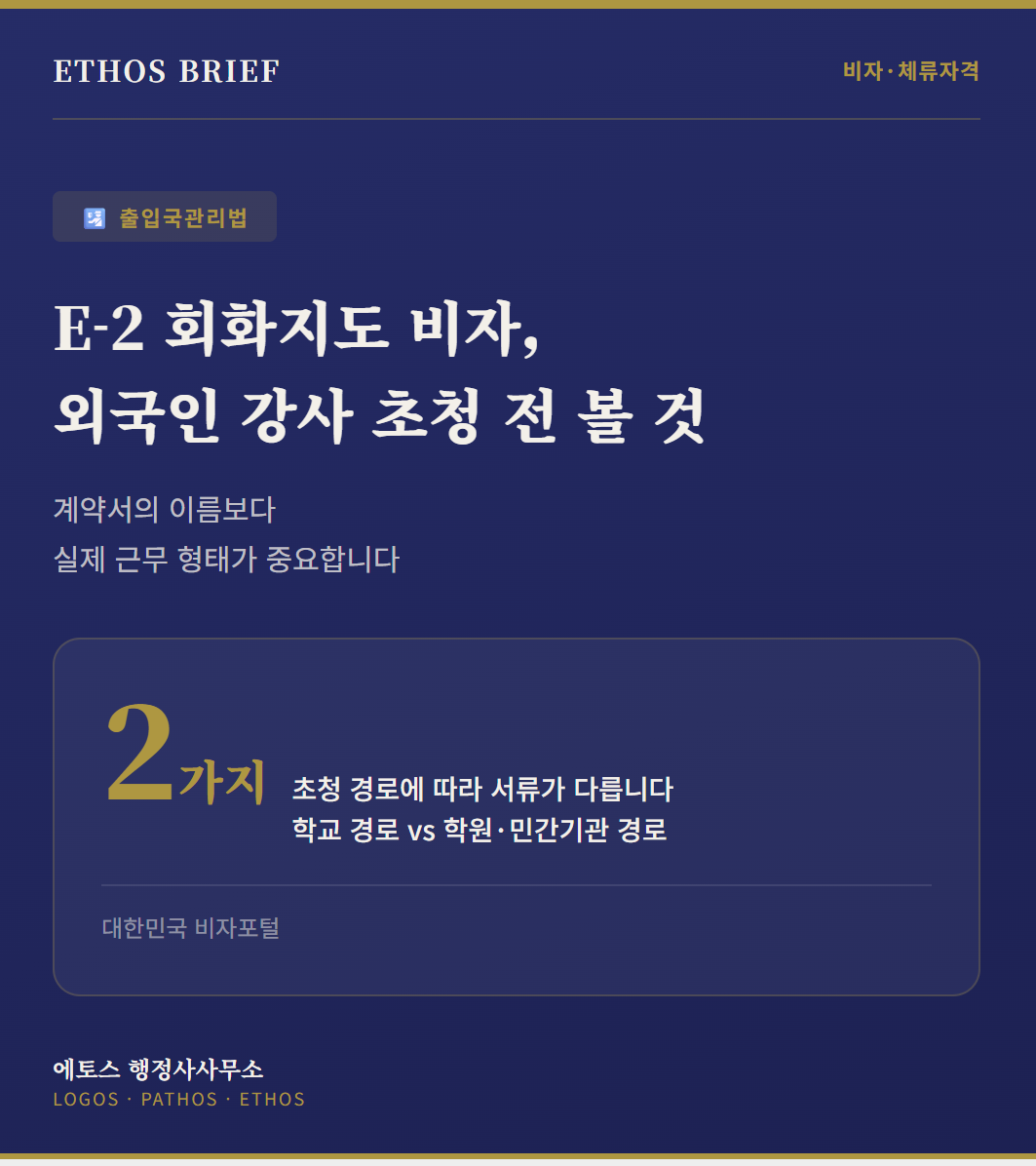
Hello, this is Administrative Agent Jean.
If you have ever attended a language academy in Korea for TOEIC, speaking, or conversation classes, you may have taken a class from a foreign instructor.
The visa commonly used by foreign instructors who teach conversational language in Korea is the E-2 Foreign Language Instructor visa.
Many people casually call it the “English teacher visa.” But the E-2 visa is not issued simply because someone speaks English or has teaching experience.
The key questions are:
Who is sponsoring the instructor?
Where will the instructor teach?
Does the employment contract match the actual teaching arrangement?
The E-2 visa is not just a document checklist. It is an employment-based status of stay that reviews the sponsoring institution and the actual teaching structure together.
This article explains what the E-2 visa is, how the school route differs from the private academy route, what documents are usually required, how the Confirmation of Visa Issuance works, what happens after entry, and why workplace management is so important.
Key Summary
| Category | Details | |---|---| | Visa type | E-2 Foreign Language Instructor | | Main applicants | Foreign nationals who teach conversational language in Korea | | Common cases | Language academy instructors, native-speaking teachers at elementary/middle/high schools, foreign language instructors at educational institutions | | Main review points | Sponsoring institution, employment contract, degree, criminal record, health statement, actual workplace | | Main routes | School route / private academy or private institution route | | Confirmation of Visa Issuance | E-2 is eligible for application through the Korea Visa Portal | | Period of stay | Up to 2 years per grant, subject to review | | After entry | Alien registration required if staying over 90 days | | Important caution | Teaching at an unapproved branch, affiliate center, or second workplace may require separate permission or reporting |
What Is the E-2 Visa?
The E-2 visa is a Korean employment status for foreign language conversation instruction.
In simple terms, it is used when a foreign national comes to Korea to teach conversational language at a school, language academy, educational institution, or similar organization.
But one point must be clear:
The E-2 visa is not a visa that allows a foreigner to teach English anywhere in Korea.
It is closer to a work visa tied to a specific sponsoring institution and workplace.
Before applying, the following points should be organized:
- What nationality the instructor holds
- What language the instructor will teach
- Whether the sponsor is a school or private academy
- Where the workplace is listed in the employment contract
- Where classes will actually be held
- Whether the institution is eligible to sponsor an E-2 instructor
- Whether post-entry alien registration and workplace management can be handled properly
If this structure is unclear, problems can arise later, such as receiving the visa under one academy name but teaching at another branch or partner center.
The E-2 Visa Has Two Main Routes
Even under the same E-2 visa category, the required documents and explanation differ depending on the application route.
Broadly, there are two routes.
1. School Route
This applies to foreign language instructors selected through a public recruitment or placement system involving the Ministry of Education, local education offices, or related public institutions.
Examples may include native-speaking teacher programs and public school placement programs.
In this route, documents such as a notice of acceptance, invitation letter, or employment recommendation from the relevant education authority may be important in addition to the employment contract.
2. Language Academy or Private Institution Route
This route is commonly used for instructors hired by private language academies, private educational institutions, company-affiliated training centers, or similar organizations.
In practice, this is one of the most common E-2 routes.
For this route, immigration usually looks at both the instructor’s qualifications and the institution’s legitimacy through documents such as degree proof, criminal record certificate, health statement, employment contract, and academy or institution registration documents.
School Route vs. Private Institution Route
| Category | School Route | Academy / Private Institution Route | |---|---|---| | Common example | Native-speaking teacher at elementary, middle, or high school | Language academy, private educational institution, company-affiliated training center | | Sponsorship structure | Public education authority or school placement structure | Individual academy or private institution hiring structure | | Key documents | Notice of acceptance, invitation letter, employment recommendation | Employment contract, criminal record certificate, health statement, institution registration documents | | Review focus | Public selection process and placement institution | Institution eligibility, contract structure, actual teaching location | | Common issue | Misunderstanding the public program route | Branch teaching, part-time teaching, mismatch between contract and actual workplace | | After entry | Alien registration and workplace confirmation | Alien registration and workplace change/addition management |
If the route is not identified at the beginning, the applicant may prepare the wrong document set even though the visa name is the same.
E-2 Application Process
In practice, the process often follows these steps.
STEP 1. Confirm the Sponsoring Institution Structure
First, identify what kind of institution is sponsoring the instructor.
Check whether it is:
- An elementary, middle, or high school
- A local education office program
- A private language academy
- A private educational institution
- A company or organization-affiliated training center
- A single teaching location or multiple teaching locations
If the workplace structure is unclear, document supplementation or workplace issues may arise later.
STEP 2. Review the Employment Contract and Teaching Duties
The E-2 visa is based on foreign language conversation instruction.
The employment contract should clearly state:
- Employer
- Workplace
- Duties
- Teaching language
- Contract period
- Salary
- Working hours
- Housing arrangement, if any
- Insurance and other employment conditions
The title of the contract is less important than the actual working arrangement.
If the contract lists Academy A but the instructor actually teaches at Branch B or an affiliated center, the arrangement should be reviewed separately.
STEP 3. Prepare Instructor Qualification Documents
Common instructor-side documents may include:
- Degree certificate or graduation certificate
- Criminal record certificate
- Health statement
- Passport copy
- Photo
- Resume or career record
- Documents related to nationality and language eligibility
- Additional documents requested by the Korean consulate or immigration office
For English conversation instruction, some public education programs require instructors to be from designated English-speaking countries. However, detailed requirements may vary by program, consulate, and sponsoring institution, so individual confirmation is necessary.
STEP 4. Prepare Sponsoring Institution Documents
The sponsoring institution must also prepare documents.
Common institution-side documents may include:
- Employment contract
- Business registration certificate
- Academy registration or institution establishment documents
- Documents explaining the reason for invitation
- Institution information
- 담당자 information and contact details
- Documents for Confirmation of Visa Issuance
The E-2 visa is not something the instructor prepares alone.
The sponsor’s document readiness often determines how smoothly the timeline moves.
STEP 5. Apply for Confirmation of Visa Issuance
The E-2 visa is eligible for the Confirmation of Visa Issuance process through the Korea Visa Portal.
A Confirmation of Visa Issuance allows the sponsor or authorized agency in Korea to apply first, and then the foreign national uses the approved visa issuance number to apply for the visa at a Korean diplomatic mission abroad.
The general process is:
- Sponsor prepares documents
- Sponsor applies for Confirmation of Visa Issuance through the Visa Portal or relevant immigration office
- Immigration reviews the application
- Visa issuance number is issued
- Foreign national applies for the visa at the Korean consulate
- Visa is issued and the instructor enters Korea
Each Korean consulate may have different submission methods, processing times, and additional document requirements. Always check the consulate with jurisdiction over the instructor’s residence.
STEP 6. Complete Alien Registration After Entry
If an E-2 visa holder intends to stay in Korea for more than 90 days, alien registration is required.
In principle, registration must be completed at the competent immigration office within 90 days from the date of entry.
Receiving the visa is not the end of the process.
Post-entry registration is what stabilizes the instructor’s legal stay in Korea.
Basic Required Documents
E-2 documents may vary depending on the route, consulate, nationality, and sponsor. The following is a general practical structure.
Instructor Documents
- Passport
- Photo
- Visa application form or e-Form
- Degree certificate or graduation certificate
- Criminal record certificate
- Health statement
- Resume or career record
- Visa issuance confirmation number, if applicable
- Additional documents required by the consulate
Sponsoring Institution Documents
- Employment contract
- Business registration certificate
- Academy registration or institutional establishment documents
- Documents explaining the invitation
- Institution profile
- 담당자 identification and contact information
- For school route: notice of acceptance, invitation letter, employment recommendation, or similar documents
Additional Items to Check
- Tuberculosis test certificate, depending on nationality and consulate
- Apostille or consular confirmation
- Whether originals are required
- Whether translations are required
- Validity period of the criminal record certificate
- Degree verification method
- Consulate-specific checklist
Degree and criminal record documents are especially sensitive because issuance method, apostille or consular confirmation, and original submission rules vary by country.
Health Statement and Tuberculosis Test
Health-related documents should not be treated lightly in E-2 cases.
A health statement for E-2 visa applicants may be required. In addition, nationals of tuberculosis high-risk countries who apply for a visa to stay in Korea for more than 90 days may be required to submit a tuberculosis test certificate issued by a hospital designated by the Korean diplomatic mission.
So the sponsor should not simply say, “A health statement is enough.”
Check:
- Instructor’s nationality
- Korean consulate handling the application
- Intended period of stay
- Whether the instructor is from a tuberculosis high-risk country
- Whether a designated hospital certificate is required
- Health statement form
- Whether a medical check is required after entry into Korea
Health document requirements can vary by consulate and timing, so updated guidance should always be checked.
Where E-2 Applications Often Get Stuck
1. Confusing the School Route and Academy Route
If the sponsor prepares documents as if the instructor is joining a public school program, but the actual job is with a private academy, the required document set may not match.
The reverse can also happen.
The sponsoring route should be identified before preparing the file.
2. The Actual Teaching Location Differs From the Contracted Workplace
The workplace matters in E-2 cases.
The following situations should be reviewed carefully:
- Contract signed under the main academy, but classes held at a branch
- Instructor employed by Academy A but teaching at Center B
- Classes conducted at a partner or affiliated institution
- Online and offline teaching locations mixed together
- Instructor moving among multiple campuses
It is not safe to assume that “same brand” means “same workplace.”
The visa-listed workplace and actual teaching structure should match.
3. Treating Part-Time Teaching Too Casually
If an E-2 instructor teaches part-time at another academy or provides private lessons, immigration issues may arise.
Employment visa holders must generally work within the scope of their permitted status and workplace.
Teaching elsewhere may require workplace addition, permission for activities outside the current status, or another applicable procedure.
4. Weak Sponsor Documents
Even if the instructor’s degree and criminal record documents are perfect, weak sponsor documents can delay the review.
Private institutions should be able to show:
- They are actually operating
- They are eligible to provide foreign language conversation instruction
- They have a real need to hire the instructor
- The employment contract is genuine
- The teaching location can be verified through documents
5. Missing Alien Registration After Entry
The process does not end when the E-2 visa is issued.
If the instructor stays in Korea for more than 90 days, alien registration must be completed. After that, extension of stay, workplace change or addition, and address change reports may also become relevant.
The Actual Working Arrangement Matters More Than the Contract Title
For E-2 cases, the title or form of the contract is less important than the actual operation.
In Anti-Corruption and Civil Rights Commission decision 2009-08744, the issue involving foreign language academy instructors was not merely whether the contract looked like a freelance contract on paper. The actual teaching arrangement, institutional control, and management structure were important points of review.
The same issue appears often in visa practice.
Examples include:
- A contract written like a freelance arrangement, but the instructor works fixed hours
- Classes conducted under the direction and supervision of a specific academy
- Salary payment and work management resembling an employment relationship
- Workplace and actual teaching location separated in practice
E-2 cases can connect not only to immigration issues but also to labor, insurance, and tax issues. It is better to organize the structure from the beginning.
Workplace Change or Addition Must Be Reviewed Separately
If an E-2 instructor leaves one academy for another, or wants to teach at an additional workplace, workplace change or addition issues may arise.
Practical points to check include:
- Whether the existing employment contract has ended
- Whether the new workplace can sponsor an E-2 instructor
- Whether permission or reporting is required for workplace change or addition
- New employment contract
- Business registration and academy registration documents
- Whether consent or documentation from the previous workplace is required
- Expiration date of current stay period
- Timing of the application
Starting to teach at another place without the required procedure can become a visa violation.
Even “just helping for a few days,” “weekend part-time classes,” or “online lessons” may need review if there is compensation and institutional control.
E-2 Sponsorship Checklist
Before sponsoring an E-2 instructor, check:
- Is the activity truly eligible for E-2?
- Is the sponsor a school, academy, or private institution?
- Does the actual teaching location match the workplace in the contract?
- Are branch, campus, or partner-center classes involved?
- Is the degree verification method clear?
- Is the criminal record certificate issued and authenticated correctly?
- Have health statement and tuberculosis test requirements been checked?
- Will the case proceed through Confirmation of Visa Issuance or direct consular filing?
- Has the consulate-specific checklist been reviewed?
- Is alien registration scheduled within 90 days after entry?
- Is any workplace change or addition likely after entry?
Frequently Asked Questions
Q. Is the E-2 visa only for English teachers?
It is commonly known as an English teacher visa, but the legal category is foreign language conversation instruction.
Languages other than English may also be reviewed depending on the case. Requirements can vary by language, nationality, institution, and program.
Q. Is a degree enough to get an E-2 visa?
No.
A degree is only one important requirement. Criminal record, health statement, employment contract, sponsor eligibility, actual workplace, and consulate-specific documents must also be reviewed.
Q. Can an instructor freely teach at multiple branches of the same academy brand?
Do not assume so.
It depends on how the workplace is registered and how the branch structure is organized. If classes will be held at multiple locations, the workplace structure should be clarified from the beginning.
Q. Can an E-2 instructor teach part-time at another academy?
Not without checking first.
Teaching at another institution without the proper procedure may cause immigration problems. Workplace addition, permission for activities outside status, or other procedures should be reviewed in advance.
Q. Does an E-2 visa holder need alien registration after entering Korea?
Yes, if staying for more than 90 days.
In principle, alien registration must be completed at the competent immigration office within 90 days from the date of entry.
Q. How long does E-2 processing take?
It depends on the Confirmation of Visa Issuance review, consular application, and the processing time of the specific Korean diplomatic mission.
Some consulates advise that E-2 visa review can take several weeks, so sponsors should prepare early enough to match the planned start date.
How an Administrative Agent Helps
The E-2 visa may look simple if you only read a document checklist.
In practice, the structure matters more.
An administrative agent can help review:
- Sponsoring institution type
- School route vs. private institution route
- Instructor qualification documents
- Degree and criminal record authentication method
- Health statement and tuberculosis certificate requirements
- Confirmation of Visa Issuance process
- Consulate-specific submission requirements
- Contract and actual workplace structure
- Post-entry alien registration and follow-up obligations
This is especially helpful when an academy or educational institution is sponsoring a foreign instructor for the first time.
In Short, E-2 Reviews Both the Instructor and the Institution
The E-2 Foreign Language Instructor visa is not automatically issued just because someone has a degree and can speak English.
You need to check whether the case is a school route or academy route, whether the sponsoring institution can provide the required documents, whether the actual teaching location matches the registered workplace, and whether post-entry alien registration and workplace management can be handled properly.
In E-2 cases, the actual working arrangement matters more than the contract title.
If a visa is issued under one institution but the instructor teaches somewhere else, or if part-time teaching begins casually, immigration issues may follow.
If you are preparing to sponsor a foreign instructor, or if you are unsure whether to proceed through Confirmation of Visa Issuance or consular filing, start by reviewing the sponsor and workplace structure first.