
D-2 Students Cannot Work as Delivery Riders Even with a Part-Time Work Permit
If you are hungry but do not feel like cooking, delivery is probably one of the first things that comes to mind in Korea.
These days, foreign nationals are also increasingly visible in the delivery industry.
But when a foreign national works in Korea, the first question is not simply, "Can I make money doing this?"
The more important question is:
"Does my current status of stay allow me to do this work?"
Delivery work is no exception.
Because delivery and platform-based side jobs can often be started simply by signing up through an app, some foreign nationals begin working before checking whether the activity is actually permitted under their visa.
For D-2 international students, this can become an immigration issue.
This article explains whether a D-2 student can work as a delivery rider after obtaining permission for part-time employment, and what should be reviewed if the student has already performed delivery work.
Can a D-2 student work as a delivery rider after receiving permission for part-time employment?
Suppose a student has already obtained confirmation from the university and permission from immigration to work part-time.
Can that student also work as a delivery rider?
The answer is no.
Receiving permission for part-time employment does not mean that a D-2 student may take any type of job.
In particular, delivery-platform rider activities are listed among the restricted activities under the part-time employment rules for international students.
This is not merely a warning appearing on university notice boards.
The Ministry of Justice carried out intensive enforcement against illegal foreign delivery work between January and April 2026 and detected 628 foreign delivery riders.
Among them, 541 were subject to fines totaling approximately KRW 1.54 billion, while 55 were subject to departure-related measures, including deportation.
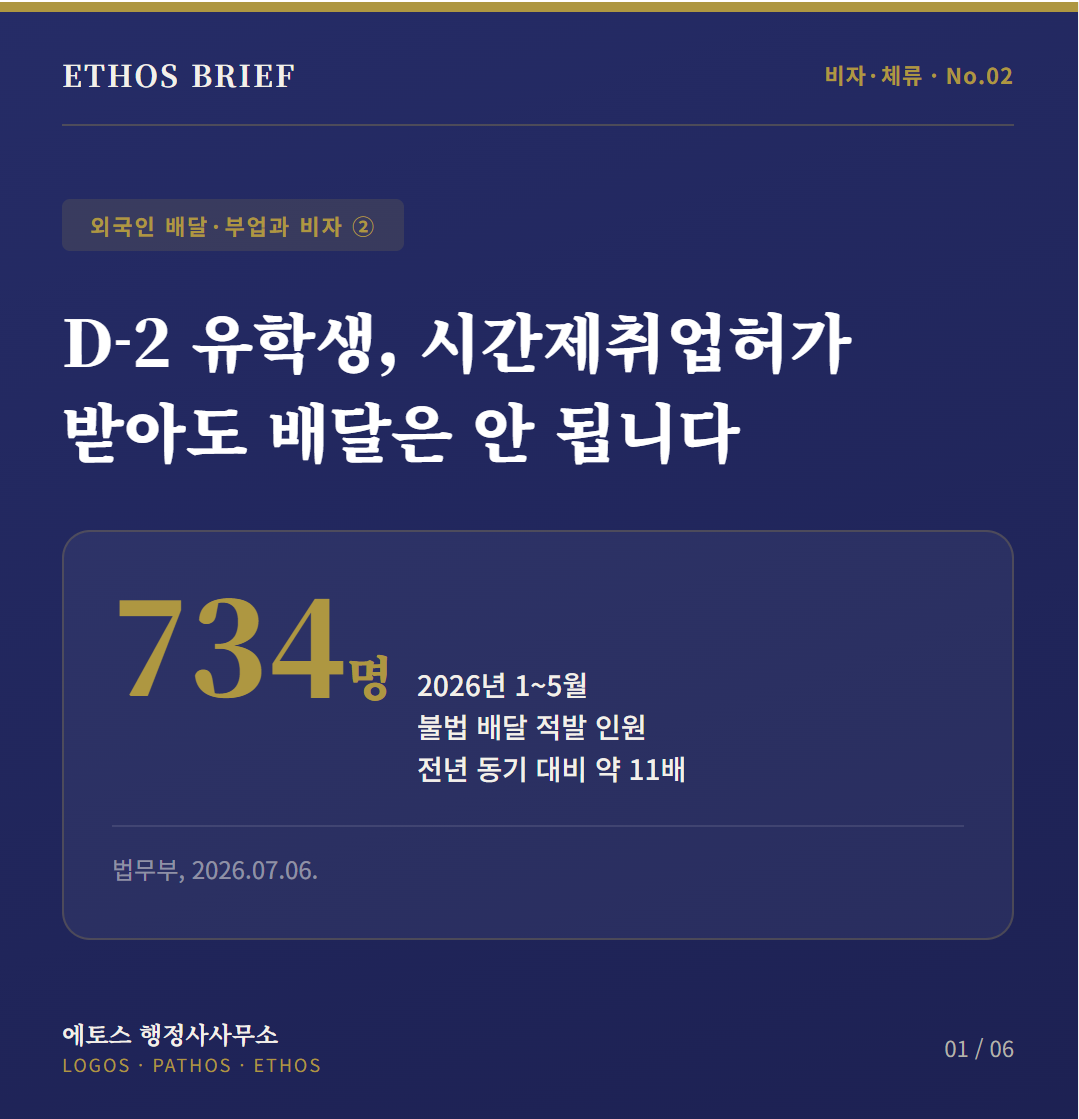
By the end of May, the number of foreign delivery riders detected had increased to 734, approximately 11 times the figure recorded during the same period a year earlier.
Ministry of Justice, June 8, 2026, policy report on immigration and immigration-policy reform
So the important question is not simply:
"Do I have a part-time work permit?"
You also need to examine:
- what type of work was authorized,
- at which workplace the work was authorized, and
- what work was actually performed.
If delivery work has already taken place, the issue becomes more complicated.
At that point, the question is no longer only:
"Should I stop now?"
The more important question becomes how the delivery activity already performed may be evaluated by Korean immigration authorities.
I already have a part-time work permit. Why can I still not do delivery work?
This is an easy point to misunderstand.
A student may naturally assume that once permission for part-time employment has been granted, any job is acceptable as long as the permitted working hours are not exceeded.
That is not how the system works.
A part-time work permit does not mean:
"This student may now work freely in Korea."
D-2 is fundamentally a student status of stay.
Profit-making and employment activities by international students are generally restricted.
Part-time employment is permitted only as a limited exception when the relevant requirements are satisfied, the university provides the required confirmation, and permission is obtained in advance from the immigration authority.
Article 18(1) of the Immigration Act also establishes the general principle that a foreign national who wishes to work in Korea must hold a status of stay that permits employment activities.
For part-time employment, at least three different issues must therefore be distinguished:
- What type of work is being performed?
- At which workplace is the work performed?
- When and for how many hours is the work performed?
For example, suppose a D-2 student receives permission to work 20 hours per week at a restaurant.
That permission does not mean that the student can finish a restaurant shift, open a delivery app, and begin working separately as a delivery rider.
Permission to work at a restaurant and delivery-rider activity are different matters.
That distinction is central to this issue.
Are delivery riders excluded from the types of work available to international students?
The Ministry of Justice identifies certain activities that remain restricted even within the part-time employment framework for international students.
Among activities involving certain forms of special-type work, the guidance includes examples such as:
- parcel delivery drivers,
- delivery-platform riders,
- designated drivers,
- insurance agents,
- home-study teachers, and
- door-to-door sales workers.
Universities also issue notices warning international students about these restrictions.
For example, on April 28, 2026, Incheon National University published guidance on part-time employment for foreign students based on the Immigration Act and the Ministry of Justice's international-student stay guidance manual.
Why are delivery riders restricted?
The Ministry of Justice's guidance for international-student part-time employment does not separately explain the policy reason for restricting delivery riders.
However, the broader foreign-employment policy framework points to two relevant considerations.
The first is maintaining the student's original purpose of stay — study — while allowing employment only on a limited basis.
The second is managing the impact of foreign employment on the domestic labor market and employment opportunities for Korean nationals.
The Ministry of Justice has stated in its broader foreign-workforce policy that foreign labor should be utilized in a manner that does not undermine employment opportunities for Korean nationals or worsen working conditions.
The government has also stated that the effect of foreign inflows on domestic employment and wages will be considered in the management of visa issuance and immigration policy.
Ministry of Justice, April 2, 2025, policy announcement on demand-based visa programs supporting national competitiveness and regional economic activity
Delivery-platform rider activity also differs from ordinary part-time work at a fixed business establishment because it falls within a special form of work rather than a conventional student part-time job.
Accordingly,
"I received permission for part-time employment, therefore I can also do delivery work"
is not a correct conclusion.
The number of hours a student may work and the type of work the student may perform are separate legal and administrative issues.
If students can work more during vacations, can they do delivery work then?
This is another common misunderstanding.
The number of hours permitted for D-2 students can vary depending on factors such as the degree program, Korean-language proficiency, and other applicable requirements.
In some cases, students who satisfy the relevant conditions may benefit from more flexible working-hour rules on weekends, public holidays, or during school vacations.
But that does not change the type of work that may be performed.
An increase in permitted working hours does not convert a restricted activity into an authorized activity.
For example, a student cannot begin working through Coupang Eats or Baemin Connect merely because the student is on vacation and may work more hours.
The number of working hours may change.
The category of permitted work does not automatically change with it.
The Korean government is also closely monitoring illegal delivery work
This issue has become more important because the Ministry of Justice has intensified enforcement against illegal delivery activity by foreign nationals.
Between January and April 2026, immigration authorities detected 628 foreign nationals working illegally as delivery riders, along with delivery businesses connected to the provision of accounts under other people's names.
In a Ministry of Justice announcement dated July 6, 2026, the number detected between January and May had increased to 734.
That was approximately 11 times the 67 cases identified during the same period in the previous year.
The Ministry of Justice also recommended that delivery platforms introduce facial authentication systems.
Ministry of Justice, July 6, 2026, announcement regarding 734 foreign riders detected using other people's accounts for illegal delivery work
So statements such as:
"All my friends are doing it."
"My friend has never been caught."
"What if I only do it a few times?"
are risky assumptions.
Consider this example
Suppose there is a D-2 student named James.
James has received university confirmation and immigration permission to work 20 hours per week at a restaurant.
But he needs additional money for living expenses.
His Korean friend Minsoo says:
"You can make decent money by doing deliveries for two or three hours in the evening.
If you cannot create an account under your own name, just use mine."
James then starts making deliveries after finishing his restaurant shifts and uses Minsoo's delivery-platform account for approximately three months.
Eventually, immigration authorities detect the activity.
James may feel that the situation is unfair.
He may say:
"But I had permission to work part-time."
Immigration authorities, however, would need to consider more than the existence of that permit.
First, was the restaurant work covered by the original permission the same activity as the delivery-rider work actually performed?
No.
The student was authorized to work at the restaurant, not to work separately as a delivery rider.
Second, does delivery-rider activity itself fall within the permitted scope of part-time employment for international students?
As explained above, delivery-rider activity is listed among the restricted activities.
Third, if another person's delivery account was used, how should that fact be evaluated?
That introduces an additional issue involving the use of an account registered under another person's name.
For this reason, such cases cannot be resolved simply by calculating:
"How many hours did the student work?"
What if I only worked a few times?
A real administrative appeal illustrates why unauthorized work should not be treated as a minor technical violation.
The case did not involve delivery work, but it shows how unauthorized employment by a D-2 student can affect the student's immigration status.
The applicant was studying in Korea under D-2 status.
On August 22, 2025, he worked for only one day at a building demolition site and received a daily wage of KRW 150,000.
After immigration authorities confirmed the employment, they imposed a KRW 2 million fine and a departure order.
The student filed an administrative appeal.
He argued that only one semester remained before graduation, that immediate departure would effectively destroy the value of the time and money he had invested in his studies, and that imposing a departure order in addition to the fine was excessive.
The Central Administrative Appeals Commission dismissed the appeal.
The Commission placed significant weight on the fact that the student had engaged in unauthorized employment while holding D-2 status.
It also found that the student could have been subject to deportation but that the departure order was a comparatively mitigated measure in light of his willingness to leave voluntarily.
Cancellation of Departure Order
Central Administrative Appeals Commission Case No. 2025-14310
November 18, 2025
Dismissed
This does not mean that every D-2 student who works without authorization for one day will automatically receive a departure order.
It does mean that unauthorized employment by a D-2 student should not be viewed simply as a minor violation of part-time work rules.
Does a history of unauthorized employment always lead to an unfavorable immigration decision?
Not necessarily.
Another administrative appeal provides a useful comparison.
The applicant in that case had previously worked under an approved part-time work arrangement while holding D-2 status.
However, after the permitted employment period expired, he continued working for approximately one month without obtaining advance permission and later paid a KRW 1.05 million fine.
He subsequently changed to D-10 job-seeking status and applied to change his status of stay to E-7-1.
The application was denied, and he filed an administrative appeal.
On June 30, 2020, the Commission cancelled the denial.
However, the appeal was not accepted because the Commission considered the previous unauthorized employment insignificant.
The decisive issue was that the immigration officer had incorrectly explained the applicable rules, causing the applicant to lose a proper opportunity to apply under the occupation category he had originally intended to use — mechanical engineering technician.
Cancellation of Denial of Change of Status of Stay
Central Administrative Appeals Commission Case No. 2019-22488
June 30, 2020
Accepted
This case does not stand for the proposition that unauthorized employment is harmless.
Rather, it demonstrates that immigration cases require an examination not only of previous violations but also of the surrounding facts, the administrative process, and how the immigration authority reached its decision.
That is why searching the internet or asking an AI:
"Does unauthorized employment under D-2 always lead to deportation?"
and expecting a simple YES or NO answer is not sufficient.
What should you check if you have already worked as a delivery rider?
1. You have already performed delivery work, but immigration has not contacted you
The first step is to organize the relevant facts.
Consider the following:
- your exact D-2 subtype,
- whether you had permission for part-time employment,
- which workplace and type of work were covered by that permission,
- when you started and stopped doing delivery work,
- approximately how many times or how frequently you worked,
- whether you used your own delivery-platform account or another person's account, and
- whether you have any previous history of unauthorized employment.
In particular, continuing delivery work on the assumption that
"I already have a part-time work permit, so it should be fine"
is not advisable.
2. Immigration has already contacted or investigated you
At this stage, the situation changes.
Simply stopping delivery work does not erase activity that immigration authorities have already identified.
It is also not enough to focus only on:
"How much will the fine be?"
The following issues may also need to be reviewed:
- what facts immigration authorities have confirmed,
- what statements you made during the investigation,
- how the duration and form of the unauthorized work were recorded,
- your previous immigration and stay history, and
- whether immigration authorities are considering a stay-related disposition in addition to a monetary fine.
For an international student, this can become more than a financial issue.
If the student's status of stay is affected, the consequences may also affect remaining semesters, tuition, housing, departure arrangements, and future plans to remain in Korea.
For that reason, the individual facts should be reviewed first.
What documents should you check if you had a part-time work permit but already performed delivery work?
Start with the following:
- Your Alien Registration Card and exact status of stay
- The workplace, period, and type of activity covered by your part-time work permission
If immigration authorities have already contacted you or issued any documents, also review:
- Any immigration summons, immigration-offense documents, penalty notices, departure-related documents, or other notices you received
These documents can help distinguish whether the matter is currently:
- primarily about organizing the facts of unauthorized employment, or
- already at the stage where a stay-related disposition may need to be reviewed.
Key takeaway
D-2 is not a status of stay that allows unrestricted employment.
Part-time work is allowed only on a limited basis and generally requires advance permission.
Under the current part-time employment guidance for international students, delivery-platform rider activity is identified as a restricted activity.
However, once unauthorized work has already occurred, the immigration consequences cannot be determined from that fact alone.
As the administrative appeal cases above demonstrate, later immigration outcomes can differ depending on the facts and on the administrative decision-making process.
If delivery work has already taken place, the following should be reviewed together:
- current status of stay,
- scope of any existing part-time employment permission,
- duration and frequency of delivery work,
- whose delivery account was used,
- previous immigration violations, and
- whether an immigration investigation or disposition has already begun.
You can begin by reviewing the documents you currently have, including your Alien Registration Card, part-time employment permission, and any document received from immigration authorities.
Individual Review
If you have already performed delivery work while holding D-2 status, or if Korean immigration authorities have contacted you, it may be difficult to assess the possible immigration consequences based only on general rules.
The facts can first be reviewed based on the documents currently available.
Initial review: free · Consultation: paid · Consultation fee deducted upon engagement
References
- Ministry of Justice, June 8, 2026, policy report on immigration and immigration-policy reform
- Ministry of Justice, July 6, 2026, announcement regarding 734 foreign riders detected using other people's accounts for illegal delivery work
- Ministry of Justice, Guidance Manual on the Stay of International Students
- Incheon National University, April 28, 2026, Notice on Part-Time Employment Precautions for International Students
- Central Administrative Appeals Commission Case No. 2025-14310, November 18, 2025, Cancellation of Departure Order
- Central Administrative Appeals Commission Case No. 2019-22488, June 30, 2020, Cancellation of Denial of Change of Status of Stay