
Korea’s 2030 Immigration Reform, Part 3 — Why the Ministry of Justice Is Emphasizing Certified Immigration Application Agencies
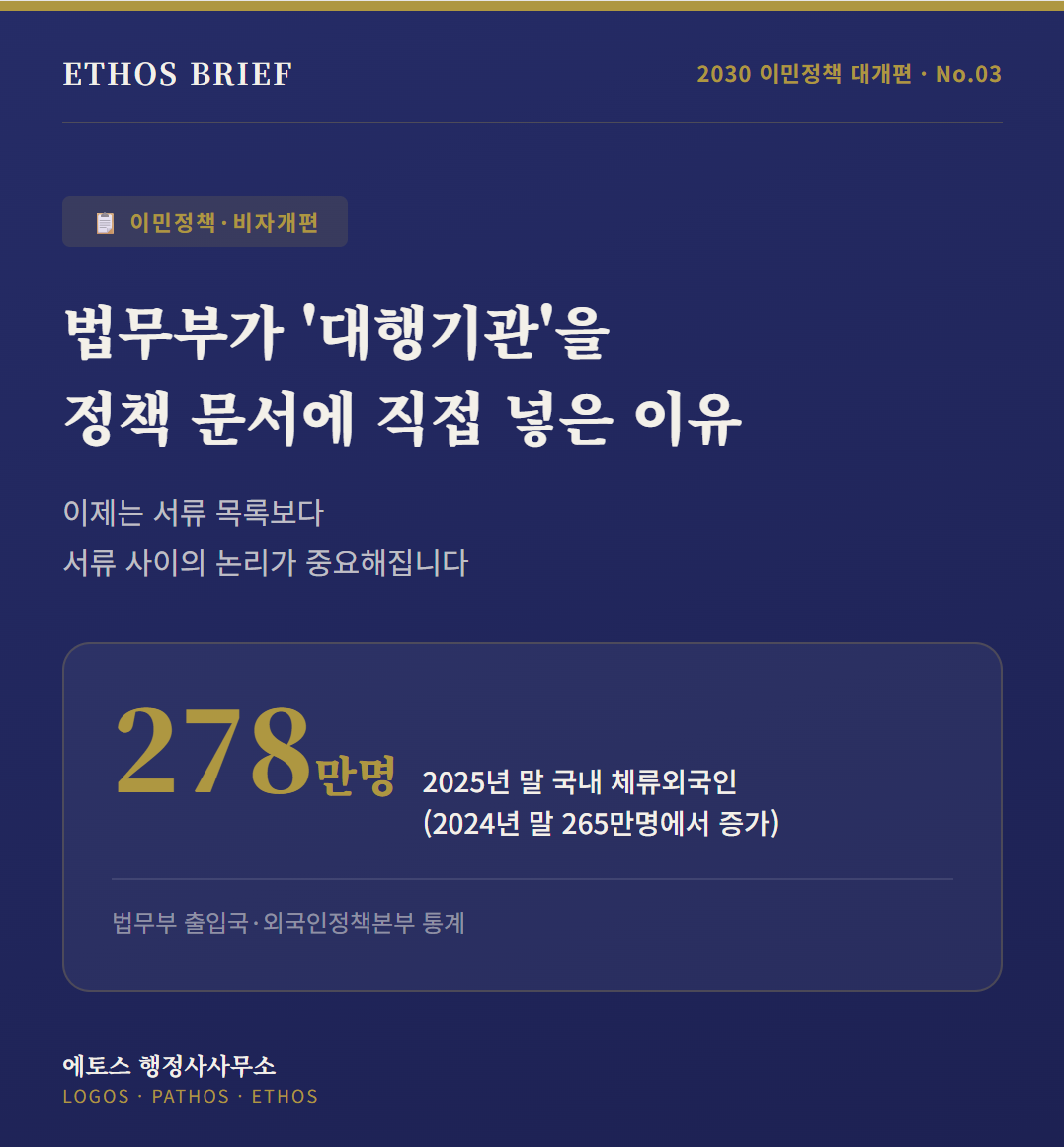
This is the final article in the three-part series “Korea’s 2030 Immigration Reform.”
Part 1: When 39 Work Visa Categories Become 3 Levels
Part 2: The New E-7-M / K-CORE Visa
Hello, this is Administrative Agent Jean.
In the 2030 Immigration Policy Future Strategy announced by Korea’s Ministry of Justice in March 2026, one sentence deserves special attention.
In summary, the Ministry of Justice stated that it will promote the use of attorneys and registered immigration application agencies for preliminary review of residence permit documents and electronic filing, in order to improve service quality and processing speed.
Two phrases matter here:
Preliminary review
Application agency
This means Korea’s immigration process may move further away from a simple “bring documents to the counter” model and toward a system where documents are reviewed for completeness before filing and then submitted electronically.
In this final article, we will look at what that change means, who legally qualifies as an immigration application agency, and why foreign residents and employers should start checking whether they are using a properly registered channel.
Key Summary
| Category | Details | | --- | --- | | Policy background | 2030 Immigration Policy Future Strategy | | Main change | Promotion of certified immigration application agencies | | Key words | Preliminary review, electronic filing, service quality, processing speed | | Legal basis | Immigration Act Article 79-2, Enforcement Rules Articles 68-2 to 68-5 | | Eligible agencies | Registered attorneys, general administrative agents, qualified corporations or joint offices | | Excluded under current guidelines | Technical administrative agents and foreign-language translation administrative agents | | Practical meaning | Document logic and completeness matter more than a checklist | | Applicant risk | Supplement requests, rejection, denial, visa gap | | Employer risk | Illegal employment, weak stay management, K-Trust certification risk | | What to prepare | Visa code, expiration date, current activity, future plan |
Why Did the Ministry of Justice Mention Application Agencies?
Immigration application agencies already existed before this policy announcement.
What changed is that the Ministry of Justice is now treating them as part of a broader cooperation structure to improve immigration service quality and processing speed.
This signals a shift.
Korea’s immigration administration is likely to move in three directions:
| Change | Meaning | | --- | --- | | More electronic applications | Increased use of HiKorea, Visa Portal, and online filing | | AI and digital screening | Documents become data and may be pre-classified or screened digitally | | Preliminary review by agencies | Agencies help improve completeness before official review |
In other words, the question will not be only “Did you submit documents?”
The more important question will be:
Were the documents complete, consistent, and ready for review?
In visa work, the real danger is not the number of documents.
The real danger is when the documents tell different stories.
An Application Agency Is a Legally Recognized Channel
An immigration application agency is not simply “someone who knows visas.”
It is a registration-based system under Korean law.
The structure can be understood in three layers.
Layer 1 — Immigration Act
Article 79-2 of the Immigration Act provides the legal basis for application agency services.
It allows foreign nationals, employers of foreign nationals, training institutions, and schools to entrust certain immigration-related applications to registered agencies.
A person who wants to become an application agency must register with the Minister of Justice and meet requirements such as attorney or administrative agent qualification and completion of required training.
This is important because immigration application support is not just a convenience service.
It is a legally recognized procedure.
Layer 2 — Enforcement Rules of the Immigration Act
Articles 68-2 to 68-5 of the Enforcement Rules set out registration procedures, types of agency work, standard processing procedures, and sanctions for agencies.
For example, agency registration may require documents such as proof of attorney practice registration or administrative agent business registration, as well as proof of completion of required training.
The Enforcement Rules also connect agency work to standard procedures and disciplinary standards.
In other words, agencies are not supposed to operate freely without structure. They are managed within a formal regulatory framework.
Layer 3 — Guidelines on Immigration Application Agencies
The Ministry of Justice’s Guidelines on the Management of Immigration Application Agencies provide detailed operating rules.
The guidelines describe immigration application agencies as follows:
| Category | Details | | --- | --- | | Application agency | A registered attorney, administrative agent, related corporation, or joint administrative agent office authorized to handle immigration applications and reports | | Eligible registrants | Attorneys, law firms, general administrative agents, administrative agent corporations, joint administrative agent offices | | Excluded | Technical administrative agents and foreign-language translation administrative agents under current guidelines | | Duties | Fairness, transparency, good faith, protection of client interests | | Fees | Socially reasonable fees | | Liability | Compensation may be required for damages caused intentionally or negligently |
The point is clear.
Not everyone can legally handle immigration filing as an application agency.
Applicants should confirm whether the person or office is a registered attorney, general administrative agent, or properly qualified entity.
What Can an Application Agency Handle?
Registered immigration application agencies can handle various immigration applications and reports.
Common examples include:
| Work Type | Example | | --- | --- | | Certificate for Confirmation of Visa Issuance | Sponsorship process before hiring a foreign worker | | Extension of stay | E-7, D-2, F-2, and other status extensions | | Change of status | D-2 to D-10, D-10 to E-7, E-series to F-series, etc. | | Permission for activities outside status | Part-time work for students, side activities, additional activities | | Workplace change or addition | Company change or additional workplace for work visa holders | | Foreign registration matters | Change of registered information, change of residence | | Receipt of alien registration card | Where permitted by law | | Re-entry permit | Procedures related to leaving and re-entering Korea |
However, not every step can always be delegated.
Fingerprint registration, identity verification, interviews, or personal attendance requests may still require the applicant to appear in person.
Using an agency does not mean everything disappears from the applicant’s responsibility. It means the delegated and non-delegated parts should be clearly separated.
Why Is the Agency Role Becoming More Important Now?
This did not happen suddenly.
Three structural changes are happening at the same time.
1. More Foreign Residents Mean More Immigration Applications
The number of foreign residents in Korea continues to increase.
According to immigration statistics, Korea had 2,650,783 foreign residents at the end of 2024, and 2,783,247 at the end of 2025.
As the foreign resident population grows, immigration applications naturally increase.
| Common Applications Created by Growth | | --- | | Extension of stay | | Change of status | | Work permission | | Workplace change | | Permission for activities outside status | | Foreign registration | | Change of residence | | Family accompaniment | | Permanent residence | | Response after denial |
Immigration offices have limited counters and review capacity.
If applications are submitted with incomplete or inconsistent documents, supplement requests repeat. Applicants wait longer, officers spend more time, and employers face hiring delays.
Promoting registered agencies can be understood as a way to reduce that bottleneck.
2. Electronic Filing Makes Pre-Filing Completeness More Important
The 2030 Immigration Policy Future Strategy refers to an integrated electronic civil service platform connecting HiKorea, Visa Portal, and the Social Integration Information Network, as well as AI-based classification and review systems.
Electronic filing sounds convenient, but it creates a practical issue.
At a physical counter, an officer might immediately say, “This document is missing.”
In an electronic filing environment, incomplete materials may be uploaded and enter the system as they are.
That often leads to:
| Process | Result | | --- | --- | | Incomplete submission | Delay or supplement request | | Supplement notice | Additional documents required | | Re-submission | Review restarts or continues later | | Reference date passes | Stay period, contract period, or income period issues arise | | Repeated supplements | Higher risk of rejection or denial |
This is why “preliminary review” matters.
Before filing, the form, content, timing, and internal logic of the documents must be checked.
3. Employer Responsibility Will Increase Under Systems Like K-Trust
The 2030 Immigration Policy Future Strategy also includes the K-Trust Company Stay and Employment Certification System.
This system is designed to give incentives to companies that legally employ foreign workers and properly manage human rights and stay-related obligations.
In practical terms, companies may need to manage the following more carefully:
| Employer Records | Why They Matter | | --- | --- | | Employment contract | Confirms actual job duties and visa scope | | Wage payment records | Shows salary requirement and actual employment | | Social insurance records | Proves employment relationship | | Tax records | Supports income and compliance history | | Stay expiration dates | Prevents illegal stay or illegal employment | | Workplace change history | Prevents missed reporting or permission | | Housing and human rights records | May matter for K-Trust evaluation | | Visa status by employee | Confirms whether work assignment is permitted |
Hiring foreign employees is no longer only an HR matter.
It is becoming a risk management issue involving visas, labor law, tax records, stay management, and human rights compliance.
Document Checklists Are Public. The Problem Is Consistency.
HiKorea publishes document guidance by status.
Anyone can access it.
But in actual immigration practice, the difficult part is not simply knowing which documents are required.
The difficult part is whether those documents tell the same story.
Common issues include:
| Problem | Why It Is Risky | | --- | --- | | Job duties in the contract do not match the visa job code | Permitted activity scope issue | | Business registration industry differs from actual work | Employer or job suitability issue | | Income document period does not match review criteria | May appear to fail income requirement | | Academic status does not match D-2 stay basis | Post-graduation stay gap risk | | Family documents have inconsistent name spellings | Identity or family relationship issue | | Business plan and sales records do not match | Business genuineness or renewal risk | | Workplace changed without reporting | Workplace change or addition violation | | AI-generated checklist only | Individual facts not reflected |
More documents do not always mean a stronger application.
Documents must point in the same direction.
That is why preliminary review by a qualified agency matters.
If AI Exists, Why Use an Administrative Agent?
This question comes up often.
AI is useful.
It can summarize required documents, explain basic rules, and help search laws quickly.
But visa practice has areas where AI is weak.
| AI Is Good At | Human Review Is Needed For | | --- | --- | | General document checklist | Selecting documents for the exact situation | | System summary | Judging status change possibility | | Draft translation | Checking filing language and factual consistency | | Legal search | Assessing local office practice and supplement risk | | Standard procedure explanation | Designing timing and alternative routes |
Visa work is not just a search problem.
Most issues arise from questions like:
- Should I apply now or next month?
- Does this job match the E-7 occupational code?
- The company requirement is weak. Can it be supplemented?
- After D-2 graduation, is D-10, E-7, or E-7-M better?
- My F-2 points are enough, but my income documents are unclear. What should I do?
- I have a past violation. Is extension still possible?
- What should be fixed before denial happens?
These questions cannot be answered properly with a document checklist alone.
They require individual facts, timing, local practice, and alternative route review.
Attorney vs. Administrative Agent: What Is the Difference?
In visa matters, attorneys and administrative agents have different roles.
| Category | Attorney | Administrative Agent | | --- | --- | --- | | Main role | Litigation, legal disputes, criminal cases, legal advice | | Administrative agent role | Preparing, filing, and handling documents submitted to administrative agencies | | Visa filing stage | Both may be involved | | Prevention before denial | Strong fit for administrative agent work | | Litigation after denial | Attorney’s area | | Administrative appeal | Must be reviewed depending on the case and legal scope | | Strength | Dispute resolution and legal judgment | | Administrative agent strength | Pre-filing document structure and administrative procedure management |
Simply put, if litigation or criminal issues have already started, an attorney’s role becomes important.
But if the case is still at the stage of visa application, extension, change of status, or permission for activities outside status, an administrative agent helps organize the application before it turns into a denial or supplement problem.
Most immigration matters never go to court.
They are decided at the document stage: approval, supplement, rejection, or denial.
That is why document strategy before filing matters.
Brokers and Certified Agencies Are Not the Same
One of the biggest risks in the immigration market is the unregistered broker.
Visa matters involve a large information gap.
The applicant may not speak Korean well, the expiration date may be close, the employer may want the worker to start quickly, and online information may conflict.
In that situation, phrases like “guaranteed approval,” “fast processing,” or “we will make the documents for you” can be dangerous.
Before relying on someone, check:
| What to Check | Why It Matters | | --- | --- | | Registered immigration application agency status | Confirms legal filing authority | | General administrative agent or attorney qualification | Confirms eligibility under current guidelines | | Display of registration certificate | Helps verify actual registration | | Written contract | Clarifies scope and fee | | Fee explanation | Prevents excessive or unclear charges | | How they explain possibility | Be careful with “100% approval” language | | Whether they ask about weak facts | Violations, income shortage, employer issues, etc. | | Supplement response scope | Confirms whether they handle post-filing requests |
A proper agency does not simply say, “It will work.”
A proper agency first checks:
What is your current status? When does it expire? What are you actually doing? Do your documents match each other?
Be careful of anyone who says yes without checking these things.
What Foreign Residents Should Check Now
If you are preparing for visa extension or change of status, start with these three points.
| Key Information | What to Check | | --- | --- | | Status code | D-2, D-10, E-7, E-9, F-2, etc. | | Expiration date | By when the application must be filed | | Current activity | Study, employment, business, part-time work, research, etc. |
The review becomes much more accurate if you also prepare:
| Document | Example | | --- | --- | | Passport and alien registration card | Identity and stay period | | Employment contract | Job duties, salary, workplace | | Business registration | Company industry and actual business | | Income documents | Income certificate, withholding records | | Academic documents | Enrollment, graduation, completion status | | Korean language proof | TOPIK, KIIP | | Past history | Violations, fines, unauthorized work, denial history | | Future plan | Extension, change, F-2, F-5, startup, family accompaniment |
A visa is not only about whether you have documents today.
It is about whether your current status and next plan connect without a gap.
What Employers Should Check Now
Employers should not treat foreign employee visas as only the employee’s personal issue.
If the employee’s status does not match the actual job, the company may also face risk.
Employers and HR managers should check:
| Employer Checklist | Key Point | | --- | --- | | Visa status by employee | Whether the employee can perform the job | | Stay expiration date | Extension timing | | Job duties and visa code | E-7 job code, E-9 industry, etc. | | Workplace | Whether registered workplace and actual workplace match | | Salary | Whether visa-specific wage requirements are met | | Tax and insurance records | Proof of actual employment | | Change reporting | Whether workplace, duty, or income changes require reporting | | Long-term plan | E-7, E-7-4, F-2, F-5 route possibilities |
If K-Trust and similar systems become fully implemented, employer stay-management records may become even more important.
Foreign hiring does not end with recruitment.
The real management begins after hiring.
Bring These 3 Things to Your First Consultation
You do not need every document for the first consultation.
Start with these three points:
- Current status code and expiration date
- Current activity or job duties
- Future stay plan
For example:
| Current Situation | Next Review | | --- | --- | | D-2 student close to graduation | D-10, E-7, E-7-M, K-STAR | | E-7 worker planning to change jobs | Workplace change or addition permission/report | | E-9 worker seeking long-term stay | E-7-4 or another transition route | | Preparing for F-2 | Points, income, Korean language, stay history | | Preparing a startup | D-8, D-9, D-10, F-series activity scope | | Employer HR manager | Visa expiration and job suitability by employee |
Visa continuity often depends on one document and one deadline.
The later you check, the fewer options you may have.
How an Administrative Agent Can Help
Ethos Administrative Office can assist with:
- Extension of stay
- Change of status
- E-7 work visa review
- D-2 post-graduation routes: D-10, E-7, E-7-M
- F-2 residence and F-5 permanent residence preparation
- Permission for activities outside status
- Startup visas: D-8, D-9, D-10
- Employer-side foreign worker visa risk review
- HiKorea electronic filing preparation
- Pre-checking documents likely to trigger supplement requests
- Preparing statements of reason, plans, and explanatory materials for immigration filing
The core of visa work is not simply submitting documents for someone.
It is making sure that, before the officer reviews the file, the documents all point in the same direction.
Closing — Finishing the 2030 Immigration Reform Series
This article concludes the three-part series “Korea’s 2030 Immigration Reform.”
In Part 1, we looked at the broad plan to reorganize Korea’s 39 work visa subcategories into three skill levels: high-skilled, mid-skilled, and low-skilled.
In Part 2, we reviewed E-7-M, the new K-CORE visa, and what it means for junior college international students and regional manufacturing companies.
In Part 3, we examined why the Ministry of Justice is emphasizing certified immigration application agencies and what that means for foreign residents and employers.
Korea’s visa system will become more digital, more structured, and faster.
That also means applications may need to be more complete from the beginning.
The most important principle is simple:
Prepare correctly from the start.
Your visa code, expiration date, current activity, and future plan.
If these four points are clear, your immigration risk becomes much easier to review.
If you are preparing for visa extension, status change, employment, startup, F-2, or F-5, it is better to check early than to wait until the deadline is close.