
From H-2 to F-4: What Existing Working Visit Holders and Employers Must Check Now
Hello, this is Administrative Agent Jean from Ethos Administrative Office.
On February 12, 2026, the Ministry of Justice implemented a major reform of Korea’s Overseas Korean visa system through Ministry of Justice Notice No. 2026-65.
The key change is simple but important:
New H-2 Working Visit visa issuance has been suspended, and Overseas Korean residence status is now being consolidated around the F-4 visa.
For current H-2 holders, this does not mean that your status disappears overnight. Existing H-2 holders may stay in Korea until the upper limit of their permitted period of stay. However, if you miss the transition timing and let your stay period expire, re-entry or continued residence may become much more difficult.
If you have heard that “H-2 is no longer being issued” or that “H-2 holders should change to F-4,” this is the point where you should stop guessing and start checking your documents.
This article explains what changed, what current H-2 holders should do, and what employers must review before the transition causes problems.
Key Summary
| Item | What Changed | | --- | --- | | Policy start date | February 12, 2026 | | Main change | Overseas Korean statuses consolidated around F-4 | | H-2 new issuance | Suspended | | Existing H-2 holders | May stay until the allowed period of stay expires | | Change to F-4 | Available through the F-4 consolidated application | | Application channel | HiKorea e-Application may be available | | Fee waiver | Change-of-status fee waived until December 31, 2027 | | Important note | Domestic Residence Report card issuance fee is not waived | | Employment scope | 10 previously restricted occupations are newly permitted for F-4 | | Employer risk | Visa status, job scope, reporting, and employment records must be reviewed |
What Changed?
1. New H-2 Working Visit Visa Issuance Has Stopped
After February 12, 2026, new issuance of the H-2 Working Visit visa has been suspended.
This means that the previous route often used by Overseas Koreans from China and certain former Soviet Union regions is no longer available in the same way.
However, current H-2 holders are not required to leave Korea immediately. They may continue staying in Korea until the upper limit of their permitted stay period.
In practice, this means current H-2 holders should use the remaining stay period to prepare for F-4 transition.
2. The F-4 System Now Applies More Equally Across Nationalities
Previously, Overseas Koreans from certain countries often had to prove additional education, career, or qualification requirements to obtain F-4 status.
Under the new integration policy, the system has moved toward applying the same F-4 framework regardless of nationality, once the applicant is confirmed as an Overseas Korean.
That said, F-4 is not automatic.
Applicants may still be reviewed for criminal history, immigration violations, identity documents, family relationship records, and other eligibility issues. The Ministry of Justice notice also explains that persons with serious criminal records such as murder, rape, drugs, or voice phishing may be ineligible for F-4 status.
In short:
The door is wider, but the screening has not disappeared.
3. F-4 Employment Scope Has Expanded
One of the biggest practical limits of the F-4 visa used to be the restriction on simple labor.
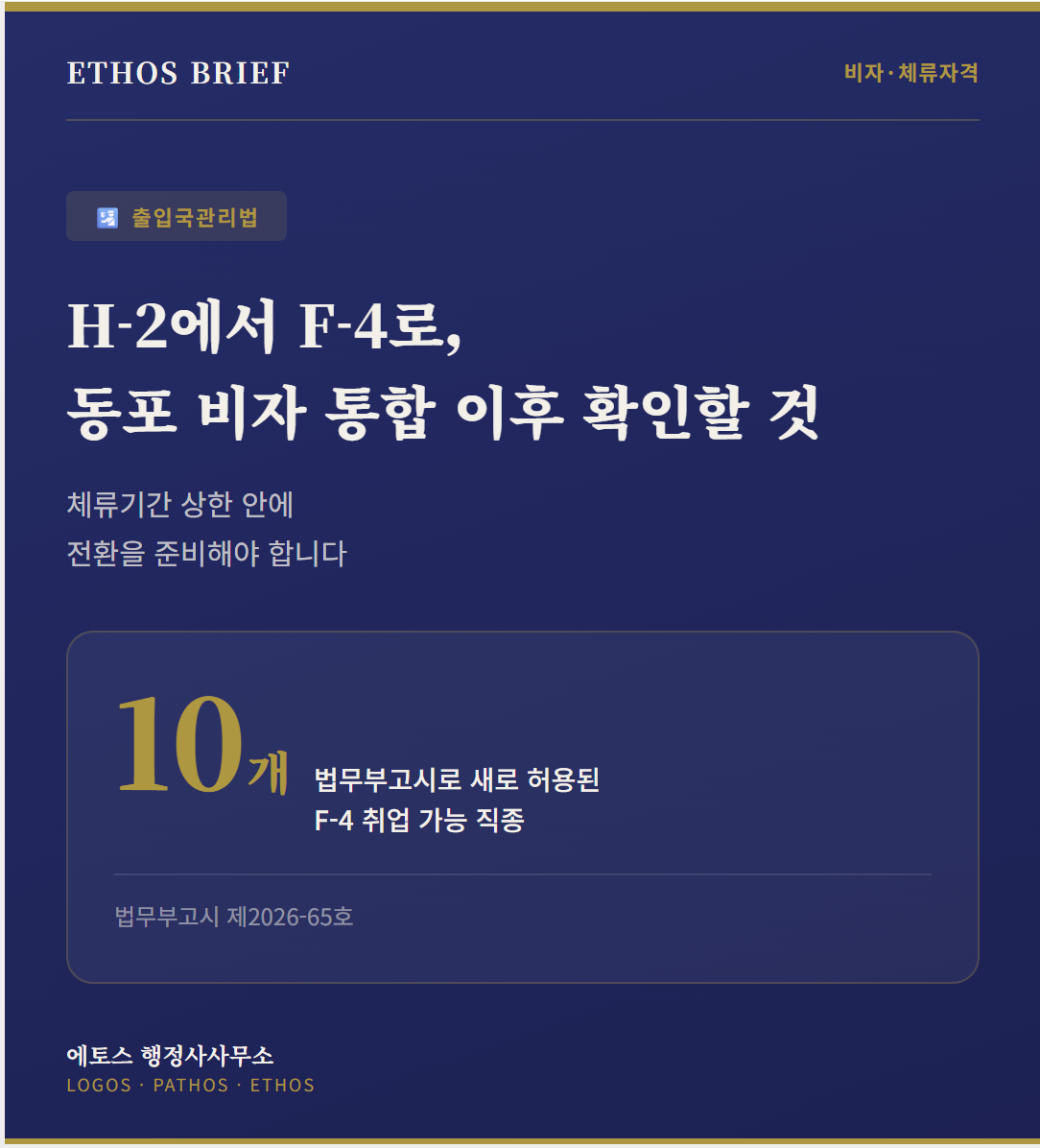
Under Ministry of Justice Notice No. 2026-65, 10 occupations that were previously restricted are now newly permitted for F-4 holders.
Newly permitted occupations include:
| Newly Permitted Occupations | | --- | | Construction simple laborer | | Mining simple laborer | | Loading and unloading laborer | | Other loading and unloading laborer | | Manual packaging laborer | | Manual labeling laborer | | Gas station attendant | | Store shelf stocker / store organizer | | Parking attendant | | Vending machine attendant |
This is a meaningful change, especially for industries facing labor shortages.
However, this does not mean that F-4 holders may work in every simple labor job. Some occupations remain restricted, including certain delivery, cleaning, security, entertainment, and socially sensitive industries depending on the detailed notice and applicable rules.
Before starting work, both the worker and employer should confirm whether the specific job is allowed under the current F-4 employment restriction notice.
What Existing H-2 Holders Should Do Now
If you currently hold H-2 status, the first question is not “Can I change to F-4 someday?”
The better question is:
How much time do I have left, and what must be prepared before that date?
A practical review should begin with the following:
| Step | What to Check | | --- | --- | | 1 | Current H-2 expiration date | | 2 | Total permitted stay period | | 3 | Whether an employment-period extension confirmation exists | | 4 | Whether you are eligible for F-4 transition | | 5 | Whether early adaptation program completion is required | | 6 | Whether Korean language proof can help with stay period | | 7 | Whether your current job is permitted under F-4 | | 8 | Whether employment information reporting is needed after transition |
Existing H-2 holders generally had an initial stay period of up to 3 years, and with an employment-period extension confirmation from the Ministry of Employment and Labor, the total stay may extend up to 4 years and 10 months from the date of entry.
That remaining time should be used carefully.
Do Not Miss the Fee Waiver Period
The Ministry of Justice guidance states that the change-of-status processing fee for H-2 to F-4 transition is waived until December 31, 2027.
This is helpful, but it should not be misunderstood.
The fee waiver does not mean you can wait until the last minute.
Also, the Domestic Residence Report card issuance fee is not waived.
In practice, the more important deadline is not only the fee waiver deadline. It is your own stay expiration date.
If your H-2 period is close to expiration, document preparation should begin earlier.
Check the Early Adaptation Program Requirement
When changing to F-4 under the integration policy, completion of the Early Adaptation Program may be required.
The program generally covers basic legal order, social adaptation information, crime prevention, industrial safety, and settlement guidance.
Exemptions may apply in certain cases, such as:
| Possible Exemption Category | | --- | | Persons currently attending or having graduated from Korean elementary, middle, or high school | | Children aged 6 or younger | | Persons aged 65 or older | | Persons who have stayed in Korea for 3 years or more under a long-term status | | Persons who have completed or are enrolled in KIIP Step 1 or higher |
Because exemption rules can depend on individual facts, it is safer to check before applying.
Period of Stay May Depend on Korean Language Ability
Not every F-4 holder receives the same period of stay.
Under the new policy, the period of stay may be granted within a maximum of 3 years depending on Korean language ability and Korea Immigration & Integration Program participation or completion.
Examples of Korean language proof may include:
| Proof Type | Example | | --- | --- | | TOPIK | Valid TOPIK score | | KIIP | Social Integration Program evaluation or completion | | King Sejong Institute | Relevant beginner-level completion record |
If no Korean language proof is submitted, a shorter stay period may be granted, which can create annual extension burdens.
For those who are considering long-term residence or permanent residence later, Korean language preparation should not be treated as an afterthought.
What Employers Must Check
This policy is not only an issue for foreign workers.
If your business employs H-2 workers, you should review the transition carefully.
Employers should check:
| Employer Checklist | Why It Matters | | --- | --- | | H-2 employee’s expiration date | To avoid illegal stay or employment issues | | Whether the employee changed to F-4 | Employment management may change after status change | | Whether the job is allowed under F-4 | F-4 employment is broader, but not unlimited | | Whether employment information reporting is completed | Online reporting may be required | | Whether employment change reporting is needed | Some employers may need to report status changes | | Whether departure guarantee insurance should be settled | Relevant when the worker has been employed for a qualifying period |
If an H-2 worker changes to F-4, the employer may need to update employment-related records and report relevant changes depending on the employment system and agency guidance.
Foreign employee hiring is not finished at recruitment. The real compliance work begins with continued status management.
H-2 to F-4 Transition Checklist
Before applying, prepare the following review:
- Current passport and alien registration card
- H-2 expiration date
- Total stay period and extension history
- Overseas Korean eligibility documents
- Family relationship or nationality-related documents
- Criminal or immigration violation history
- Early Adaptation Program requirement or exemption
- Korean language proof, if available
- Current workplace and job description
- Whether the job is permitted under F-4
- HiKorea account access
- Employment information reporting status
A missing document can lead to a supplement request. If your stay period is already close to expiration, even one supplement request can become a serious timing problem.
Frequently Asked Questions
Q. Does this mean all H-2 holders automatically become F-4 holders?
No. Existing H-2 holders may apply to change to F-4 through the consolidated application process, but the status is not automatically changed without application and review.
Q. Can current H-2 holders remain in Korea?
Yes. Current H-2 holders may remain in Korea until the upper limit of their permitted stay period. However, they should prepare F-4 transition before the stay period expires.
Q. Is the F-4 change-of-status fee really waived?
The processing fee for the change of status is waived until December 31, 2027. However, the Domestic Residence Report card issuance fee is not waived.
Q. Can F-4 holders now work in any simple labor job?
No. The permitted scope has expanded, but some occupations remain restricted. The exact job category should be checked before employment begins.
Q. What should employers do first?
Employers should first check each foreign worker’s current visa status, expiration date, actual job duties, and whether the employee has already changed or plans to change from H-2 to F-4.
How an Administrative Agent Can Help
The H-2 to F-4 transition may look simple because the policy direction is clear.
But in practice, the risk is usually in the details:
- Is the person clearly eligible as an Overseas Korean?
- Is the current H-2 stay period still valid?
- Are there any criminal, immigration, or employment records that may affect the application?
- Is the current job permitted under F-4?
- Has the employer handled the required reporting?
- Is the application being filed before the deadline becomes risky?
At Ethos Administrative Office, we help organize the transition process from eligibility review to document preparation, HiKorea application support, and employer-side compliance checks.
Closing
The H-2 to F-4 integration is a major policy shift.
For many Overseas Koreans, it creates a better and fairer route to stable residence in Korea. For employers, it may also help reduce uncertainty in industries that rely on foreign Korean workers.
But the transition still requires timing, document control, and employment-scope review.
If you are a current H-2 holder, do not wait until your stay period is almost over.
If you are an employer, do not assume the employee’s visa change is only the worker’s problem.
The safest approach is to check the current status, permitted job scope, reporting duties, and transition schedule now.