
H-2 Working Visit Visa — Receiving the Visa Is Only the Beginning
Hello, this is Administrative Agent Jean.
The H-2 visa is commonly known as the Working Visit visa.
Because of that name, many people understand it very simply.
“If it is a working visit visa, I can just come to Korea and work, right?”
“I can enter with H-2 first and change to F-4 later, correct?”
“Once I get the visa, staying in Korea should be fine, shouldn’t it?”
In practice, H-2 is not that simple.
H-2 is a status of stay that allows employment activity, but it does not mean that a person can work anywhere, in any job, in any way. The visa must be managed together with employment scope, stay period, violation history, work records, and possible future change to F-4.
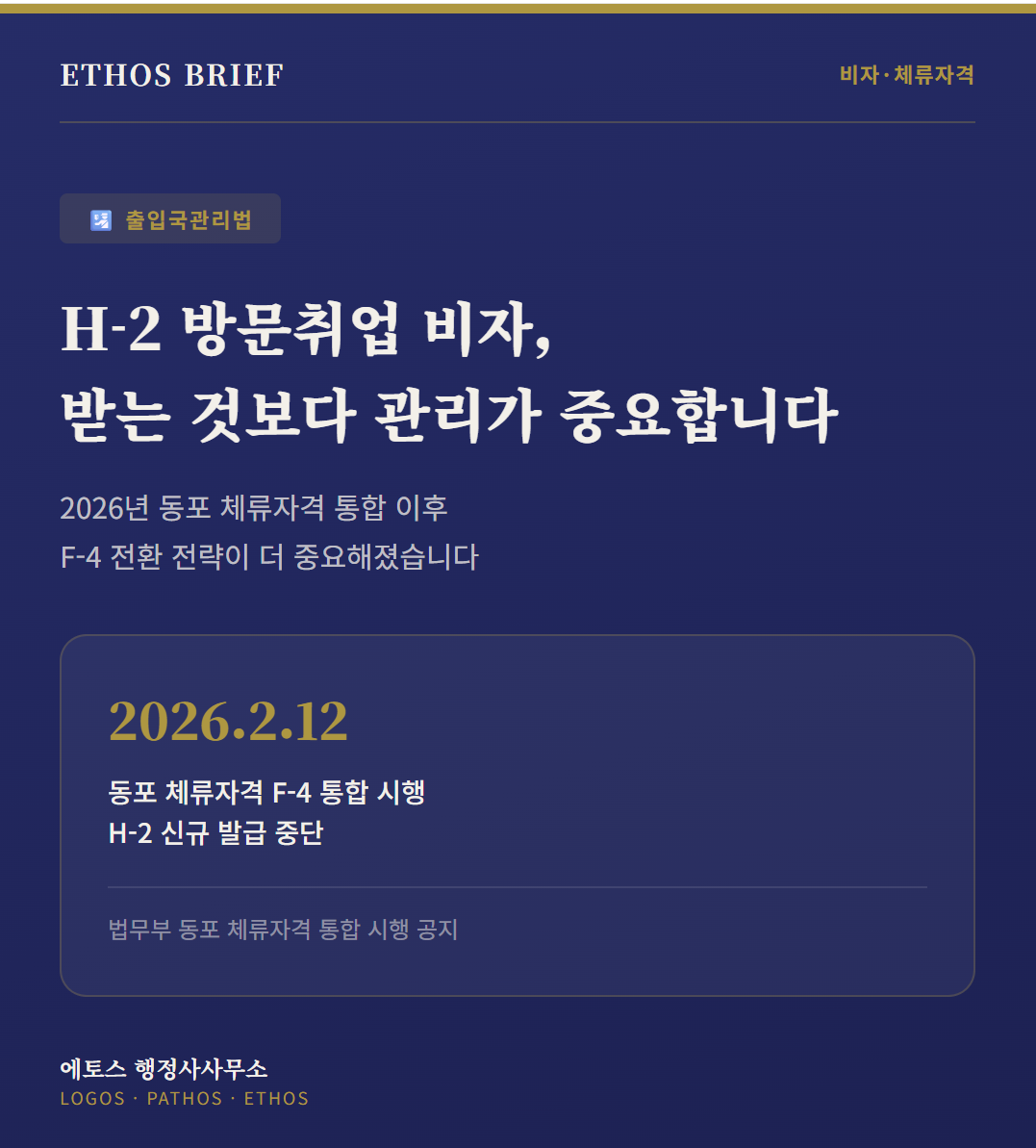
This became even more important after February 12, 2026, when the Ministry of Justice implemented the policy consolidating Overseas Korean residence statuses around F-4.
Today, H-2 is less about starting a new visa route and more about managing existing H-2 stay properly and reviewing whether transition to F-4 is possible.
This article explains the H-2 Working Visit visa, the 2026 policy change, employment management, violation risks, and what existing H-2 holders should check before moving toward F-4.
Key Summary
| Category | Details | |---|---| | Visa type | H-2 Working Visit | | Main nature | Employment-permitted status for certain foreign national Koreans | | 2026 change | Overseas Korean residence statuses consolidated around F-4 | | H-2 new issuance | Discontinued under the 2026 policy direction | | Main audience now | Existing H-2 holders and people reviewing H-2 to F-4 transition | | Key management points | Employment scope, stay period, work records, violation history | | Common misunderstanding | Treating “employment permitted” as “unlimited work permitted” | | Main risks | Drunk driving, unlicensed driving, theft, immigration violations, unauthorized work | | F-4 transition | Not automatic; eligibility and restriction grounds must be reviewed separately | | Practical strategy | Review current stay, employment history, violations, and F-4 possibility together |
What Is the H-2 Working Visit Visa?
The H-2 Working Visit visa was a status of stay that allowed certain foreign national Koreans to enter Korea and engage in employment activity.
Historically, it was commonly used by overseas Koreans from countries such as China and former Soviet Union regions who entered Korea for work.
However, as of 2026, H-2 must be understood together with the major policy change.
From February 12, 2026, the Ministry of Justice implemented the Overseas Korean F-4 status consolidation policy. Under this policy, the Overseas Korean residence system has been reorganized around F-4, and new issuance of the H-2 Working Visit status has been discontinued.
Therefore, the practical focus today is:
- How existing H-2 holders should manage their current stay and employment activity
- Whether and how they may transition to F-4
- Whether past violations may affect extension, change of status, or departure order risk
H-2 may no longer be the main starting point for new applicants, but it remains highly important for people already staying in Korea under H-2.
H-2 Is Not a “Receive It and Forget It” Visa
The most common mistake is thinking that the process ends once the H-2 visa is issued.
In reality, post-entry management is often more important than visa issuance.
H-2 holders must continue to manage:
- Whether their employment activity is within the permitted scope
- Whether the employer and workplace are proper
- Whether stay period extension is filed on time
- Whether any criminal or immigration violation occurs during stay
- Whether work history supports future F-4 transition
- Whether past records may affect later review
In that sense, H-2 is not simply an entry visa.
It is a stay-management visa.
The Major 2026 Change
The key point of the February 12, 2026 policy change is that Overseas Korean residence statuses are now centered around F-4.
| Category | Details | |---|---| | Policy change | Overseas Korean status consolidated around F-4 | | H-2 new issuance | Discontinued | | Existing H-2 holders | May review change to F-4 under applicable procedures | | Employment activity | F-4 employment restriction notice must be checked | | Practical direction | F-4 transition planning becomes more important | | Warning | Criminal or immigration violations may affect transition review |
Because of this change, an H-2 guide should no longer stop at “how to apply for the Working Visit visa.”
The better questions are now:
How should existing H-2 holders manage their stay?
Can they change to F-4?
Will past violations create problems?
Will employment records help or hurt future review?
Five Things H-2 Holders Should Check First
1. Current Eligibility and Status
First, confirm whether you are currently an H-2 holder or otherwise within the Overseas Korean residence framework.
Check:
- Whether you qualify as a foreign national Korean
- Whether your current status is H-2
- How much stay period remains
- Whether you have any past immigration violations
- Whether F-4 change of status may be available
Since new H-2 issuance has been discontinued under the 2026 policy, the practical question is usually not “Can I newly apply for H-2?” but “How should I manage my current H-2 and move forward?”
2. Employment Scope
H-2 permits employment activity, but it does not mean unlimited employment.
Before working, check:
- Whether the industry or job is permitted
- Whether the employer can legally hire the worker
- Whether employment commencement reporting or other procedure is required
- Whether workplace-related reporting is needed after changes
- Whether the activity stays within the status of stay
- Whether the work record may affect later F-4 review
“Working Visit” should not be interpreted as “work anywhere.”
3. Stay Period Management
The expiration date matters.
If the stay period expires, the issue is no longer simple extension. It may become an overstay or violation issue.
If F-4 transition is being considered, review the next step early rather than waiting until the expiration date is close.
4. Violation History
Violations during H-2 stay may affect extension, change of status, departure order, or deportation review.
Be especially careful with:
- Drunk driving
- Unlicensed driving
- Failure to act after a traffic accident
- Theft
- Assault
- Immigration Act violations
- Unauthorized employment
- Failure to report address change
- False documents
Even if the person thinks it was “just a small mistake,” immigration may review it from the perspective of stay order and public welfare.
5. H-2 to F-4 Transition
A transition from H-2 to F-4 may be possible, but it is not automatic.
Review:
- Current H-2 status
- Overseas Korean eligibility
- Nationality and family relationship documents
- Korean language or social integration factors
- Criminal and immigration violation history
- Employment history
- Latest F-4 integration rules from the Ministry of Justice
If H-2 is part of a long-term stay plan, F-4 transition should be considered from the beginning.
H-2 Practical Structure at a Glance
| Category | What to Check First | Why It Gets Stuck | Practical Note | |---|---|---|---| | Eligibility | Overseas Korean status, current status of stay | Korean background is explained, but application route is unclear | Eligibility should be checked first | | Employment | Permitted industry and work method | “Can work” is interpreted too broadly | Employment permitted does not mean unlimited work | | Stay period | Extension or change timing | Applicant thinks visa issuance is the end | Expiration date management is critical | | Post-entry risk | Criminal or immigration violations | Applicant treats violations too lightly | Records affect later review | | H-2 to F-4 | Transition possibility and requirements | Applicant assumes automatic conversion | Requirements must be reviewed separately |
What “Employment Permitted” Really Means
H-2 allows employment activity.
But that should be broken into more precise questions.
- Is this job within a permitted field?
- Is this employer able to hire the worker properly?
- Is employment commencement reporting required?
- Is workplace reporting required?
- Is the activity outside the permitted status?
- Could this work record create a problem for future F-4 transition?
For H-2 holders considering F-4, the question is not only whether they can work now.
The more important question is:
How will this work history be viewed later?
What Happens If a Violation Occurs During H-2 Stay?
The result is not always the same.
A violation does not automatically mean departure in every case.
But it also should not be taken lightly.
Immigration may consider:
- Type of violation
- Penalty level
- Repetition
- Impact on public order
- Length of stay in Korea
- Family and livelihood foundation
- Previous violation history
- Evidence of remorse and prevention
- Need for continued stay
The same H-2 status can lead to different outcomes depending on the facts.
Administrative Appeal Cases Showing H-2 Risk
Administrative Appeal 2024-07831
In a 2024 administrative appeal case, an H-2 Working Visit holder received a KRW 6 million fine for drunk driving and was issued a departure order.
However, the departure order was canceled.
The issue was not merely whether drunk driving occurred. The question was whether maintaining the departure order was justified after considering the applicant’s full circumstances.
This case shows that even when an H-2 holder has a violation record, there may be room to argue depending on the specific facts.
Administrative Appeal 2020-18526
In contrast, another H-2 holder with drunk driving, unlicensed driving, and theft history challenged a departure order, but the claim was not accepted.
This case shows that the seriousness and repetition of violations can change the result.
What These Cases Show
In H-2 cases, the key issue is not only whether there was a violation.
The important factors include:
- Was it a single incident or repeated conduct?
- Was it only a traffic offense, or combined with another crime?
- How serious was the penalty?
- How long has the person lived in Korea?
- Is there a stable livelihood or family foundation?
- Can the person explain prevention of recurrence?
Do not assume that paying a fine ends the visa problem.
Immigration issues may begin after the criminal case is over.
H-2 to F-4 Is Not Automatic
One of the most common misunderstandings is:
“I can enter with H-2 first and change to F-4 later.”
Sometimes transition may be possible. But it is not automatic.
Administrative Appeal 2021-16010
In case 2021-16010, an H-2 holder entered Korea, reported employment commencement, and later applied to change to F-4-24 Overseas Korean status.
The application was denied because the person did not meet the requirement of working for at least two years at the same manufacturing workplace in a local area.
The denial was upheld.
The lesson is clear.
The pathway from H-2 to F-4 may exist, but satisfying the requirements is a separate issue.
Work history, workplace requirements, stay history, violation records, and documents must all line up.
After 2026, F-4 Transition Strategy Matters More
After the Ministry of Justice consolidated Overseas Korean statuses around F-4, existing H-2 holders should review whether transition to F-4 is possible.
However, F-4 review still includes:
- Overseas Korean eligibility
- Family relationship and nationality documents
- Existing H-2 stay history
- Korean language or social integration factors
- Overseas or domestic criminal history
- Immigration violation history
- Whether the intended job is restricted under F-4
- Whether the application can be filed before current stay expires
F-4 may provide a more stable residence pathway, but restriction grounds and employment limits still matter.
What Existing H-2 Holders Should Check Now
1. Stay Period
Check your expiration date first.
If the expiration date is close, there may be less time to prepare for F-4 transition or respond to document issues.
2. Employment History
Organize where, when, and how you worked.
If you are considering F-4 change, employment history and supporting evidence may matter.
3. Violation History
Check whether there is any drunk driving, unlicensed driving, unauthorized work, address reporting issue, or other immigration violation.
A record that seemed minor may become important during change of status.
4. F-4 Possibility
Under the current system, reviewing F-4 change may be a more realistic strategy than simply continuing under H-2.
But eligibility depends on individual facts.
5. Restricted Occupations
Even after changing to F-4, not all work is allowed.
Check the Ministry of Justice notice on F-4 employment restrictions before starting a job.
How an Administrative Agent Would Organize the Case
An H-2 matter should not begin with a random document checklist.
It should begin with a timeline.
STEP 1. Review Current Stay Status
- Current status of stay
- Expiration date
- Entry history
- Extension history
- Past change of status history
STEP 2. Organize Employment Activity
- Workplace
- Work period
- Industry
- Reporting status
- Wage records
- Same-workplace continuity
- Evidence available for future submission
STEP 3. Check Violation History
- Drunk driving
- Unlicensed driving
- Criminal penalties
- Immigration violations
- Unauthorized work
- Failure to report address change
- Departure order or deportation history
STEP 4. Review F-4 Transition
- Overseas Korean eligibility
- Family relationship documents
- Nationality history
- Korean language or social integration documents
- Criminal record restriction risk
- F-4 restricted occupation issue
STEP 5. Decide the Next Procedure
- Extension of stay
- Change to F-4
- Departure and re-entry review
- Explanation of violation history
- Response to departure order
- Review of another status of stay
For H-2, the core question is not simply “What document should I submit?”
The real question is:
How have you stayed so far, and what status can stabilize your stay next?
H-2 Checklist
Before taking the next step, check:
- Do you currently hold H-2 status?
- When does your stay period expire?
- Have you checked F-4 transition after the 2026 status consolidation?
- Did you properly complete employment commencement or workplace-related procedures?
- Does your workplace match your actual work?
- Do you have wage records, employment records, and work history evidence?
- Do you have any drunk driving, unlicensed driving, theft, or other criminal history?
- Do you have any Immigration Act violation?
- Can you prepare family relationship and nationality documents for F-4?
- Have you checked whether your planned job is restricted under F-4?
- Are you preparing early enough before expiration?
Frequently Asked Questions
Q. Can I newly apply for an H-2 visa in 2026?
Under the Ministry of Justice policy implemented on February 12, 2026, Overseas Korean residence statuses were consolidated around F-4, and new H-2 issuance was discontinued.
Therefore, the more important issue now is how existing H-2 holders manage their stay and whether they can change to F-4.
Q. Can H-2 holders work immediately?
H-2 allows employment activity, but not unlimited employment.
Permitted industries, employer structure, employment commencement reporting, workplace management, and status-of-stay scope should be checked.
Q. Is H-2 automatically changed to F-4?
No.
F-4 transition may be possible, but it is not automatic. Overseas Korean eligibility, nationality and family documents, Korean language or social integration factors, criminal history, and immigration violations must be reviewed separately.
Q. Does drunk driving automatically lead to a departure order?
Not always.
The type of violation, fine amount, repetition, other criminal history, length of stay, family ties, livelihood foundation, and public order concerns may all be considered. However, drunk driving is not treated lightly in immigration review.
Q. Is the visa issue over once I pay the criminal fine?
No.
Even if the criminal case is closed, immigration may separately review the issue during extension, change of status, departure order, or deportation proceedings.
Q. If I change to F-4, can I work freely?
Not completely.
F-4 has a broader activity scope than H-2 in many cases, but certain simple labor jobs and activities restricted by Ministry of Justice notice may still be limited. Check whether the exact job is restricted before starting work.
H-2 Is More About Management Than Issuance
In short, the H-2 Working Visit visa should not be understood as “a visa that lets you come to Korea and work anywhere.”
Especially after the 2026 policy change, the more important question is not whether H-2 can be newly issued. The important question is whether existing H-2 holders can manage their current stay and move toward F-4 safely.
A practical sequence is:
- Confirm current status and expiration date
- Organize employment activity and work history
- Review violation history
- Check F-4 transition possibility
- Confirm restricted occupations
- Decide extension, change, or explanation strategy
For existing H-2 holders, the visa still matters.
But the real value now is in building a stable next step.
If you are currently staying under H-2 and wondering whether you can change to F-4, start by organizing your current stay status, employment history, and violation record on one page.