
Korea’s 2030 Immigration Reform, Part 1 — What Happens When 39 Work Visa Categories Become 3 Levels?
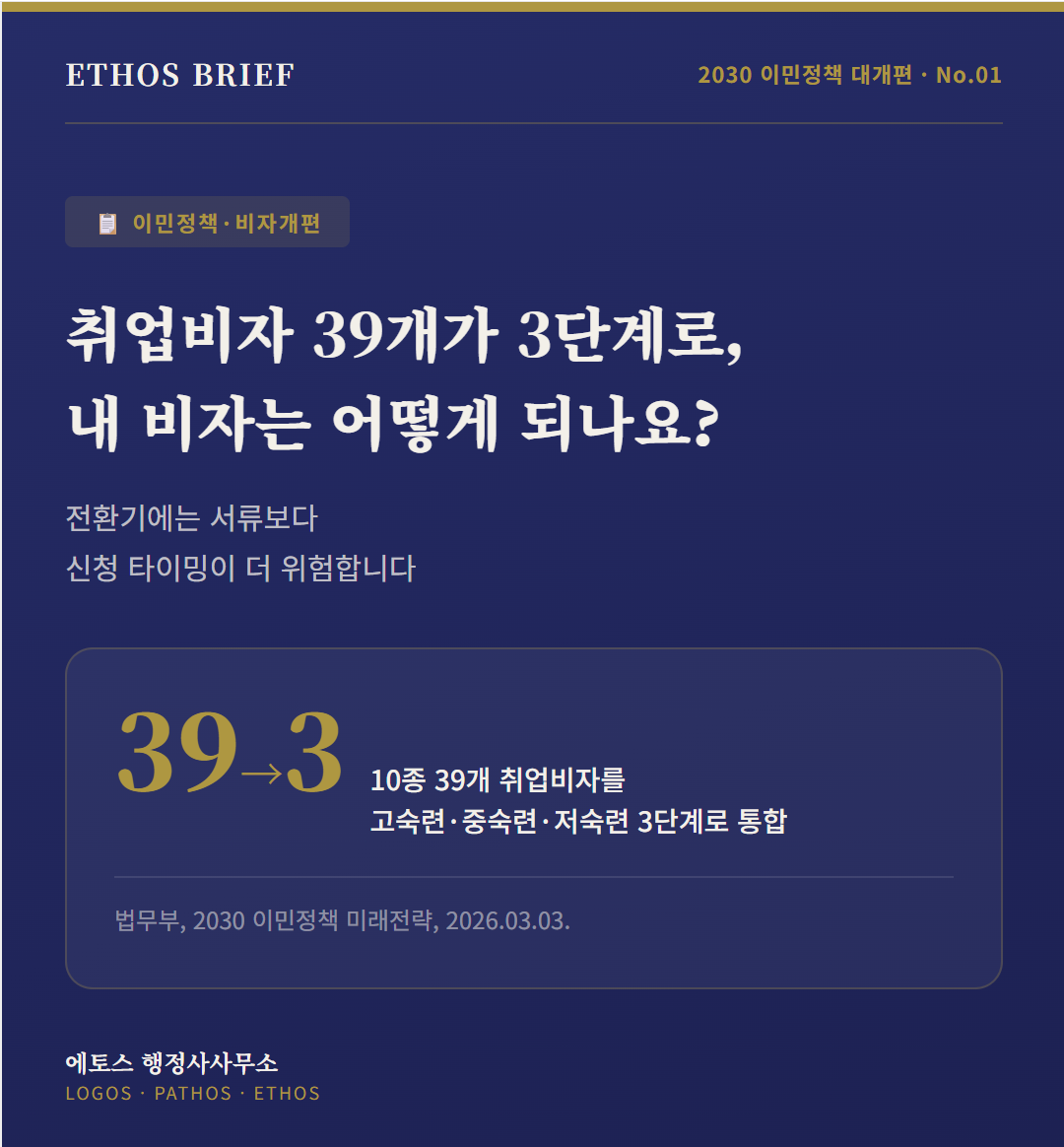
This is the first article in the three-part series “Korea’s 2030 Immigration Reform.”
Hello, this is Administrative Agent Jean.
On March 3, 2026, Korea’s Ministry of Justice released two numbers that matter.
By 2030, Korea’s working-age population is expected to decline by 3.13 million, and industries may face a shortage of at least 1.12 million workers.
These numbers were presented during the Ministry of Justice briefing on the “2030 Immigration Policy Future Strategy.”
This is not just a demographic statistic.
It is the starting point for a major policy shift that may affect foreign workers, international students, employers, researchers, business operators, and long-term foreign residents in Korea.
The most important part for many people is the planned reform of Korea’s work visa system.
Currently, Korea’s work visa structure has 10 E-series categories and 39 subcategories. The Ministry of Justice itself has recognized that this structure is difficult for companies and ordinary applicants to understand. As part of the 2030 strategy, the government plans to reorganize the work visa system into three levels: high-skilled, mid-skilled, and low-skilled.
So the real question is:
“Where will my current visa fit in the new system, and should I extend or change my status now?”
In this first article, we will look at the overall direction of the 2030 Immigration Policy Future Strategy and the practical risks applicants should watch during the transition period.
Key Summary
| Category | Details | | --- | --- | | Announcement date | March 3, 2026 | | Policy name | 2030 Immigration Policy Future Strategy | | Main background | Low birth rate, aging population, labor shortage | | Current work visa structure | 10 E-series categories and 39 subcategories | | Reform direction | Simplification into high-skilled, mid-skilled, and low-skilled levels | | Key changes | Expanded Top-Tier visa, new E-7-M/K-CORE visa, new skilled agriculture and fisheries visa | | Directly affected groups | E-series work visa holders, D-series international students, employers hiring foreign workers | | Indirectly affected groups | Foreign residents planning to move from E-series to F-2 or F-5 | | Practical focus | Stay expiration date, permitted scope of activity, and future transition route |
Why Is Korea Changing the Work Visa System?
The short answer is this:
Korea is shifting immigration policy from temporary labor supply to long-term national workforce strategy.
The Ministry of Justice identified several structural issues:
| Policy Background | Meaning | | --- | --- | | Declining working-age population | Korea will have fewer domestic workers available | | Industrial labor shortage | Manufacturing, agriculture, fisheries, regional industries, and advanced industries all face workforce pressure | | Growing foreign resident population | Foreign residents are becoming a regular part of Korean society, not only temporary labor | | Complexity of the current visa system | Employers and foreign applicants often struggle to identify the correct visa route |
Until now, Korea’s foreign workforce policy has often focused on filling immediate labor gaps.
The new direction is broader:
- Attract high-level global talent
- Train mid-skilled technical workers inside Korea
- Support settlement in regional and declining-population areas
- Protect Korean workers’ jobs and wage standards
- Manage foreign workforce inflow more systematically
This means the visa reform is not just a change in category names.
It is a redesign of how Korea decides who can work, who can stay longer, and who may eventually settle.
Why Does the Current Work Visa System Feel So Complicated?
Korea’s current employment visa system is highly segmented, especially within the E-series.
Representative categories include:
| Status | Main Activity | | --- | --- | | E-1 | Professor | | E-2 | Foreign language instructor | | E-3 | Research | | E-4 | Technology transfer | | E-5 | Professional occupation | | E-6 | Arts and entertainment | | E-7 | Specially designated activities | | E-8 | Seasonal worker | | E-9 | Non-professional employment | | E-10 | Vessel crew |
The problem is not only the number of categories.
Even within E-7, requirements can vary depending on job code, education, career, salary, company size, Korean employee count, employment reason statement, and permitted job duties.
In practice, applicants and employers often ask:
- Does this job qualify for E-7?
- Is this E-7-1 or E-7-2?
- Does the company meet the sponsorship requirements?
- Can an international student change to a work visa after graduation?
- Is this activity outside the permitted scope of stay?
- Will the same standard apply at extension?
The reform aims to reduce this complexity.
However, the transition period requires extra caution. When old and new rules overlap, application timing, local immigration office practice, and requested supplementary documents may vary.
From 39 Subcategories to 3 Levels
The Ministry of Justice plans to simplify the employment visa system according to skill level.
| Level | Main Target | Related Visas and Programs | | --- | --- | --- | | High-skilled | Advanced industry, science and technology, research and professional talent | Top-Tier visa, E-7-1, etc. | | Mid-skilled | Locally trained technical talent and skilled workers | E-7-M, E-7-4, etc. | | Low-skilled | Non-professional employment, seasonal work, agriculture and fisheries workforce | E-9, E-8, skilled agriculture and fisheries visa, etc. |
The keyword is simplification.
But simplification does not mean easier approval.
It may actually make screening more structured by clarifying which type of foreign worker Korea wants to attract, where they can work, and whether they may move toward long-term residence.
Level 1 — High-Skilled Talent: Top-Tier Visa and E-7-1
The high-skilled level targets global talent, advanced industry workers, scientists, researchers, and highly specialized professionals.
The Ministry of Justice announced that the Top-Tier visa will be expanded. Previously, it mainly focused on corporate personnel in eight advanced industries, such as semiconductors and artificial intelligence. The plan is to expand the scope to professors and researchers in science and technology fields.
| Category | Details | | --- | --- | | Main target | Advanced industry talent, science and technology professors and researchers, high-level professionals | | Related status | Top-Tier visa, E-7-1, etc. | | Policy direction | Attract global talent and support settlement in Korea | | Practical point | Education, career, research output, salary, institutional need, and contribution to Korea may matter |
For high-skilled visas, it is usually not enough to say “the applicant has strong qualifications.”
In practice, the following materials may matter:
- Degree and major relevance
- Career certificates
- Research achievements, papers, patents
- Employment contract
- Reason why the company or institution needs the applicant
- Salary level and job responsibility
- Contribution to Korean industry or research
High-skilled routes may also connect to long-term residence options such as F-2, F-5, or special naturalization. That is why a long-term immigration strategy should be considered from the first application stage.
Level 2 — Mid-Skilled Talent: E-7-M / K-CORE Visa and E-7-4
The most notable change in the mid-skilled level is the new E-7-M, also called the K-CORE visa.
E-7-M is designed for foreign students who graduate from manufacturing-related departments at Korean junior colleges. The purpose is to train technical workers in Korea and connect them to manufacturing industries that need mid-skilled personnel.
| Category | Details | | --- | --- | | Visa | E-7-M | | Common name | K-CORE visa | | Main target | Foreign graduates of manufacturing-related departments at Korean junior colleges | | Policy purpose | Develop mid-skilled technical talent inside Korea | | Current status | Pilot program stage as of 2026 | | Practical point | Participating schools, major, TOPIK level, employment contract, and wage requirements should be checked |
E-7-4, the skilled worker route, is also an important part of the mid-skilled level.
Foreign workers who have stayed and worked under statuses such as E-9, E-10, or H-2 may be able to move to E-7-4 based on skill level, income, experience, recommendations, and points.
However, during reform, wage requirements, job categories, recommendation standards, and points-based rules may change. Anyone preparing for extension or status change should confirm the latest criteria before applying.
Level 3 — Low-Skilled Workforce: E-9, E-8, and Skilled Agriculture/Fisheries Visa
The low-skilled level includes non-professional employment, seasonal work, and agriculture or fisheries-related workforce programs.
The Ministry of Justice announced a plan to create a skilled agriculture and fisheries visa so that excellent seasonal workers may work in those sectors for a longer period.
| Category | Details | | --- | --- | | Main target | Non-professional workers, seasonal workers, agriculture and fisheries workforce | | Related status | E-9, E-8, skilled agriculture and fisheries visa | | Policy direction | Move part of the system from short-term labor use to longer-term skilled participation | | Practical point | Stay period, workplace, industry restrictions, and employer reporting duties must be checked |
Because low-skilled employment is closely connected to domestic labor protection, wage standards and employment management rules may also become stricter.
For employers, the question is not only whether a foreign worker can be hired.
The question is whether that worker can legally perform that specific job under that specific status.
Are F-2 and F-5 Directly Affected?
F-series visas such as F-2 residence, F-5 permanent residence, and F-6 marriage migrant status are not the direct target of the three-level work visa reorganization.
However, there may be indirect effects.
Many foreign residents follow routes such as:
| Current Stage | Next Goal | | --- | --- | | D-2 student | D-10 or E-7 employment | | E-7 employment | F-2 residence | | F-2 residence | F-5 permanent residence | | E-9 or E-10 | E-7-4 skilled worker | | E-7-4 | F-2 or F-5 |
If the E-series system changes, the route from E-series to F-series may also be affected.
Therefore, applicants aiming for F-2 or F-5 should not only check their current visa. They should also review how their current status may fit into the future transition route.
Where Does My Current Visa Fit?
A practical overview may look like this:
| Current Status | Reform Impact | What to Check | | --- | --- | --- | | E-7 | Direct impact likely | Job code, salary, company requirements, permitted job scope | | E-9 | Direct impact possible | Workplace, industry, stay period, skilled transition route | | E-8 | Direct impact possible | Seasonal work period, possibility of skilled agriculture/fisheries route | | D-2 | Strong indirect impact | Post-graduation route to E-7-M, E-7, or D-10 | | D-4 | Indirect impact possible | Training-to-employment route | | F-2 | Limited direct impact | E-series history and renewal or conversion requirements | | F-5 | Limited direct impact | Work is broad, but past stay history remains important | | F-6 | Limited direct impact | Employment is generally unrestricted, but individual review may still matter |
The key point is this:
Do not rely only on the first letter of the visa code.
Even within E-7, E-7-1, E-7-2, E-7-3, and E-7-4 have different requirements and review points. Even among D-2 students, the available route may depend on degree level, major, school, TOPIK level, and employment contract.
3 Practical Risks During the Transition Period
The most dangerous time in visa reform is the period immediately before and after implementation.
Official rules may be the same, but in actual filing practice, requested documents may differ depending on the immigration office, officer, application type, and timing.
These three points should be checked first.
1. Application Timing Before Stay Expiration
Extension or change of status should generally be filed before the current stay period expires.
During the transition period, it is safer to prepare earlier than usual. Applications may increase just before a new rule takes effect, and supplementary document requests may become more common right after implementation.
| Risk Situation | Possible Result | | --- | --- | | Applying right before expiration | Not enough time to respond to supplement requests | | Applying after expiration | Administrative fine and negative stay history | | Waiting only for the new system | Missing the chance to apply under current rules | | Filing with incomplete documents | Higher risk of supplement request or rejection |
A visa deadline is not just an administrative date.
One late filing can affect future F-2, F-5, re-entry, family accompaniment, and employer screening.
2. Rechecking the Permitted Scope of Activity
Even if the visa code remains the same, the permitted scope of activity may need to be reviewed.
A work visa does not mean “you can work anywhere.”
It means you can work within the permitted scope of that status.
Be careful in situations such as:
- The actual job is different from the approved E-7 job duties
- Workplace changed but reporting or permission was missed
- Job duties changed within the same company
- A student worked without part-time work permission
- An E-9 worker worked in an unauthorized industry
- A narrow activity visa such as E-2 or E-6 was used for unrelated activities
If the actual activity goes beyond the permitted scope, it may become an issue of unauthorized activity or illegal employment under Korean immigration law.
During transition, “this was fine before” may not be enough. The actual job and the permitted activity should be matched again.
3. Planning a Move from E-Series to F-Series
Many E-7 or E-7-4 holders eventually aim for F-2 residence or F-5 permanent residence.
In that case, the question is not only the next extension.
The long-term route matters.
| Goal | What to Check | | --- | --- | | E-7 extension | Salary, job duties, company requirements, tax records, employment contract | | E-7 to F-2 | Income, points, Korean language, stay history, legal compliance | | E-7-4 to F-series | Skilled worker points, employment history, income, recommendation | | D-2 to E-7-M | School, major, TOPIK, employment contract, pilot program eligibility | | D-2 to D-10 | Graduation timing, stay period, job-seeking plan, financial proof |
Applying too quickly before the new standards are clarified may create unnecessary supplement requests or rejection risk.
But simply waiting for the new system can also be risky if your current stay period is close to expiring.
The practical approach is to compare your available options under the current rules with possible options under the new framework.
What Employers Should Check
This reform is not only for foreign workers.
Employers and HR managers hiring foreign employees should also review their current workforce.
| Employer Checklist | Why It Matters | | --- | --- | | Current visa status of each employee | To confirm whether the employee can legally perform the job | | Stay expiration date | To avoid illegal stay or illegal employment | | Match between job duties and visa status | To prevent unauthorized activity issues | | Workplace change or addition | To avoid missed reporting or permission | | Wage requirement | Important for extension or status change | | Tax and social insurance records | Needed to prove actual employment relationship | | Future status plan | Important for long-term foreign workforce planning |
The most dangerous assumption for employers is:
“The employee has a visa, so the employee can work.”
Having a visa and being legally allowed to perform the current job at the current workplace are different questions.
Documents to Prepare Before Consultation
If you want to review your risk under the 2030 immigration reform, prepare the following information first.
| Category | Documents or Information | | --- | --- | | Basic identity | Passport, alien registration card, current visa status | | Stay period | Expiration date, most recent extension date | | Job information | Current job duties, position, department | | Company documents | Business registration, employment insurance list, tax documents | | Contract documents | Employment contract, salary, working hours | | Income documents | Income certificate, withholding tax records | | Education and career | Degree certificate, graduation certificate, career certificates | | Korean language | TOPIK, Korea Immigration & Integration Program records | | Future plan | Extension, status change, F-2, F-5, or long-term residence goal |
With these materials, it becomes possible to review not only whether you can apply now, but also which route may become more favorable after reform.
Frequently Asked Questions
Q. I currently hold an E-7 visa. Will I be affected immediately?
The reform direction has been announced, but specific application dates and detailed standards may differ by category. Current E-7 holders should first check whether their job code, salary, employer requirements, and actual duties match the current rules.
Q. Is F-2 directly affected by this reform?
F-2 itself is not the direct target of the three-level employment visa reform. However, applicants planning to move from E-series to F-2 should keep checking whether the transition requirements change.
Q. Does this affect D-2 international students?
Yes, indirectly. The new E-7-M / K-CORE visa may create a new employment route for foreign graduates of manufacturing-related departments at Korean junior colleges. However, participating schools, major, TOPIK, employment contract, and wage requirements must be reviewed carefully.
Q. Is it better to apply before or after the reform?
It depends on the individual case. If your stay period is close to expiration, waiting may be risky. If the new system creates a better route for you, it may be better to confirm the new standards first. Timing should be decided based on your current expiration date and target status.
Q. What should employers check first?
Employers should first check each foreign worker’s current status, stay expiration date, actual job duties, and whether the visa permits that work at that workplace.
How an Administrative Agent Can Help
The 2030 immigration reform will likely be implemented step by step over several years.
The challenge is the transition period.
During this period, application timing, document structure, immigration office practice, and job duty explanation may affect the result.
Ethos Administrative Office can assist with:
- Reviewing where your current status fits under the reform direction
- Planning extension or status change timing
- Reviewing E-7, E-7-4, and E-7-M requirements
- Reviewing post-graduation work visa options for D-2 students
- Designing long-term routes from E-series to F-2 or F-5
- Checking employer-side visa, job duty, and employment management risks
- Organizing documents likely to trigger supplement requests
Visa continuity can depend on one document and one deadline.
If you can organize your current visa code, stay expiration date, and future activity plan, your transition risk can be reviewed much more clearly.
Closing
The 2030 Immigration Policy Future Strategy is not just a visa reform announcement.
It is a policy shift about how Korea will accept foreign talent, foreign workers, and long-term residents in the years ahead.
The current employment visa system, with 10 categories and 39 subcategories, is expected to be simplified into high-skilled, mid-skilled, and low-skilled levels. The Top-Tier visa will be expanded, new mid-skilled routes such as E-7-M will appear, and some short-term labor systems may open longer-term pathways.
But better policy does not automatically mean easier approval.
During the transition period, applicants and employers need to check more carefully.
Which level does your visa belong to? Should you extend now or wait? Does your current job match the permitted scope of activity? What long-term route should you prepare?
In the next article, we will focus on the newly introduced E-7-M / K-CORE visa and the expanded Top-Tier visa.