
Is It Over After Receiving an Acceptance Decision in an Administrative Appeal? You Must Check Binding Effect, Re-Disposition, and Indirect Compulsion
Hello, this is Administrative Agent Jean.
If you receive an acceptance decision in an administrative appeal, it is true that you have overcome a major hurdle.
But all procedures do not automatically end the moment you receive the written decision.
In practice, the next issues may arise.
- You received an acceptance decision, but the administrative agency takes no follow-up action
- The administrative agency issues a similar disposition again based on different reasons
- A business suspension is changed to an administrative surcharge, but this is misunderstood as a full cancellation
- After dismissal or rejection, someone tries to file another administrative appeal for the same case
In other words, in an administrative appeal, receiving the decision is important, but you must also check what the administrative agency does afterward.
In this article, focusing on issues that may arise after receiving an acceptance decision in an administrative appeal against an administrative disposition such as business suspension, I will explain:
binding effect, re-disposition, direct disposition, indirect compulsion, prohibition of repeated appeal, and administrative litigation.
Can Problems Still Arise Even After Winning an Administrative Appeal?
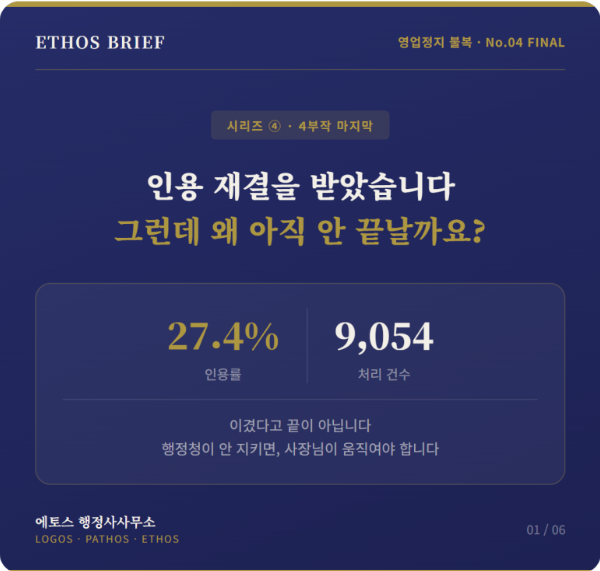
In the first half of 2025, the Central Administrative Appeals Commission recorded an acceptance rate of 27.4% for general cases.
This was an increase of 11.7 percentage points from 15.7% in the same period of the previous year.
In a July 2025 announcement, the Anti-Corruption and Civil Rights Commission stated that it had corrected many dispositions based on inadequate investigations by disposition authorities.
However, receiving an acceptance decision does not mean every case is resolved immediately that day.
For example:
I received a decision revoking the business suspension disposition, but I have not heard anything from the district office.
Or:
I won the administrative appeal, but a few days later I received a new prior notice of disposition with similar content.
Or:
I heard that the business suspension was changed to an administrative surcharge. Does that mean it is just over?
Each situation requires a different response.
Therefore, when you receive the written decision, the first thing to do is not merely to look at the conclusion that you “won,” but to read the order and reasoning of the decision accurately.
When an Acceptance Decision Is Issued, the Administrative Agency Must Follow It
Article 49 of the Administrative Appeals Act provides the binding effect of an acceptance decision.
Simply put, when an acceptance decision is issued, the respondent and related administrative agencies must follow the purport of that decision.
The administrative agency cannot arbitrarily ignore it by saying:
The commission thinks so, but we disagree, so we will proceed with the original disposition.
However, because acceptance decisions can take several forms, the follow-up action required of the administrative agency may differ.
If It Is a Revocation Decision
If the commission decides:
The business suspension disposition issued by the respondent to the claimant is revoked.
then the effect of that disposition must be handled according to the contents of the revocation decision.
The administrative agency must organize the relevant administrative disposition status in line with the purport of the decision.
If part of the business suspension has already been executed, it may also be necessary to separately check what follow-up actions are needed afterward.
If It Is a Modification Decision
The entire disposition may not disappear; its content may be modified.
For example:
Business suspension for 15 days → business suspension for 7 days
In this case, the administrative agency must take follow-up action according to the modified disposition.
Therefore, you must distinguish whether the written decision says “revocation” or “modification.”
If Business Suspension Is Changed to an Administrative Surcharge
Under the Food Sanitation Act, in certain cases, the disposition may be changed so that an administrative surcharge is paid instead of a business suspension.
In this situation, the disposition has not completely disappeared.
The business suspension has been changed into an administrative surcharge disposition.
Therefore, you should not think:
I won the administrative appeal, so I do not need to do anything.
If a notice of administrative surcharge is issued, you must separately check the payment deadline and amount.
What Happens If a Publicly Announced or Notified Disposition Is Revoked?
The Administrative Appeals Act also provides follow-up measures where a disposition that was publicly announced or notified is revoked or modified by a decision.
There may be cases where the administrative agency must publicly announce or notify without delay that the disposition has been revoked or modified by the decision. If the disposition was notified to interested parties, the agency may also need to inform those interested parties of the result of the decision.
In other words, binding effect may not end with simply:
Changing the disposition status in the administrative agency’s internal system.
You must also check how the disposition was externally announced or notified at the time.
Can the Administrative Agency Issue the Same Disposition Again?
This is what many people worry about after winning an administrative appeal.
What if the district office gets upset and issues the same business suspension again?
In principle, due to the binding effect of an acceptance decision, it may not be permissible to repeat the same disposition by relying again on the same reason that was found unlawful in the decision.
In Supreme Court Decision 2002Du3201, decided April 25, 2003, the Court held, in relation to the binding effect of a decision, that it is not permissible to issue the same disposition again based on a reason that has the same basic facts as the reason found unlawful in the decision.
Put simply, it is difficult to repeat:
same facts + same unlawful reason + same disposition
as is.
But there is an important exception.
If the Disposition Was Revoked Due to a Procedural Defect, a New Disposition May Be Issued
Let’s take an example.
A restaurant received a business suspension disposition.
In the administrative appeal, the owner argued:
I did not receive prior notice and had no opportunity to submit opinions.
The commission accepted this argument and revoked the disposition.
From the owner’s perspective, it may feel as if the case is completely over.
However, the administrative agency may now:
- Give prior notice
- Provide an opportunity to submit opinions
- Clearly explain the reason for the disposition
- Issue another business suspension disposition based on the same violation
The Supreme Court has held that where a disposition is revoked due to procedural or formal defects, the administrative agency may correct those procedural or formal defects and issue a new disposition without violating the binding effect.
A representative case is Supreme Court Decision 91Nu5242, decided May 26, 1992.
Therefore, you should not assume:
Since I won once in the administrative appeal, the agency can never issue another disposition on the same issue.
Why the Difference Between Procedural Illegality and Substantive Illegality Matters
This is why it is important from the first administrative appeal to consider the reason for seeking revocation.
Suppose a disposition has the following problems at the same time:
- Prior notice was not given
- What was actually a first violation was calculated as a second violation
- The business suspension period is excessively harsh in light of individual circumstances
These may respectively involve:
- Procedural illegality
- Substantive illegality such as misapplication of disposition standards
- Violation of proportionality or deviation and abuse of discretion
If the disposition is revoked only because of a procedural defect, the administrative agency may have room to supplement the procedure and issue a new disposition.
On the other hand, if the decision finds that the substantive basis of the disposition itself was wrong, it becomes much harder for the agency to issue the same disposition again based on the same facts and same reasons.
Therefore, in an administrative appeal, it is important not merely to:
Find one reason that can win.
but rather to:
Structure all unlawful or unfair grounds that actually exist in the case.
Of course, this does not mean that adding many unsupported arguments is good.
The grounds must be supported by the actual facts and law.
What If the Agency Issues a New Disposition Based on “Different Reasons”?
This is not simple either.
Just because the administrative agency slightly changes the wording of the previous disposition and issues it again does not always mean it is a new disposition.
Conversely, even if the wording is similar, it may be legally based on different facts.
The Supreme Court has held that, when determining whether the basic facts of the disposition reason are the same, one should not look only at the legal label. Instead, one must examine whether the concrete social facts before legal evaluation are basically the same.
A representative case is Supreme Court Decision 2003Du7705, decided December 9, 2005.
Therefore, if the administrative agency issues a new disposition, you should not look only at:
The disposition name is the same.
Instead, you should compare:
- Existing disposition reason
- Part found unlawful in the decision
- New disposition reason
- Legal basis of the new disposition
- Newly added facts
In this process, whether the new disposition violates the binding effect may become an issue.
What If the Administrative Agency Does Not Implement the Acceptance Decision?
Sometimes, even after an acceptance decision is issued, the administrative agency does not take the required action.
The Administrative Appeals Act contains systems to address such situations.
Representative systems include direct disposition and indirect compulsion.
However, these systems are not general follow-up measures that can automatically be used in every revocation appeal case. Their requirements must be accurately checked, especially in situations where the administrative agency must make a certain disposition according to the purport of the decision, such as a disposition-ordering decision.
What Is Direct Disposition?
Article 50 of the Administrative Appeals Act provides that, in certain cases, if the administrative agency does not make the disposition according to the purport of the decision, the commission may order correction, and if the agency still fails to comply, the commission may directly make the disposition.
Simply put, this is a mechanism to address a situation where:
The commission ordered the agency to make a disposition, but the agency does not do it.
However, the commission cannot substitute every administrative act.
Depending on the nature of the disposition and the legal relationship, direct disposition may be impossible.
Therefore, rather than simply approaching it as:
The administrative agency has not contacted me after the acceptance decision, so I should apply for direct disposition under Article 50.
you should first check the type of decision and the specific disposition duty borne by the administrative agency.
What Is Indirect Compulsion?
Article 50-2 of the Administrative Appeals Act provides a system of indirect compulsion where, after certain acceptance decisions, the administrative agency does not make the disposition according to the purport of the decision.
The commission sets a reasonable period and requires performance.
If the administrative agency still does not make the disposition within that period, the commission may order payment of a certain amount according to the delay period, or order immediate payment.
The purpose of indirect compulsion is not simply to pay money to the victim.
It is to pressure the administrative agency to perform its duty according to the purport of the decision through the burden of payment.
A decision of indirect compulsion has strong effect, to the extent that it can be connected to compulsory execution.
However, this is also not automatically available in every revocation decision, so the targets and requirements under Article 50-2 must first be checked.
So You Should Not Think “Wait a Few Weeks After the Acceptance Decision, Then Immediately Apply for Indirect Compulsion”
In practice, it is necessary to check the administrative agency’s follow-up actions.
However, there is no uniform statutory standard such as:
Since 2 or 4 weeks have passed since receiving the decision, I can automatically apply for indirect compulsion.
What matters is:
- What the order of the decision says
- Whether the administrative agency has a separate duty to make a re-disposition
- Whether the reasonable period required by law has passed
- Whether the administrative agency is actually taking no action
Therefore, rather than calculating dates alone, it is important to first check the order of the decision and the legal duty of the administrative agency.
If the Administrative Appeal Is Dismissed, Can You File Another Administrative Appeal?
In principle, this is difficult.
Article 51 of the Administrative Appeals Act provides that once a decision is made on an administrative appeal, another administrative appeal may not be filed against that decision or the same disposition or omission.
In other words, for the same disposition, it is not allowed to repeatedly file appeals by saying:
This time, I will change the arguments a little and file another administrative appeal.
This is the prohibition of repeated administrative appeal.
That is why it is important to structure the issues properly in the first administrative appeal.
If the Appeal Is Dismissed, the Next Step May Be Administrative Litigation
If the administrative appeal is dismissed or rejected, administrative litigation may be considered depending on the case.
In administrative litigation, as a rule, a revocation lawsuit is filed against the original administrative disposition.
This is because Article 19 of the Administrative Litigation Act is based on the principle of original disposition.
However, if the decision itself has unique illegality, a revocation lawsuit against the decision may exceptionally become an issue.
Administrative litigation also has filing periods.
As a rule, a revocation lawsuit must be filed within 90 days from the date the person became aware of the disposition, and if an administrative appeal was pursued, there may be cases where the filing period must be checked based on the date the certified copy of the decision was served.
There is also a one-year limit from the date of the disposition.
Therefore, if the administrative appeal is dismissed, you should not put the decision in a drawer and think about it again months later.
The deadline for the next procedure may begin again.
Three Things to Check First After Receiving an Acceptance Decision
① Read the Order of the Decision Accurately
First, check the order on the first page.
For example, does it say:
The disposition in this case is revoked.
or:
The disposition in this case is changed to business suspension for 7 days.
or:
The business suspension disposition is changed to an administrative surcharge disposition.
What you need to do next differs depending on the wording.
Do not assume that everything has been fully revoked just because you see the word “accepted.”
It may be a partial acceptance or modification decision.
② Check the Administrative Agency’s Follow-Up Action
Next, confirm whether the administrative agency has taken necessary action according to the purport of the decision.
For example:
- Has the disposition status been revoked or changed?
- Has a new disposition notice been issued?
- Has an administrative surcharge notice been issued?
- Has publicly announced administrative disposition information been corrected?
For food sanitation-related administrative dispositions, you may also check, where necessary, how publicly disclosed administrative disposition information has been handled.
However, public pages are only auxiliary confirmation tools. The most important materials are formal administrative documents and the written decision.
③ If a New Disposition Arrives, Compare It With the Existing Decision
If the administrative agency issues a new disposition or prior notice after the decision, you should not immediately conclude:
This violates the binding effect.
or:
It is a new disposition, so there is nothing I can do.
You must compare the following items.
| Existing Case | New Disposition | |---|---| | Existing disposition reason | New disposition reason | | Existing legal basis | New legal basis | | Unlawful grounds recognized in the decision | Content supplemented in the new disposition | | Existing facts | Newly added facts | | Order of the decision | Content of the new disposition |
This comparison is necessary to determine whether it is a re-disposition that violates the binding effect or a lawful new disposition that corrected the procedure.
Check Which Stage Your Situation Is In
If you have received a written decision, it is advisable to check the following:
- Was the decision acceptance, partial acceptance, dismissal, or rejection?
- Does the order involve revocation, modification, or surcharge substitution?
- When did you receive the certified copy of the decision?
- Did the administrative agency send any separate follow-up notice?
- Has part of the business suspension already been executed?
- Has a new disposition or prior notice arrived?
- Is the new disposition reason substantially the same as the existing case?
- Is this a case where the administrative agency must make a separate disposition according to the decision?
- If dismissed or rejected, does the administrative litigation filing period remain?
If any of these points is unclear, the entire written decision should be reviewed again.
Why You Should Not Look Only at the Order in the Written Decision
The first thing to check in a decision is the order.
However, the reasoning is also important for determining the scope of the binding effect.
For example, suppose both cases received the same order:
The business suspension disposition is revoked.
Case A was revoked because:
It is procedurally unlawful because prior notice was not given.
Case B was revoked because:
The claimant’s act does not constitute a violation under the relevant law.
Even though the order is the same, the scope within which the administrative agency may issue another disposition afterward may not be the same.
Therefore, after a decision, you must read:
the order + the reasoning
together.
Acceptance in an Administrative Appeal Does Not Mean All Damages Are Automatically Compensated
One more distinction is necessary.
Even if the business suspension disposition is revoked, the administrative agency does not automatically pay compensation for sales losses that have already occurred.
The core of an administrative appeal is correcting the unlawfulness or unfairness of the administrative disposition itself.
Whether monetary compensation can be received for already incurred losses involves separate legal requirements and procedures.
Therefore, you should not think:
Since I received a decision revoking the business suspension, last month’s sales will also be automatically compensated.
This is why it is important to consider suspension of execution before the business suspension is actually enforced.
When the Case May Need to Move From Administrative Appeal to Administrative Litigation
After the decision, there may be three main directions.
Accepted and the Administrative Agency Properly Implements It
The case can be handled according to the contents of the decision.
Accepted, but the Administrative Agency Does Not Implement It or Issues a Re-Disposition
You must review possible procedures such as binding effect, legality of re-disposition, direct disposition, and indirect compulsion.
Dismissed or Rejected
Rather than filing another administrative appeal against the same disposition, you must review the possibility of administrative litigation and the filing period.
In other words, a decision is not the end. It is a branching point that determines the next procedure.
The Most Important Thing Throughout the Administrative Appeal Process Is Connection
Business suspension cases may seem complicated if each procedure is viewed separately.
But the overall flow is relatively clear.
Check the disposition notice
→ Check the administrative appeal filing period
→ Analyze procedural and substantive issues in the disposition
→ Apply for suspension of execution if necessary
→ File the administrative appeal
→ Check the order and reasoning of the decision
→ Confirm the administrative agency’s follow-up action
→ If necessary, respond to re-disposition, indirect compulsion, or administrative litigation
If one middle step is missed, the options available at the next stage may shrink.
Especially after a decision, instead of thinking:
It was accepted, so it is over.
it is more accurate to regard confirming whether the administrative agency actually implemented the purport of the decision as part of case handling.
Closing
Receiving an acceptance decision in an administrative appeal is an important result.
But receiving the written decision and having the actual problem fully resolved are not the same thing.
An acceptance decision has binding effect, so the administrative agency must follow the purport of the decision.
However, a new disposition correcting procedural defects may still be possible, and there may be cases where you must again judge whether a new disposition violates the binding effect of the existing decision.
If the administrative agency fails to make a disposition it is required to make according to the decision, systems such as direct disposition or indirect compulsion may become relevant depending on the case type.
Conversely, if the administrative appeal was dismissed or rejected, rather than repeatedly filing administrative appeals against the same disposition, you must check administrative litigation and its filing period.
So when you receive a written decision, check these three things first:
First, what exactly does the order say?
Second, why was that decision made?
Third, what did the administrative agency actually do according to that decision?
An administrative appeal does not always end on the day you receive the written decision. In some cases, it ends only after you confirm whether the decision has actually been reflected in administrative practice.