
When Can a Non-Disclosure Decision Be Reversed Through Administrative Appeal?
Hello, this is Jean, a licensed administrative agent.
Many people think information disclosure requests are mainly used by journalists or civic organizations.
But that is no longer the case.
In 2023, the number of information disclosure requests in Korea reached 1.84 million per year, a 70-fold increase since the system was introduced 25 years ago. According to the Ministry of the Interior and Safety, much of this recent growth has been driven by individuals using the system to solve everyday problems, such as insurance claims or preparation for litigation.
(2024 Information Disclosure Annual Report)
The Ministry has even begun classifying these requests separately as information directly related to people’s livelihood.
For example:
- A foreign national whose visa was denied wants to see the review opinion explaining why.
- A business owner whose restaurant permit was rejected wants to check what was insufficient.
- A property owner whose building permit was returned wants to confirm the grounds for rejection.
- A student who failed an exam wants to review the grading criteria.
People file information disclosure requests because they want to understand why something was denied.
But many receive the same answer:
Non-disclosure
In fact, an analysis of information disclosure processing by central government agencies from 2019 to 2023 shows that the tendency toward non-disclosure has become stronger.
(Open Net Korea Information Disclosure Center, 2024.09.05., “The Trap Behind the 94.5% Disclosure Rate: Central Agencies With Rising Non-Disclosure Rates”)
You filed an information disclosure request, and the answer was “non-disclosure.”
You filed an objection, and it was rejected.
The remaining option is administrative appeal.
But can an administrative appeal really reverse the decision?
Many people hesitate at this point.
They may know that something seems wrong with the notice, but they are unsure whether an administrative appeal can actually change the outcome, whether it is worth the time and effort, or whether losing the appeal could make the situation worse.
In short, a dismissed administrative appeal does not make the situation worse.
If the appeal is dismissed, the original non-disclosure decision simply remains in place.
There is no additional penalty for filing the appeal.
You may also challenge the matter again through administrative litigation.
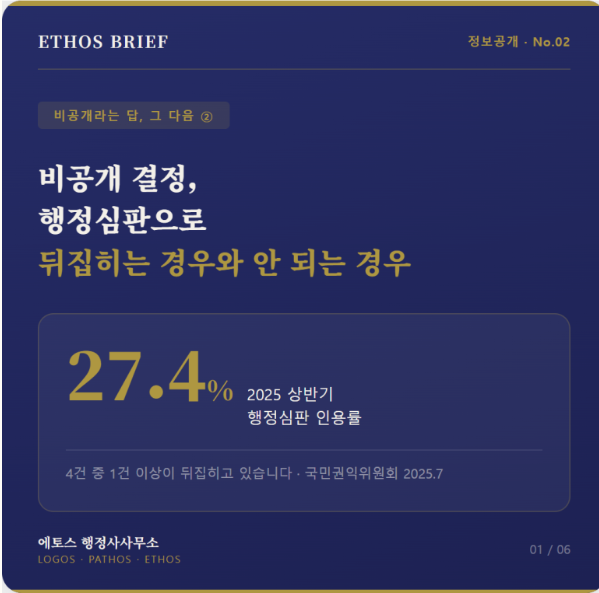
In the first half of 2025, the acceptance rate for general cases before the Central Administrative Appeals Commission was 27.4%, meaning that more than one in four general cases were accepted.
But that number alone does not tell you which side your case falls on.
This article explains the structures in which a non-disclosure decision may be reversed, and the structures in which it is unlikely to be reversed, based on court precedents and administrative appeal decisions.
Reversible Case 1 — Non-Disclosure Without Proof of a “High Probability” of Harm
Let’s look at Alex, who applied for a D-8 investment visa.
Alex deposited KRW 100 million and waited two months, only to receive a denial of visa extension.
To find out why, he filed an information disclosure request for the review opinion.
The response was roughly as follows:
Non-disclosure under Subparagraph 5, as disclosure of matters in the decision-making process may interfere with the fair performance of duties.
But how serious must this “interference with duties” be for non-disclosure to be lawful?
The Supreme Court has set the standard.
It refers to cases where there is a high probability that disclosure would objectively and significantly interfere with the fair performance of duties. Whether this applies must be determined by comparing and balancing the interest in fairness of duty performance protected by non-disclosure against the public’s right to know protected by disclosure.
(Supreme Court Decision 2002Du12946, Aug. 22, 2003, Cancellation of Refusal to Disclose Information)
In other words, it is not enough for the agency to say, “Disclosure would be inconvenient.”
The agency must prove a high probability that disclosure would objectively and significantly interfere with fair duty performance.
It must also explain why that interference outweighs the public’s right to know.
Let’s see how this standard worked in an actual case.
A prosecutor’s office held a dispatch ledger related to psychophysiological examinations, commonly known as lie detector tests.
When an information disclosure request was filed, the prosecution refused disclosure under Subparagraph 5.
The argument was:
Disclosure would interfere with psychophysiological examination duties.
But the Supreme Court disagreed.
It is difficult to find a high probability that disclosure of the dispatch ledger would objectively and significantly interfere with the fair performance of duties.
The Supreme Court found the non-disclosure decision unlawful.
(Supreme Court Decision 2012Du11409, 2012Du11416, Dec. 15, 2016, Cancellation of Refusal to Disclose Information)
The prosecution argued that disclosure would interfere with the examination process, but the Court found that the connection between disclosure of the dispatch record and interference with duties was not specific enough.
Alex’s visa review opinion may follow the same structure.
If the agency only says that disclosure would interfere with review duties, without explaining which duty would be affected and how, this precedent may be relevant.
In particular, if the visa denial decision has already been completed, the requirement that the information be “in the decision-making process” under Subparagraph 5 may itself become questionable.
Take out your notice again.
Does the non-disclosure reason include the phrase “interference with the fair performance of duties”?
Does it explain which duty would be affected and how?
If not, the agency may not yet have proven the required “high probability.”
If you want to check whether your non-disclosure reason satisfies this standard, you may send a photo of the notice for review.
Check the possibility of challenging your non-disclosure decision
Reversible Case 2 — Full Non-Disclosure Without Fulfilling the Duty of Partial Disclosure
Let’s return to Alex’s situation.
The review opinion may state which parts of Alex’s business plan failed to meet the relevant criteria.
At the same time, it may also include the name or contact information of the reviewing officer.
But what if the agency withheld the entire document as one block?
That means it did not separate personal information, such as the officer’s name, from the review opinion that Alex needed to understand.
A similar structure appeared in an actual administrative appeal.
A requester sought information about a transportation company’s accident records, vehicle numbers, corporate registration number, business registration number, and the representative’s name and resident registration number.
The agency refused disclosure of the entire information on the ground of personal information protection under Subparagraph 6.
The Central Administrative Appeals Commission held that the representative’s name, resident registration number, and address were personal information and could properly be withheld.
However, it found that the transportation company name, vehicle numbers, corporate registration number, and business registration number were not likely to significantly interfere with duties if disclosed, and therefore partially accepted the claim.
In other words, only the personal information should have been withheld, while the rest should have been disclosed.
(Anti-Corruption and Civil Rights Commission Decision 2014-10928, Sept. 23, 2014, accepted)
Alex’s review opinion may follow the same pattern.
The reviewing officer’s name may be redacted.
But information such as “which part of the business plan failed to meet which standard” may be separable.
If the agency failed to make this separation and instead issued a full non-disclosure decision, that becomes an issue for administrative appeal.
This issue is not limited to visa cases.
- In restaurant permit review materials, the applicant’s name may be redacted while review criteria may still be disclosed.
- In building permit rejection materials, sensitive information may be redacted while the grounds for rejection may still be disclosed.
- In exam-related materials, third-party personal information may be redacted while grading standards may still be disclosed.
The mere fact that a document contains personal information does not automatically justify full non-disclosure.
If you received a full non-disclosure notice, check this first:
After removing names, resident registration numbers, or other identifying information, is the remaining information still meaningful and disclosable?
If it can be separated, the agency may have failed to comply with its duty of partial disclosure.
Reversible Case 3 — When the Agency Changes the Ground for Non-Disclosure Afterward
When you file an administrative appeal, the agency submits a written response.
In that response, the agency may add a ground for non-disclosure that was not included in the original notice.
For example, the notice may have listed only Subparagraph 5, concerning the decision-making process.
But in the administrative appeal response, the agency may argue:
Actually, it also falls under Subparagraph 7, trade secrets.
Or it may argue:
It also falls under Subparagraph 6, personal information.
Here, two situations must be distinguished.
Situation A — The Agency Changes Grounds Because Its Original Ground Is Weak
Administrative appeal decisions and court precedents place limits on adding new grounds after a disposition.
If the newly added Subparagraph 7 or 8 does not share the same basic factual relationship with the original grounds, such as Subparagraphs 1, 2, or 5, the new ground may not be accepted.
This is because each subparagraph protects a different legal interest.
For example, Subparagraph 5 protects the fair performance of duties.
Subparagraph 7 protects corporate trade secrets.
If the protected interest is different, adding a new ground afterward is similar to changing the legal basis of the disposition.
If the added ground is not accepted, the decision is judged only based on the original ground written in the notice.
If that original ground is weak, the non-disclosure decision may be reversed.
Let’s look at an actual case.
A requester sought disclosure of information related to telecommunications cost data.
The agency disclosed only the total cost amount without sufficient explanation and withheld the rest.
During litigation, the agency newly argued that the withheld information constituted corporate trade secrets under Subparagraph 7.
The Supreme Court held that failure to state the reason for non-disclosure at the time of the decision was itself unlawful, and that raising trade secrets only during litigation was an impermissible addition of a ground lacking the same basic factual relationship.
(Supreme Court Decision 2014Du5477, Apr. 12, 2018, Cancellation of Refusal to Disclose Information)
In simple terms, if the agency did not properly state the reason at the beginning, it is difficult for it to later say, “Actually, it was a trade secret.”
What should have been disclosed at the time of the decision must be stated then, and changing grounds afterward is limited.
The same logic may apply to Alex’s case.
If the notice mentioned only Subparagraph 5, but the agency later argues in the administrative appeal that the information also falls under Subparagraph 6, personal information, the issue becomes whether Subparagraph 5 and Subparagraph 6 share the same basic factual relationship.
Subparagraph 5 protects fairness in administrative duties.
Subparagraph 6 protects personal information.
Because the protected legal interests are different, the added ground may be contested.
However, in 2024, the Supreme Court stated that adding a ground may be allowed if the other party to the disposition expressly consents.
(Supreme Court Decision 2023Du61349, Nov. 28, 2024, Cancellation of Rejection of Building Permit Application)
From the requester’s perspective, this also means that if you do not consent, the traditional limitation on adding new grounds remains important.
Situation B — The Information Actually Falls Under Another Non-Disclosure Ground
Even if the agency did not initially mention Subparagraph 6, the information may actually contain personal information.
In this case, the agency is not simply “switching grounds.”
Rather, the substantive nature of the information may have fallen under Subparagraph 6 from the beginning.
For example, if Alex’s review opinion contains the names or passport numbers of other visa applicants, those parts may fall under Subparagraph 6 whether or not the agency mentioned it initially.
In this situation, the key issue is not necessarily cancellation of the entire non-disclosure decision.
The key issue becomes partial disclosure under Article 14 of the Official Information Disclosure Act.
The logic is to redact the personal information and disclose the review criteria or reasoning.
The duty of partial disclosure discussed above applies again here.
However, if the remaining information becomes meaningless after separation, the result may be different.
For example, suppose the entire review opinion consists of comparative evaluation against other applicants, and once all third-party information is redacted, the context itself disappears.
If the core of the information is inseparably linked with another person’s personal information, partial disclosure may not be enough to obtain the information you want.
Summary
| Situation | Result | |---|---| | The agency changes grounds because the original ground is weak | If there is no same basic factual relationship, the added ground may not be accepted → the original ground is reviewed | | The information actually falls under another ground and can be separated | Partial disclosure under Article 14 → redact what must be redacted and disclose the rest | | The information actually falls under another ground but becomes meaningless after separation | Non-disclosure may be maintained → partial disclosure may have little practical value |
Understanding this structure helps you respond when the agency introduces a new non-disclosure ground in its written response.
The first question is:
Is this a post-hoc change of grounds, or is it a genuine issue about the nature of the information?
Cases Where Reversal Is Difficult
Knowing when a case is unlikely to succeed is just as important.
If you pursue a case that is unlikely to succeed without recognizing the issue, you may spend time and energy without much benefit.
Knowing the limits can save time.
Difficult Case 1 — The Agency Actually Proves a “High Probability” of Harm
This is the opposite of Reversible Case 1.
Let’s look at an actual administrative appeal decision.
In a request for disclosure of a legal advisory report, the Central Administrative Appeals Commission held that the refusal to disclose the information under Subparagraph 5 was not unlawful or improper.
In that case, the agency specifically explained that disclosure of the legal advice would directly affect its strategy in ongoing litigation.
This was not an abstract claim of “interference.”
A high probability of harm in a specific context was recognized.
The same Subparagraph 5 can lead to different outcomes.
The difference is this:
- Prosecutor’s dispatch ledger case: the agency merely claimed that harm would occur → failure to prove → reversal possible
- Legal advisory report case: the agency explained how disclosure would affect ongoing litigation → proof accepted → non-disclosure may be maintained
If the agency’s explanation is abstract, the decision may be reversed. If the explanation is concrete, the decision may be upheld.
That is why results can differ even under the same legal provision.
Difficult Case 2 — Missing the Deadline
This is the most painful case.
If the 90-day period for filing an administrative appeal has passed, the appeal may be dismissed without a review of the merits.
In other words, the substance of the case may never be examined.
Even if the non-disclosure reason is vague, even if the agency failed to consider partial disclosure, and even if the agency’s explanation is abstract, those issues may be difficult to raise once the deadline has passed.
If Alex simply assumed, “They cited Subparagraph 5, so there is nothing I can do,” and let two or three months pass, the opportunity may be lost.
KRW 100 million may remain tied up without him ever learning why the application was denied.
However, if an objection was filed first, the 90-day period may restart from the date of the objection decision.
(Supreme Court Decision 2022Du52980, Jul. 27, 2023, Cancellation of Refusal to Disclose Information)
Because an objection may help secure additional time, filing an objection first can be one strategy if time allows.
The 90-day deadline is difficult to recover once missed.
Check how many days have passed since the non-disclosure decision.
The Core Question That Separates Disclosure From Non-Disclosure
The key issue is simple:
Is the agency’s reason for non-disclosure specific and justified, or not?
This assessment often requires reviewing the original notice.
If you want to assess the agency’s non-disclosure reason, start with the notice itself.
Can I File an Administrative Appeal by Myself?
This is one of the first questions people ask when they are new to administrative appeals.
Can I do it without an attorney?
Yes.
There is no requirement to be represented by an attorney in an administrative appeal.
Once you understand the following three steps, the procedure becomes clearer.
Step 1 — Prepare and Submit the Claim
An administrative appeal can be filed online through the relevant public petition or administrative appeal system.
You do not need to go to court, and there is no filing stamp fee.
The claim should include three main items.
- Content of the disposition: “The non-disclosure decision made by ○○ agency on ○○ date”
- Date you became aware of the disposition: the date you received the notice
- Claim and reasons: “Cancel the non-disclosure decision” plus the reasons why it is unlawful or improper
The reasons are the most important part.
This is where the arguments discussed in this article are used, such as:
- failure to prove a high probability of harm,
- violation of the duty of partial disclosure,
- non-disclosure based only on a general reason,
- limits on changing the grounds for the disposition.
Step 2 — Review the Agency’s Written Response
After the administrative appeal is filed, the agency submits a written response.
At this stage, the agency may add or clarify its non-disclosure grounds.
If you understand the limits on changing grounds after the disposition, you can respond more effectively to the agency’s arguments.
Step 3 — Wait for the Decision
The administrative appeals commission reviews both sides’ arguments and issues a decision.
The statutory period is generally 60 days from the filing date, with a possible 30-day extension.
In practice, it often takes about two to three months.
Administrative appeal has one advantage over administrative litigation.
Administrative litigation mainly reviews whether the decision is unlawful.
Administrative appeal reviews both whether the decision is unlawful and whether it is improper or unreasonable.
This means that even if illegality is not obvious, the appeal may still be accepted if the non-disclosure decision is unreasonable.
You can file an administrative appeal by yourself.
However, how you structure the reasons can affect the result.
Which issue should be raised first, how precedent should be cited, and how to respond to the agency’s written response can make a difference.
This is where review with an administrative agent may be helpful.
Closing
We have reviewed when a non-disclosure decision in an information disclosure case may be challenged through administrative appeal.
The following points depend on the specific facts and should be reviewed together with the notice and the requested information.
- Even under the same Subparagraph 5, whether a “high probability” is recognized depends on the nature of the information.
- Whether to argue for partial disclosure or cancellation of full non-disclosure depends on the notice and the requested information.
- Which issue should be raised first differs from case to case.
- It is also necessary to anticipate what grounds the agency may add in its written response.
- If the 90-day filing period is missed, it may be difficult to receive a review on the merits.
If your case seems to fit one of the “reversible” structures discussed above, send a photo of the notice.
I can help identify which issue may support an administrative appeal and what should be done first within the deadline.