
Disaster Damage Fact-Finding: The Disaster May End, but Proving the Damage Remains
Hello, I’m Sangjin Ji, a Korean Administrative Attorney.
The fire has been extinguished.
The floodwater has receded.
Damaged facilities are beginning to be cleared away.
From the outside, the disaster may appear to be over.
But for those affected, another problem may remain:
How can I show what was actually damaged, and what evidence can prove it?
When a disaster occurs, protecting people and ensuring their safety must come first.
Once the immediate emergency has passed, however, the focus changes. Damage reporting, recovery support, and other administrative procedures may require a much more detailed explanation of what happened.
What existed before the disaster?
Who owned or used it?
What exactly was damaged?
And what records are available to support those facts?
Ultimately, many post-disaster administrative procedures come back to one question:
What happened, and what evidence can show it?
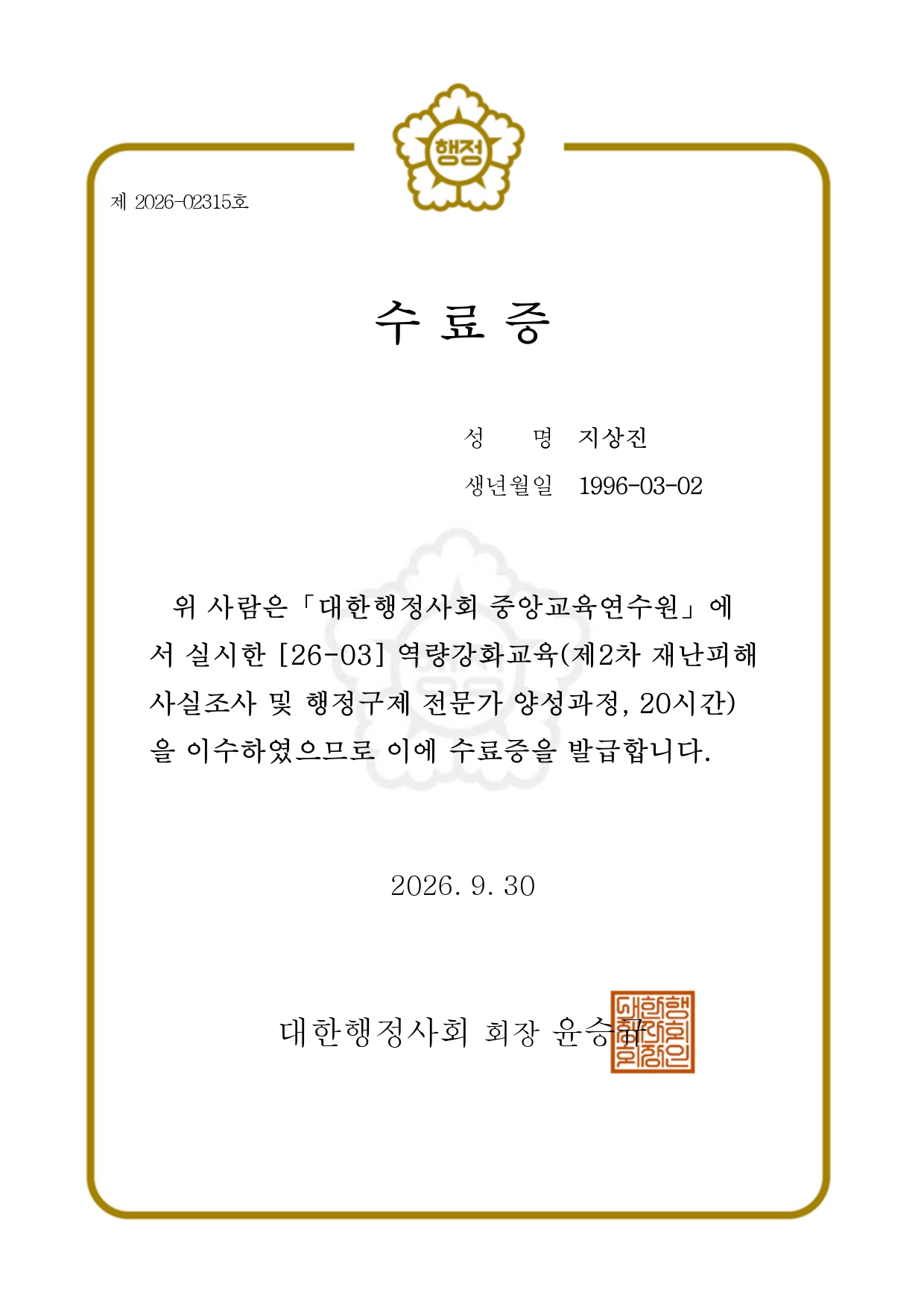
On September 29 and 30, I completed a 20-hour training program titled “The Second Disaster Damage Fact-Finding and Administrative Relief Specialist Training Program” provided by the Central Education and Training Institute of the Korea Association of Administrative Attorneys.
I have continued to study and write about the fact-finding work performed by administrative attorneys. This training gave me an opportunity to examine that work more closely in the context of disaster damage, factual verification, and administrative relief.
Saying “My Restaurant Was Flooded” May Not Be the End of the Process
Consider a restaurant that has been flooded after heavy rainfall.
The refrigerator no longer works.
Kitchen equipment and fixtures have been damaged.
From the owner’s perspective, the loss may seem obvious.
But once the damage must be documented for an administrative procedure, the questions become more specific.
Who owned each facility or item?
Was it actually being used at the premises?
Is there a receipt or payment record showing when it was purchased?
Are there photographs showing its condition before the flood?
Which parts were damaged after the disaster?
The training addressed this type of situation through a practical sequence: reviewing the lease agreement, comparing photographs from before and after the damage with purchase records, preparing an inventory of damaged property and a statement describing the circumstances, and organizing the materials for submission to the relevant local government.
This helps explain what fact-finding actually means.
Fact-finding is not simply about writing down a victim’s statement. It is about organizing different pieces of evidence so that they support the same factual account.
A lease may help establish ownership or use.
A receipt may show that an item was purchased.
Photographs may help establish the condition of property before and after the disaster.
The important point is therefore not simply how many documents exist.
It is what each document proves and how those documents connect to one another.
Records Created Immediately After a Disaster May Become More Important Later
Immediately after a disaster, documentation is rarely the first thing on someone’s mind.
People need to evacuate, extinguish fires, remove water, and deal with damaged property.
But the situation changes once the site has been cleaned up.
If an item has already been discarded or a damaged facility has been demolished, it may become much harder to explain later what originally existed.
That is why preserving records can matter.
The training covered the importance of collecting older photographs, purchase records, and other documentation after fire damage. For snow-related structural damage, it also addressed recording the original structure, size, use, and damaged portions of facilities.
In other words, disaster damage fact-finding does not necessarily begin only after a dispute develops.
It may begin with the records preserved immediately after the disaster.
The Situation Becomes More Complicated When Damage Is Omitted
A more difficult situation arises when an official assessment has already been completed, but the recorded damage does not match what actually existed at the site.
Imagine that a facility was being used before the disaster but was omitted from the initial damage assessment.
From the victim’s perspective, the response may seem simple:
“It was definitely there.”
But an administrative procedure may require more.
Did the facility actually exist?
Who owned or used it?
Was it still in use when the disaster occurred?
What documents, photographs, or other records can establish those facts?
The training also addressed situations in which the initial notice or assessment from an administrative authority must be compared with site records, evidence of ownership or use must be gathered, the factual circumstances must be organized objectively, and materials may then be prepared for an objection or petition.
This is where fact-finding and administrative relief begin to connect.
There is an important difference between saying:
“This is unfair.”
and explaining:
“The initial assessment states A, but the lease, photographs, and other records also support fact B.”
Before an administrative objection can be properly considered, the underlying facts often need to be organized first.
The Role of an Administrative Attorney Is to Connect Facts with Administrative Procedures
An administrative attorney does not resolve every issue that arises from a disaster.
Emergency command, determining the cause of an accident, structural safety assessments, loss adjustment, and litigation each belong to other authorities or licensed professional fields.
Likewise, an official disaster damage investigation conducted on behalf of a local government is different from independently entering a disaster site and conducting an official assessment. Where a public authority formally commissions an investigation, the scope, standards, and reporting structure of that commission must be followed.
The role of an administrative attorney in disaster-related fact-finding is therefore not to make every technical or legal determination.
It is closer to reviewing the available records, organizing the factual circumstances, preparing relevant administrative documents, and connecting those facts to the appropriate administrative procedure.
Knowing the boundaries is part of the work.
It is more important to understand what can properly be verified and organized through administrative fact-finding, and where another professional’s expertise is required, than to claim that one profession can handle every aspect of a disaster.
What Can a Victim Prepare on Their Own?
If the damage is relatively straightforward and sufficient documentation remains available, there are several things a victim can begin organizing without professional assistance.
Once it is safe to do so, photograph or record the damaged site from multiple angles.
Locate any photographs showing the condition of the property before the disaster.
Collect relevant lease agreements, purchase receipts, bank transfer records, and other documents in one place.
It is also useful to prepare a simple list of damaged facilities, equipment, and property rather than relying entirely on memory.
These are matters that many victims can initially handle themselves.
A more structured review may become necessary, however, where:
- significant evidence has been lost;
- the owner and actual user of the damaged property are different;
- several parties have overlapping interests;
- the administrative authority’s findings do not match the actual damage;
- facilities or property were omitted from an assessment; or
- an objection or petition regarding omitted damage needs to be considered.
In these situations, the issue is no longer simply collecting more documents.
The important questions become which document proves which fact, whether the evidence is internally consistent, and how the factual circumstances should be presented to the relevant administrative authority.
After the Disaster, the Record Remains
This training gave me an opportunity to examine the fact-finding work I have been studying from another perspective: disaster damage and administrative relief.
A disaster may eventually end.
But the administrative process that follows often depends on the record that remains.
What happened.
What was damaged.
And what evidence can explain it.
If you are unsure how photographs, contracts, receipts, and other records in your possession can be organized to explain the damage, or whether your situation falls within the scope of administrative fact-finding and document preparation, you can request a free preliminary review to confirm what may be possible in your case.