
Before Foreigners Acquire Korean Real Estate or Land: Check Whether It Is a Report, Permit, or Covered by Real Estate Transaction Reporting
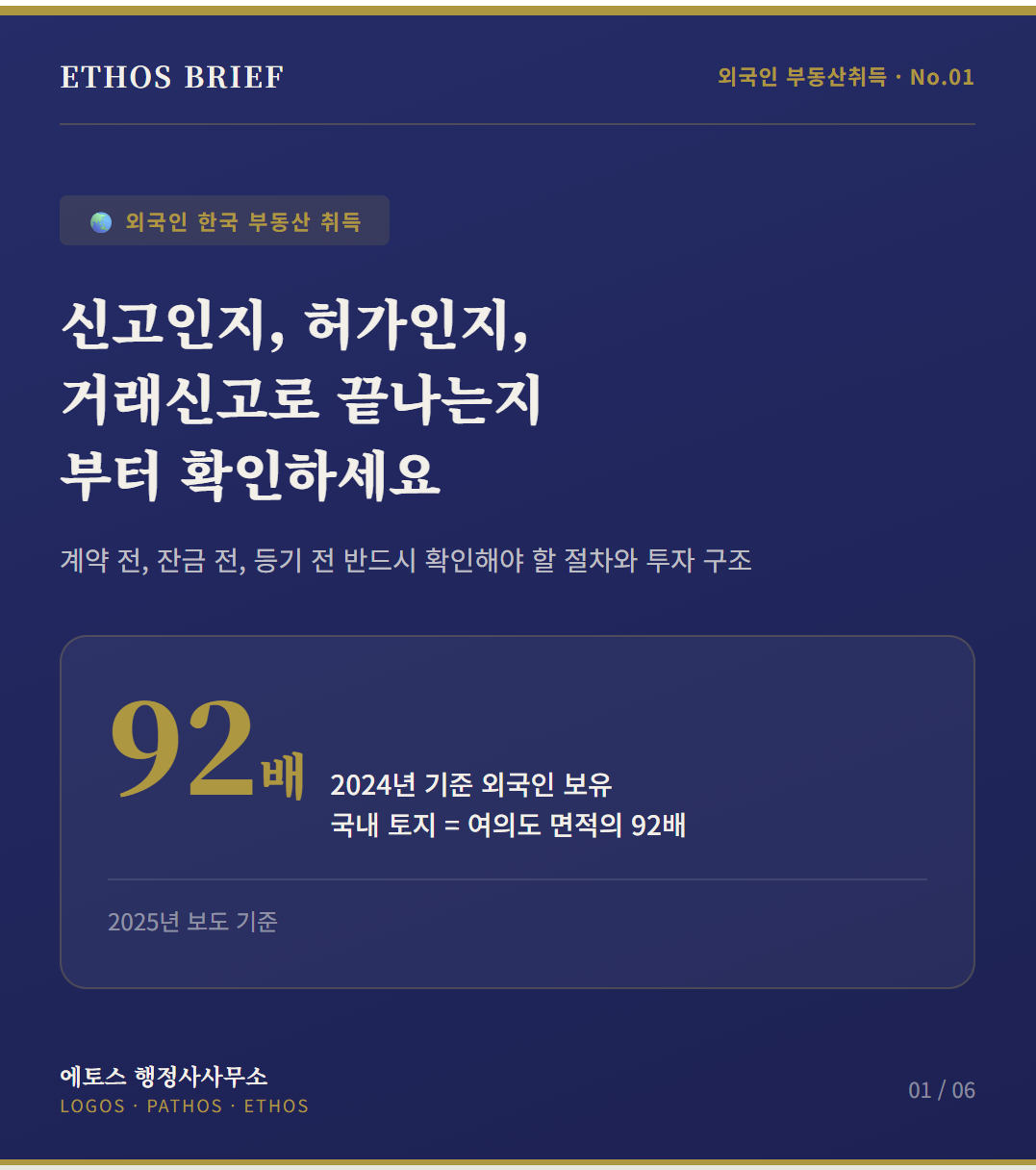
According to 2025 media reports, as of 2024, land held by foreigners in Korea reached an area equivalent to 92 times the size of Yeouido, and foreign-owned housing exceeded 100,000 units for the first time.
As foreign acquisition of Korean real estate increases, similar questions often arise in consultations.
“Can foreigners buy Korean land?”
“Is signing the contract enough?”
“Do I need to file a separate foreign land acquisition report?”
“What happens if the land is in a permit-required area?”
“Should we acquire under an individual foreigner’s name, a foreign corporation, or a Korean corporation?”
The key issue is not whether foreigners can buy Korean real estate.
The more important question is:
“Is this transaction subject to reporting, subject to permit, already covered by real estate transaction reporting, and what acquisition name and structure should be used?”
Foreign land acquisition in Korea cannot be handled by simply memorizing that “all foreigners must report.”
The current system operates under the Act on Report on Real Estate Transactions, Etc., which incorporated the previous foreign land acquisition framework.
Therefore, before preparing the contract, the following should be organized:
- Whether the acquirer qualifies as a foreigner or foreign entity
- Whether the target is land, building, or other real estate rights
- Whether the acquisition cause is a contract, such as sale or gift
- Whether it is a non-contract cause, such as inheritance, auction, court judgment, or merger
- Whether the land is in a permit-required area
- Whether it is in a land transaction permit zone
- Whether ordinary real estate transaction reporting will be filed
- Whether a separate foreign real estate acquisition report is required
- Whether acquisition will be under an individual foreigner, foreign corporation, or Korean corporation
- Whether leasing, development, business operation, or visa issues are connected after acquisition
This article summarizes the reporting, permit, and investment-structure issues foreign individuals, foreign corporations, and foreign-invested companies should check before signing, before payment, and before registration.
Bottom Line: Foreign Real Estate Acquisition Starts With Land Location and Acquisition Cause
The riskiest order is:
- Find the property
- Sign the sale contract first
- Prepare payment
- Check reporting or permit issues right before registration
This is risky.
If the land is in a permit-required area, permit may be required before signing the contract, not after signing.
A safer order is:
- Confirm the acquirer’s status
- Confirm the target real estate
- Check land location and applicable zones
- Confirm acquisition cause
- Check permit-required area status
- Check land transaction permit zone status
- Check ordinary real estate transaction reporting status
- Determine whether separate foreign real estate acquisition reporting is required
- Review acquisition name and investment structure
- Sign the contract
- Proceed with reporting or permit procedure
- Complete payment, registration, tax, foreign exchange, and follow-up procedures
The key point is simple.
Before the contract, foreign real estate acquisition should start with land location, acquisition cause, and acquisition name.
What Legal Framework Applies to Foreign Land Acquisition?
Current practice centers on the Act on Report on Real Estate Transactions, Etc.
This law covers ordinary real estate transaction reporting, reporting of foreign real estate acquisition and continued holding, permits for foreign land acquisition, and land transaction permit zones.
In other words, it is not appropriate to treat the old Foreigners’ Land Acquisition Act and ordinary real estate transaction reporting as separate systems.
Foreign real estate acquisition is usually divided as follows:
| Category | Examples | Deadline or Timing | Key Point | |---|---|---|---| | Acquisition by contract | Sale, gift, etc. | Within 60 days from contract date | Check overlap with ordinary transaction reporting | | Acquisition by non-contract cause | Inheritance, auction, redemption right, final court judgment, corporate merger, etc. | Within 6 months from acquisition date | Do not calculate like a sale contract | | Land in permit-required area | Military facility protection zone, cultural heritage protection zone, ecological and landscape conservation area, etc. | Permit before contract | Prior permit, not post-contract supplementation | | Transaction report already filed | Real estate transaction report under Article 3 | Separate report may be unnecessary | Avoid duplicate reporting misunderstanding | | Continued holding report | Korean national or entity becomes foreign and continues holding | Within 6 months from status change | Check nationality or entity status change |
The table may look simple, but many mistakes occur at the first step.
People often assume, “The buyer is foreign, so we just report,” without separating acquisition cause and land location.
If a Transaction Report Was Filed, Is a Separate Foreign Land Report Needed?
In short, if real estate transaction reporting has already been filed, a separate foreign real estate acquisition report may not be required in some cases.
Local government guidance also explains that if a transaction report under Article 3 of the Act on Report on Real Estate Transactions, Etc. has been filed, a separate foreign real estate acquisition report may not be necessary.
However, three points often cause confusion.
1. Ordinary Sale, but Duplicate Reporting Is Feared
If an ordinary real estate transaction report has already been filed through a broker, parties may still think a separate report is needed simply because the buyer is foreign.
In such cases, duplicate reporting may not be necessary, so first check whether transaction reporting has been completed.
2. Non-Contract Acquisition Treated Like a Sale
Inheritance, auction, final court judgment, and corporate merger differ from sale contracts.
These are often treated under a 6-month-from-acquisition reporting structure.
If you think only in terms of 60 days from contract date, the deadline may be calculated incorrectly.
3. Permit-Required Area Mistaken for a Report Case
This is the most dangerous category.
If the land is in a permit-required area, permit may be required before contract.
In that case, the approach “sign first and report within 60 days” does not work.
Permit-Required Areas Are Completely Different From Reports
If land to be acquired by a foreigner is located in certain areas, permit from the competent reporting authority may be required before entering into the land acquisition contract.
Representative areas include:
- Military base and military facility protection zones
- Designated cultural heritage and its protected objects or protection zones
- Ecological and landscape conservation areas
- Special wildlife protection zones
The key here is permit before contract.
A report usually informs the authority of an acquisition or contract within a certain period.
A permit requires approval from the authority before signing the contract.
Therefore, the following order is risky in a permit-required area:
Contract signing
→ Payment preparation
→ Registration preparation
→ Late discovery of permit-required status
If the land is in a permit-required area, the validity of the contract itself may become an issue.
For foreign land acquisition, the first item to check is not price, but land location.
The Acquisition Name Matters: Individual Foreigner, Foreign Corporation, or Korean Corporation
Foreign real estate acquisition is not just about whose name appears on the contract.
Reporting, permits, tax, foreign exchange transfers, investment reporting, and future leasing or development plans may differ depending on whether the property is acquired under:
- An individual foreigner’s name
- A foreign corporation’s name
- A Korean corporation established for the acquisition
For example, if a foreigner plans to operate a business in Korea, real estate acquisition may connect with:
- Korean corporation establishment
- Foreign investment reporting
- Business registration
- Representative’s visa status
- Leasing or development permits
- Foreign exchange transfer
- Acquisition tax and holding tax
- Registration procedure
By contrast, if the purpose is simple residential acquisition, foreign acquisition reporting, transaction reporting, registration, and tax issues may be central.
Before signing, the following questions should be organized:
- Will the acquisition be under an individual foreigner’s name?
- Will it be under a foreign corporation?
- Will a Korean corporation be established for the acquisition?
- Will the property be leased, developed, or used for business?
- Is foreign investment reporting or corporation establishment required?
- Is the representative’s or investor’s visa status connected?
- How will fund transfer and source-of-funds documents be prepared?
If the name structure is chosen incorrectly, the issue can later expand beyond real estate into tax, foreign exchange, corporate, and visa matters.
Contracts Should Reflect Reporting and Permit Risk
If permit-required area status or land transaction permit zone status is uncertain, the risk should be reflected at the contract stage.
In particular, if prior permit is required, signing before permit may itself create a problem.
If permit requirements are uncertain, the parties should organize how to handle deposit, payment date, termination if permit is denied, cooperation with documents, and deadline for confirming with the authority.
Items to review include:
- Condition for confirming whether permit or report is required
- Termination possibility if permit is denied
- Deposit refund conditions
- Seller’s obligation to cooperate with documents
- Relationship between payment date and permit processing period
- Possibility of submitting land use plan if in a land transaction permit zone
- Coordination with foreign investment or corporation establishment procedures
- Coordination between foreign exchange transfer and payment schedule
- Confirmation of report or permit completion before registration
In foreign real estate acquisition, the contract can be more than a document of sale terms.
It can also be a tool for managing regulatory risk.
Middle East and Overseas Investors Should Not Review Real Estate in Isolation
When Middle East investors or overseas companies acquire Korean real estate, the matter should not be reviewed only as a real estate report or permit.
The structure may also involve whether to establish a Korean branch or corporation, whether foreign investment reporting is required, whether a representative visa is needed, and whether the property will be used for leasing, development, or business operations.
For example, if a Middle East company plans to acquire an office, warehouse, lodging facility, or commercial facility in Korea, the following may need review together:
- Foreign real estate acquisition report
- Foreign land acquisition permit-required area status
- Land transaction permit zone status
- Foreign investment reporting
- Korean corporation establishment
- Business registration
- Real estate use and related permits
- Visa status for representative or employees
- Follow-up administrative procedures for leasing, development, or operation
- Arabic or English document translation and certification
- Overseas remittance and source-of-funds documentation
Ethos Administrative Office does not view foreign real estate acquisition as mere report filing.
We review it together with investment structure, stay status, and business operation.
7 Things Foreign Buyers Should Check Before Acquisition
Before a foreigner acquires Korean real estate, the following seven items should be checked.
1. Whether the Acquirer Qualifies as a Foreigner or Foreign Entity
Not only individual foreigners, but also foreign corporations, foreign governments, and certain companies with foreign ownership may need review.
The applicant’s status and corporate structure should be checked first.
2. What Is Being Acquired
The procedure may differ depending on whether the target is land, building, land and building together, or a share.
If land is included, location and zone review become especially important.
3. Whether the Acquisition Cause Is Contract or Non-Contract
Sale and gift may be contract acquisitions.
Inheritance, auction, final court judgment, corporate merger, and new building construction may be non-contract causes.
Reporting deadlines differ by acquisition cause.
4. Whether Real Estate Transaction Reporting Has Already Been Filed
In ordinary sale transactions, if real estate transaction reporting has already been filed, a separate foreign acquisition report may not be required in some cases.
Before worrying about duplicate reporting, first check transaction reporting status.
5. Whether the Land Is in a Permit-Required Area
Military facility protection zones, cultural heritage protection zones, ecological and landscape conservation areas, and special wildlife protection zones may require prior permit.
Land use planning confirmation documents should be checked.
6. Whether It Is in a Land Transaction Permit Zone
Separate from foreign land acquisition permits, the ordinary land transaction permit zone system may also apply.
If the land is in such a zone, permit may be needed regardless of whether the buyer is foreign or Korean.
7. Whether Registration, Tax, and Source of Funds Are Connected
Foreign real estate acquisition does not end with reporting or permit.
Registration, acquisition tax, source of funds, foreign exchange transfer, corporate investment structure, and leasing plans may all connect.
Common Mistakes
1. Thinking “Foreigners Always Need a Separate Report”
If ordinary real estate transaction reporting has already been filed, a separate foreign real estate acquisition report may not be required.
Duplicate reporting should be checked first.
2. Not Separating Contract and Non-Contract Acquisitions
Sale and inheritance are different.
Sale may involve 60 days from contract date, while inheritance and other non-contract causes may involve 6 months from acquisition date.
3. Checking Permit-Required Areas Too Late
Permit-required areas require prior permit.
This may not be something that can be fixed by a post-contract report.
4. Not Separately Checking Land Transaction Permit Zones
Even if foreign land acquisition permit does not apply, an ordinary land transaction permit zone may create a separate permit issue.
5. Looking Only at the Real Estate and Not the Investment Structure
Tax, registration, investment reporting, and foreign exchange procedures may differ depending on whether acquisition is under an individual foreigner, foreign corporation, or Korean corporation.
Foreign Real Estate Acquisition Checklist
If three or more of the following are unclear, review is recommended before signing:
- You are not sure whether the acquirer qualifies as a foreigner or foreign entity.
- You have not organized whether the acquisition is land only or includes buildings.
- You are unsure whether the acquisition cause is sale, gift, inheritance, or auction.
- You do not know whether real estate transaction reporting will already be filed.
- You do not know whether a separate foreign real estate acquisition report is required.
- You have not checked whether the land is in a military facility protection zone.
- You have not checked cultural heritage protection zone or ecological and landscape conservation area status.
- You have not checked land transaction permit zone status.
- You do not know whether permit is required before contract.
- You plan to acquire under a foreign corporation’s name.
- You have not decided whether to acquire through a Korean corporation or individual name.
- You plan to lease, develop, or operate a business after acquisition.
- You do not know whether foreign investment reporting or corporation establishment is required.
- You do not know whether the representative’s or investor’s visa status is connected.
- Foreign exchange transfer, source of funds, and tax issues have not been reviewed.
- The contract does not address termination or deposit refund if permit is denied.
Foreign real estate acquisition is much safer before signing than after signing.
After contract execution, the options become narrower.
Frequently Asked Questions
Q. Can foreigners acquire Korean land?
In many cases, yes.
However, reporting or permit procedures may be required depending on land location, acquisition cause, and permit-required area status.
Q. If a foreigner buys an apartment, is a foreign land report needed?
It depends.
If ordinary real estate transaction reporting has been filed, a separate foreign real estate acquisition report may not be needed in some cases.
However, you should check whether land share is included, whether transaction reporting has been filed, and what the acquisition cause is.
Q. When should a sale contract acquisition be reported?
If a foreigner acquires real estate by contract and a separate report is required, the general structure is reporting within 60 days from the contract date.
However, if real estate transaction reporting has been filed, duplicate reporting may not be required.
Q. Is reporting required if land is acquired by inheritance?
For acquisitions by non-contract causes such as inheritance, auction, or final court judgment, reporting within 6 months from acquisition date may become an issue.
The deadline differs from sale contracts.
Q. If the land is in a permit-required area, can I sign first and report later?
No.
If land is in a permit-required area, permit may be required before contract.
The key is pre-contract confirmation, not post-contract supplementation.
Q. Are land transaction permit zones and foreign land acquisition permit areas the same?
No.
Land transaction permit zones may apply regardless of whether the buyer is foreign, while foreign land acquisition permit areas are a separate restriction system.
Both should be checked.
Q. Are procedures the same when a foreign corporation acquires Korean land?
The basic issues still need review: whether the acquirer is a foreign entity, what is being acquired, what the acquisition cause is, and whether the land is in a permit-required area.
However, foreign corporations, Korean corporations, and foreign-invested company structures may add investment reporting, foreign exchange, tax, and registration issues.
Q. Can Korean real estate acquisition connect with visa or corporation establishment?
Yes.
If the property will be merely held, used as a business site, leased, or developed, the structure may connect with corporation establishment, foreign investment reporting, business registration, and representative visa status.
When a Pre-Contract First Review Is Needed
Ethos Administrative Office does not treat foreign real estate acquisition as simply “file a report.”
Based on the current property and acquisition structure, we review:
- Whether the acquirer qualifies as a foreigner or foreign entity
- Whether the target is land, building, or real estate rights
- Whether the acquisition cause is contract or non-contract
- Whether real estate transaction reporting covers the case
- Whether a separate foreign real estate acquisition report is required
- Whether the land is in a permit-required area
- Whether it is in a land transaction permit zone
- Whether permit is required before contract
- Which acquisition name is appropriate: individual foreigner, foreign corporation, or Korean corporation
- Whether a foreign corporation or foreign-invested company structure is involved
- Whether leasing, development, or business operation is connected
- Whether visa, business registration, corporation establishment, or foreign investment reporting is also needed
- In what order to contact or file with the city, county, or district office
Foreign real estate acquisition should begin with land location and acquisition cause before the contract.
If you are reviewing land or real estate in Korea, check reporting and permit feasibility and acquisition structure before signing.
For consultation, please contact us through the consultation channel.
How Ethos Administrative Office Can Help
Ethos Administrative Office helps foreign individuals, foreign corporations, and foreign-invested companies review administrative procedures related to Korean real estate acquisition.
We can assist with matters such as:
- Review of whether foreign real estate acquisition reporting is required
- Review of foreign land acquisition permit-required areas
- Review of overlap between real estate transaction reporting and foreign acquisition reporting
- Deadline review for contract and non-contract acquisitions
- Reporting procedures for inheritance, auction, judgment, and corporate merger acquisitions
- Land transaction permit zone review
- Real estate acquisition structure review for foreign corporations or foreign-invested companies
- Connection with foreign investment reporting, Korean corporation establishment, and business registration
- Administrative procedure review for Middle East and overseas investors acquiring Korean real estate
- Connection between representative or employee visa status and acquisition structure
- Arabic and English document translation and certification procedure review
- Preparation of documents for city, county, or district office filing
- Proxy filing and related document preparation
Foreign real estate acquisition may not end with signing the contract.
Whether the case is a report, permit, covered by transaction reporting, requires pre-contract permit, or involves a specific acquisition name can completely change the process.
Ethos Administrative Office can help organize foreign land acquisition reports, permits, and required administrative documents.
For consultation, please contact us through the consultation channel.
References
- YTN: Foreign-Held Land in Korea Increased 20% in Four Years, 92 Times the Size of Yeouido
- Korea Law Information Center: Act on Report on Real Estate Transactions, Etc.
- Easy Law: Real Estate Transactions by Foreign-National Koreans
- Yongin Cheoin-gu: Foreign Real Estate Acquisition Report Guide
- Songpa-gu Office: Foreign Real Estate Acquisition, Continued Holding Report, and Permit Application Guide