
Starting an Airbnb in Korea — What Happens If You Do Not File the Required Registration?
Hello, this is Administrative Agent Jean.
If you watch overseas travel YouTubers, you often see them booking and staying at Airbnbs.
Watching that, many people think, “Could I use an empty room and start an Airbnb business too?”
And when people hear that many hosts earn more than KRW 1 million a month, it feels like an opportunity worth trying.
You finish planning the interior, choose furniture, and go to Hometax thinking that business registration is all you need.
Business registration takes about ten minutes.
But six months after you start receiving guests, the district office conducts an on-site inspection.
The result is detection as an unreported lodging business.
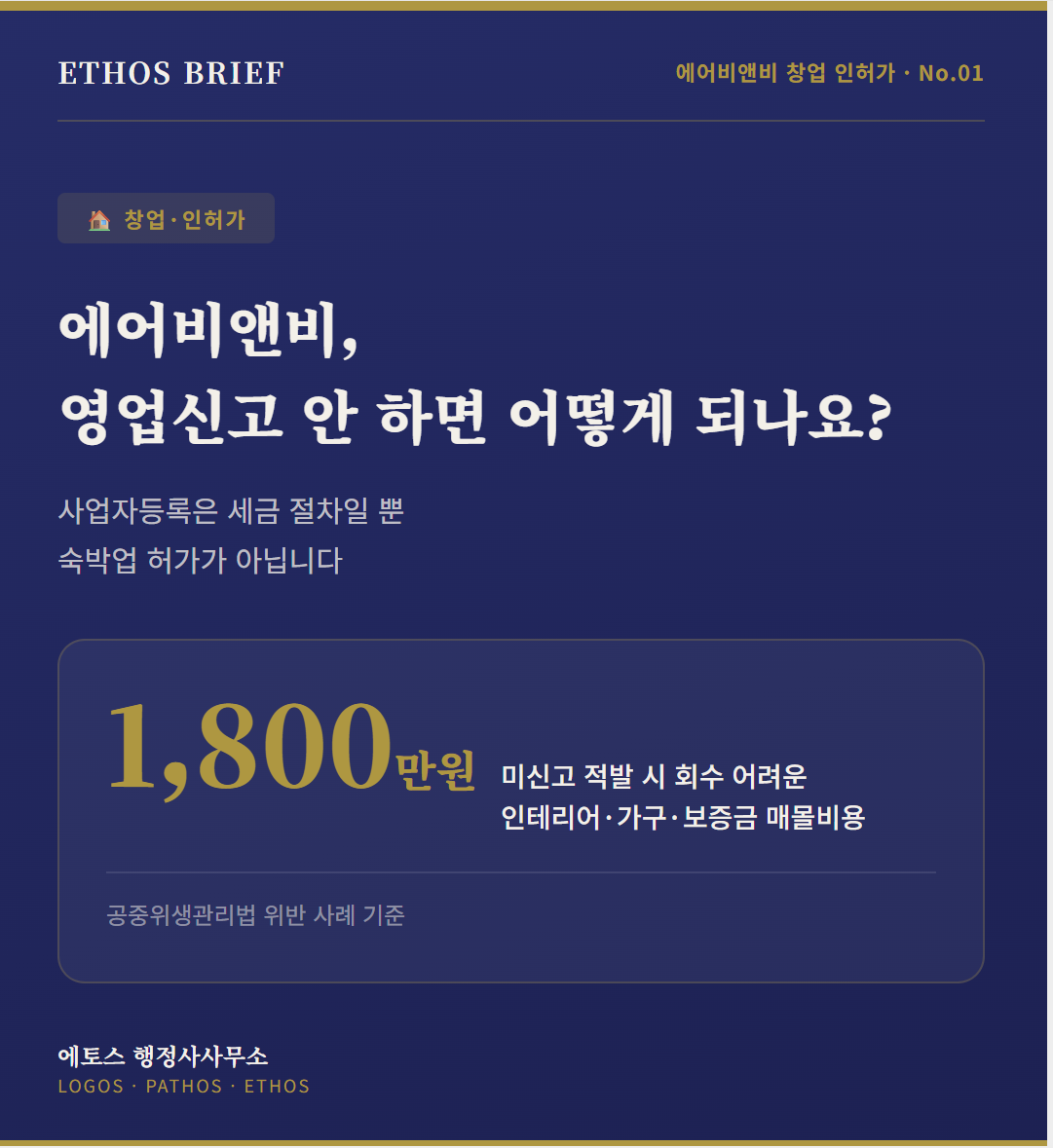
Interior work: KRW 5 million.
Furniture and appliances: KRW 3 million.
Deposit: KRW 10 million.
The KRW 18 million already spent may not be recoverable. The fine is separate.
Your listing may be removed from Airbnb, and re-registration at the same address may become difficult. Revenue drops to zero, your investment is stuck, and penalties go out separately.
This series explains how to avoid that situation and legally operate Airbnb-style accommodation in Korea.
- What happens if you do not file the required lodging registration? ← This article
- Did you know Airbnb in an officetel can be illegal?
- If a foreign national wants to host, the visa must be checked first
In this first article, we will look at how Airbnb-style accommodation can be registered and operated legally in Korea.
Isn’t Business Registration Enough?
If you are thinking this, you may be reading this article at exactly the right moment.
You may have already completed business registration, uploaded photos to Airbnb, and be just about to receive reservations. Or you may already be receiving them.
But business registration is a tax procedure handled by the tax office.
It is not permission to operate lodging.
To operate lodging, you may need to separately register or report the business with the relevant district office before or in connection with tax office business registration.
In Korea, ordinary Airbnb-style shared accommodation is generally reviewed under the structure of foreign tourist urban homestay, which is aimed at foreign tourists.
Domestic guest accommodation is not automatically allowed simply because you have foreign tourist urban homestay registration. Domestic shared accommodation must be separately reviewed under special systems, pilot programs, or future legal changes.
The basic order is therefore:
- Foreign tourist urban homestay registration
District office, Tourism Promotion Act - Tax office business registration
- Listing registration on Airbnb or another platform
Business registration is not the first thing to rely on.
The first step is checking whether the accommodation structure is legally possible.
Why Does the Tourism Promotion Act Apply?
“I am just renting out one room. Is that really tourism business?”
You may think that.
The Enforcement Decree of the Tourism Promotion Act treats foreign tourist urban homestay as a type of tourist accommodation-related business.
The core idea is this:
A resident in an urban area uses the house where they live to provide suitable facilities and accommodation so that foreign tourists can experience Korean home culture.
So the moment you provide accommodation to foreign tourists through Airbnb, this structure may apply.
It does not matter whether you rent out one room or the entire home.
If you provide lodging to foreign tourists, you must first check whether tourism business registration applies.
The law becomes a little complex here.
If foreign tourist urban homestay registration is properly completed, the business may be excluded from ordinary lodging business reporting under the Public Health Control Act.
But if you operate without registration, you do not satisfy the exclusion condition. The activity may then be treated as an unreported lodging business under the Public Health Control Act.
Many actual unregistered Airbnb cases are handled as Public Health Control Act violations. Seoul’s enforcement against unreported lodging businesses and Jeju single-family-house Airbnb cases are examples of this structure.
In one sentence:
What you should do: register as a foreign tourist urban homestay under the Tourism Promotion Act.
What you risk if you do not: unreported lodging business under the Public Health Control Act.
Both laws work together.
What Do You Actually Lose If You Do Not Register?
“Isn’t it just a small administrative fine?”
You might think so.
But it may not be just an administrative fine.
Operating lodging without the required report under the Public Health Control Act can lead to criminal penalties. Imprisonment for up to two years or a fine of up to KRW 20 million may apply.
In other words, this can be a criminal issue.
Administrative measures and criminal procedures may proceed at the same time.
For example:
- Interior work: KRW 5 million
- Furniture and appliances: KRW 3 million
- Deposit: KRW 10 million
- Monthly revenue: KRW 800,000
If you are detected while operating in that condition, business suspension, listing removal, penalties, and re-registration problems may come all at once.
The KRW 18 million already spent may be hard to recover, revenue stops, and penalties are paid separately.
There are actual cases where people who operated unreported lodging hundreds of times through accommodation-sharing platforms received criminal fines.
Airbnb looks like a platform business, but legally it is a lodging structure.
That is why registration feasibility must be checked before starting.
What Legal Routes Are Available?
In Korea, there are roughly three legal routes for providing Airbnb-style or shared accommodation.
Route 1. Foreign Tourist Urban Homestay
This is the first route most Airbnb hosts consider.
It is a structure where the host receives foreign tourists in the house where the host actually lives. If the requirements are met, the registration process can be relatively straightforward.
However, it does not freely allow domestic guests.
Route 2. General Lodging Business
This route can accommodate both Korean and foreign guests.
It can also be listed on Airbnb or similar platforms.
However, the building use must be lodging facility, and the facility standards are much stricter. It is not easily available for ordinary houses, apartments, or officetels.
Route 3. Regulatory Sandbox Pilot Program
Through certain platforms, shared accommodation for domestic guests has been allowed in certain regions, within limited days and under limited conditions.
But this is not the same as a fully general legal system.
You must check the region, platform, period, number of hosts, and annual operating day limits.
Which route is possible is first determined by one document: the building register.
Go to Government24 and check the building register.
The first key point is what appears in the “use” section.
Misunderstanding 1. What About Officetels?
Many people think an empty investment officetel could generate income through Airbnb.
The short answer is that foreign tourist urban homestay registration is generally difficult.
Foreign tourist urban homestay is based on the use of a house where an urban resident lives.
But officetels are often classified as business facilities under the Building Act. Because they are not houses, foreign tourist urban homestay registration is difficult.
Many people do not know this and buy an officetel with a tenant deposit structure.
They renovate it, upload photos, and start receiving reservations.
After about six months of smooth operation, the district office conducts an inspection.
If detected, the money already spent on interior work, furniture, appliances, and deposit becomes hard to recover. A fine may also follow.
“Then can’t I just change the building use?”
Changing the use of an officetel is often practically difficult because fire safety, parking, floor-area ratio, building use, and management rules are all connected.
Check the building register.
If the use is listed as business facility, proceeding as a foreign tourist urban homestay is generally difficult.
Misunderstanding 2. Can I Start in an Apartment Without Resident Consent?
If the building register confirms that the use is residential, the next thing to check is the management rules.
For apartments, row houses, and multi-family housing, management rules and resident consent can become important at the registration stage.
In some rejected foreign tourist urban homestay applications, failure to check management rules or obtain resident consent becomes a problem.
If the management rules prohibit lodging, homestay, or similar use, the district office may reject the registration application.
For multi-unit housing, at least the following should be checked:
- Whether the management rules prohibit homestay or lodging business
- Whether consent from residents or management is required
- What scope of household consent is required
- Whether adjacent household consent is required
- Whether the district office has a required consent form
This is a problem because most people have never actually read the management rules.
If you skip this step, finish renovation, and then get rejected at registration, the interior cost becomes sunk cost.
Check now.
Call the management office and ask:
“Do the management rules restrict homestay or lodging business?”
Misunderstanding 3. Foreign Hosts Must Check Visa Status
If a foreign national living in Korea wants to host on Airbnb, visa status must be checked before registration.
If the status of stay does not match the actual profit-making activity, problems can arise.
For example, if someone staying in Korea on a D-2 student visa earns income from Airbnb without permission, this may be considered activity outside the permitted status of stay.
Earning lodging income without proper authorization can lead to Immigration Act issues.
If the visa and business activity do not match, the person’s stay in Korea may be affected before the lodging registration issue is even resolved.
Foreign hosts should first check:
- Current status of stay
- Whether lodging or tourism business activity is allowed under that status
- Whether permission for activity outside the status of stay is required
- Whether business registration conflicts with the visa
- How tax reporting should be handled once revenue is generated
For foreign nationals, whether business registration is possible and whether the activity is permitted under the visa must be reviewed separately.
Check Your Current Situation
As you read this, you may be asking, “Where does my situation fall?”
Compare your situation with the list below.
- You completed business registration but have not registered as a foreign tourist urban homestay.
- You are operating or planning Airbnb in an officetel.
- You have never checked the building use on the building register.
- You are in an apartment, row house, or multi-family home but have not checked the management rules.
- You registered as a foreign tourist urban homestay but also receive domestic guests.
- You are a foreign national earning lodging income without permission for activity outside your status of stay.
- You have not installed fire or safety facilities.
- You are trying to list on Airbnb without submitting a registration certificate.
If even one applies, start by checking one screenshot of the building register.
With the building register alone, you can begin to see whether registration is possible and which route should be considered.
For shared accommodation permits, one screenshot of the building register is enough to start the review.
Let’s Check the Registration Procedure
Based on the Tourism Promotion Act enforcement rules and practical registration requirements for foreign tourist urban homestay, the following steps are generally reviewed.
Step 1. Check the Building Register
View the building register for free through Government24 and check the use section.
Foreign tourist urban homestay is based on residential use.
If the building is an officetel or listed as a business facility, registration is difficult.
Step 2. Check the Floor Area
Check the total floor area on the building register.
For foreign tourist urban homestay, the floor area must generally be less than 230㎡.
If it exceeds that, registration may be difficult.
Step 3. Check Management Rules
If the property is an apartment, row house, or multi-family home, contact the management office.
“Do the management rules prohibit homestay business?”
“Is resident consent required for foreign tourist urban homestay registration?”
The required consent scope may differ by district office, so the district office should also be checked.
Step 4. Prepare Fire and Safety Facilities
The following facilities may need to be prepared:
- Fire extinguisher
- Stand-alone smoke alarm
- Carbon monoxide alarm
If applicable, such as individual heating - Evacuation or safety guidance materials
- Other items checked during district office inspection
Because district offices may confirm actual installation during on-site inspection, these should be prepared before application.
Step 5. Prepare Foreign-Language Guidance
Foreign tourist urban homestay is designed to allow foreign tourists to experience Korean home culture.
Therefore, foreign-language guidance should be prepared.
Examples include:
- English or other foreign-language accommodation guide
- Facility use instructions
- Safety guide
- Waste disposal guide
- Nearby transportation information
- Emergency contact information
The required level may differ by district office, so confirmation with the tourism department of the relevant district office is necessary.
Step 6. Apply for Registration With the District Office
Apply for foreign tourist urban homestay registration with the relevant district office.
Generally, the following documents are prepared:
- Tourism business registration application
- Business plan
- Facility layout or photos
- Proof of ownership or right to use the property
- Building register
- Foreign-language guidance materials
- Fire and safety facility materials
- For multi-unit housing, management rules or consent documents
The processing period is often around 14 days, but it may vary depending on the district office and the facts.
Step 7. Complete Tax Office Business Registration
After receiving the tourism business registration certificate from the district office, complete business registration at the tax office.
The foreign tourist urban homestay registration certificate is usually needed to register under the proper business category.
Step 8. Register on Airbnb or Other Platforms
Submit the registration certificate received from the district office to Airbnb or other platforms.
Platforms may require the certificate to verify lawful accommodation listings.
Listing without a registration certificate is becoming increasingly difficult.
How Fees Are Determined
Shared accommodation permit support differs depending on complexity.
A simple case requiring only foreign tourist urban homestay registration is different from a complex case involving building use, resident consent, fire safety facilities, and foreign host visa status.
Consultation fees may vary by case, and can be deducted if representation is retained.
The safest way to estimate accurately is to first check the building register and current situation.
Summary
Airbnb licensing does not end with business registration.
If you want to receive foreign tourists through Airbnb, foreign tourist urban homestay registration should be reviewed first.
The key points are:
- To host foreign tourists through Airbnb, foreign tourist urban homestay registration should be reviewed first.
- The registration certificate connects to tax office business registration and platform listing.
- Officetels are often business facilities, making foreign tourist urban homestay registration difficult.
- Operating lodging without registration can lead to criminal penalties as unreported lodging business under the Public Health Control Act.
- Multi-unit housing requires review of management rules and resident consent.
- Domestic guest accommodation requires separate review of pilot programs or special systems.
- Foreign hosts must first check whether the planned income activity is allowed under their visa status.
Some issues require individual review:
- Building use on the building register
- Whether the total floor area is under 230㎡
- Whether actual residence requirements are met
- Management rules for multi-unit housing
- Scope of resident consent
- District office registration standards
- Foreign-language guidance system
- Fire and safety facilities
- Visa status of foreign hosts
- Whether domestic shared accommodation rules or pilot programs apply
In general, foreign tourist urban homestay registration is possible if the conditions are met.
But whether the building use fits, whether resident consent is needed, and which route should be used must be determined from the building register.
For actual document design, district office registration applications, and fire or facility standard responses, individual consultation is safer.
If any item above applies to you, start with one screenshot of the building register.
That will help determine which route is possible and what should be done first.
Preparing to Start Airbnb in Korea?
Airbnb looks like simply uploading a listing to an app.
Legally, however, it is tied to lodging business, tourism business, building use, multi-unit housing rules, fire and safety, and visa status.
Before listing a property, check at least the following:
- Is the building use residential on the building register?
- Is it an officetel or business facility?
- Is the floor area under 230㎡?
- Is it the home where you actually live?
- If it is multi-unit housing, do the management rules restrict homestay business?
- Is resident consent required?
- Is foreign tourist urban homestay registration available?
- If you want domestic guests, does a pilot program or special system apply?
- Are fire and safety facilities prepared?
- Is foreign-language guidance prepared?
- If the host is a foreign national, does the current visa allow this activity?
Business registration may be the starting point.
But for Airbnb, it is not the end.
Checking whether the listing can legally be registered before uploading it is much safer than stopping operation and losing investment after enforcement.
In the second article, we will look more specifically at why Airbnb in an officetel can be illegal.