
Shared Kitchens — Licensing Changes Once the Structure Becomes Shared
Hello, this is Administrative Agent Jean.
Over the weekend, on my way to Itaewon, I came across an unmanned tobacco store.
Near university areas, I also noticed more unmanned claw machine shops.
New forms of business are growing quickly: unmanned stores, drones, game development, AI services, pet businesses, and shared kitchens. At first glance, it is easy to think, “Business registration should be enough.” In reality, however, many of these businesses require separate registration, permission, or notification.
Licensing and permits are often called the heart of administrative agent work.
In this series, we are looking at licensing procedures that are easy to miss when starting a new type of business, and where an administrative agent can help.
- Unmanned stores — 3 licensing issues people often miss
- Drone business — 3 registration steps before business registration
- Game development — required registration before uploading to app stores
- AI services — one business code can determine eligibility for government support
- Pet businesses — why pet food may require food manufacturing registration
- Shared kitchens — licensing changes once the structure becomes shared ← This article
Read Part 1: https://blog.naver.com/attorney_jean/224335126223
Read Part 2: https://blog.naver.com/attorney_jean/224339040711
Read Part 3: https://blog.naver.com/attorney_jean/224346285490
Read Part 4: https://blog.naver.com/attorney_jean/224357704165
Read Part 5: https://blog.naver.com/attorney_jean/224357752543
A leased a building equipped with kitchen facilities.
A is planning a business that rents kitchen space to people who want to start delivery-only restaurants.
“It’s just kitchen rental, so I should register as a real estate leasing business.”
That is what A thought.
But that may be wrong.
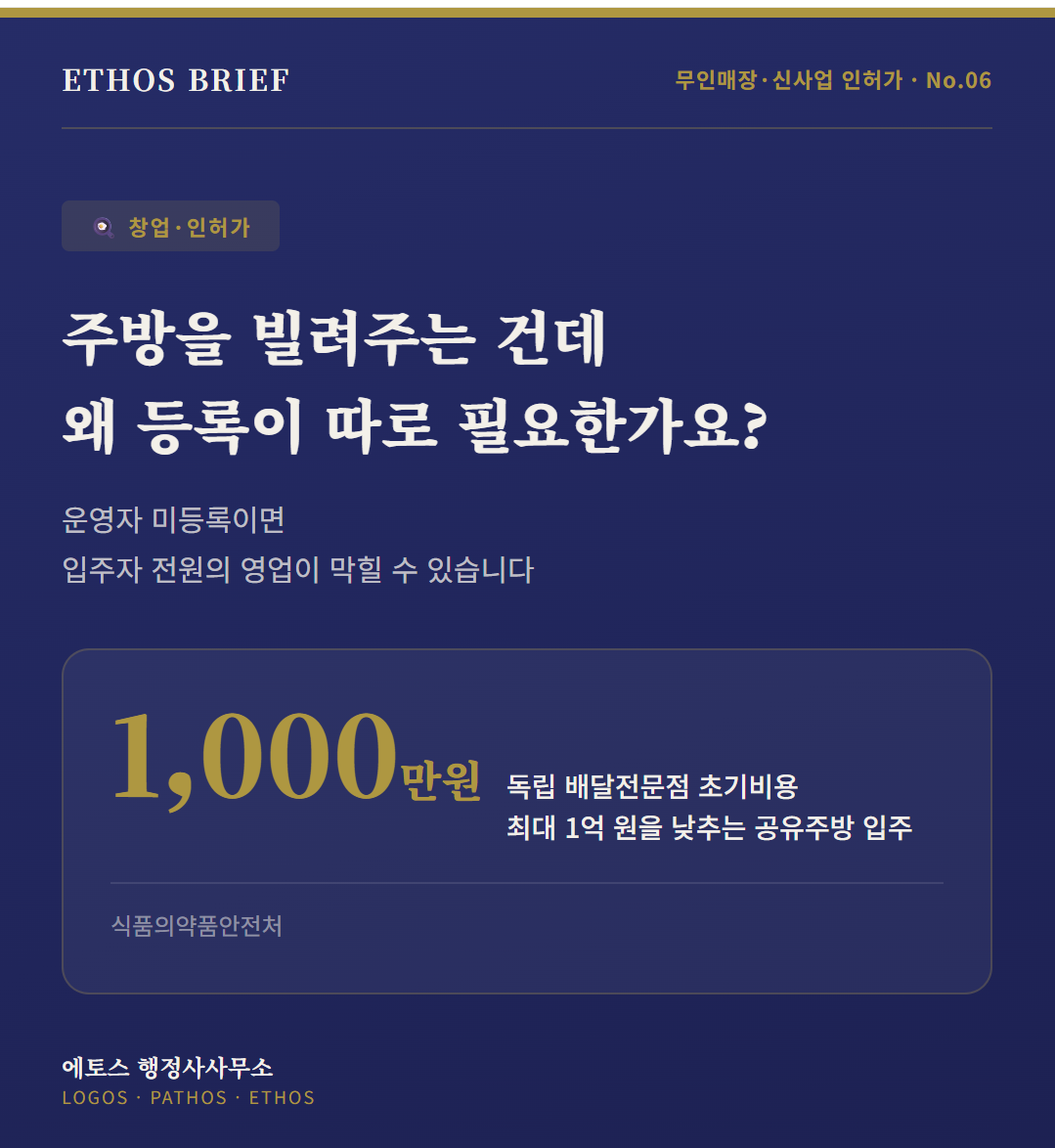
If multiple food business operators use one kitchen facility together, it may not be a simple real estate lease. It may qualify as a shared kitchen operation under the Food Sanitation Act.
Shared kitchen operation is separately listed as a business type under Article 21, subparagraph 9 of the Enforcement Decree of the Food Sanitation Act. Under Article 37(5) of the Food Sanitation Act, it must be registered with the relevant mayor, county governor, or district office head.
What happens if A accepts tenants without this registration?
The problem does not stop with A.
The operating basis of every tenant may be affected.
For a tenant to file a restaurant business notification, a shared kitchen use agreement is required. But if A has not registered as a shared kitchen operator, that use agreement becomes problematic.
The district office may not accept the tenant’s business notification.
One unregistered operator can undermine the entire business structure of all tenants.
The reason this system exists becomes clear when looking at the numbers.
In 2024, the number of business closure reports exceeded one million in Korea. The three-year survival rate for common small business categories is around half, and the five-year survival rate is even lower. The delivery market is growing quickly, but the cost of opening an independent store remains high.
Starting one delivery-only restaurant as an independent store can cost tens of millions of won, and in some cases close to KRW 100 million, once deposit, interior work, equipment, and fixtures are included.
By contrast, entering a shared kitchen can significantly lower the initial cost.
This is why the Ministry of Food and Drug Safety operated a regulatory sandbox for shared kitchens from June 2019 and introduced shared kitchen operation as an official business type from December 30, 2021.
The point is simple:
Lower the initial cost, but manage hygiene and safety within the legal system.
Today, let’s organize the licensing structure that shared kitchen operators and tenants often miss into three points.
1. If I Am Just Renting Out a Kitchen, Why Is It Different From Leasing?
First, we need to look at the legal definition of a shared kitchen.
Under the Food Sanitation Act, a shared kitchen means a place equipped with facilities, machinery, or equipment necessary for manufacturing, processing, cooking, storing, subdividing, or transporting food, where multiple business operators can use those facilities together, or where the same operator can use the facilities for multiple types of food business.
A shared kitchen operation means operating a shared kitchen used by multiple business operators.
Suppose you install kitchen facilities and rent the space to three delivery food founders by time slot.
You are not simply renting out “space.”
You are creating a structure where multiple food business operators share facilities necessary for food manufacturing or cooking.
In that case, you must review whether this is a shared kitchen operation.
The difference between real estate leasing and shared kitchen operation is as follows.
| Category | Real Estate Leasing | Shared Kitchen Operation | |---|---|---| | Legal basis | Lease under civil law | Food Sanitation Act Article 37(5), Enforcement Decree Article 21(9) | | Registration | Mainly tax office business registration | Shared kitchen operation registration with district office | | Hygiene manager | Not required | Required | | Liability insurance | Generally not required | Required for food-related consumer harm | | Facility standards | Building use and general facility standards | Food Sanitation Act facility standards by tenant business type | | Fire and safety | General building and fire standards | Additional multi-use facility safety rules may apply depending on size and business type | | Hygiene education | Generally not required | Food hygiene education required | | HACCP | Not applicable | Shared kitchen HACCP standards may apply | | Tenant business notification | Based mainly on lease agreement | Shared kitchen use agreement required |
The key point is the last row.
In a lease structure, the tenant may rely on a lease agreement when reviewing business notification.
In a shared kitchen structure, a shared kitchen use agreement is required, and that agreement has meaning only when the operator has the proper shared kitchen operation registration.
What happens if the operator is not registered?
The tenant may not be able to file a business notification.
All tenants may end up operating without proper permission or notification.
During the MFDS pilot project, shared kitchens expanded from time-separated use to simultaneous use, and the eligible business types expanded from snack restaurants to general restaurants and instant food manufacturing and processing businesses.
After the pilot project verified that hygiene could be managed safely, the system was formally introduced.
Even after formal introduction, however, the question “Isn’t this just leasing?” continues to come up.
The reason MFDS and local governments separately explain the shared kitchen system is that many people confuse it with ordinary lease structures.
2. What Do You Need to Register as a Shared Kitchen Operator?
Shared kitchen operation registration has several key requirements.
Requirement 1. Eligible Tenant Business Types Are Limited
The types of businesses that may use a shared kitchen must fall within the legally recognized scope.
The following seven business types are generally listed as eligible shared kitchen users:
- Food manufacturing and processing business
- Food additive manufacturing business
- Instant food manufacturing and processing business
- Food subdivision business
- Snack restaurant business
- General restaurant business
- Bakery business
Therefore, businesses such as entertainment bars or karaoke-style bars that are outside this scope cannot operate in a shared kitchen.
The operator must decide which business types will be admitted at the time of registration.
If the operator later changes or adds tenant business types, change registration may be required.
Requirement 2. Facility Standards Differ by Tenant Business Type
The shared kitchen operator must meet the facility standards for the business types that will be admitted.
For example, if general restaurants will be admitted, facility standards for general restaurants must be reviewed, including kitchen, water supply, and restroom requirements.
If food manufacturing and processing businesses will be admitted, facility standards for that business type must be satisfied.
In the traditional Food Sanitation Act structure, one business operator operating in one business place was closer to the default rule. A shared kitchen is an exception to that structure.
Because it is an exception, additional controls such as prevention of cross-contamination, hygiene management, and usage record management become important.
Requirement 3. A Hygiene Manager Must Be Appointed
Under Article 41-2 of the Food Sanitation Act, a shared kitchen operator must appoint a hygiene manager.
Not just anyone can become the hygiene manager.
Generally, the following qualifications or backgrounds should be reviewed:
- Licensed hygienist
- Food manufacturing engineer or similar food-related certificate holder
- Licensed dietitian
- Graduate of a food-related department at a university or junior college, etc.
If the operator does not have the required qualification, an outside person may need to be hired.
This often becomes an unexpected labor cost.
The hygiene manager performs duties such as:
- Hygiene management and maintenance of the shared kitchen
- Keeping records on shared kitchen use
- Supporting investigation of causes and prevention of harm in food poisoning or food accidents
- Providing hygiene guidance and education to shared kitchen users
- Checking management standards to prevent cross-contamination
Requirement 4. Liability Insurance Is Mandatory
Article 44-2 of the Food Sanitation Act requires shared kitchen operators to purchase liability insurance.
This is because food manufactured, processed, or cooked in the shared kitchen may cause harm to consumers.
The insurance generally means accident liability insurance or equivalent coverage for consumer damage caused by food hazards.
Proof of liability insurance must be submitted when applying for registration.
Without insurance, the registration process may stop.
Requirement 5. Fire and Safety Obligations May Be Added Depending on Floor Area
For shared kitchens used for snack restaurant, bakery, or general restaurant businesses, additional obligations under the Special Act on the Safety Management of Publicly Used Establishments may apply if the total floor area reaches a certain threshold.
For example, if the total floor area is at least 100㎡, or at least 66㎡ in an underground floor, fire liability insurance and multi-use facility safety obligations should be reviewed.
This means that one insurance policy may not be enough.
- Food hazard liability insurance
- Fire liability insurance
- Other facility or fire safety insurance and duties
Each must be checked separately depending on floor area and business structure.
Registration Process Summary
The following documents are generally checked when registering a shared kitchen operation.
| Document | Details | |---|---| | Business registration application | Application for shared kitchen operation registration | | Types of tenant businesses | Business types to be admitted to the shared kitchen | | Hygiene manager appointment report | Appointment of a qualified hygiene manager | | Liability insurance certificate | Food hazard liability insurance | | Food hygiene education documents | Education completion by operator or relevant responsible person | | Facility-related documents | Confirmation that facility standards by tenant business type are met |
These requirements must be in place for registration to proceed.
If even one is missing, registration may be delayed or rejected.
What Are the Penalties for Violations?
Violations related to shared kitchen operation are not light.
| Violation | Legal Basis | Penalty or Sanction | |---|---|---| | Unregistered shared kitchen operation | Food Sanitation Act provisions on unregistered business | Up to 5 years imprisonment or fine up to KRW 50 million may apply | | Failure to appoint or report hygiene manager | Food Sanitation Act Article 41-2 | Administrative fine may apply | | Obstruction of hygiene manager duties | Food Sanitation Act Article 41-2 | Administrative fine may apply | | Incomplete records of hygiene manager duties | Relevant enforcement rules | Administrative fine or disposition may apply | | Failure to purchase liability insurance | Food Sanitation Act Article 44-2 | Administrative fine or registration/business issue may apply | | Failure to complete food hygiene education | Food Sanitation Act Article 41 | Administrative fine may apply | | Failure to meet facility standards | Food Sanitation Act facility standards | Registration rejection or administrative disposition may apply |
MFDS and local governments conduct hygiene inspections that include delivery restaurants and shared kitchens. Storage of expired products, poor hygiene management, and labeling or storage violations can all be inspection targets.
Because shared kitchens are now part of the official system, they are also inspection targets.
If you are preparing to operate or enter a shared kitchen, check first what registration is required.
3. Do Tenants Also Need Separate Notification? Yes
Even if the shared kitchen operator has completed registration, tenants do not automatically receive the right to operate.
Each tenant must separately file the appropriate business notification or registration for their own business type.
For example, if a tenant enters a shared kitchen to start a delivery-only restaurant, the tenant must file a general restaurant business notification.
The main documents may include:
- Business notification form
- Food hygiene education certificate
- Health examination result
- Shared kitchen use agreement
- Other documents required by business type
The key document is the shared kitchen use agreement.
A shared kitchen use agreement generally includes:
- Location of the shared kitchen
- Use area
- Use time
- Tenant’s business type
- Scope of facility use
- Hygiene management responsibility
- Contract period
- Usage fee or commission structure
The operator must be registered as a shared kitchen operator for this agreement to serve as the basis for the tenant’s business notification.
If the operator is unregistered, the tenant may not be able to proceed with the business notification.
For example:
You plan to enter a shared kitchen and start a delivery-only restaurant. You pay a deposit of KRW 10 million and monthly rent of KRW 800,000. You buy KRW 2 million worth of ingredients and prepare to register menus on delivery apps.
But when you go to the district office to file a general restaurant business notification, you hear this:
“This shared kitchen is not registered as a shared kitchen operation, so we cannot accept your business notification.”
Your deposit, ingredients, equipment, and delivery app entry costs are all tied up, but you cannot begin operating.
This is why checking the operator’s registration is critical in shared kitchens.
The obligations of operators and tenants can be divided as follows.
| Category | Operator | Tenant | |---|---|---| | Registration or notification | Shared kitchen operation registration | Business notification or registration by business type | | Hygiene manager | Appointed by operator | Often no separate appointment required | | Liability insurance | Operator must purchase | Separate insurance recommended | | Food hygiene education | Required | Required by business type | | Facility standards | Operator satisfies standards by tenant business type | Uses operator’s facilities | | Business scope | Shared kitchen operation and management | Limited to business type stated in use agreement | | HACCP | Shared kitchen standards may apply | Separate HACCP may apply by tenant business type | | Cost structure | Facility investment, hygiene manager, insurance | Deposit, rent, commission, etc. |
The cost structure also differs between an independent store and shared kitchen entry.
| Category | Independent Delivery Restaurant | Shared Kitchen Tenant | |---|---|---| | Initial cost | KRW 50 million to 100 million possible | KRW 10 million to 20 million possible | | Monthly fixed cost | Rent, maintenance, labor | Rent or revenue-based commission | | Facility investment | Founder bears directly | Uses operator’s facilities | | Licensing | Founder handles everything directly | Operator registration + tenant business notification | | Closure risk | Difficult to sell facilities | More flexible at contract termination | | Profitability | No revenue-based commission | Commission can pressure margins |
It is true that initial costs can be reduced.
But that cost-saving effect only works when the operator has properly completed shared kitchen operation registration.
In lectures for foreign founders, this dual structure was one of the most confusing parts.
“The operator and tenant each need different registrations? Can’t one registration cover everything?”
No.
The operator must register as a shared kitchen operator, and the tenant must file the business notification for the actual business type.
They are separate.
If one side is missing, both sides may be unable to operate.
Does This Apply to You?
If two or more of the following apply, you should review your licensing status.
- You plan to equip a kitchen facility and rent it to others.
- You have never registered as a shared kitchen operator.
- You have not appointed a hygiene manager.
- No one meets the hygiene manager qualification requirements.
- You have not purchased liability insurance.
- You plan to enter a shared kitchen and start a delivery-only restaurant.
- You have not checked the operator’s registration certificate.
- The floor area is at least 100㎡, but you do not know whether fire liability insurance is required.
- You have not clarified whether the structure is time-separated use or simultaneous use.
- You have not checked whether the tenant business type is allowed in a shared kitchen.
This Is the General Rule So Far
The points that can be stated clearly are as follows:
- A structure where multiple business operators share one kitchen facility may qualify as shared kitchen operation.
- Shared kitchen operation requires registration with the district office.
- Appointment of a hygiene manager and liability insurance are important for registration.
- Eligible tenant businesses are limited to categories such as food manufacturing and processing, food additive manufacturing, instant food manufacturing and processing, food subdivision, snack restaurant, general restaurant, and bakery businesses.
- Tenants must file separate business notification with a shared kitchen use agreement attached.
- If the operator is unregistered, the use agreement and tenant business notification may both become problematic.
- Failure to appoint or report a hygiene manager may be subject to administrative fines.
- If the floor area exceeds certain thresholds, fire liability insurance and multi-use facility safety requirements must be reviewed.
- Shared kitchens may be subject to MFDS and local government hygiene inspections.
The following points require individual review:
- Whether the structure is leasing or shared kitchen operation
- Whether multiple business operators share the facility
- Whether one business operator uses the entire kitchen exclusively
- Whether the tenant business type is allowed in a shared kitchen
- Whether a qualified hygiene manager is available
- Whether outside hiring is required
- Whether food hazard liability insurance and fire liability insurance are each required
- Whether the building use is appropriate for shared kitchen operation
- Whether shared kitchen HACCP certification is needed
- How tenants can verify the operator’s registration
- Whether the operation is time-separated or simultaneous use
- How each tenant’s use time and facility scope should be written in the agreement
Where Do People Get Stuck When Preparing Alone?
Let’s return to A’s case.
A planned to begin as a “kitchen rental business.”
But in reality, the following steps must be reviewed.
-
Confirm the business structure
Determine whether it is simple leasing or shared kitchen operation. -
Decide tenant business types
Choose which eligible shared kitchen business types will be admitted. -
Check facility standards
Confirm that standards for each tenant business type are met. -
Secure a hygiene manager
Appoint or hire someone who meets the qualification requirements. -
Purchase liability insurance
Prepare food hazard liability insurance. -
Apply for shared kitchen operation registration
Submit the application, tenant business types, hygiene manager appointment report, insurance certificate, etc. -
Check fire and safety obligations
Depending on floor area, review fire liability insurance and multi-use facility safety requirements. -
Prepare the shared kitchen use agreement
Clearly state location, area, use time, business type, and hygiene responsibility. -
Support tenant business notification
Align the agreement and facility standards so tenants can file their business notifications.
That is nine steps.
A thought it was simply “renting out a kitchen,” but the actual structure connects to the Food Sanitation Act, Building Act, fire safety laws, insurance, and multi-use facility safety rules.
What would have been different if A had checked with an administrative agent from the beginning?
First, the structure would be classified as leasing or shared kitchen operation.
If multiple business operators share the facility, it may be shared kitchen operation.
If one business operator exclusively leases and uses the entire kitchen, it may be closer to an ordinary lease structure.
This boundary must be checked first.
Then the following flow is organized:
- Decide which of the seven eligible tenant business types will be admitted
- Check facility standards for each business type
- Secure a qualified hygiene manager
- Purchase liability insurance
- Check fire liability insurance based on floor area
- Prepare and submit registration documents
- Design the shared kitchen use agreement
- Support tenant business notification documents
- Set up hygiene management records and education during operation
Operator registration alone is not the end.
The business begins only when the tenants’ business notifications are also completed.
If operator registration and tenant notifications are not designed as one connected flow, the following problems can occur:
- The operator is registered, but the tenant is blocked at business notification.
- The tenant signs a contract, but the operator’s facility standards are insufficient.
- The use agreement lacks business type, area, or use time, causing a correction request.
- Hygiene manager appointment is delayed, delaying registration.
- Liability insurance and fire insurance are confused, delaying registration.
A shared kitchen is a structure where the operator’s and tenants’ permits affect one another.
If one side is wrong, both sides may have to stop operating.
That is why the connected structure should be designed from the beginning.
What Changes When You Work With an Administrative Agent?
Shared kitchen licensing is not simply filing one application.
The structure of the operator and tenants must be aligned together.
An administrative agent can review the following:
- Whether the structure is leasing or shared kitchen operation
- Whether the tenant business type is allowed
- Whether facility standards by tenant business type are met
- Whether hygiene manager qualification requirements are met
- Whether liability insurance and fire liability insurance are each required
- Whether building use and fire safety requirements are appropriate
- Whether the shared kitchen use agreement contains required information
- Whether tenants can file business notifications under the structure
- Whether hygiene management records and education systems are prepared for operation
Under Article 2 of the Certified Administrative Agents Act, preparing and submitting documents to administrative agencies can fall within the scope of administrative agent work.
Shared kitchen operation registration, hygiene manager appointment reports, and tenant business notifications are all connected to documents submitted to administrative agencies.
Check first, for free, which structure your planned shared kitchen falls under.
Preparing a Shared Kitchen?
A shared kitchen can be a good way to reduce initial startup costs.
But because the operator’s and tenants’ licensing structures are connected, a poor initial design can stop several businesses at once.
Business registration may be the starting point.
But for shared kitchens, it is not the end.
Check at least the following questions:
- Is my business simple leasing or shared kitchen operation?
- Are multiple business operators using the same kitchen facility together?
- Is the tenant business type allowed in a shared kitchen?
- Are facility standards for tenant business types satisfied?
- Can a hygiene manager be appointed?
- Has liability insurance been purchased?
- Do floor area thresholds trigger fire liability insurance or multi-use facility safety duties?
- Does the shared kitchen use agreement clearly state location, area, use time, and business type?
- Can tenants use this agreement to file business notifications?
- Are hygiene management records and education systems prepared?
Checking these questions first is much safer than discovering after signing tenants that their business notifications cannot proceed.
This completes all six articles in the “I Thought Business Registration Was Enough” series.
I will continue sharing helpful articles on new licensing issues and the kinds of support administrative agents can provide.