
Same-Sex Couples May Be Legally Protected in Korea: Life Partnership, Damages, and Cohabitation Agreements
Hello, this is Administrative Agent Jean.
In June 2026, a Korean court held that a same-sex couple’s shared life may, in certain circumstances, be legally protectable.
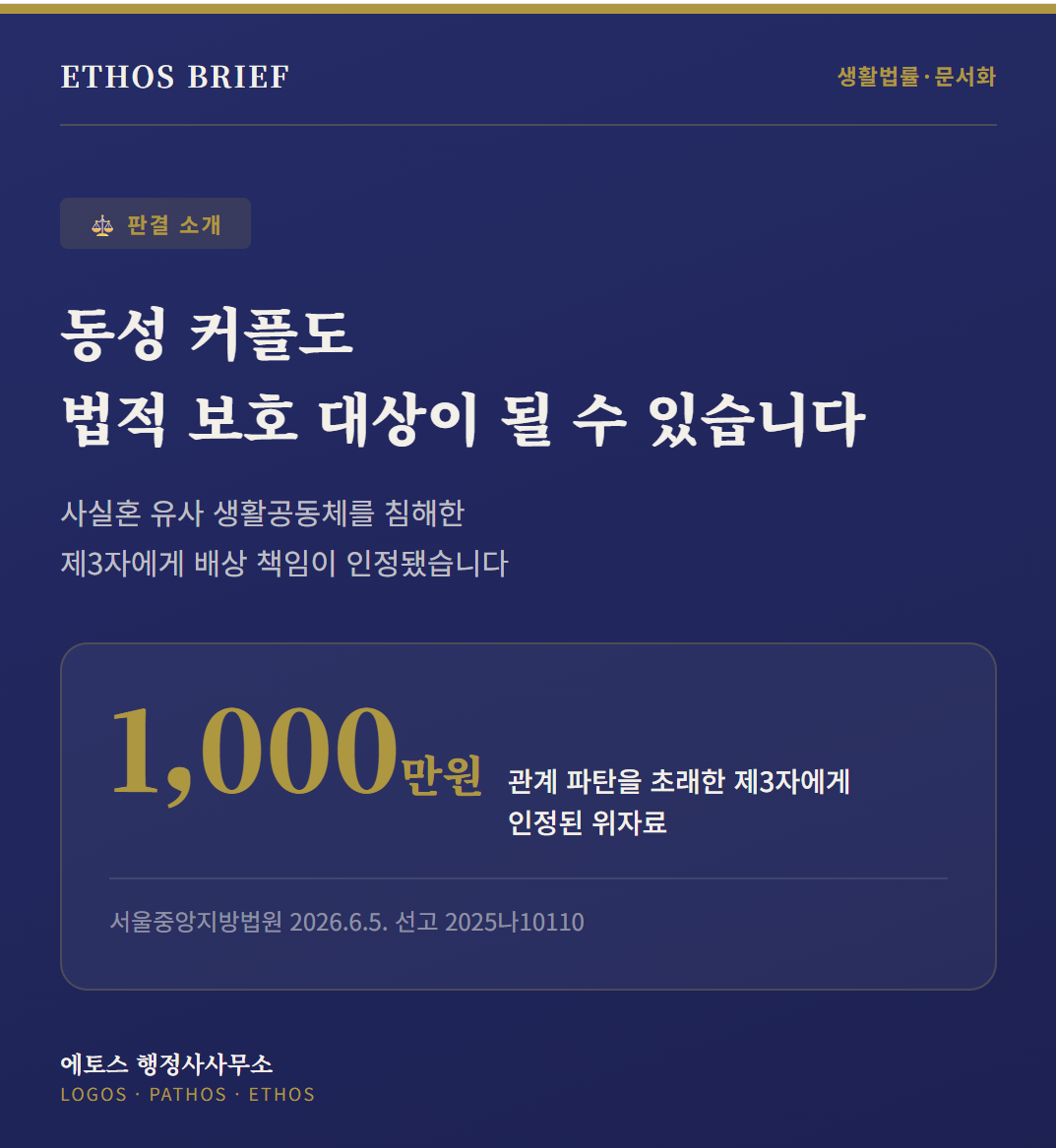
On June 5, 2026, the Seoul Central District Court Civil Appeals Division 3-2 partially upheld a damages claim filed by A against C, a third party who contributed to the breakdown of A’s relationship with same-sex partner B.
The Court viewed A and B’s relationship as more than a simple romantic relationship.
It described the relationship as a life partnership similar to a de facto marriage.
The Court then ordered C to pay KRW 10 million in damages.
This decision did not recognize same-sex marriage.
But it did show that when a same-sex couple has actually lived together, been recognized by family, and formed an economic community, the interests arising from that life partnership may be legally protected.
This article explains the meaning of the decision and the documents that same-sex and unmarried couples can prepare to reduce disputes.
Key Summary
| Category | Details | |---|---| | Case | Seoul Central District Court Decision 2025Na10110, June 5, 2026 | | Core holding | Same-sex couple’s relationship recognized as a legally protectable life partnership similar to de facto marriage | | Evidence considered | Family recognition, participation in family events, economic community, and shared financial contributions | | Result | KRW 10 million damages awarded against the third party | | Limitation | The decision did not recognize same-sex marriage or full de facto marriage status under the Civil Act | | Practical point | Evidence and documents showing the substance of shared life are important | | Useful documents | Cohabitation agreement, living agreement, deposit contribution statement, shared property settlement agreement, fact confirmation statement |
What Is the Core Meaning of This Decision?
The core meaning is not that the court directly recognized same-sex marriage or full de facto marriage status.
The important point is different.
The Court held that when a same-sex couple forms a relationship based on an intention similar to marriage and becomes mentally, physically, and economically connected as a shared life community, that relationship may constitute a legally protectable interest.
According to reports and case commentary, the Court considered factors such as:
- The couple disclosed the relationship to their families.
- They participated in family events together.
- They formed an economic community, including shared payment toward an apartment installment.
- Their relationship went beyond ordinary dating.
- The Court also considered the direction of the Supreme Court’s 2024 National Health Insurance dependent-status ruling.
In other words, if these materials had not existed, the outcome might have been different.
Saying “we were together for a long time” may not be enough.
Courts and institutions ultimately look at evidence.
Did the Court Recognize Same-Sex Marriage?
No.
This point should be clearly separated.
The decision did not allow same-sex marriage registration. It also should not be overstated as a full recognition of same-sex de facto marriage under the Civil Act.
Rather, the Court acknowledged the current legal limits on same-sex marriage and de facto marriage, while recognizing that a same-sex couple’s life partnership similar to de facto marriage may still deserve legal protection.
A more accurate summary is:
- Recognition of same-sex marriage: No
- Full recognition of same-sex de facto marriage: Not clearly
- Recognition of legally protectable life partnership: Yes
- Damages for interference with that relationship: Yes
The practical question is therefore:
How can the couple prove that their relationship was a real life partnership?
Why Is a Cohabitation Agreement Needed?
A had to go to court.
That likely required time, money, and emotional energy.
If the couple had prepared documents from the start, such as rules on living expenses, housing, deposit contributions, shared property, and settlement upon separation, proving the existence and substance of the relationship may have been easier.
For same-sex and unmarried couples, a cohabitation agreement is not only about preparing for separation.
Its more fundamental purposes are:
- To explain that the couple lived together
- To document living expenses and rental deposit contributions
- To clarify ownership of jointly formed property
- To set settlement rules if the relationship ends
- To prepare materials for hospitals, employers, insurers, health insurance, or housing-related institutions
- To organize evidence showing the substance of the relationship
When marriage registration is accepted, certain protections arise automatically by law.
For same-sex and unmarried couples, those protections often do not operate automatically.
Documents can help fill part of that gap.
When Is a Cohabitation Agreement Useful?
If any of the following apply, preparation is recommended.
- The couple lives together in a home that is not under both names.
- One person is the leaseholder, but both contributed to the rental deposit.
- Shared living expenses are paid through one person’s account or card.
- Furniture, appliances, vehicle costs, or pet-related expenses were jointly paid.
- One person spends more time on housework, care, or daily support.
- The couple has lived together for years but has no written documents.
- The relationship is known to family, and the couple attends family events together.
- Documents may be needed for employer benefits, insurance, health insurance, hospitals, or housing.
- There is no agreement on how deposits and property will be settled if the relationship ends.
Even if the couple has already lived together for years, preparing documents still has practical value.
The longer the shared life, the more assets and records there are to organize.
Essential Clauses in a Cohabitation Agreement
A cohabitation agreement should reflect the couple’s actual life.
The following clauses should generally be reviewed.
1. Housing Clauses
Housing is one of the biggest sources of disputes.
This is especially true when the leaseholder and deposit contributors are different.
A cohabitation agreement should include:
- Name of the leaseholder
- Actual residents
- Deposit contributors and contribution ratio
- Rent and maintenance fee allocation
- Decision-making for lease renewal
- Deposit return and settlement method
- Settlement timing if one person moves out first
- Notice period for lease termination or changes
For example, if one person contributed KRW 30 million and the other contributed KRW 20 million to a KRW 50 million deposit, that ratio and transfer records should be clearly documented.
Even if the lease is under one person’s name, the actual contribution structure can be separately recorded.
2. Living Expenses and Shared Property
Living expenses recur every month, so disputes often arise.
At first, expenses may be shared naturally. Over time, memories differ.
The following items should be organized:
- Rent
- Maintenance fees
- Electricity, gas, and water
- Internet and phone bills
- Food
- Household supplies
- Pet expenses
- Vehicle maintenance
- Subscriptions
- Travel and family event expenses
The payment method should also be specified.
Examples include:
- 50:50 split
- Income-ratio split
- Item-by-item allocation
- One person pays first and monthly settlement follows
- Both deposit into a joint account first
Shared property should also be covered.
Examples include:
- Appliances
- Furniture
- Vehicle
- Expensive electronics
- Pet-related expenses
- Interior costs
For each item, the agreement should state who paid how much, who keeps the item if the relationship ends, and how much should be paid to the other person if one person keeps it.
3. Emergency and Medical Clauses
If the couple is not legally married, hospitals or institutions may require an explanation of the relationship.
A cohabitation agreement or separate confirmation statement may include:
- Emergency contact priority
- Intention to cooperate in hospital visits and care
- Order of contacting family or close friends
- Medical expense allocation
- Handling of housing and living expenses during long-term hospitalization
- Whether a separate fact confirmation statement will be prepared for submission
However, medical decision-making authority, life-sustaining treatment decisions, and legal representation may involve separate laws and institutional rules.
A simple agreement cannot solve every issue.
If needed, attorneys, notaries, and hospital-specific requirements should be reviewed.
4. Separation and Settlement Clauses
This is the hardest section to write, but often the most important.
When the relationship is good, it may feel uncomfortable to write these clauses.
When the relationship ends, these clauses can reduce conflict.
The agreement should address:
- How one party communicates the intention to end the relationship
- Notice period before moving out
- Deposit settlement timing
- Settlement of unpaid rent, maintenance fees, and utilities
- Joint account balance settlement
- Division of jointly purchased property
- Pet custody and expenses
- Cancellation of automatic payments under one person’s name
- Amendment and termination method
- Dispute resolution process
A document cannot prevent separation.
But it can reduce confusion after separation.
5. Evidence of Shared Life
In the 2026 decision, family recognition and economic community were important.
Therefore, evidence showing the substance of shared life should be organized in advance.
Examples include:
- Lease agreement
- Address or residence records
- Rent and maintenance fee transfer records
- Utility payment records
- Joint account transaction records
- Joint purchase receipts
- Family event photos or records
- Travel, hospital, or insurance records
- Statements from people who know the relationship
- Pet registration and medical expense records
- Emergency contact registrations
- Employer benefit or insurance submission materials
The point is not to search for evidence later.
The point is to organize it while life is ongoing.
Documents an Administrative Agent Can Help Prepare
Under the Administrative Agent Act, administrative agents may prepare documents concerning rights, obligations, facts, contracts, agreements, confirmations, and related submissions within the permitted scope.
For same-sex and unmarried couples, useful documents may include:
| Document | Purpose | |---|---| | Cohabitation agreement | Living expenses, deposit, shared property, and settlement rules | | Living agreement | Daily living rules, cost sharing, and shared household structure | | Deposit contribution statement | Clarifies lease title and actual contribution relationship | | Shared property list | Organizes ownership and settlement rules for appliances, furniture, vehicles, etc. | | Fact confirmation statement | Explains the substance of shared life to external institutions | | Party statement | Allows the parties to explain the relationship and shared life | | Evidence list | Organizes contracts, transfers, photos, receipts, and other materials | | External submission summary | Purpose-specific summary for employers, agencies, hospitals, or insurers |
However, an administrative agent does not resolve every legal issue.
Court litigation representation is handled by attorneys.
Notarization requires a notary process.
Inheritance, wills, trusts, tax, and insurance beneficiary designation may require review by attorneys, judicial scriveners, tax professionals, or insurance specialists.
The administrative agent’s role is to structure the couple’s living arrangement and agreement into documents, and to organize fact evidence for the intended purpose.
Is Notarization Required?
Notarization may be helpful depending on the matter.
However, it is not accurate to say that any notarized agreement automatically enables compulsory execution without a court judgment.
A simple notarization or certification of a private document can help prove that the document was signed or executed.
By contrast, to allow compulsory execution for a monetary obligation, a notarial deed with an execution acceptance clause may be required.
Different types of notarization have different legal effects.
| Type | Role | |---|---| | General cohabitation agreement | Organizes the agreement between the parties | | Certification of private document | Strengthens proof of signature and document formation | | Notarial deed with execution acceptance clause | May allow compulsory execution for certain monetary obligations if requirements are met | | Fact confirmation statement | Explains the substance of shared life |
If significant assets, deposits, loans, or settlement amounts are involved, notarization should be separately reviewed.
Does It Still Matter If We Have Lived Together for Years?
Yes.
In fact, the longer the couple has lived together, the more there may be to organize.
After five years of living together, there may be:
- Rental deposit contributions
- Rent and maintenance fee records
- Jointly purchased appliances and furniture
- Living expenses paid more heavily by one person
- Pet care expenses
- Hospital visits and caregiving records
- Family event participation
- Joint account history
If the relationship ends without documentation, the first dispute may be over who paid what.
Preparing an agreement now allows the couple to organize past contributions and set a clear starting point going forward.
The document does not need to be perfect.
The first step is to organize the current situation.
Practical Lesson from the 2026 Decision
The decision sends an important message.
The substance of a relationship should be explained through evidence.
The Court looked at facts that already exist in ordinary life.
- Was the relationship known to family?
- Did the couple participate in family events?
- Did they form an economic community?
- Did they share housing and expenses?
- Was there a real shared life beyond ordinary dating?
These are not extraordinary materials.
But when they are scattered, their evidentiary power is weak.
When organized, they become a coherent explanation.
A cohabitation agreement and fact confirmation statement help turn scattered records into one understandable narrative.
Pre-Drafting Checklist
Before drafting, answer these questions.
- When did the relationship begin?
- When did cohabitation begin?
- Was the relationship disclosed to family?
- Did the couple participate in family events or holidays together?
- Who is the leaseholder?
- Who paid how much of the rental deposit?
- How are rent and maintenance fees shared?
- Is there a joint account?
- Are there jointly purchased appliances or furniture?
- Is there a pet?
- Does one person do more housework or caregiving?
- How will the deposit be settled if the relationship ends?
- Is a document needed for an external institution?
- Is there a monetary obligation that may require notarization?
The answers usually reveal which documents are needed.
How Ethos Administrative Office Can Help
Ethos Administrative Office can assist same-sex and unmarried couples with life partnership documentation through:
- Understanding the current shared household structure
- Organizing deposit, rent, and living expense contributions
- Organizing shared property and settlement rules
- Drafting a cohabitation agreement or living agreement
- Preparing a shared-life fact confirmation statement
- Preparing external-use explanation documents
- Creating an evidence list
- Conducting a first-stage review of notarization needs
- Identifying whether attorneys, tax professionals, or other specialists should be involved
The purpose of documentation is not to doubt the relationship.
It is to set standards that protect both people.
Frequently Asked Questions
Q. Does a cohabitation agreement automatically prove de facto marriage?
No. A cohabitation agreement alone does not automatically establish de facto marriage or a life partnership similar to de facto marriage. However, it may be important evidence of shared intent, economic community, living expense contributions, and shared residence.
Q. Did the 2026 decision recognize same-sex marriage?
No. The decision did not recognize same-sex marriage. It recognized that the interests arising from a same-sex couple’s life partnership similar to de facto marriage may be legally protected.
Q. Is notarization safer?
It may help depending on the matter. However, the legal effect differs depending on whether it is simple certification or a notarial deed with an execution acceptance clause.
Q. Can we prepare an agreement even if we have lived together for years?
Yes. It can help organize past contributions and reduce future disputes.
Q. Can pet-related terms be included?
Yes. The agreement can cover caretaker, veterinary expenses, food costs, insurance, and pet custody if the relationship ends.
Q. Can an administrative agent represent us in a damages lawsuit?
No. Litigation representation is handled by attorneys. An administrative agent can assist with documents such as agreements, fact confirmation statements, party statements, and evidence organization within the permitted scope.
Closing
Unmarried households and same-sex couples already exist in Korea.
They live together, pay expenses together, meet each other’s families, and form economic communities.
But the legal system does not always protect that life automatically.
The 2026 decision is meaningful because the court looked more directly at that reality.
Still, one court decision does not solve everything.
The substance of the relationship must be explained with evidence.
Family event participation, economic community, shared rental deposits, and records of shared life are often already present in daily life.
The important thing is not to leave them as scattered memories.
They should be organized into documents.
A cohabitation agreement or living agreement is not a cold document prepared only for separation.
It is a practical safety device that clarifies rights and responsibilities while people live together.
Turning vague trust into clear sentences.
That is one of the most realistic forms of preparation available to same-sex and unmarried couples today.