
How to Draft a BAI Review Petition in Korea — From the 90/180-Day Filing Periods to Legal Arguments and Evidence
Hello, this is Administrative Agent Jean.
When someone receives an unfavorable decision from a Korean administrative authority, the first remedy that usually comes to mind is an administrative appeal.
It is one of the most commonly used procedures for challenging administrative measures such as business suspensions, administrative surcharges, and permit cancellations.
However, an administrative appeal is not the only route available for challenging an administrative action.
Another procedure is a review petition before the Board of Audit and Inspection of Korea (BAI) under Article 43 of the Board of Audit and Inspection Act.
The official form for a BAI review petition is not difficult to find.
Following the amendment of the Rules on Review Petitions before the Board of Audit and Inspection on June 18, 2025, the petition form was also revised.
The current form includes a separate “Statement of the Purpose and Grounds for Review”, and expressly requires supporting documents that substantiate the grounds for the petition, together with documents confirming the petitioner’s identity.
At first glance, this can make the process look straightforward.
“Do I just describe the administrative decision, explain why it was unfair, and attach a few documents?”
Not quite.
The difficult part of a BAI review petition is not filling in the blanks.
It is showing what facts the authority relied on, what law it applied, where that reasoning went wrong, and which evidence proves the error.
And before reaching that stage, there is an even more fundamental issue.
No matter how strong the argument is, it is of little use if the petition never reaches review on the merits.
Article 44 of the Board of Audit and Inspection Act provides that a review petition must be filed within 90 days from the date the petitioner became aware of the relevant disposition or act and within 180 days from the date of the disposition or act itself.
The Act expressly treats both periods as non-extendable statutory periods.
In other words, drafting a persuasive petition is important, but missing the 90-day or 180-day period may prevent even a strong petition from being considered on the merits.
Meeting the deadline is not the end of the analysis either.
Article 45 of the Board of Audit and Inspection Act provides that review is, in principle, conducted on the basis of the petition and the documents submitted by the relevant administrative authority.
The BAI may request additional materials, hear opinions, or conduct further investigation where necessary, but the starting point remains the written record.
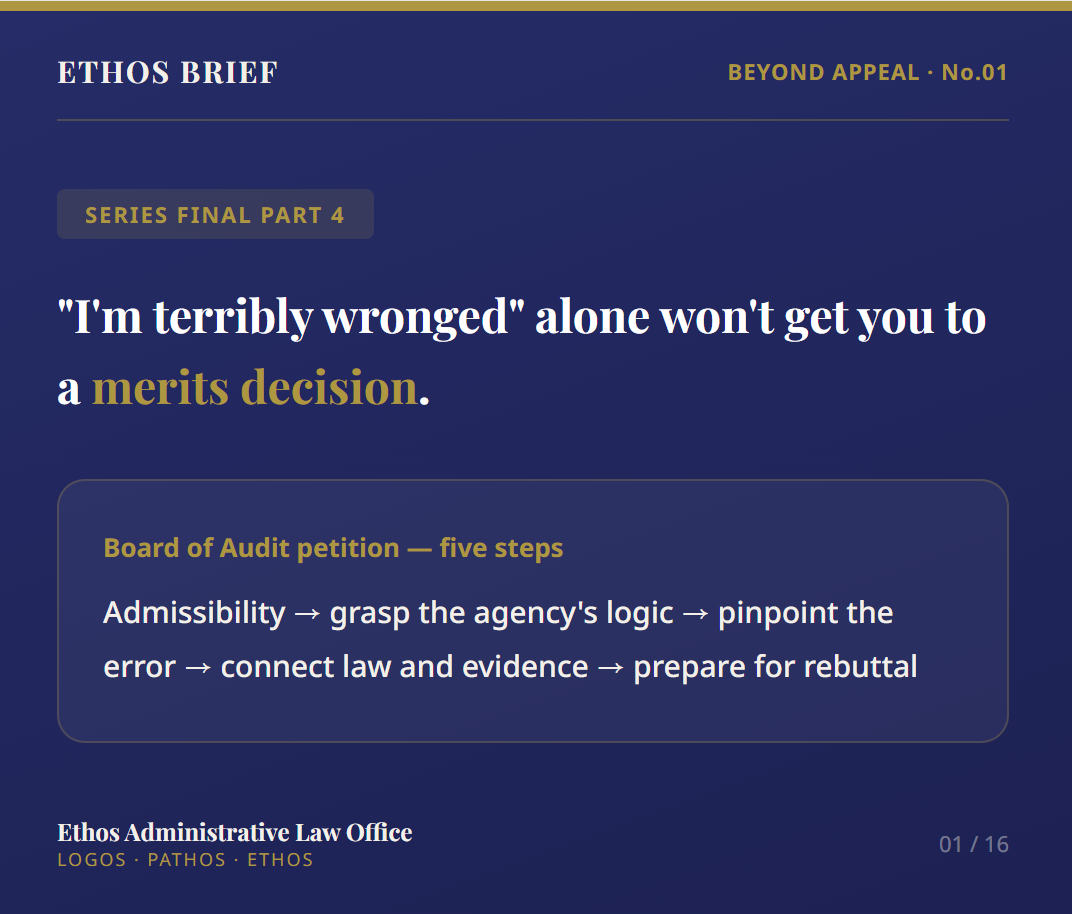
A BAI review petition therefore needs to follow a logical sequence:
1. Can this petition reach review on the merits?
↓
2. What reasoning did the administrative authority use?
↓
3. Exactly where did that reasoning go wrong?
↓
4. Which law and evidence demonstrate the error?
↓
5. If the authority responds, how will that response be answered?
This article explains those steps using actual BAI decisions.
Step 1. Before Drafting the Grounds, Ask Whether the Petition Can Reach the Merits
Before preparing a detailed review petition, there is a threshold question:
Is the petition procedurally admissible?
Article 6 of the current Rules on Review Petitions before the Board of Audit and Inspection identifies circumstances in which a petition will be dismissed without a substantive determination.
Representative examples include:
- the matter is not eligible for a BAI review petition;
- the petitioner is not an interested party;
- the statutory filing period has expired;
- an administrative appeal decision has already been issued concerning the matter;
- litigation concerning the matter has already been filed; or
- statutory or procedural requirements have not been satisfied.
There is an important exception concerning prior administrative appeals.
Where the earlier administrative appeal ended in a procedural dismissal without a decision on the merits, the existence of that dismissal is treated differently.
The key question at the drafting stage is therefore:
“Can this matter actually proceed to substantive review?”
The filing periods deserve particular attention.
When you receive a written administrative disposition, it is useful to identify two dates immediately:
- the date you became aware of the disposition or act; and
- the date on which the disposition or act actually occurred.
The corresponding periods are 90 days and 180 days, and both are treated as non-extendable statutory periods under the Board of Audit and Inspection Act.
If the legal argument is strong and the evidence is available but the petition cannot be considered because the filing period has expired, the substance of the dispute may never be reached.
Step 2. The Current Petition Form Already Shows How the Case Should Be Organized
The current petition form, revised on June 18, 2025, requires information including:
- the petitioner;
- the relevant administrative authority;
- the act or disposition subject to review;
- the purpose and grounds of the petition;
- the date of the disposition or act;
- the date on which the petitioner became aware of it; and
- whether an administrative appeal or lawsuit has already been filed.
A separate Statement of the Purpose and Grounds for Review may also be prepared.
Documents supporting the grounds for review must be attached.
The logic behind the form can be simplified as follows:
What happened?
↓
What result do you want?
↓
Why do you believe the administrative decision was wrong?
↓
What proves that argument?
A well-structured petition ultimately follows this sequence.
Step 3. The Requested Relief — Specify What You Want Changed
The first issue is the relief being requested.
In simple terms, the question is:
“What exactly are you asking the BAI to address?”
A statement such as the following is generally too vague:
I have been treated unfairly, so please review my circumstances and provide appropriate relief.
The petitioner’s frustration may be understandable, but the statement does not clearly identify which administrative disposition is being challenged or what result is being requested.
Depending on the case, the request may instead be structured along the following lines:
I request that corrective measures, including cancellation, be required with respect to the ○○ disposition issued to the petitioner by ○○ Authority on [date].
The precise wording will vary by case.
But the principle is clear.
The challenged disposition and the requested result should be identified.
Article 12 of the current Rules on Review Petitions also provides that the BAI, in principle, reviews the matters asserted by the petitioner.
The BAI may examine facts not specifically asserted where necessary, but it cannot decide matters outside the disposition or act that is the subject of the review petition.
A petitioner therefore should not assume:
“The BAI will identify whatever was wrong on its own.”
The petitioner first needs to identify what is being challenged.
Step 4. Before Explaining Why You Are Unhappy, Break Down the Authority’s Reasoning
This is one of the most important parts of the process.
Instead of beginning immediately with the petitioner’s objections, start by breaking down the written disposition itself.
The logic of an administrative decision can often be simplified as follows:
The authority found Fact A
↓
It applied Law B
↓
It concluded that Requirement C was satisfied or not satisfied
↓
It therefore issued Disposition D
Once the decision is broken down this way, the relevant questions become clearer.
- Is Fact A actually correct?
- Does Law B actually apply to this case?
- Was Law B interpreted correctly?
- Were the established facts properly applied to Requirement C?
- Were required procedures or legally relevant considerations overlooked?
The task is to identify where the authority’s chain of reasoning breaks down.
There is a substantial difference between saying:
The disposition is unfair.
and saying:
The authority applied Provision B on the assumption that Fact A existed, but that factual finding is inconsistent with Evidence No. 1, which had already been submitted before the disposition was issued.
The latter creates a specific issue that can actually be reviewed.
For Analytical Purposes, This Article Divides Potential Errors into Four Categories
The following four categories are not an official classification established by the Board of Audit and Inspection Act or its review rules.
They are an analytical framework used in this article to help identify the central issue in a disposition.
A real case may involve more than one category at the same time.
Type 1. Error in Fact-Finding
This occurs where the underlying factual assumption used by the authority is wrong.
For example, suppose the authority states:
“Document A was never submitted.”
But electronic filing records and a filing receipt show that Document A was submitted before the disposition.
The central issue is not statutory interpretation.
It is:
Was Document A submitted or not?
Relevant evidence may therefore include:
- filing receipts;
- electronic filing records;
- official correspondence; and
- copies of the documents actually submitted.
Type 2. Error in Statutory Interpretation
In some cases, the underlying facts are largely undisputed, but the meaning of the law itself is contested.
The authority may interpret a provision as meaning A, while the petitioner argues that it should be interpreted as B.
In such a case, factual documents alone may not resolve the dispute.
Relevant legal materials may include:
- the statutory text;
- enforcement decrees and enforcement rules;
- relevant court decisions;
- legislative amendment history;
- the relationship between related provisions; and
- where appropriate, official interpretive materials issued by the relevant authority.
Type 3. Error in Applying a Statutory Requirement
Sometimes there is no major disagreement about the meaning of the law itself.
The issue is instead whether the established facts were properly matched to the statutory requirements.
Suppose a statute requires Requirements A, B, and C.
The administrative authority concludes that Requirement B has not been satisfied.
The analysis should then connect:
the precise legal meaning of Requirement B
↓
the facts actually established
↓
why those facts do or do not satisfy Requirement B
Type 4. Procedural or Discretionary Error
In other cases, the problem may lie not only in the substantive result but also in how the disposition was reached.
For example, it may be necessary to examine:
- whether procedures required by law were followed;
- whether legally required factors were actually considered;
- whether applicable disposition standards were used; or
- in a discretionary decision, whether the authority properly considered the individual circumstances.
Relevant materials may include:
- advance notices;
- written opinions submitted by the affected party;
- hearing records;
- applicable disposition standards; and
- official correspondence before and after the disposition.
Why Identify the Type of Error First?
Because different errors require different forms of proof.
If the real issue is statutory interpretation, submitting dozens of transaction records may not answer the decisive legal question.
Conversely, if the dispute concerns what actually happened in a transaction, citing ten pages of statutory language may also be insufficient.
First determine:
“Exactly what part of the authority’s reasoning is wrong?”
Only then can you answer:
“What do I need to prove that error?”
If the issue is misidentified, the wrong evidence may be prepared.
Even a large volume of supporting materials can result in a weak submission if they do not address the actual issue.
Actual Cancellation Decision 1 — A Tax Assessment of More Than KRW 20 Million Was Cancelled Over Statutory Interpretation
Consider BAI Decision GamSim 2023-360, October 17, 2024.
The petitioner had invested a total of KRW 325,000,000 in venture companies between 2018 and 2020.
The tax authority calculated the applicable income deduction limitation differently and imposed an additional KRW 20,008,900 in comprehensive income tax for 2020.
The central dispute was not a simple mathematical error.
It concerned the interpretation of the phrase “the relevant taxable year” under the former Restriction of Special Taxation Act.
The BAI’s conclusion was clear.
It determined that the KRW 20,008,900 comprehensive income tax assessment for 2020 should be cancelled.
What matters for drafting purposes is not merely the amount.
It is the type of issue that changed the result.
Where statutory interpretation is decisive, simply saying:
I believe the statute means something different.
is not enough.
The submission should connect:
- the relevant statutory language;
- its relationship with other provisions;
- relevant precedent; and
- the broader statutory structure supporting the proposed interpretation.
In other words, in a statutory-interpretation case, the legal framework itself becomes part of the core argument.
Actual Cancellation Decision 2 — The BAI Looked Beyond Formal Registration to Actual Use and Control
Now consider BAI Decision GamSim 2022-1577, June 27, 2024.
A religious organization transferred real estate for which acquisition tax relief had been granted into the name of a denominational maintenance foundation.
The local tax authority treated the transfer as a gift triggering recapture and imposed:
- Acquisition tax: KRW 78,320,750
- Local education tax: KRW 6,784,910
- Special tax for rural areas: KRW 3,397,930
- Total: KRW 88,503,590
The BAI determined that the tax assessments should be cancelled.
What is particularly important is that the BAI did not look only at the formal change in registered ownership.
Its analysis considered matters including:
- the denomination’s doctrines and governing rules;
- internal rules requiring property to be managed in the foundation’s name;
- the local church’s practical involvement in property dispositions and security interests;
- continued use of the property as a religious facility after the transfer;
- responsibility for repairs and maintenance expenses; and
- relevant legal principles distinguishing nominal ownership arrangements from gifts.
The important point is not simply the assertion:
“The registry says one thing, but the reality was different.”
What mattered was that the actual relationship was supported by materials concerning internal rules, actual use, management authority, and financial responsibility.
These types of records can become particularly important where the dispute turns on the substance of the factual relationship.
A Recent Rejected Petition Shows the Other Side
If we look only at successful petitions, it is easy to reach the conclusion:
“If I submit enough documents, the disposition will be cancelled.”
That is not how the process works.
Where objective evidence points in a different direction from the petitioner’s characterization of the facts, the outcome may also be different.
In BAI Review 2025-318, decided April 27, 2026, concerning a capital gains tax assessment, the BAI concluded that the tax authority’s assessment was justified.
According to the published summary, the BAI considered matters including:
- the division and consolidation history of the land involved in the contracts;
- the actual sequence of transactions between the parties;
- financial transactions between the parties; and
- relevant court precedents.
It then applied the substance-over-form principle.
The lesson is significant.
The name written on a contract or the petitioner’s description of the transaction does not by itself determine the underlying facts.
The decision may also depend on:
- how money actually moved;
- how the transaction was carried out in practice; and
- what the objective documentary record shows when considered as a whole.
So when reviewing evidence, it is not enough to ask:
“Which documents are favorable to me?”
A more important question is:
“When all of the documents are considered together, do the actual facts support my position?”
Step 5. Do Not Merely Attach Evidence — Connect Each Document to What It Proves
Article 3 of the current Rules on Review Petitions requires supporting documents that substantiate the grounds for review.
But attaching more documents does not automatically make the petition stronger.
Suppose 30 exhibits are attached and the petition merely says:
Please refer to the attached documents.
The reviewer still has to determine:
“Which document proves which assertion?”
A stronger structure makes that connection explicit.
For example:
Administrative Authority’s Finding
Document A was not submitted, so the statutory requirement was not satisfied.
Petitioner’s Response
Document A was submitted before the disposition.
Evidence
- Evidence No. 1: Filing receipt
- Evidence No. 2: Electronic filing record
Fact to Be Proven
Document A was actually received by the administrative authority on April 8, 2026.
The last element is critical.
It is not enough simply to identify the document.
You should be able to explain in one sentence:
“What specific fact does this document prove?”
Before Drafting the Petition, Organize Each Issue in This Sequence
Instead of immediately writing a long narrative, it can be useful to organize each issue separately.
Issue 1. The Authority Concluded That Document A Had Not Been Submitted
Authority’s position
Document A was not submitted, so a statutory requirement was not satisfied.
Type of error
Fact-finding.
Petitioner’s position
Document A was submitted before the disposition.
Relevant legal basis
Identify the provision for which submission of Document A is legally relevant.
Evidence
Filing receipt and electronic submission records.
Fact established by the evidence
Document A was actually received by the authority on April 8, 2026.
Possible response from the authority
“The document was submitted, but its contents were insufficient to satisfy the statutory requirement.”
At that point, proving only that the document was submitted may no longer be enough.
The next question becomes whether the contents of the document actually satisfied the legal requirement.
Issue 2. The Authority Concluded That Requirement B Was Not Satisfied
Authority’s position
The statutory Requirement B was not satisfied.
Type of error
Application of a statutory requirement.
Petitioner’s position
The actual facts satisfy Requirement B.
Relevant legal basis
For example, the enforcement decree or other provision defining Requirement B.
Evidence
Contracts, official correspondence, or actual-use records.
Fact established by the evidence
The facts required by law for Requirement B actually existed.
Possible response from the authority
“Even if Requirement B was satisfied, separate Requirement C was not.”
In that situation, attacking Requirement B alone may not resolve the case.
All requirements supporting the disposition should be separated and examined.
Issue 3. The Authority Applied Provision D
Authority’s position
Provision D applies to this case.
Type of error
Statutory interpretation.
Petitioner’s position
Based on the facts and the statutory structure, the case falls outside the scope of Provision D.
Relevant legal basis
Applicable statutes, enforcement decrees, precedent, and legislative history.
Evidence or reference materials
Materials showing whether the factual preconditions for applying Provision D exist.
Point to be established
The case falls outside the legally defined scope of Provision D.
Possible response from the authority
“The text and purpose of the statute support application of Provision D.”
In this type of case, submitting more factual documents may matter less than explaining precisely why the provision does or does not apply.
For each issue, the structure becomes:
Authority’s reasoning
↓
Type of error
↓
Petitioner’s response
↓
Relevant law
↓
Evidence and fact to be proven
↓
Expected response from the authority
This is not an official statutory form.
Nor is it a document that must necessarily be filed.
But if this structure can be completed for each major issue, much of the logic of the petition has already been organized.
If important parts remain blank, it may be better to clarify the factual or legal issue before drafting a lengthy petition.
Step 6. With Legal Provisions, Connection Matters More Than Quantity
Citing more statutes does not automatically make a petition stronger.
The important question is:
“What role does this provision play in my case?”
Suppose the law requires Requirements A, B, and C.
The analysis could be organized like this:
Requirement A
→ Evidence No. 1 shows that the requirement was satisfied.
Requirement B
→ Evidence Nos. 2 and 3 show that the requirement was satisfied.
Requirement C
→ The authority concluded that the requirement was not satisfied, but the petitioner argues that a different standard applies under the wording of Article ○ of the applicable Enforcement Decree.
Now the law and the facts are connected.
By contrast, if several pages of statutory provisions are reproduced without explaining which language conflicts with which part of the authority’s reasoning, the reviewer must make that connection independently.
In a review petition, it is generally more useful to connect the right legal provision to the right issue than simply to cite more law.
The BAI Is Not the Only Reader of the Petition
This is a particularly important practical point.
Under Article 43 of the Board of Audit and Inspection Act, a review petition is, in principle, submitted through the head of the relevant authority that made the disposition or act.
If the authority does not forward the petition to the BAI within one month after receiving it, the petitioner may, under the statutory framework, submit the petition directly to the BAI without going through the authority.
More importantly, Article 5 of the Rules on Review Petitions requires the relevant authority to review the petition within one month after receipt.
There are then two possibilities.
1. The Authority Concludes That the Petition Is Well-Founded
The authority may take corrective action, forward information concerning that action to the BAI, and notify the petitioner of the result.
2. The Authority Maintains That the Petition Is Not Well-Founded
The authority sends its written defense and supporting evidence to the BAI.
The implication is clear.
The BAI is not the only reader of the petition. The authority that issued the challenged decision will also review it.
A strong petition should therefore do more than say:
“I was treated unfairly.”
It should allow the administrative authority to reconsider its own reasoning:
“Your authority relied on Fact A to reach Conclusion B, but Fact A is inconsistent with Evidence No. 1, and the interpretation used for Conclusion B is also inconsistent with Article ○.”
What If the Authority Does Not Forward the Petition for More Than One Month?
The petitioner does not necessarily have to wait indefinitely.
Article 43(3) of the Board of Audit and Inspection Act provides that where the relevant authority fails to forward the petition to the BAI within one month after receiving it, the petitioner may submit the petition directly to the BAI without going through that authority.
Under the current Rules on Review Petitions, the petitioner must be able to establish in writing that one month has passed since the petition was first submitted to the relevant authority.
For that reason, retaining proof of filing can be important.
Step 7. A Second Round of Written Argument May Begin After the Authority’s Defense
If the relevant authority maintains that its original disposition was justified, it sends its written defense and supporting evidence to the BAI.
Does the petitioner then have to wait without knowing what the authority argued?
No.
Article 5-2 of the Rules on Review Petitions provides that once the BAI receives the authority’s written defense, a copy must be served on the petitioner without delay.
The petitioner may then submit a supplemental written statement in response.
The written exchange may therefore proceed as follows:
1. Petitioner’s initial review petition
↓
2. Authority’s written defense + supporting evidence
↓
3. Petitioner’s supplemental submission
Knowing this changes how the initial petition should be prepared.
The question is no longer only:
“Why am I right?”
It should also include:
“How is the administrative authority likely to respond?”
Why Anticipating the Authority’s Response Matters
Suppose the petitioner argues:
Requirement A was satisfied.
The authority may respond:
Whether Requirement A was satisfied is not the issue. The disposition was based on the failure to satisfy Requirement B.
The petitioner then needs to address Requirement B.
Or the authority may say:
We acknowledge that the document was submitted, but the document does not establish Fact A.
The dispute has now shifted from whether the document was submitted to whether its contents are sufficient to prove the relevant fact.
A strong administrative submission therefore should not stop at:
Argument
↓
Evidence
Where possible, it should proceed to:
Argument
↓
Evidence + fact to be proven
↓
Expected counterargument
↓
Response to that counterargument
This is where simple form-filling begins to differ from substantive case analysis.
“Can I File Something Basic First and Fix It Later With a Supplemental Submission?”
That is not how the supplemental procedure should be understood.
Article 3-2 of the current Rules on Review Petitions allows the petitioner to modify the purpose or grounds of the petition to the extent that the underlying basis of the claim is not changed.
A supplemental statement may also be submitted to supplement facts already asserted in the petition.
So supplementation is possible.
But it does not mean the case can be completely rewritten without limitation.
The petitioner should not assume:
I can file anything within the deadline and rebuild the entire case later.
At the initial filing stage, the petitioner should at least identify:
- which disposition is being challenged;
- what part of the authority’s reasoning is alleged to be wrong;
- the core relevant facts;
- the applicable legal issue; and
- the evidence supporting the argument.
“If Something Is Missing, Won’t the BAI Simply Tell Me to Correct It?”
There is a correction procedure.
But it must be understood accurately.
Article 6 of the Rules on Review Petitions provides that where statutory or procedural requirements are not satisfied but the defect is capable of correction, the BAI may set a period and require correction.
If the defect is corrected within that period, the petition is treated as having been properly filed from the beginning.
If it is not corrected within the required period, the petition is dismissed.
The important distinction is this:
Correcting a procedural defect is not the same as repairing a weak substantive argument.
A missing document and a failure to identify why the authority’s reasoning is wrong are not the same problem.
The correction procedure should therefore not be understood as:
“If my legal reasoning is weak, the BAI will tell me how to fix it.”
When Reading BAI Decisions, Look Beyond Who Won
When people search BAI decisions, they naturally look first at the result:
Cancelled or rejected?
The result matters.
But if the purpose is to draft a review petition, the result alone is not enough.
A more useful reading order is:
1. The Original Disposition
Identify why the authority issued the disposition.
2. The Petitioner’s Grounds
Identify which part of the authority’s reasoning the petitioner challenged.
3. The Relevant Authority’s Position
Identify how the administrative authority responded.
4. The BAI’s Analysis
Identify which facts and legal rules the BAI relied on and which side’s reasoning it accepted.
The same structure can then be reversed to create a drafting framework:
Understand the authority’s reasoning
↓
Identify the decisive issue
↓
Develop the petitioner’s response
↓
Connect the relevant law and evidence
↓
Anticipate the authority’s counterargument
↓
Prepare the response
The purpose of reviewing precedents is therefore not merely to find:
“Someone with a similar disposition won.”
The real purpose is to understand:
What question did the BAI consider decisive, and what materials did it use to answer that question?
Use This Five-Sentence Test Before Drafting
Place the written disposition in front of you and answer each of the following in one sentence.
1. What exactly is the disposition I am challenging?
You should be able to identify it in one sentence.
2. Why did the administrative authority issue this disposition?
Summarize the principal reason stated in the disposition.
3. Exactly what part of that reasoning is wrong?
Do not stop at “it is unfair.”
Identify whether the issue concerns fact-finding, statutory interpretation, application of a statutory requirement, or procedure.
4. What law or evidence demonstrates the error?
You should be able to place the supporting authority or document directly next to the argument.
5. If the administrative authority responds, what is it likely to say?
Consider the counterargument as well.
If one of these five questions is difficult to answer, the case may still be at the “case analysis” stage rather than the “drafting” stage.
This distinction matters.
Anyone can download the official petition form.
The form itself cannot identify the decisive error in the administrative disposition.
What Is Legally Clear, and What Still Depends on the Individual Case?
Several features of the BAI review process are clear from the governing statutes and rules.
- There are non-extendable filing periods of 90 days from awareness and 180 days from the act itself.
- Review is, in principle, based on the petition and documents submitted by the relevant administrative authority.
- Evidence substantiating the grounds for review must be attached.
- The petition is, in principle, submitted through the relevant administrative authority.
- The relevant authority must process the petition within one month.
- If the authority considers the petition well-founded, it may take corrective action.
- If it does not, it submits its written defense and supporting evidence to the BAI.
- The written defense is served on the petitioner, who may submit a supplemental response.
Other questions, however, depend on the specific case.
For example:
- Which part of the authority’s reasoning should become the central issue?
- Which prior BAI decision actually concerns the same legal issue?
- Which evidence is genuinely decisive?
- Which statutory requirement does a particular document actually prove?
- How should the petitioner respond to the authority’s expected defense?
These questions cannot be resolved by simply checking boxes on the official form.
Can a Korean Administrative Agent Represent a Petitioner Before the BAI?
This point should be clearly distinguished.
According to Ministry of Government Legislation Interpretation No. 23-0439 dated October 24, 2023, a general administrative agent cannot be appointed as a representative for a BAI review petition under Article 4(1)(3) of the Rules on Review Petitions.
Accordingly, it would not be appropriate to state:
“An administrative agent can represent you in a BAI review petition.”
Work relating to a BAI review petition should therefore be approached without assuming formal representation.
Instead, the relevant scope of work should be distinguished according to applicable law, including such matters as organizing the written disposition and previously submitted materials, reviewing the relevant administrative laws, procedures, and systems, and preparing documents for submission to administrative authorities where legally permitted.
What Can You Prepare Yourself?
If the disposition is relatively simple and the central issue is clear, there is a substantial amount you can organize yourself.
Start with the written disposition and:
- identify the date of the disposition and the date you became aware of it;
- underline the reasons given by the administrative authority;
- identify the legal provisions cited as the basis for the disposition;
- list all documents submitted before the disposition;
- write one sentence explaining what each document proves;
- identify which part of the authority’s reasoning you disagree with; and
- search for BAI decisions addressing similar legal issues.
In particular, next to every document, ask:
“What exactly does this document prove?”
That is a useful exercise to perform before drafting.
When Does the Matter Become a Case-Analysis Problem?
The next stage is different from simply organizing documents.
It involves:
- separating the authority’s factual findings from its legal conclusions;
- identifying which objections actually relate to the legality or propriety of the disposition;
- determining whether a seemingly favorable BAI decision involves merely the same type of disposition or genuinely the same legal issue;
- connecting each piece of evidence to the relevant statutory requirement; and
- anticipating the authority’s written defense and structuring the submission accordingly.
At this stage, the key question is no longer how many documents exist.
It is how those documents connect to the decisive legal issue.
What Ultimately Matters in a BAI Review Petition?
The strength of a BAI review petition is not determined by how strongly the petitioner feels the decision was unfair or by how many pages of documents are submitted.
In GamSim 2023-360, the interpretation of statutory language led to a determination that a KRW 20,008,900 comprehensive income tax assessment should be cancelled.
In GamSim 2022-1577, the BAI looked beyond formal registration and considered actual use, management relationships, and internal rules before determining that KRW 88,503,590 in acquisition tax and related taxes should be cancelled.
By contrast, in 2025 Review 318, the BAI examined the actual transaction process and financial flows and concluded that the tax authority’s assessment was justified.
The results were different.
But all three cases illustrate the same point.
What matters in a BAI review petition is neither the intensity of the petitioner’s grievance nor the number of documents submitted.
The task is to break down the authority’s reasoning and, where a link in that reasoning is wrong, demonstrate the error with the relevant law and evidence.
Ultimately, a BAI review petition should show:
What facts the authority found
↓
What law it applied
↓
Where that connection went wrong
↓
What evidence demonstrates the error
Based on the written disposition and the materials already submitted to the administrative authority, a free initial review can help determine which issues can be organized and what scope of preparation may be available in your particular situation.