
Permission for Activities Outside Status of Stay — For International Students, Working Before Approval Is Illegal
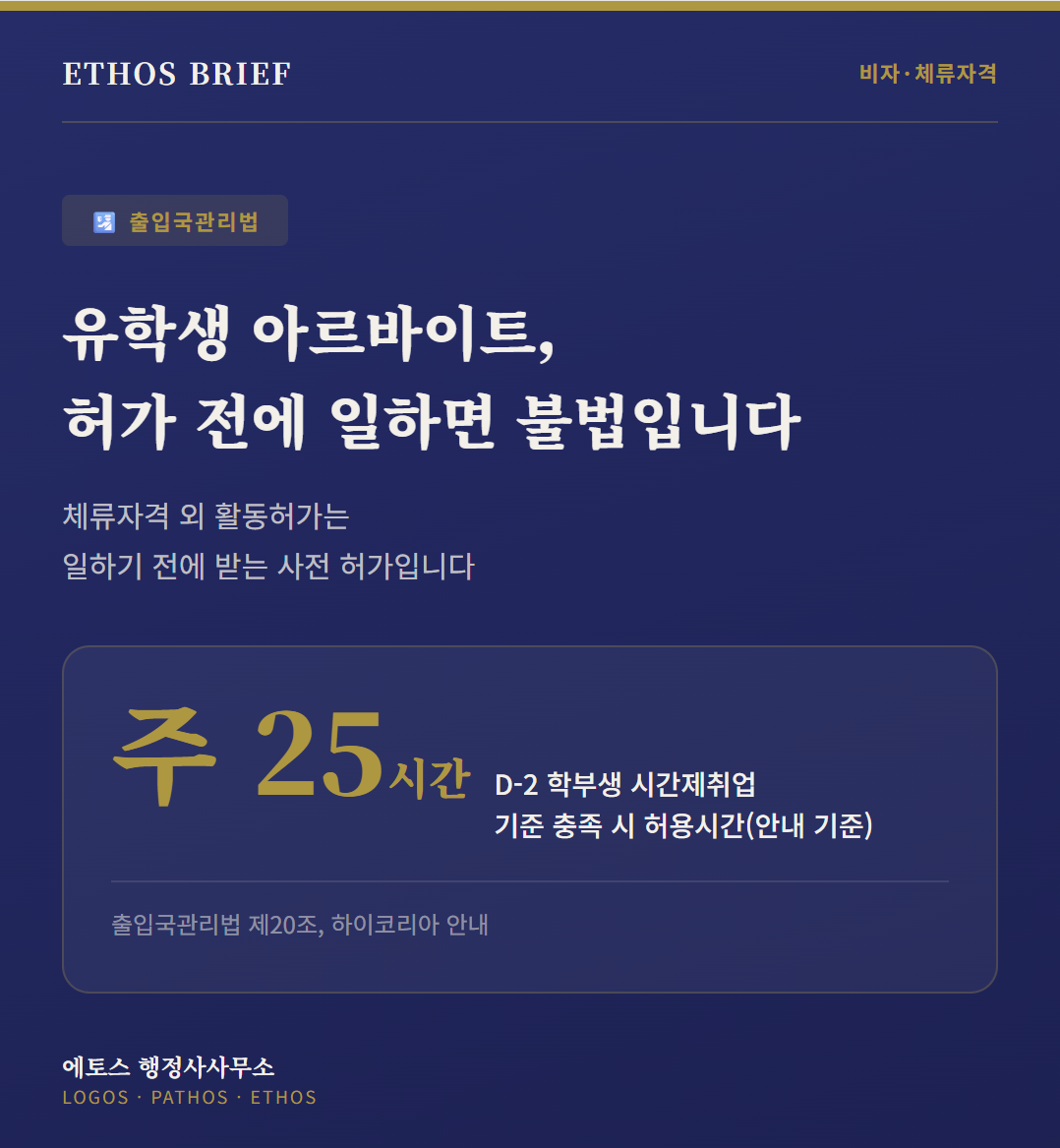
Hello, this is Administrative Agent Jean.
You may have heard stories about D-2 international students in Korea being caught while working part-time at convenience stores.
“Why is it a problem? It is just a small part-time job.”
It may feel that way.
But once a foreign national engages in an activity that does not fall within their current status of stay, it can become a violation of the Immigration Act.
In particular, D-2 international students, D-4 language trainees, and D-10 job-seeking visa holders should not ask only “Can I work?” They must first check whether they can receive permission before starting work.
This article explains what permission for activities outside status of stay is, which visa holders may apply, how far international student part-time work is allowed, and what happens if you work without permission.
Key Summary
| Category | Details | |---|---| | Legal basis | Immigration Act Article 20 | | Target | Foreign nationals who want to engage in an activity outside their current status of stay | | Common example | D-2 international student doing part-time work | | When to apply | Before starting the activity | | Core rule | Working before approval is unauthorized employment | | How to apply | HiKorea visit reservation and immigration office visit, or check e-application availability | | Fee | Must be checked by case | | Processing period | Usually several weeks or longer, depending on the case | | If violated | Deportation, departure order, penalty payment, fine, and future visa disadvantages may apply |
The most important rule is simple.
You cannot start working first and receive permission later.
Permission for activities outside status of stay must be obtained in advance.
What Is Permission for Activities Outside Status of Stay?
Permission for activities outside status of stay is a system for foreign nationals in Korea who want to continue their current visa activity while also engaging in another activity that belongs to a different status category.
Put simply:
It is permission to add another activity while keeping the original purpose of the current visa.
For example, a D-2 international student is in Korea to study. If that student wants to work part-time at a convenience store while attending university, the student keeps the D-2 status but must receive separate permission for the additional activity of part-time work.
This is different from changing status.
| Category | Meaning | Example | |---|---|---| | Change of status | Changing the visa itself | D-2 study → E-7 employment | | Permission for activity outside status | Keeping current visa while adding another activity | D-2 study + part-time work |
So a D-2 student doing part-time work does not change to an E-7 employment visa.
Instead, the student must receive part-time work permission while maintaining D-2 status.
Can I Apply With My Visa?
Not every visa is eligible for permission for activities outside status of stay.
Visa types can be divided into three broad categories.
1. Visas That May Be Eligible Under Conditions
Representative examples include D-2 study, D-4 general training, and D-10 job seeking.
However, these visas do not mean “free employment.”
Conditions must be met, and permission must be received in advance.
| Status | Possibility | Caution | |---|---|---| | D-2 Study | Possible under conditions | School confirmation, grades, Korean ability, work-hour limits | | D-4 General Training | Possible under conditions | Required stay period, attendance, Korean ability | | D-10 Job Seeking | Limited possibility | Must not undermine the purpose of job seeking, individual review needed | | E-series employment visas | Limited possibility | Change or addition of workplace and activity scope must be checked |
D-2 and D-4 part-time work permission is the most common issue.
D-10 is a status for job seeking, so ordinary part-time work should not be assumed to be freely allowed. The activity and current guidelines must be checked.
2. Visas With Broad Employment Freedom Without Separate Permission
Some F-series visas have relatively fewer employment restrictions.
| Status | Employment Possibility | Caution | |---|---|---| | F-2 Residence | Relatively broad | Activity scope should be checked by subtype | | F-5 Permanent Residence | Broadly free | No separate activity-outside-status permission required | | F-6 Marriage Immigrant | Broadly free | No separate activity-outside-status permission required | | F-4 Overseas Korean | Broadly allowed | Some occupations are restricted, such as simple labor and certain public morals-related businesses |
F-6 marriage immigrants and F-5 permanent residents generally have no employment restriction.
However, F-4 overseas Koreans should not assume that every job is allowed. Restricted occupations such as simple labor must be checked.
3. Visas Where Employment Is Generally Difficult
Short-term stay visas generally do not permit employment.
| Status | Employment Possibility | Note | |---|---|---| | B-series | Generally not allowed | Visa waiver or short-term stay | | C-3 | Generally not allowed | Tourism, visit, etc. | | C-4 | Limited possibility | Only if aligned with short-term employment purpose | | Visa-free entry | Generally not allowed | Employment outside stay purpose prohibited |
Working part-time after entering Korea on a tourist or short-term visit status is very risky.
It may not be resolved by saying, “It was only for a short time.”
D-2 and D-4 Student Part-Time Work — The Most Common Case
International student part-time work is one of the most common areas for permission for activities outside status of stay.
D-2 international students and D-4 language trainees are in Korea primarily to study.
Part-time work is therefore an exceptionally permitted activity.
Basic Requirements for Student Part-Time Work
Generally, the following are reviewed:
- Valid D-2 or D-4 status
- Confirmation by the school’s international student office
- Part-time work confirmation form
- Employment contract
- Business registration certificate of employer
- Certificate of enrollment
- Transcript
- Passport
- Alien registration card
- Korean language ability
- Academic sincerity
D-2 students are often required to have at least a C average, usually GPA 2.0 or higher, in the previous semester.
For D-4 language trainees, an overall attendance rate of at least 90% is often important.
If grades or attendance are insufficient, part-time work permission may be difficult.
Permitted Working Hours
Permitted working hours for international students differ depending on program, year level, Korean language ability, university certification status, and preferential factors.
As of 2026, it is not enough to simply say “undergraduates can work 20 hours and master’s students 30 hours.”
The general structure to check is as follows.
| Program | If Korean Requirement Not Met | If Requirement Met | Note | |---|---:|---:|---| | D-4 Language Training | Around 10 hours per week | Around 20 hours per week | Limits may apply even during vacation | | D-2 Associate Degree / Bachelor Years 1–2 | Around 10 hours per week | Around 25 weekday hours | Weekend, holiday, and vacation rules must be checked | | D-2 Bachelor Years 3–4 | Around 10 hours per week | Around 25 weekday hours | Korean language standard may be higher | | D-2 Master’s / Doctoral | Around 15 hours per week | 30 or more weekday hours possible | Detailed rules differ by program | | Preferential cases | Additional hours possible | Additional hours possible | University certification, grades, Korean level, etc. |
The exact hours should be checked through the latest HiKorea status-specific manual and the school’s international office guidance at the time of application.
But there is a more important point.
Work-hour limits matter only after permission is granted.
Before permission is granted, even one hour of work can be a problem.
Prohibited or High-Risk Jobs
International student part-time work is not allowed in every industry.
The following should be treated with special caution:
- Delivery agency work
- Platform rider work
- Parcel delivery
- Logistics centers
- Construction sites
- Manufacturing
- Adult entertainment businesses
- Gambling-related businesses
- Dispatched labor
- Structures where the employer and actual user are different
- Work requiring a professional license
Part-time work in convenience stores, restaurants, or cafes may be eligible, but delivery app rider work, parcel delivery, construction, logistics, and manufacturing can lead to serious consequences if detected.
Delivery agency work is especially risky because many students assume it is “just like part-time work,” but it is often excluded from student part-time work permission.
Application Procedure
Permission for activities outside status of stay must be applied for before the activity begins.
STEP 1. Check Eligibility
First, check whether your current visa and intended activity are eligible.
Review:
- Current status of stay
- Current stay expiration date
- Type of activity
- Workplace
- Employment contract terms
- Working hours
- Whether school confirmation is available
- Whether the job is in a restricted industry
STEP 2. Prepare Documents
Commonly prepared documents include:
- Integrated application form
- Passport
- Alien registration card
- Proof of residence
- Employment contract
- Employer’s business registration certificate
- Part-time work confirmation form
- Certificate of enrollment
- Transcript
- Korean language ability evidence
- Other documents by status
For D-2 and D-4 students, confirmation from the school’s international office is very important.
If you go directly to immigration without school confirmation, filing may be difficult.
STEP 3. Make a HiKorea Reservation or Check E-Application
Make a visit reservation through HiKorea.
The general process is:
- Access HiKorea
- Select visit reservation
- Choose the competent immigration office
- Select the civil service category
- Choose visit date
- Print or save reservation confirmation
Some student part-time work permissions may be available through e-application, so school guidance and HiKorea standards should be checked together.
STEP 4. Apply at the Immigration Office
Visit the immigration office on the reserved date with the documents.
Approval may not be issued immediately.
Supplementary documents may be requested, and the review period can become longer depending on workplace or activity details.
STEP 5. Start Work After Approval
Work should begin only after approval is granted.
Do not start work just because the application has been filed.
Working before the result is issued can be treated as unauthorized employment.
2026 Change — Employment Information Reporting Goes Online
From 2026, online processing of foreign employment information reporting is expanding.
For certain status holders, when a foreign national is employed, information such as occupation, industry, and annual income must be reported. This reporting is increasingly being moved to HiKorea online channels.
However, be careful here.
Employment information reporting and permission for activities outside status of stay are different systems.
| Category | Meaning | |---|---| | Permission for activities outside status | Permission obtained before doing an activity outside the current visa scope | | Employment information reporting | Reporting occupation, industry, income, etc. after or upon employment for relevant statuses |
The fact that online reporting is available does not mean you can work first without permission.
What Happens If You Work Without Permission?
Working without permission for activities outside status of stay can create serious problems for the foreign national.
Possible consequences include:
- Immigration Act violation
- Penalty payment
- Departure order
- Deportation
- Disadvantages in extension of stay
- Disadvantages in change of status
- Disadvantages in future visa applications
- Possible criminal penalty
Under the Immigration Act, engaging in unauthorized activities outside status of stay can lead to strong sanctions.
For short-term visitors, international students, or job-seeking visa holders, unauthorized employment can affect the entire future plan to stay in Korea.
Employers are not exempt.
If an employer hires a foreign national without checking status and work authorization, the employer may also face penalties, fines, or restrictions on hiring foreigners.
“I hired them because the foreign worker said it was okay” is unlikely to be enough.
Frequently Asked Questions
Q. If My Workplace Changes, Do I Need to Apply Again?
Yes. If the workplace or employer changes, new permission is often required.
If you received permission for Convenience Store A but work at Restaurant B, that can become a separate violation.
Working outside the approved workplace, duties, or hours can be a violation.
Q. Can I Work as a Delivery App Rider?
Generally, it is very difficult.
Platform rider work through delivery agencies is often excluded from student part-time work permission.
However, if you have a direct employment contract with a restaurant and delivery is only an incidental duty, individual review may be needed.
The key questions are whether the employer and actual user are the same, whether it is independent platform labor, and whether the job is an eligible permitted activity.
Q. I Have F-6 Marriage Immigrant Status. Do I Need Permission?
Generally, no.
F-6 marriage immigrants generally have no employment restriction, so separate permission for activities outside status of stay is not required.
However, if the job requires a professional license, that separate licensing law must still be checked.
Q. Can F-4 Overseas Koreans Work Any Job?
No.
F-4 allows broad employment activity, but some activities are restricted, including simple labor, gambling-related work, and certain public morals-related businesses.
The industry should be checked.
Q. I Am a D-2 Student. Can I Work Unlimited Hours During Vacation?
It depends on Korean language ability, program, and permission details.
Some degree-course students may have relaxed hour limits during weekends, holidays, and vacations, but D-4 language trainees or students who do not meet Korean language requirements may still be restricted.
Most importantly, even during vacation, you must work after receiving permission.
Where Do People Get Stuck When Preparing Alone?
Permission for activities outside status looks simple, but in practice people often get stuck.
Common issues include:
- Starting work before approval
- Applying to immigration without school confirmation
- Employment contract working hours exceed permitted limits
- Employer’s business registration shows a restricted industry
- Actual workplace differs from the contract address
- Delivery, parcel, logistics, manufacturing, or construction restrictions are missed
- Grade or attendance requirements are not met
- Korean language ability is calculated incorrectly
- Workplace changes without new permission
- Application is filed too close to stay expiration, leaving insufficient processing time
Permission for activities outside status may look like a small part-time work approval, but violations can affect the entire stay in Korea.
What Changes When You Work With an Administrative Agent?
The key is first determining whether the current visa and intended activity fit together.
An administrative agent can review the following flow:
- Current status of stay
- Whether the intended activity is eligible for permission
- Whether the job is in a restricted industry
- Working hours and contract terms
- Whether school confirmation can be issued
- Grade, attendance, and Korean language requirements
- Application document preparation
- HiKorea reservation or e-application availability
- Response to supplementary requests
- Risks for future extension or change of status
Student part-time work in particular requires alignment among the school, employer, and immigration office.
A student may receive school confirmation but still be refused by immigration because the job is restricted. Or the employment contract may be signed, but working hours exceed the permitted range.
The structure should be checked from the beginning.
If You Are Preparing Activity Outside Your Status of Stay
The most dangerous thought for foreign nationals working in Korea is this:
“I’ll start first and apply later.”
Permission for activities outside status is prior permission.
Before applying, check at least the following:
- Can I do this activity under my current visa?
- Is this subject to permission for activities outside status?
- Is permission required, or is reporting enough?
- Is the workplace in a restricted industry?
- Are the working hours in the employment contract within the permitted range?
- Is school confirmation required?
- Do I meet grade, attendance, and Korean language requirements?
- If the workplace changes, do I need new permission?
- Have I avoided starting work before approval?
- Could this disadvantage future extension or change of status?
If you begin working without answering these questions, a simple part-time job can become an immigration violation.
Permission for activities outside status may look small, but it connects to the foreign national’s entire stay in Korea.