
Regional Specialized Visa, Part 2 — Local Government Recommendation Process and Common Traps
Hello, this is Administrative Agent Jean from Ethos Administrative Office.
If you have been working in a regional area of Korea for several years, you may have wondered:
What happens when my current visa expires?
Can I stay longer through a Regional Specialized Visa?
I heard I need a recommendation letter first. Where do I even begin?
When you search online, you will see similar-looking visa names: F-2-R, E-7-4R, and F-4-R. They are connected to regional settlement, but the applicants, procedures, and required documents are not the same.
This is the second article in a three-part series on Korea’s Regional Specialized Visa.
- Eligibility and visa-type comparison
- Local government recommendation process and common traps
- Immigration filing and document preparation
In Part 1, we reviewed the differences between F-2-R, E-7-4R, and F-4-R.
In this article, we will focus on how to actually receive the local government recommendation and where many applicants lose time.
Key Summary
| Category | What to Check | What Can Go Wrong | |---|---|---| | Region | Whether your residence and workplace are in an eligible region | You may be unable to apply at all | | Local Notice | Office, deadline, remaining quota | Application period may close or quota may be exhausted | | Pre-Step | Local registration or education requirement | Your documents may not even be accepted | | Recommendation | City/county filing and metropolitan/provincial recommendation | Waiting time before immigration filing | | Immigration Filing | HiKorea reservation and status-change application | Recommendation alone does not change your visa | | After Approval | Residence and workplace compliance | Problems may arise at extension stage |
A recommendation letter is not the end.
It is the starting point for the immigration application.
What Is the Recommendation Process?
Regional Specialized Visas are different from ordinary status-change applications.
Under Article 24 of the Immigration Act, a foreign national in Korea must receive permission from the Minister of Justice before changing to another status of stay. For Regional Specialized Visas, however, an additional step comes first: a local government recommendation.
The general sequence is:
- Check the local government notice
- Confirm eligible region, visa type, and quota
- Complete any required local pre-registration or education
- Submit recommendation documents to the city, county, district, or designated agency
- Receive the local government recommendation
- Make a HiKorea visit reservation
- Apply for change of status at the competent immigration office
- Wait for immigration review and final decision
The important point is this: each local government may operate the process differently.
Some regions receive applications directly through city or county offices. Some use designated employment centers or support agencies. Some collect applications by a monthly deadline and review them in batches.
That is why copying another person’s case can be risky. The same visa name does not mean the same local procedure.
What Happens If You Start in the Wrong Order?
Imagine a foreign worker in Gyeongbuk who wants to change to a Regional Specialized Visa.
First, he calls the immigration office.
The answer is simple:
Please obtain the local government recommendation first.
So he visits the city hall.
Then the officer asks:
Have you completed the required local registration or education?
If that step has not been completed, the application may not be accepted.
Only then does he contact the relevant local support center or K-Dream Foreign Resident Support Center, and the next available education session may be one or two weeks away.
The actual route becomes:
Immigration office → city hall → education/support center → city hall again → immigration office.
For a foreign worker who is already employed, taking several weekdays off is not easy. For the employer, it also creates a staffing gap.
This is why Regional Specialized Visa applications must begin with the sequence, not the document list.
Local Procedures Differ by Region
Even for the same Regional Specialized Visa system, local governments differ in application office, review method, recommendation schedule, and deadline.
| Region | Application Structure | Practical Point | |---|---|---| | Gyeongbuk | Mainly through city/county offices | Some local procedures may involve K-Dream Center registration or education | | Busan Seo-gu, Dong-gu, Yeongdo-gu | Each district office handles applications | Even within Busan, the office and department may differ | | Jeonbuk State | City/county or designated agency filing, then consolidated review | Applications may be reviewed based on a monthly schedule | | Daegu Seo-gu | Recruitment for F-2-R and F-4-R | Deadline and quota must be checked | | Chungcheongnam-do | City/county filing followed by provincial recommendation | Remaining quota and department contact should be confirmed |
For example, Busan does not necessarily operate as one single filing window. Seo-gu, Dong-gu, and Yeongdo-gu may each have their own office and department.
Jeonbuk explains the Regional Specialized Visa system by separating F-2-R, F-4-R, and E-7-4R, and provides a local filing and review structure.
Daegu Seo-gu separately announced recruitment for regional excellent talent and overseas Korean applicants.
In practice, the exact city, county, or district can matter more than the province name.
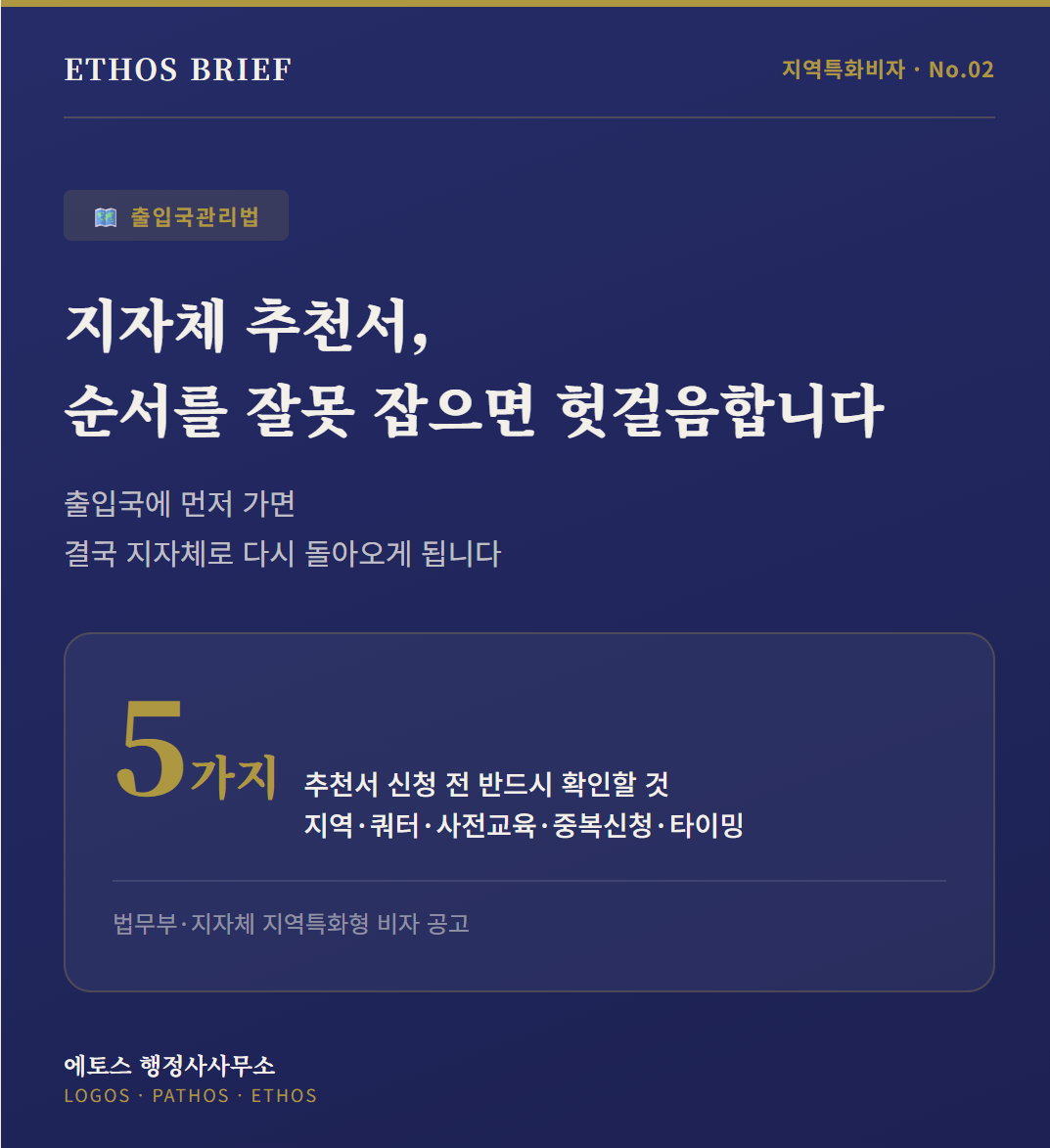
Five Things to Check Before Applying for a Recommendation
1. Is Your Region Eligible?
Not every regional area qualifies.
Regional Specialized Visas are operated based on designated population-declining regions or other program areas. Even within the same province, some cities or counties may be included while others are not.
It is not enough to say, “I live outside Seoul.”
Your residence, workplace, and recommended region must match the local notice.
2. Is There Remaining Quota?
Regional Specialized Visas are quota-based.
Even if you meet the requirements, you may not receive a recommendation if the quota has already been exhausted.
Some local governments regularly disclose remaining quota. Others require direct confirmation with the responsible department.
Before preparing documents, ask this first:
Is there still quota available for my visa type and nationality?
3. Is Pre-Registration or Education Required?
Some regions may require pre-registration or completion of a local education program before accepting a recommendation application.
For example, in certain Gyeongbuk-related procedures, K-Dream Foreign Resident Support Center registration or education may be relevant.
But this should not be treated as a nationwide rule. It depends on the local notice.
If you visit the local office without completing a required pre-step, your documents may not be accepted even if they are otherwise ready.
4. Is There a Duplicate Recommendation Issue?
Some applicants try to apply to several regions at the same time.
The intention is understandable. They want the fastest route. But some local notices restrict duplicate applications or prior recommendation history.
If you have already applied for or received a recommendation from another region, check before filing again.
A poorly planned recommendation strategy can make the process slower, not faster.
5. Is There Enough Time Before Your Current Visa Expires?
Receiving the recommendation does not automatically change your visa.
After receiving the recommendation, you still need to make a HiKorea reservation and submit a status-change application to the immigration office.
The issue is timing. Reservation slots may not be immediately available. During that waiting period, some documents may pass their validity period and need to be reissued.
You should calculate the following dates together:
- Current visa expiration date
- Recommendation filing deadline
- Expected recommendation issuance date
- HiKorea reservation date
- Document issuance date
- Document validity period
Regional visa applications often become difficult not because the documents are impossible, but because the dates do not align.
Traps After Receiving the Recommendation
1. Expired Documents
This is one of the most common problems.
The applicant believes everything is ready. But by the time they visit immigration, one or more documents may be too old.
Income documents, criminal record documents, family or identity-related documents, and other supporting materials may have validity limits depending on the case.
Always check the recommendation date, immigration appointment date, visa expiration date, and document issuance date together.
2. Moving or Changing Workplace After Recommendation
Regional Specialized Visas are based on local settlement.
If you receive a recommendation based on residence and employment in one region, then move or change workplace to another region, this may create a status-management issue.
Moving to the Seoul metropolitan area or working outside the recommended region can be especially risky.
Before changing residence or workplace, confirm with the competent immigration office or seek professional review.
3. Leaving Korea After Receiving the Recommendation
Some applicants plan to briefly visit their home country after receiving the recommendation.
This can be risky.
A change-of-status application is generally based on the applicant being present in Korea. If you leave Korea before or during the immigration review, the application may be affected depending on immigration practice.
The law does not simply state that departure after recommendation automatically cancels the case. However, in practice, departure during a pending status-change process should be handled with great caution.
If you already received a recommendation, the safest approach is to remain in Korea until the immigration filing and review are completed. If departure is unavoidable, contact 1345 or the competent immigration office in advance.
A Recommendation Does Not Guarantee Approval
A local recommendation is not a visa approval.
Change of status is a discretionary immigration decision. Korean courts have recognized that a change-of-status permission has the nature of granting a new legal status, and the immigration authority may consider the applicant’s eligibility, purpose of stay, and public interest when deciding whether to approve.
This means the immigration office may still refuse the application even after a local recommendation if there are problems such as:
- The current status does not allow the requested change
- Income, education, or Korean language proof is insufficient
- Workplace and recommended region do not match
- The purpose of stay does not fit regional settlement
- Prior immigration violations or criminal history are problematic
- Submitted documents contradict each other
Regional Specialized Visas involve both the local government and immigration office.
Passing one stage does not end the process.
How I Would Handle the Process as an Administrative Agent
First, I would check the applicant’s current status of stay and expiration date.
Next, I would confirm whether the residence and workplace are located in an eligible region.
Then I would identify the correct route: F-2-R, E-7-4R, or F-4-R.
After that, I would check the local quota, responsible office, pre-registration or education requirement, and document validity period.
Finally, I would calculate whether the recommendation issuance date and HiKorea appointment can be completed before the current visa expires.
Regional Specialized Visa cases are not won by collecting more documents first.
They are won by getting the order right.
Documents and Information to Prepare Before Consultation
If you want a faster review, prepare the following:
- Current visa status
- Alien registration card expiration date
- Current residence address
- Actual workplace address
- Employer name and business registration information
- Employment contract
- Income proof or salary information
- Korean language proof, if any
- Graduation certificate or degree document, if any
- Desired application region
- Any prior recommendation application or issuance history
- Planned departure from Korea, if any
With this information, we can usually identify whether your case can proceed now, whether a recommendation should be checked first, or whether another visa route may be safer.
FAQ
Q. If I receive the recommendation letter, is the visa automatically approved?
No. The recommendation letter is important, but the final decision is made by the immigration office.
Q. Do I need the local government recommendation before immigration filing?
In most Regional Specialized Visa cases, yes. However, the exact procedure and pre-steps differ by local government, so the local notice must be checked first.
Q. Can I move to another region after receiving the recommendation?
Be careful. Regional Specialized Visas are based on settlement in the recommended region. Residence or workplace changes should be reviewed before moving.
Q. What if my HiKorea appointment is delayed?
Document validity and current visa expiration may become an issue. Plan the recommendation and immigration filing dates together.
Q. How can I check whether quota remains?
Some local governments disclose remaining quota online. Others require direct confirmation with the responsible department.
Closing
Regional Specialized Visas are a valuable opportunity. But without the right sequence, the process can become unnecessarily difficult.
If you contact immigration first, you may be told to obtain a recommendation.
If you visit the local office first, you may be told to complete a pre-step.
If you wait for education, quota may decrease.
If you receive the recommendation, you still need to manage HiKorea reservation and document validity.
That is why the first question should not be only “Am I eligible?”
The better question is:
What is the correct order for my region, visa type, and expiration date?
If you are preparing for a Regional Specialized Visa, start by organizing your current visa, expiration date, residence, workplace, and target region on one page.
That one page can save you several unnecessary visits and protect your continuity of stay.
In the next article, we will cover the immigration filing stage after receiving the recommendation, including tuberculosis test documents, overseas criminal record certificates, income documents, and other practical paperwork issues.