
Extension of Stay in Korea — Why Missing Your Visa Expiration Date Can Become a Serious Problem
Hello, this is Administrative Agent Jean.
In life, we sometimes miss a deadline and lose something important.
Visa deadlines work the same way.
For foreign residents in Korea, the key issue in an extension of stay is not simply whether you “had a visa.” The real question is whether you applied for an extension before your authorized period of stay expired, and whether you still meet the requirements for your current status of stay.
Even being one day late can change the conversation at immigration. Instead of receiving a simple explanation about extension procedures, you may first hear about penalties, violation records, or possible overstay consequences.
That is why extension of stay is one of the most basic but most important immigration procedures for foreigners living in Korea.
This article explains what an extension of stay means, when to apply, what documents are usually required, what differs by visa type, and where applicants most often run into problems.
Key Summary
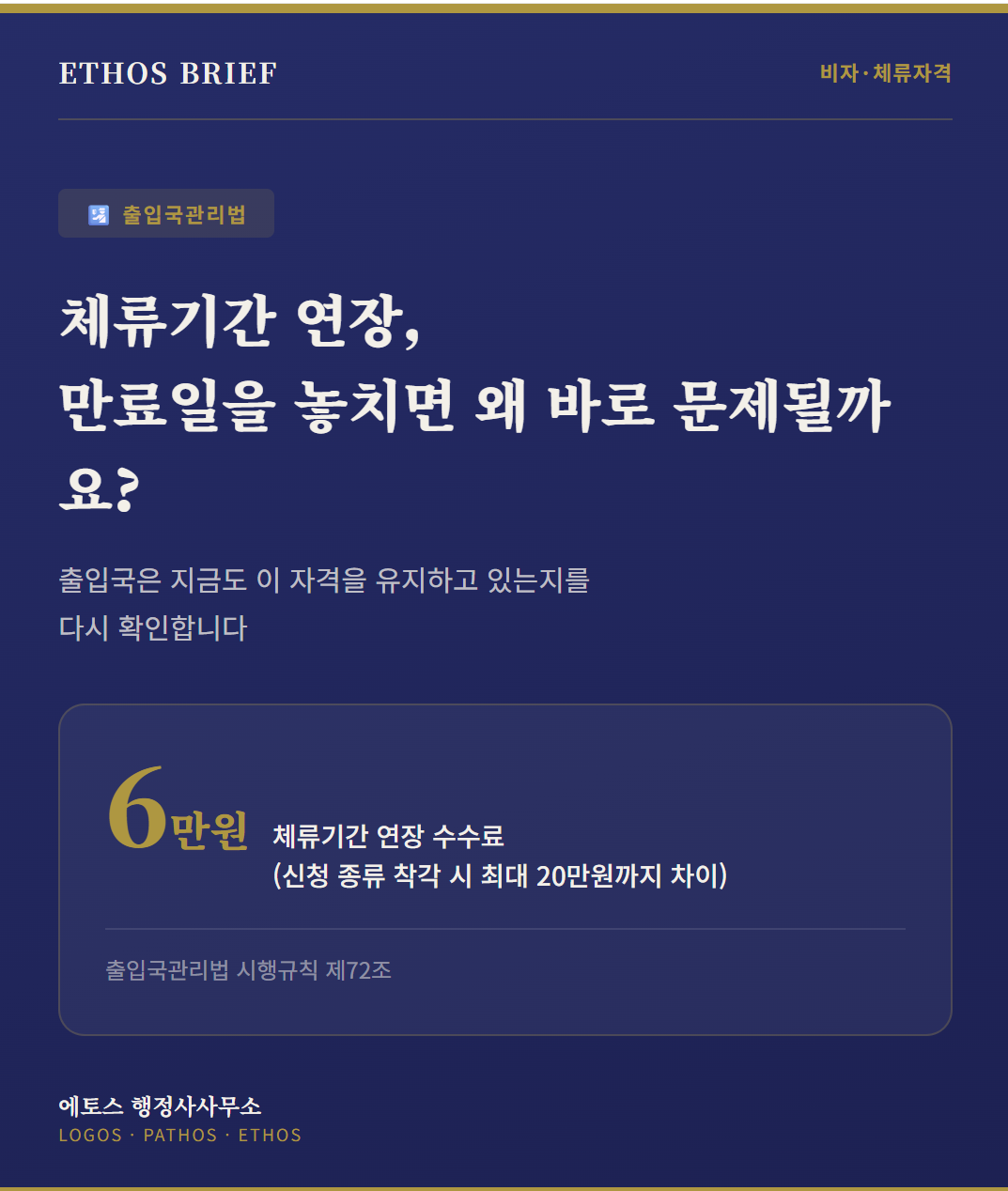
| Category | Details | |---|---| | Procedure | Permission to extend period of stay | | Legal basis | Article 25 of the Immigration Act | | Application timing | Before the current period of stay expires | | Basic documents | Application form, passport, Alien Registration Card, proof of residence, visa-specific documents | | Standard fee | KRW 60,000 | | F-6 fee | KRW 30,000 | | Application method | HiKorea e-Application or visit reservation followed by immigration office visit | | Main review point | Whether the applicant still qualifies for the current status of stay | | If expired | Possible penalty, departure order, deportation review, or future visa disadvantage |
Extension of Stay Is Not Just a “Visa Sticker Renewal”
Many people casually call it a “visa renewal.”
However, under Korean immigration practice, the core issue is more precise:
Can you continue staying in Korea under your current status of stay?
That is why immigration does not review only your passport and Alien Registration Card. Officers may also check whether your current activities still match your visa purpose.
For example:
- A D-2 student may need to show academic enrollment, attendance, grades, and school records.
- An E-7 worker may need to show continued employment, salary payment, and job-code consistency.
- An F-6 marriage migrant may need to show marital relationship, residence, and living foundation.
- A D-10 job seeker may need to show job-seeking activity and financial ability.
In other words, extension of stay is not automatic.
It is closer to a review of whether your current visa status is still valid in substance.
Legal Basis — Apply Before Expiration
Article 25 of the Korean Immigration Act states that a foreigner who wishes to continue staying beyond the authorized period must obtain permission to extend the period of stay before the period expires.
Article 31 of the Enforcement Decree of the Immigration Act also provides that a person applying for extension of stay must submit the application and required documents before the expiration of the stay period.
The practical rule is simple:
Extension of stay is not something to fix after expiration. It is something to file before expiration.
If you wait until the last day, even a small issue can become serious.
Common last-minute problems include:
- HiKorea system errors
- Fully booked immigration office appointments
- Delayed school or employer documents
- Missing residence documents
- Translation or notarization delays
- Additional document requests
- Payment or upload issues during e-Application
For visa extension, the date comes first. Documents come second.
Where Can You Check Your Expiration Date?
Registered foreigners usually check the expiration date on their Alien Registration Card.
If you have extended your stay before, the updated period may be written on the back of the card.
You can also check through:
- Front or back side of the Alien Registration Card
- HiKorea stay period inquiry
- Passport visa or stay information
- Competent immigration office
- Immigration Contact Center 1345
If the dates shown in different places do not match, confirm the latest approved stay period with HiKorea, 1345, or the competent immigration office.
How to Apply for Extension of Stay
There are generally two application routes.
1. HiKorea e-Application
Some extension applications can be filed online through HiKorea.
This is convenient because it may reduce the need to visit an immigration office. However, not every visa type and not every case can be handled fully online.
A visit or additional review may be required if:
- Original documents must be checked
- The visa type requires more detailed review
- Proof of residence is unclear
- Continued eligibility is uncertain
- There is a past immigration violation
- The online system does not allow the application
- The immigration office requests additional documents
2. Visit Reservation and Immigration Office Visit
If e-Application is not available or not appropriate, you must make a visit reservation through HiKorea and visit the competent immigration office.
When reserving, choose the correct service type.
Similar names can mean very different procedures.
| Procedure | Meaning | |---|---| | Extension of stay | Extending the period while keeping the same status | | Change of status | Changing from one visa status to another | | Permission for activities outside status | Keeping current status while adding another permitted activity | | Change or addition of workplace | Changing or adding workplace under an employment visa | | Extension of stay for departure | Short extension for departure preparation due to unavoidable reasons |
Before applying, always ask:
Am I changing my visa type, or only extending the period of my current status?
This distinction determines the entire application strategy.
Review Points by Visa Type
The most important question is whether your current status of stay can still be maintained.
| Visa Group | Main Review Points | Common Problems | |---|---|---| | D-2, D-4 study/training | Enrollment, attendance, grades, tuition payment, residence | Low attendance, weak grades, financial proof requests | | E-1 to E-7 employment | Employment status, job-code match, salary payment, contract continuity | Unclear work, salary issues, contract termination | | F-1 to F-6 family/status | Family relationship, cohabitation, livelihood, residence | Separation, weak relationship proof, insufficient living foundation | | D-10 job-seeking | Job-seeking activity, financial ability, future employment plan | Weak activity proof, bank record issues, suspected unauthorized work | | G-1 miscellaneous | Continued reason for stay, ongoing procedure | Expired reason, insufficient proof | | Short-term stay | Reason for extension, departure plan, flight information | Unclear reason for continued stay |
The name of the document is not enough.
Immigration looks at whether the documents show continued eligibility for the current visa status.
Basic Required Documents
The exact documents differ by status of stay, but the following are commonly required.
Common Documents
- Application form
- Passport
- Alien Registration Card
- Proof of residence
- Application fee
- Status-specific supporting documents
Examples of Proof of Residence
- Lease agreement
- Real estate registration certificate
- Accommodation confirmation form
- Dormitory or goshiwon confirmation
- ID copy of the housing provider
- Relationship proof if staying at a family member’s or friend’s place
Proof of residence is one of the most common reasons for supplementation requests.
Prepare carefully if:
- The lease is not under your name
- You live in a company dormitory
- You stay at a friend’s or family member’s home
- You live in a goshiwon or short-term accommodation
- The lease period has expired
- Your registered address differs from your actual residence
Immigration generally needs residence that can be confirmed through documents, not just a verbal explanation.
Three Places Where Extensions Often Get Stuck
1. Applying Too Late
This is the most dangerous mistake.
Although the law says to apply before expiration, practical preparation takes time.
You may run into:
- School document delays
- Employer document delays
- Proof of residence issues
- Translation or notarization needs
- HiKorea reservation limits
- Online application errors
- Additional document requests
If the expiration date is close, the first step is not gathering every possible document.
The first step is confirming the correct filing route and whether you can still submit on time.
2. Weak Proof of Residence
Proof of residence is not a small administrative detail.
It confirms where the foreign resident is actually staying in Korea and whether that address can be verified.
If the proof is weak, immigration may issue a supplementation request even when other documents look fine.
3. Actual Life No Longer Matches the Visa Status
Problems often arise when the person’s real situation has changed.
Examples include:
- A D-2 student is no longer studying normally
- A D-4 language trainee has poor attendance
- An E-7 worker performs duties different from the approved job code
- Salary payment under an employment visa is unclear
- An F-6 holder needs to explain marital relationship or cohabitation
- A D-10 holder has little evidence of job-seeking activity
- There are signs of unauthorized work
Extension of stay is not just about submitting documents.
It is about showing that you still qualify for the status you already have.
Fees
As of 2026, the standard fee under the Enforcement Rule of the Immigration Act is as follows.
| Application Type | Fee | |---|---:| | General extension of stay | KRW 60,000 | | F-6 marriage migrant extension | KRW 30,000 | | Extension of stay for departure | No fee |
Be careful not to confuse extension fees with other immigration application fees.
| Application Type | Fee | |---|---:| | Extension of stay | KRW 60,000 | | Change of status | KRW 100,000 | | Change to F-5 permanent residence | KRW 200,000 | | Permission for activities outside status | KRW 120,000 |
Choosing the wrong application type can delay or derail the filing.
Why Does Overstay Immediately Lead to Penalty Issues?
Once the authorized period of stay expires, the issue is no longer a simple extension.
It becomes an overstay issue.
Depending on the case, this can lead to:
- Administrative penalty
- Departure order
- Deportation review
- Disadvantage in future visa extension or change
- Negative impact on future re-entry screening
- Issues for the employer or school
You may see online references to specific penalty amounts, but penalties vary depending on overstay period, circumstances, past violation history, visa type, and whether the person voluntarily reports.
The important point is not memorizing one penalty amount.
The important point is making sure the application is filed before expiration.
Special Extension Situations
Not all extension cases follow the ordinary route.
Special Rules for Certain Victims, Including Marriage Migrants
The Immigration Act includes special rules that may allow extension of stay for certain foreign residents, including marriage migrants, when rights-relief procedures are pending in relation to domestic violence, sexual violence, child abuse, human trafficking, or similar circumstances.
These cases require a different document strategy.
Instead of ordinary family relationship documents only, the applicant may need to organize:
- The nature of the harm
- Pending legal or administrative procedures
- Need for protection
- Reason continued stay is necessary
- Supporting evidence from relevant institutions
Extension of Stay for Departure
An extension for continued residence is different from an extension for departure.
If a person intends to leave Korea but cannot depart immediately due to flight unavailability, illness, accident, or another unavoidable reason, an extension of stay for departure may be considered.
Important documents may include:
- Flight ticket or reservation
- Planned departure date
- Written explanation
- Medical or accident-related proof, if applicable
- Documents showing why immediate departure is difficult
The purpose matters.
Are you trying to keep living in Korea, or are you preparing to leave Korea?
The answer changes the documents.
A Practical Way to Prepare
It helps to organize the documents into three groups.
1. Identity Documents
These are the basics.
- Passport
- Alien Registration Card
- Application form
- Photo, if required
- Fee
2. Documents Showing Continued Visa Eligibility
This is the core of the review.
| Status | Preparation Focus | |---|---| | D-2, D-4 | Enrollment, attendance, grades, tuition, school confirmation | | E-7 and other employment visas | Employment, salary, contract, job-code consistency | | F-6 | Marriage relationship, cohabitation, livelihood, residence | | D-10 | Job-seeking activity, financial ability, future employment plan | | F-2 | Income, residence foundation, continued eligibility | | G-1 | Continued existence of the reason for stay |
3. Living Foundation in Korea
These documents show whether the applicant’s actual life in Korea is stable and verifiable.
- Proof of residence
- Income or financial proof
- Family relationship documents
- Employment or academic documents
- Bank statements, if required
- Written explanation, if needed
A strong extension file is not just a large bundle of documents.
It should clearly answer this question:
Why should this person continue staying in Korea under this status of stay?
Frequently Asked Questions
Q. Can I apply on the expiration date?
It may be possible in some situations, but it is not recommended.
Online errors, reservation issues, missing documents, payment problems, or jurisdiction checks can create immediate risk. Applying with enough time before expiration is much safer.
Q. What if my Alien Registration Card and HiKorea show different dates?
Confirm the latest approved stay period.
Check HiKorea, your Alien Registration Card, and if necessary, call 1345 or contact the competent immigration office.
Q. What if my school or employer documents are delayed?
First confirm the expiration date and filing route.
Depending on the case, you may need to explain the delay and check whether the immigration office will accept supplementation later.
Q. Can I use a residence document that is not under my name?
It may be possible, but you need documents proving that you actually live there.
Examples may include an accommodation confirmation form, ID copy of the housing provider, dormitory confirmation, or documents explaining your relationship with the person providing the residence.
Q. Can I leave Korea while my extension is under review?
It depends on your visa type and situation.
Leaving Korea during review may affect or cancel the pending application in some cases. Before traveling, confirm with HiKorea, 1345, or the competent immigration office.
Extension of Stay Checklist
Before applying, check the following:
- Have you confirmed the exact expiration date?
- Is HiKorea e-Application available for your visa type?
- Do you need a visit reservation?
- Are you applying for extension, not change of status?
- Does your proof of residence match your current address?
- Do you have documents showing continued eligibility?
- Did anything change in your school, employment, family, or residence situation?
- Is there any risk of unauthorized work or unreported address change?
- Have you checked the correct fee?
- Do you still have enough time to respond to a supplementation request?
Closing
Extension of stay may look simple.
But if you move too late, it can become one of the most dangerous immigration procedures.
The Korean Immigration Act requires foreign residents to obtain extension permission before the authorized period expires. The required documents and review points differ by visa type, and the standard fee is generally KRW 60,000, with KRW 30,000 for F-6 marriage migrants.
The two most important points are simple:
First, do not miss the expiration date.
Second, show that you still qualify for your current status of stay.
If your expiration date is approaching, or if your school, employer, family relationship, or residence has changed, start by reviewing that point first.