
Korea Digital Nomad Visa, Part 1 — What Remote Workers Must Check Before Applying
Hello, this is Administrative Agent Jean from Ethos Administrative Office.
You want to stay in Korea long-term while working remotely.
A 90-day tourist stay is too short.
A work visa does not fit because you are not employed by a Korean company.
In that situation, the visa to consider is Korea’s Digital Nomad Visa, officially called the F-1-D Workation Visa.
But this is not a visa you should prepare based only on its name.
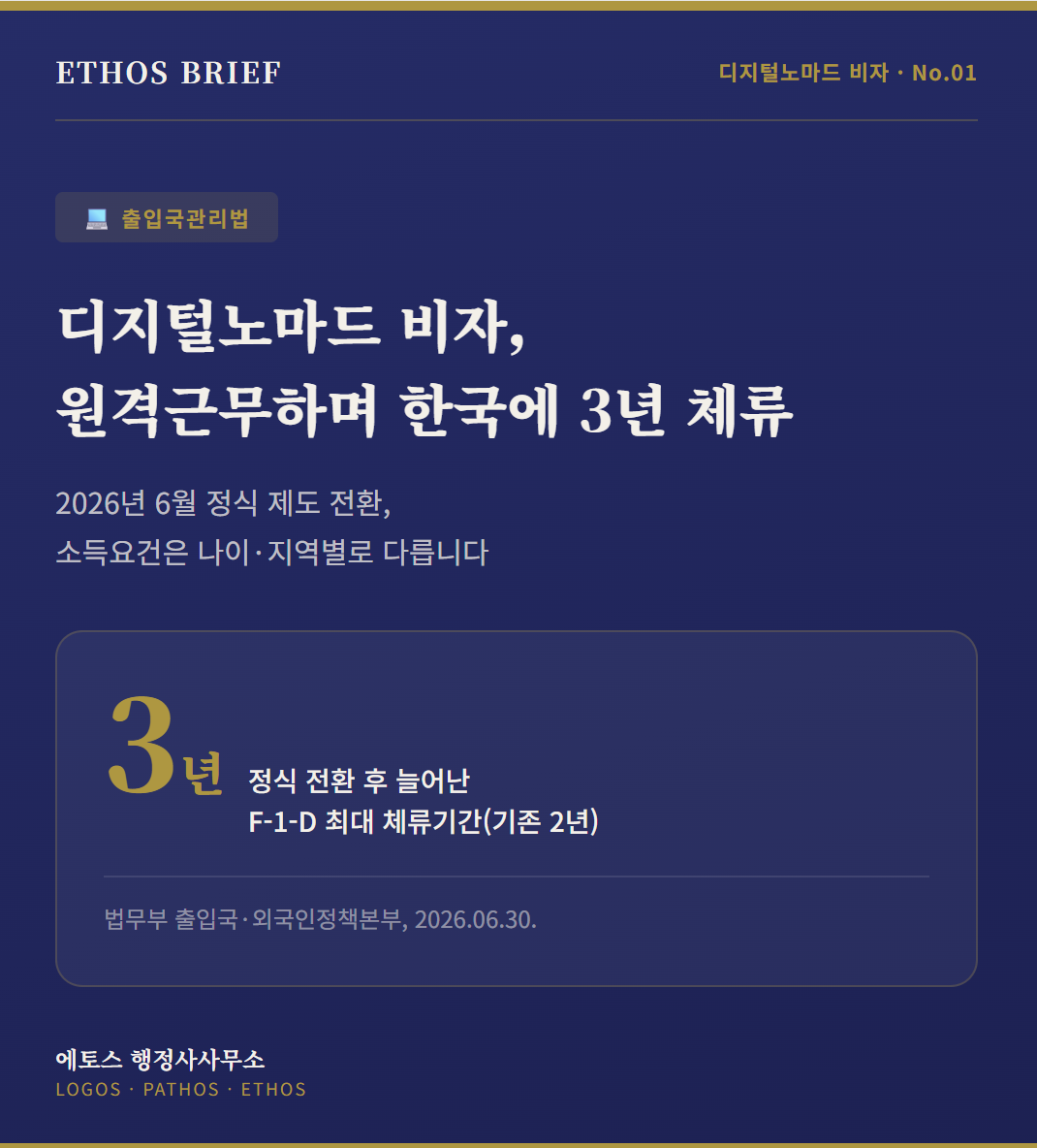
Since June 30, 2026, Korea has converted the program from a pilot system into a permanent visa category. The income requirements have changed, the maximum stay has expanded, and the applicable threshold now depends on age, region of stay, and whether family members accompany the applicant.
This series will explain the updated Digital Nomad Visa requirements and the practical reasons applications may be returned or refused.
- Permanent launch and common traps when applying alone
- Timing issues when changing from short-term status to F-1-D
- Practical FAQ and overlooked issues
This is Part 1.
Key Summary
| Category | Details | |---|---| | Status Code | F-1-D Workation Visa | | Target Applicant | Remote worker employed by an overseas company or owner of an overseas business | | Work Experience | At least one year in the same field | | Purpose of Stay | Tourism and remote work in Korea | | Korean Employment | Not permitted | | Period of Stay | One-year basis, extendable up to three years | | Income Requirement | GNI 1x to 2x depending on age, region, and family accompaniment | | Application Route | Korean embassy/consulate overseas or change of status in Korea | | Key Documents | Employment or business proof, income proof, criminal record certificate, medical insurance, residence documents |
The Digital Nomad Visa is not a visa that allows you to work in Korea.
It allows you to perform overseas work remotely while staying in Korea.
Missing this distinction can create unauthorized activity issues.
Why Korea’s Digital Nomad Visa Matters Now
The Ministry of Justice converted the Digital Nomad Visa, which had been operated as a pilot program since 2024, into a permanent program from June 30, 2026.
During the pilot period from January 2024 to May 2026, Korea issued 743 Digital Nomad Visas. As of May 2026, 398 holders were registered foreign residents, and about 85% of them were staying in Seoul, Gyeonggi, or Incheon.
In other words, the system existed, but the actual inflow was limited and heavily concentrated in the capital area.
The permanent program introduced two major changes:
- Income requirements were relaxed depending on age and region of stay.
- Maximum stay was extended from two years to three years.
This is more than a technical rule change.
It means Korea is beginning to view remote workers not only as short-term tourists, but also as long-stay consumers and potential contributors to regional revitalization.
Three Key Changes After the 2026 Permanent Launch
1. Income Requirements Now Differ by Age and Region
Under the pilot program, applicants generally had to meet an income threshold of at least two times Korea’s previous-year per-capita Gross National Income (GNI), regardless of age or region of stay.
For 2026, the relevant GNI figure is KRW 52,416,000.
Under the permanent program, the threshold differs by age and region.
| Applicant Category | Seoul Metropolitan Area | Non-Seoul Metropolitan Area or Population-Declining / At-Risk Region | |---|---:|---:| | Age 18 to 34 | 1.5x GNI | 1x GNI | | Age 35 or older | 2x GNI | 1.5x GNI | | Accompanied by Family | 2x GNI | 1.5x GNI |
For example, an applicant aged 18 to 34 who will stay in a non-Seoul metropolitan area or a population-declining or at-risk region may qualify under the 1x GNI threshold.
But an applicant aged 18 to 34 staying in Seoul, Gyeonggi, or Incheon must check the 1.5x GNI threshold.
If family members accompany the applicant, a higher threshold applies regardless of age.
A common mistake is assuming that “young applicants only need 1x GNI.”
That is not enough.
The age requirement and regional requirement must match.
2. Maximum Stay Increased to Three Years
Under the pilot program, the basic structure was one year plus one extension, for a maximum stay of two years.
Under the permanent program, applicants may stay up to three years through one-year periods and extensions.
For remote workers, the difference between one year and three years is significant.
One year feels like an extended trip.
Three years can become a real living plan: housing, local community, Korean language learning, and regional consumption patterns all change.
However, “up to three years” does not mean three years are automatically granted at once.
At each extension stage, immigration may continue to review overseas employment or business status, income, medical insurance, and purpose of stay.
3. It Is Now a Permanent Program
The biggest change is program stability.
During the pilot period, applicants had to worry about whether the system might end. Since June 30, 2026, the F-1-D Workation Visa has become a permanent visa category within Korea’s long-stay framework.
That does not mean the review is easy.
As applications increase, income proof, insurance documents, criminal record certificates, and domestic activity scope may be reviewed more carefully.
Basic Eligibility
The F-1-D Workation Visa generally requires the following:
| Requirement | Details | |---|---| | Age | 18 or older | | Employment or Business | Employed by an overseas company or owns an overseas business | | Work Type | Able to work remotely while in Korea | | Experience | At least one year in the same field | | Income | Meets the applicable GNI threshold by age, region, and family status | | Medical Insurance | Covers medical treatment and repatriation or evacuation | | Criminal Record | Overseas criminal record certificate and authentication | | Korean Activity | Korean employment and domestic for-profit activity restricted |
Family members may also apply.
In general, a legal spouse and minor children may be considered. However, family accompaniment raises the applicable income threshold, so do not apply the same standard as a single applicant.
Two Application Routes
1. Applying Through a Korean Embassy or Consulate Overseas
If you are outside Korea, you generally apply through the Korean embassy or consulate with jurisdiction over your place of residence.
Each mission may have slightly different document standards and submission procedures.
Some missions review the wording of income documents, criminal record certificates, insurance certificates, and remote work confirmation letters very carefully.
For an employment verification letter, it is safer to include:
- The applicant is employed by an overseas company
- The applicant has worked in the same field for at least one year
- Remote work is permitted
- Remote work from Korea is permitted
- Expected period of remote work in Korea
2. Changing Status While in Korea on Short-Term Stay
If you are already in Korea under B-1, B-2, C-3, or another short-term status, you may be able to apply for a change of status to F-1-D if you meet the requirements.
In this route, timing is everything.
You must have enough remaining stay period to prepare the criminal record certificate, translation, notarization, apostille or consular confirmation, medical insurance, income documents, and immigration filing.
A 90-day stay may look long, but it is often not enough once overseas documents are involved.
Required Documents
Exact documents may vary depending on the embassy, consulate, or immigration office, but the following are commonly reviewed.
| Category | Main Documents | |---|---| | Basic Documents | Application form, passport, photo, fee | | Employment or Business Proof | Employment certificate, remote work approval letter, business registration or company registration | | Experience Proof | Evidence of at least one year in the same field | | Income Proof | Tax return, payslips, bank statements, platform income reports | | Criminal Record | Overseas criminal record certificate, apostille or consular confirmation | | Medical Insurance | Insurance certificate covering medical treatment and repatriation or evacuation | | Region of Stay | Accommodation booking, lease agreement, workation facility reservation | | Family Documents | Marriage certificate, birth certificate, family relationship proof |
The document list is not the only issue.
The documents must connect with one another.
If your income documents show enough income but your employment letter does not mention remote work approval, a supplement request may follow. If the insurance amount is sufficient but repatriation wording is missing, the document may be questioned.
Trap 1 — Applying Based Only on the “Lower Income Requirement” Headline
Imagine a 32-year-old French UX designer with annual income of KRW 60 million.
She reads that young applicants may qualify with 1x GNI and assumes she is eligible.
But if her intended place of stay is Mapo-gu, Seoul, the result changes.
Even if she is aged 18 to 34, staying in the Seoul metropolitan area requires the 1.5x GNI threshold. Based on 2026 GNI of KRW 52,416,000, 1.5x GNI is about KRW 78,624,000.
KRW 60 million may be enough for the young non-metropolitan category, but not for the young Seoul metropolitan category.
Another example: a 42-year-old British backend developer plans to stay in Jeonju. Jeonju is outside the Seoul metropolitan area, but because the applicant is 35 or older, the relevant threshold is generally 1.5x GNI.
The correct understanding is not “the income rule became easier.”
It is:
The income rule now depends on your age, stay region, and family status.
Trap 2 — Income Is Enough, but the Proof Is Weak
Freelancers, platform workers, sole proprietors, and contractors with multiple clients often face the biggest difficulty in income proof.
Suppose a Canadian graphic designer earns income through Upwork and Fiverr.
The annual total exceeds the required amount.
But monthly income varies, and there are multiple clients.
A single payslip will not solve this.
The applicant may need to combine:
- Home-country tax return
- Platform income reports
- Bank deposit records
- Client contracts
- Invoices
- Business or freelancer registration
- Exchange-rate explanation
The issue is that “I earned enough” and “I can prove it in a way immigration accepts” are not the same thing.
Income proof is not only about the amount.
It is about structure.
The reviewing officer should be able to understand annual income, income source, overseas work nature, and remote-work eligibility at a glance.
Trap 3 — Starting the Criminal Record Certificate Too Late
Overseas criminal record documents can take time.
If the issuing country is not a party to the Apostille Convention, consular confirmation may be required. If the document is not in English or Korean, translation and notarization may also be needed.
For U.S. applicants, the FBI Identity History Summary and apostille may be relevant. Other countries may require documents from police, justice, or foreign affairs authorities.
If you are changing status in Korea from a short-term stay, this document often becomes the bottleneck.
Starting preparation on day 80 of a 90-day B-2 stay is likely too late.
The criminal record certificate is not a document to prepare later.
It is one of the first documents to check.
Trap 4 — Buying the Wrong Medical Insurance
Medical insurance is another common problem.
Not every travel insurance plan satisfies the requirement.
Check the following:
- Whether the coverage amount meets the required threshold
- Whether medical treatment is covered
- Whether medical evacuation or repatriation is covered
- Whether the insurance covers the full intended stay period
- Whether the certificate clearly states the covered items
- Whether the wording matches the embassy or immigration office’s requirement
Missing repatriation wording can lead to a supplement request or rejection.
A cheaper short-term policy may save money at first but put the entire visa application at risk.
Trap 5 — Thinking “A Little Freelance Work in Korea” Is Fine
The Digital Nomad Visa does not permit domestic employment in Korea.
It permits remote work for an overseas employer or overseas business.
Contracting with a Korean company, providing consulting to a Korean startup, or receiving design, translation, or marketing income from a Korean client may create unauthorized activity issues.
“It is freelance, not employment” is not a safe answer.
Under Korean immigration law, activity outside the permitted status may require separate permission. If the activity exceeds the permitted scope, it may lead to deportation, extension refusal, or re-entry restrictions.
If you stay in Korea under F-1-D, you must manage the source of your income carefully.
Trap 6 — Running Out of Time When Changing from Short-Term Stay
Changing from B-1, B-2, or C-3 to F-1-D may be possible.
But you must apply before your current stay period expires.
The problem is preparation time.
If you prepare alone, the timeline can look like this:
| Preparation Item | Estimated Time | |---|---| | Eligibility check | 1 to 2 weeks | | Criminal record issuance and authentication | 2 to 6+ weeks | | Translation and notarization | Several days to several weeks | | Income document organization | 1 to 2 weeks | | Insurance confirmation | Several days to 1 week | | Immigration reservation | Varies by office |
If you begin around day 70 or 80 of a 90-day stay, the documents may not be ready before expiration.
Once the stay period expires, changing status becomes difficult and unlawful stay issues may arise.
If you are considering a change of status while in Korea, start immediately after arrival.
Why Refusal or Return Makes the Case Harder
It is tempting to think, “If it is refused, I can just apply again.”
In practice, the loss can be significant.
1. Costs Are Not Fully Recoverable
Translation, notarization, apostille, consular confirmation, insurance, mailing, and document issuance fees may already have been paid.
Some insurance plans may be non-refundable or only partially refundable.
2. Time Is Lost
One supplement request or returned application can easily cost two to six weeks.
If you are in Korea on a short-term stay, that time may be the difference between lawful filing and expiration.
3. Refusal History Remains
The reason for a prior refusal may be reviewed in a later application.
If the same issue has not been corrected, the next application may face closer scrutiny.
4. Domestic Change May Become Impossible
If a change-of-status application is returned or refused while your short-term stay is almost over, you may need to leave Korea and apply again through a Korean embassy or consulate abroad.
This is why the first filing matters.
Pre-Application Checklist
If any of the following is unclear, check your direction before collecting documents.
- Are you employed by an overseas company or do you own an overseas business?
- Is your work for a non-Korean employer or business?
- Can you prove at least one year of experience in the same field?
- Have you decided whether you will stay in the Seoul metropolitan area or outside it?
- Will your spouse or children accompany you?
- Have you calculated the applicable GNI multiplier?
- Can your income be proven with simple payslips, or do you need multiple documents?
- Is the issuing country of your criminal record certificate an Apostille Convention country?
- Does your medical insurance cover medical treatment and repatriation?
- Does your insurance cover the full intended stay period?
- Will you receive income from any Korean company or Korean client?
- If you are currently in Korea on short-term stay, do you have more than 30 days remaining?
This visa is not only about whether you seem eligible.
It is about whether your eligibility can be proven.
How Long Does It Take to Prepare Alone?
Preparing alone often takes four to eight weeks or more.
It can take longer if your case involves:
- Freelance or platform income
- Income from multiple countries
- Family accompaniment
- Criminal record documents in a language other than English
- Documents from a non-Apostille country
- Change of status from short-term stay in Korea
- Insurance wording review
- Claiming a non-metropolitan income threshold
Working with a professional can help organize eligibility, income proof structure, translation and notarization timing, insurance requirements, and change-of-status strategy together.
The key is not simply collecting documents.
The key is designing the file so the reviewing officer can understand it.
Cost Considerations
Digital Nomad Visa work may include different scopes depending on the case.
Common review points include:
- Applicable income threshold
- Income proof structure
- Overseas remote work evidence
- Medical insurance requirement
- Criminal record authentication method
- Embassy filing or domestic change-of-status strategy
- Family-accompaniment documents
- Risk of supplement request
Consultation fees generally range from KRW 33,000 to KRW 55,000, and may be credited toward representation fees if the case proceeds.
Exact fees depend on application route, document condition, region of stay, family accompaniment, and current visa status.
How I Would Organize the Case as an Administrative Agent
First, I would check where the applicant is now.
The strategy differs depending on whether the applicant will apply overseas or change status while already in Korea.
Next, I would calculate the income threshold based on age, region of stay, and family accompaniment.
Then I would review the income structure.
A salaried employee, freelancer, business owner, and platform worker each need a different document strategy.
After that, I would check the criminal record certificate: issuing country, apostille or consular confirmation, translation needs, and timeline.
Finally, I would match the medical insurance and accommodation documents with the intended stay plan.
After this sequence, it becomes clear not only whether the applicant may qualify, but whether the filing can be completed on time.
Closing
Korea’s Digital Nomad Visa is an attractive option for foreign remote workers who want to stay in Korea long-term.
Since June 30, 2026, the program has become permanent, the income threshold has been adjusted by age and region, and the maximum stay has expanded to three years.
But only part of the requirement became easier.
The document review itself still requires careful preparation.
Income proof, criminal record certificates, medical insurance, remote-work confirmation, domestic activity restrictions, and short-term status timing must all align.
This is especially important for applicants trying to change from short-term stay to F-1-D inside Korea.
Ninety days may look sufficient, but one delayed overseas document can consume the entire window.
If you are preparing for the Digital Nomad Visa, start by organizing your age, intended region of stay, income structure, current status, and criminal record certificate timeline on one page.
That one page is the first step toward reducing refusal risk.
In the next article, we will look at a concrete case where an applicant decides to change from B-2 to F-1-D around day 80, only to discover that criminal record authentication takes three weeks.