
OASIS 1 Lecture Review: What Foreign Tech Founders Need Before Applying for a Startup Visa
Hello, this is Administrative Agent Jean.
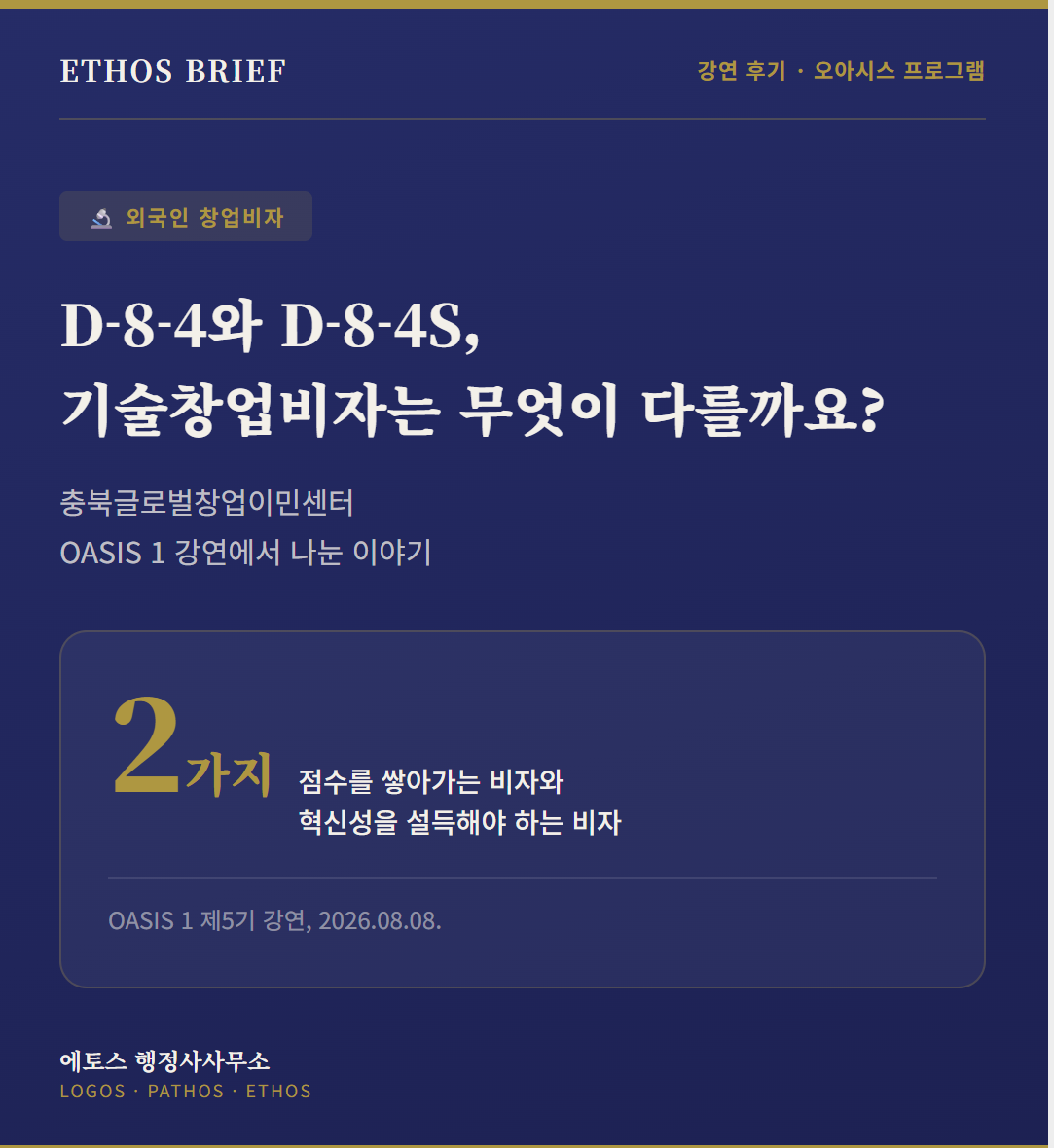
On August 8, 2026, I delivered a lecture for OASIS 1 Cohort 5 at the Chungbuk Global Startup Immigration Center in Osong, Chungbuk.
The subject I covered was Immigration Law and the Meaning of Korea’s Immigration System.
I did not want this lecture to be limited to a simple explanation of “which documents are required for a foreign startup visa.”
For foreign founders, the real questions are usually much deeper.
- Can my idea be explained as a technology-based startup?
- Should I prepare for D-8-4 or D-8-4S?
- How does intellectual property affect visa review?
- If my application is refused, how can I understand the reason?
- If I already hold an F-category visa, does it even make sense to change to an investment visa?
In this article, I will share a review of the OASIS 1 lecture and organize the practical points that foreign tech founders should consider before applying for a Korean startup visa.
Key Summary
| Category | Details | |---|---| | Date | August 8, 2026 | | Location | Chungbuk Global Startup Immigration Center, Osong | | Program | OASIS 1 Cohort 5 | | Lecture Topic | Immigration Law and the Meaning of Korea’s Immigration System | | Main Audience | Foreign founders considering D-8-4, D-8-4S, or other startup visa routes | | Participants | 23 participants, mainly from Mongolia, Uzbekistan, and Russia | | Added Topic | Information disclosure requests, visa refusal analysis, and IP review response | | Format | Interactive lecture using Mentimeter |
How Was This Different from the Previous OASIS 4 Lecture?
I previously wrote a review of my OASIS 4 lecture.
OASIS 4 lecture review: https://blog.naver.com/attorney_jean/224335458847
Both OASIS 1 and OASIS 4 are connected to foreign startup visas.
But the direction of each program is different.
| Category | OASIS 1 | OASIS 4 | |---|---|---| | Program Type | Intellectual property basic education | Startup basic education | | Main Topic | Ideas, invention, IP, and technology startup understanding | Startup operations, management, and business practice | | Main Audience | Founders preparing for D-8-4 or D-8-4S | Founders preparing for D-8-1, D-8-4, D-9, or other business routes | | Visa Focus | How technology and IP can be explained in a visa context | How business operation and immigration strategy are connected | | Practical Question | Can this idea be treated as a tech startup? | Which visa fits this business structure? |
OASIS 4 is closer to general startup practice.
It covers business operation, tax, legal, administrative procedures, immigration, and how to work with professionals.
OASIS 1 sits one step earlier.
Before sales or investment, the key question is how to explain idea, technology, intellectual property, and business potential.
In short:
OASIS 4 asks how the business will operate.
OASIS 1 asks whether the idea can be explained as a technology-based startup in Korea.
D-8-4 and D-8-4S: What Is the Difference?
One of the most confusing points for foreign tech founders is the difference between D-8-4 and D-8-4S.
Both are connected to technology-based startup activity, but their structures are different.
D-8-4 Tech Startup Visa
D-8-4 is commonly known as the Tech Startup Visa.
It is a visa route for foreign founders who want to establish and operate a company in Korea based on technology, intellectual property, or innovative business capacity.
According to OASIS guidance, D-8-4 issuance or change of status generally involves the following elements:
- Degree or recommendation-related basic requirement
- At least 60 OASIS points
- Establishment of a Korean corporation
- Intellectual property or technology startup-related proof
- Business feasibility
- Residence and business office documents
The important point is that D-8-4 is not simply a capital-based visa.
Technology, intellectual property, business feasibility, and the founder’s preparation must be explained together.
D-8-4S Startup Korea Special Visa
D-8-4S is often explained in practice as the Startup Korea Special Visa.
It was introduced by the Ministry of SMEs and Startups and the Ministry of Justice.
Under this system, a private evaluation committee reviews the startup’s business feasibility, innovation, Korean market entry potential, and contribution to the Korean economy.
If recommended by the Ministry of SMEs and Startups, the Ministry of Justice conducts the final immigration review.
Compared with the existing D-8-4 route, which often relies on OASIS points and corporate establishment, the Startup Korea Special Visa minimizes quantitative requirements and focuses more on innovation and business potential.
| Category | D-8-4 Tech Startup Visa | D-8-4S Startup Korea Special Visa | |---|---|---| | Core Structure | OASIS point-based route | Private evaluation committee + MSS recommendation | | Main Review | IP, OASIS points, corporation, business feasibility | Innovation, business feasibility, growth potential, Korea market strategy | | Best Fit | Founder with technology or IP who can build OASIS points | Founder with a highly innovative business model | | Corporation | Usually important in the filing structure | Application before incorporation may be considered depending on the process | | Caution | Points and documents must be accumulated systematically | Recommendation does not guarantee final immigration approval |
In simple terms:
D-8-4 is a visa that builds through points and documents.
D-8-4S is a visa that must persuade through innovation and business potential.
Which route is better depends on the item, IP status, team, incorporation stage, investment status, and Korea market entry plan.
New Topic Added This Time: Information Disclosure Requests
For this OASIS 1 lecture, I added information disclosure requests as a separate topic.
Why discuss information disclosure in a foreign startup visa lecture?
Because startup visas are ultimately reviewed and decided by institutions.
And in many cases, applicants do not clearly understand what was lacking, how the review was conducted, or why supplementation or refusal occurred.
An information disclosure request can become a tool for building the next strategy.
Why IP Review and Information Disclosure Are Connected
In IP-based visa preparation, technology-related information is central.
However, when applicants request review standards, decision records, or evaluation materials from relevant institutions, the institution may issue a non-disclosure decision.
A common legal basis is Article 9, Paragraph 1, Item 5 of the Official Information Disclosure Act.
This provision allows non-disclosure of certain information related to audit, supervision, inspection, examination, regulation, bidding, technical development, personnel management, decision-making processes, or internal review processes when disclosure may significantly interfere with fair performance of duties.
If IP review or evaluation records are treated as examination or review-related materials, non-disclosure may occur.
But here is the important point:
A non-disclosure decision does not always mean the matter is over.
When you receive a non-disclosure notice, you should check:
- What information you requested
- Which institution made the decision
- Which legal provision was cited
- Which item under Article 9 was applied
- Whether partial disclosure was considered
- Whether appeal procedures were properly explained
- Whether objection, administrative appeal, or litigation may be considered
An information disclosure request is not a magic tool that always produces documents.
But it can be the starting point for understanding why a case was refused, what needs to be supplemented, and how to prepare the next filing.
Can Foreigners File Information Disclosure Requests in Korea?
Possibly, yes.
Under the Official Information Disclosure Act, foreign applicants are governed by the Presidential Decree.
The Enforcement Decree allows certain foreigners to request information, including foreigners who have a fixed address in Korea and reside here, foreigners temporarily staying for academic or research purposes, and corporations or organizations with an office in Korea.
Therefore, a foreign founder who is legally staying in Korea with a domestic address may be able to file an information disclosure request.
After incorporation, a Korean office or corporation may also be able to file in its own name.
However, actual availability and scope of disclosure depend on the requested information, the institution holding the records, non-disclosure grounds, personal information, and trade secret issues.
When Is an Information Disclosure Request Useful?
For foreign founders, an information disclosure request may be useful in situations such as:
| Situation | Why It Matters | |---|---| | Visa application was refused | To understand the refusal reason and review basis | | Supplementary document requests repeat | To identify what is structurally missing | | IP review result was unfavorable | To check evaluation materials or review process where available | | Administrative appeal is being considered | To secure basic materials for the appeal | | Preparing a second application | To avoid repeating the same weakness | | The review involved a Korean corporation | To check company-related review records |
Information disclosure is not only for disputes.
In practice, it is often used as a diagnostic tool for preparing the next application more accurately.
We Used Mentimeter for Interactive Questions
This time, I used Mentimeter during the lecture.
Instead of simply listening, participants answered scenario-based questions directly.
Visa lectures can sound simple when you only listen.
But when you face actual case questions, the difficulty becomes clear.
For example:
- Does establishing a corporation automatically make D-8-4 possible?
- Is a patent application alone enough?
- If someone already has an F-2 visa, is changing to D-8-4 always beneficial?
- Should you give up after receiving a non-disclosure notice?
- How should a founder distinguish between corporate representative status and actual work activity in Korea?
When participants choose answers themselves, they immediately see what they were unsure about.
And that uncertainty is often the exact risk point in real visa preparation.
Participants Came from the Seoul Metropolitan Area Too
This cohort had 23 participants.
Many were from Mongolia, Uzbekistan, and Russia.
Because the lecture was held in Osong, Chungbuk, I expected most participants to be from Chungbuk National University or nearby areas.
But some participants came from the Seoul metropolitan area as well.
That showed how strong the interest is among foreign founders who want to start and settle in Korea.
The lecture was conducted in Korean.
I was impressed that many participants had strong Korean language ability.
It did not feel like they were attending merely to collect visa points.
It felt like many of them genuinely wanted to build a business and stay in Korea long term.
Communication Styles Differ by Cultural Background
When giving lectures, I often notice differences in how participants communicate.
Western participants tend to raise their hands and ask questions during the lecture.
Asian and Central Asian participants often listen carefully until the end and ask individually during breaks or after the session.
Neither style is better or worse.
But for a lecturer, it matters.
A quiet room does not always mean everyone understood everything.
So for this lecture, I tried to proactively point out areas where misunderstandings often happen.
- Difference between D-8-4 and D-8-4S
- Difference between incorporation and visa approval
- Difference between OASIS points and final approval
- Difference between patent application and technology proof
- Difference between information disclosure and appeal procedures
- Whether changing visas is actually beneficial if the person already has an F-category visa
For foreign founders, a useful lecture is not only about delivering information.
It should also reveal the risk points that participants may not yet know how to ask about.
Even D-8-4 Applicants Need Different Strategies
The biggest takeaway from this lecture was simple.
Even if two founders are both preparing for D-8-4, they should not use the same strategy.
For example:
| Applicant Situation | What Should Be Reviewed First | |---|---| | Founder with a registered patent | Connection between the patent and business model | | Founder with only a patent application | OASIS points and business plan supplementation | | Founder with a degree but weak IP | Recommendation route or alternative point structure | | Founder already holding F-2 or F-6 | Whether changing to D-8 has any real benefit | | Founder who already incorporated | Actual business operation records and visa fit | | Overseas team entering Korea | D-8-4S recommendation possibility and Korea market entry strategy | | Founder with prior visa refusal | Refusal reason and re-application structure |
The most dangerous phrase in visa preparation is:
“Other people did it this way.”
Foreign startup visas depend on technology, business model, funding, corporation status, immigration history, nationality, and current visa status.
Search results can explain the system.
But your route must be designed around your facts.
Documents to Prepare Before a Startup Visa Consultation
If you are preparing for D-8-4 or D-8-4S consultation, it is helpful to organize the following materials first.
| Category | Documents | |---|---| | Basic Information | Passport, current visa status, alien registration card, expiration date | | Education | Graduation certificate, degree certificate, major-related documents | | Technology | Patent certificate, patent application, design right, utility model, technology explanation | | OASIS | Completion certificates, point records, planned courses | | Business | Business plan, IR deck, market research | | Corporation | Corporate registry, business registration, shareholder list, office lease | | Funding | Investment agreement, bank balance certificate, sales records, tax records | | Immigration History | Past visa changes, extensions, refusals, departure orders, penalties | | Goal | D-8-4, D-8-4S, D-10-2, F-category, or other route |
You do not need to have every document ready before consultation.
The purpose of consultation is to identify what is missing and what needs to be strengthened.
How Ethos Administrative Office Reviews Startup Visa Cases
Foreign startup visas cannot be reviewed properly by document checklist alone.
At Ethos Administrative Office, we usually review cases in this order:
- Check current visa status and expiration date
- Review whether the business item can be explained as a technology startup
- Compare D-8-4 and D-8-4S routes
- Check current and missing OASIS points
- Review the connection between IP documents and business model
- Check incorporation status and actual business operation materials
- If the applicant already has an F-category visa, review whether changing status is beneficial
- If there was refusal or supplementation history, review possible information disclosure request
- Check application timing and continuity of stay
A visa review is not only about whether application is possible.
It should also ask:
Is this visa actually beneficial?
Is now the right time to apply?
Is another visa route better?
Closing
Every time I finish an OASIS lecture, I feel one limitation.
A lecture cannot fully capture each participant’s individual life and business situation.
Even among D-8-4 applicants, one person may have strong IP, while another may have stronger market potential.
Some may already have a stable F-category visa and may not need to change to an investment visa.
Others may need to move quickly because graduation, visa expiration, incorporation, and business deadlines are all approaching at the same time.
This time, we met in a lecture room.
But I hope to meet some of these founders again individually and help them find the visa strategy that fits their actual situation.
Foreign founders do not need only a system explanation.
They need an immigration strategy that fits their technology, business, and life in Korea.
Consultation and Lecture Inquiries
If you need consultation regarding D-8-4, D-8-4S, D-10-2, OASIS points, information disclosure requests, or visa refusal response, please contact us.
Lecture inquiries are also welcome for OASIS, foreign startup visas, immigration law, and information disclosure procedures.