Selected as a KIRD Visa Consultant for International Researchers
BySangjin Ji, Administrative Attorney3 years of embassy visa practiceLinkedIn
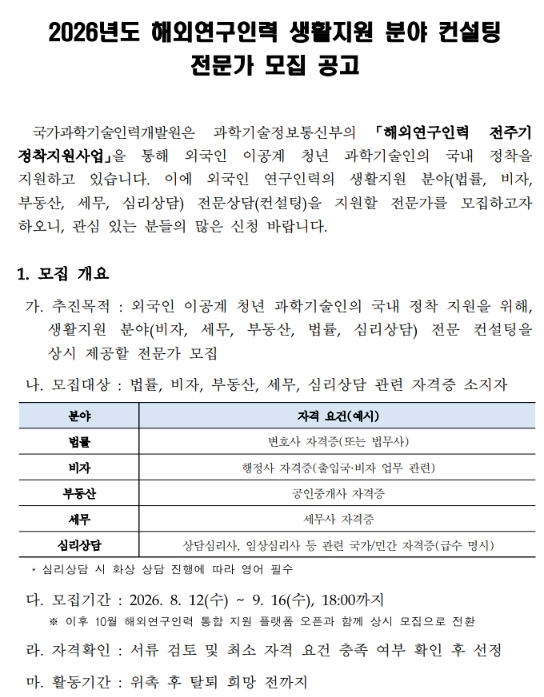
Administrative Attorney Sangjin Ji of Ethos Administrative Attorney Office has been selected as a visa consultant through the Korea Institute of Human Resources Development in Science and Technology (KIRD)'s 2026 recruitment of consulting experts for international researcher settlement support.
The selection and consultant registration process has now been completed.
Through this initiative, I will participate in providing online guidance on visa and residence-related matters to international researchers working and studying in South Korea.
For international researchers, securing a research position is only one part of building a career in Korea. Understanding immigration status, employment requirements, and residence procedures is equally important.
This opportunity is particularly meaningful because it allows me to contribute to a public initiative supporting international researchers as they establish their lives and continue their research careers in Korea.
Supporting International Researchers Through Professional Consulting
The Korea Institute of Human Resources Development in Science and Technology (KIRD) is a public institution under the Ministry of Science and ICT.
KIRD supports the education, professional development, and career advancement of science and technology professionals in South Korea.
The consulting initiative forms part of the Ministry's Full-Cycle Settlement Support Program for International Researchers.
The program aims to help international researchers and foreign graduate students adapt to life in Korea and pursue their academic and professional careers in a stable environment.
Its settlement support services include expert consulting in several fields, including immigration and visas, legal matters, real estate, taxation, and psychological counseling.
I have been selected and registered as a consultant specializing in visa and residence-related matters.
Through this role, I will help international researchers better understand the immigration requirements and administrative procedures relevant to their individual circumstances.
Why Immigration Guidance Matters for International Researchers
Immigration issues do not end when a researcher receives an initial visa to enter South Korea.
They may arise at different stages of an academic or professional career.
For example, an international doctoral student who completes a degree and accepts a position at a Korean research institution may need to review whether a change from D-2 student status to an appropriate employment-based residence status is required.
A researcher already holding E-3 research status may face different questions when moving to another institution, extending a research contract, or preparing to extend the period of stay.
Although these situations all involve continuing research activities, the applicable immigration procedures may differ.
The appropriate requirements depend on factors such as:
- The researcher's current immigration status and authorized period of stay
- The nature of the proposed research or employment activities
- The employment or research contract
- Changes to the research institution or assigned responsibilities
- The immigration requirements applicable to the particular residence status
These considerations are important not only for international researchers but also for universities and research institutions recruiting foreign scientific talent.
For instance, when a university offers a research position to an international graduate, the institution and the researcher may need to review whether the proposed duties are compatible with the relevant residence status.
Similarly, a researcher moving to another institution may need to determine whether a workplace-related notification or permission procedure applies.
A change in workplace and an extension of the authorized period of stay are separate immigration matters. The researcher should review the applicable requirements for each procedure.
Through KIRD's consulting initiative, I will provide online guidance to help international researchers understand these distinctions and identify the documents and procedures relevant to their circumstances.
Continuing to Provide Clear and Practical Immigration Guidance
At Ethos Administrative Attorney Office, my work has focused on helping foreign nationals and organizations better understand Korean immigration and administrative procedures.
I have also published educational content on visa and residence matters and delivered visa-related presentations for foreign entrepreneurs in Korea.
Being selected to participate in a public initiative supporting international researchers is therefore a particularly meaningful opportunity.
When reviewing an immigration matter, I believe it is important to look beyond the name of the visa itself.
The researcher's current residence status, proposed activities, employment conditions, and supporting documents all need to be considered.
A research contract, for example, may describe the nature of the work and the duration of the appointment. These details help identify which immigration requirements should be reviewed.
Rather than simply describing an application as possible or difficult, effective guidance should explain which requirements apply, what information needs to be confirmed, and which documents may be necessary.
This is the approach I intend to bring to my consulting activities.
I am grateful for the opportunity to contribute to KIRD's efforts to support international researchers in Korea.
I look forward to providing accurate, accessible, and practical information that helps researchers and institutions better understand the Korean immigration system.
Ethos Administrative Attorney Office also offers a free preliminary review for international researchers and institutions seeking guidance on visa and residence-related matters. Based on the applicant's current immigration status and period of stay, employment or research contract, and proposed responsibilities, we can identify which residence procedures and supporting documents should be reviewed first. Formal document preparation and application submission services, where available within the authorized scope of practice, are handled separately under an agreed service scope and fee arrangement.