
F-4 Overseas Korean Visa — Korean Heritage Alone Is Not Enough
Hello, this is Administrative Agent Jean.
The F-4 visa is commonly known as the Overseas Korean visa.
Because of that name, many applicants assume the process is simple.
“I’m ethnically Korean, so F-4 should be automatic, right?”
“My parent used to be Korean. Isn’t that enough?”
“I had Korean nationality before, so there should be no issue.”
In practice, F-4 is not that simple.
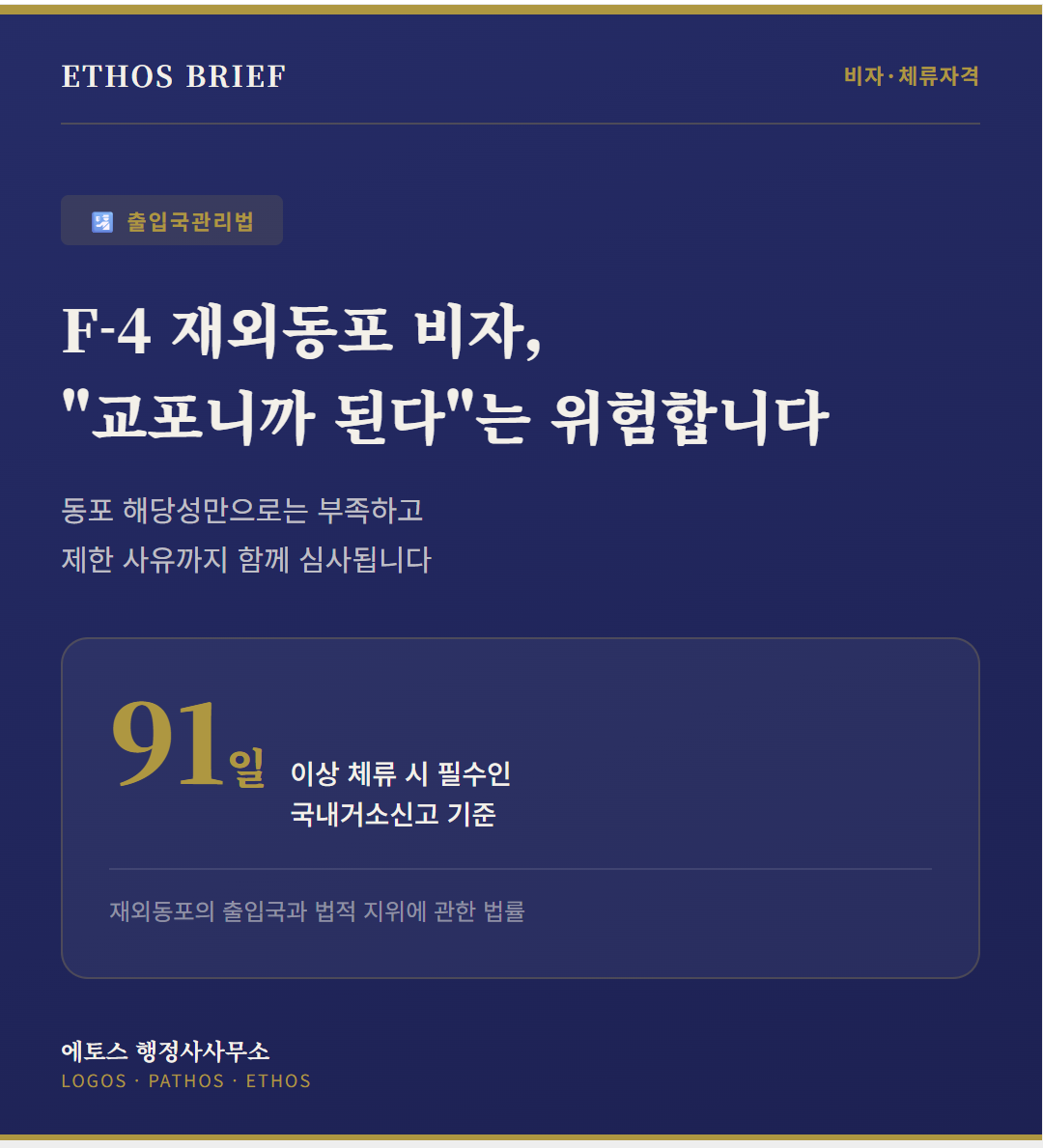
The key question is not only whether you have Korean roots. The real question is whether you can legally and clearly prove that you fall within the Overseas Korean category, and whether there are any restriction grounds that may affect approval.
For F-4, immigration may review:
- Whether you qualify as an Overseas Korean
- How your Korean nationality or family connection is documented
- When and how foreign nationality was acquired
- Whether Korean nationality loss or renunciation is properly reflected
- Whether there are military service issues
- Whether there are criminal records or immigration violations
- Whether your intended work is allowed under F-4
In 2026, this topic became even more important because the Ministry of Justice implemented the Overseas Korean status consolidation policy, placing F-4 at the center of the residence framework for overseas Koreans.
This article explains the F-4 visa from a practical point of view: eligibility, nationality history, family documents, residence reporting, employment restrictions, and real administrative cases involving criminal history and departure orders.
Key Summary
| Category | Details | |---|---| | Visa type | F-4 Overseas Korean | | Main applicants | Foreign nationals who previously held Korean nationality, or certain lineal descendants of Korean nationals | | Core issue | Proving Overseas Korean eligibility through documents | | Main documents | Passport, photo, application form, nationality loss documents, family relationship documents, foreign nationality acquisition documents | | Long-term stay | Domestic residence report required if staying 91 days or longer | | Employment | Broadly permitted, but certain work remains restricted | | Major 2026 change | Overseas Korean residence statuses consolidated around F-4 | | Main risks | Military service, criminal history, immigration violations, public order concerns | | Practical strategy | Build the nationality and family-document structure before collecting random documents |
What Is the F-4 Visa?
The F-4 visa is a Korean status of stay for foreign nationals of Korean heritage who qualify under the Act on the Immigration and Legal Status of Overseas Koreans.
In broad terms, the law recognizes Overseas Koreans as including:
- Korean nationals who have acquired permanent residence abroad or reside abroad for permanent residence purposes
- Persons who previously held Korean nationality, or their lineal descendants, who acquired foreign nationality and meet the requirements set by law
For F-4, the important question is not whether you “look Korean” or “feel Korean.”
The important question is:
Can your Korean nationality connection be proven through legally connected documents?
That is where many applications succeed or fail.
F-4 Starts With Eligibility, Not Documents
The first step in an F-4 case is not downloading a checklist.
The first step is identifying which Overseas Korean category applies to you.
1. Former Korean Nationals
This applies to people who once held Korean nationality and later acquired foreign nationality.
In this case, the file should answer:
- When did you hold Korean nationality?
- When did you acquire foreign nationality?
- Why and how did you acquire foreign nationality?
- Was Korean nationality loss or renunciation properly reported?
- Is nationality loss reflected in Korean family records?
- Can the foreign citizenship acquisition date be proven?
This is not just a paperwork issue.
It is the backbone of the application.
2. Descendants of Former Korean Nationals
Some applicants were born foreign nationals, but their parent or grandparent held Korean nationality.
In these cases, family relationship documentation becomes the center of the file.
Immigration may need to see:
- The Korean nationality history of the parent or grandparent
- The legal family link between the applicant and the Korean ancestor
- Matching names, dates of birth, and personal details across documents
- Foreign birth certificates and Korean family records that connect naturally
- Translation, notarization, apostille, or consular confirmation where required
Family background alone is not enough.
The documents must tell one consistent story.
Major 2026 Change — F-4 Status Consolidation
On February 12, 2026, the Ministry of Justice implemented a major policy change consolidating Overseas Korean residence statuses.
Before this change, the residence framework for overseas Koreans had been divided between F-4 Overseas Korean status and H-2 Working Visit status. The 2026 policy moves toward a more unified F-4-centered structure applying the same standards to overseas Koreans regardless of country of origin.
Key points include:
| Category | Details | |---|---| | Status consolidation | Overseas Korean residence status centered around F-4 | | H-2 issuance | New H-2 visa issuance discontinued | | Existing H-2 holders | May be able to change to F-4 under applicable procedures | | Employment scope | Some previously restricted occupations are now permitted | | Period of stay | May differ depending on Korean language ability and social integration factors | | Restriction grounds | Serious criminal history may restrict F-4 eligibility |
However, this policy change does not mean that every applicant automatically receives F-4.
Eligibility, nationality history, restriction grounds, intended activity, and required documents are still reviewed individually.
Five Things to Check Before Applying for F-4
A strong F-4 application starts with structure.
1. Overseas Korean Eligibility
First, confirm whether you qualify as a foreign national Korean under the Overseas Koreans Act.
Check:
- Did you previously hold Korean nationality?
- Did your parent or grandparent hold Korean nationality?
- Can the Korean nationality connection be documented?
- Can the lineal family relationship be proven?
2. Nationality Acquisition and Loss History
Nationality history is one of the most important parts of an F-4 case.
It is helpful to organize a timeline.
| Stage | What to Confirm | |---|---| | Birth | Place of birth and nationality at birth | | Korean nationality | Basis for holding Korean nationality | | Foreign nationality | Date and reason for foreign nationality acquisition | | Korean nationality loss or renunciation | Whether it was reported and reflected in records | | Current nationality | Current passport and citizenship documents |
A simple one-page nationality timeline can prevent weeks of confusion.
3. Family Document Linkage
Family documents are often the hardest part.
Review:
- Korean family relation certificate
- Basic certificate
- Removed family register or old family registry documents
- Foreign birth certificate
- Parent or grandparent nationality documents
- Name changes
- Differences in English spelling
- Differences in date of birth
- Marriage, adoption, or other family status changes
If Korean and foreign documents use different names or dates, you may need a separate explanation.
4. Restriction Grounds
F-4 is not guaranteed just because Overseas Korean eligibility exists.
The following should be reviewed early:
- Military service issues
- Criminal history
- Drunk driving
- Drug-related offenses
- Voice phishing or fraud-related crimes
- Immigration law violations
- Deportation or departure order history
- False document submission
- Concerns related to national security, public order, or public welfare
In a 2023 administrative appeal case, an applicant who had previously held Korean nationality applied for F-4 after entering Korea under B-2 status, but the application was denied due to repeated drunk driving history.
The issue was not simply whether the applicant was an Overseas Korean.
The issue was whether F-4 status should be granted despite the risk factors.
5. Application Route
There are generally two routes:
- Applying for an F-4 visa through a Korean diplomatic mission abroad
- Changing to F-4 status while already staying in Korea
The right route depends on your current status, stay period, nationality history, document readiness, and immigration record.
Copying someone else’s document list can lead you in the wrong direction.
F-4 Application Structure at a Glance
| Category | What to Check First | Why It Gets Stuck | Practical Note | |---|---|---|---| | Overseas Korean eligibility | Former Korean nationality or parent/grandparent connection | Korean heritage is explained, but legal documents are weak | Document structure matters more than family story | | Nationality history | Cause and date of foreign nationality acquisition | Nationality loss or renunciation is unclear | Build a timeline first | | Family relationship | Name, date of birth, parent/grandparent link | Korean and foreign records do not match | Name differences may require explanation | | Application route | Overseas visa or domestic change of status | Applicant follows another person’s case | Route changes the document strategy | | Restriction grounds | Military service, criminal history, immigration violations | Applicant underestimates past issues | Early risk review is safer | | Post-approval management | Residence report, activity scope, employment restrictions | Applicant thinks the visa is the final step | Domestic compliance still matters |
The table looks simple, but the issues are connected.
If the name spelling is inconsistent, family relationship proof becomes weaker.
If family relationship proof becomes weaker, Overseas Korean eligibility becomes harder to explain.
That is why in F-4 cases, the explanation structure should be fixed before the documents are collected.
Basic Required Documents
Required documents vary depending on application route, nationality, current status, consulate, and immigration office.
The following is a practical overview.
Common Documents
- Application form or visa application form
- Passport
- Photo
- Application fee
- Proof of residence, if applying for change of status in Korea
- Documents proving Overseas Korean status
For Former Korean Nationals
- Basic certificate showing nationality loss
- Removed family register, if applicable
- Document proving the cause and date of foreign nationality acquisition
- Foreign citizenship certificate or naturalization certificate
- Name change document, if applicable
For Applicants Through Parent or Grandparent
- Parent or grandparent’s basic certificate or removed family register
- Family relation certificate
- Applicant’s birth certificate
- Documents connecting the applicant to the parent or grandparent
- Translation, notarization, apostille, or consular confirmation for foreign documents
- Explanation documents for name or date-of-birth discrepancies, if needed
Additional Documents That May Be Reviewed
- Criminal record documents
- Military service documents
- Immigration history documents
- Statement explaining the reason for change of status
- Domestic activity plan
- Korean language or social integration program documents
- Employment-related documents
This is only a general framework. The exact list must be confirmed through HiKorea, the relevant Korean diplomatic mission, or the competent immigration office.
Domestic Residence Report Matters
If a foreign national Korean enters Korea with F-4 status or obtains F-4 status and intends to stay in Korea for 91 days or longer, a domestic residence report is generally required.
Common mistakes include:
- Thinking the process ends once the F-4 visa is issued
- Missing the 90-day reporting deadline after entry
- Reporting an address that differs from the actual residence
- Failing to report an address change
- Forgetting that residence card issuance fees may apply separately
F-4 is not just about visa issuance.
For long-term stay, domestic residence reporting and address management are part of the compliance structure.
F-4 Employment Is Broad, But Not Unlimited
F-4 generally allows broader employment activity than many other visa categories.
But it does not mean every job is allowed.
Employment may be restricted in areas such as:
- Simple labor
- Activities contrary to public morals or social order
- Activities restricted to protect domestic employment order
- Activities restricted by Ministry of Justice notice
- Jobs requiring separate qualifications under Korean law
As of February 12, 2026, Ministry of Justice Notice No. 2026-65 sets the scope of employment restrictions for F-4 status holders.
Under the 2026 consolidation policy, some occupations previously restricted for F-4 holders were newly permitted, especially where the risk to Korean employment was considered lower and labor shortages were severe.
Still, before starting work, check whether the specific job is restricted.
The question is not simply:
“Can F-4 holders work?”
The better question is:
Can an F-4 holder do this exact job in this exact way?
Criminal History and Drunk Driving Should Not Be Taken Lightly
Criminal history can become a serious issue in F-4 cases.
Drunk driving is especially important. Applicants sometimes think of it as a traffic matter, but immigration may review it under public order and public welfare concerns.
Administrative Appeal 2023-10016
In a September 5, 2023 administrative appeal decision, an Australian national who had acquired Korean nationality by birth entered Korea under B-2 status and applied to change to F-4.
The application was denied due to repeated drunk driving history.
The key issue was not whether the applicant had Overseas Korean background.
The key issue was whether Korea should grant F-4 status despite the applicant’s risk factors.
The decision relied on the Overseas Koreans Act provision allowing restriction where the applicant may harm Korea’s national security, public order, or public welfare.
This case shows a practical lesson:
F-4 is not automatic, even for an Overseas Korean.
Even After Getting F-4, Stay Is Not Always Secure
Receiving F-4 does not remove all future immigration risk.
If a criminal offense or immigration violation occurs during stay, it may affect extension, departure order, deportation review, or future residence status.
Administrative Appeal 2024-08505
In one 2024 case, a Korean-Chinese F-4 holder had stayed in Korea since 2016 and received a KRW 8 million fine for drunk driving. A departure order was issued, but the administrative appeal accepted the claim and canceled the departure order.
The decision considered factors such as the absence of other criminal records and the fact that the person had lived in Korea for more than eight years.
This shows that even after a violation, the outcome may depend on the full circumstances.
Administrative Appeal 2024-06942
In another 2024 case involving an F-4 holder, the person had drunk driving, unlicensed driving, and failure to take action after an accident. The request to cancel the departure order was dismissed.
The comparison between these cases shows that the result can differ depending on:
- Seriousness of the violation
- Repetition
- Risk to public order
- Length of stay
- Family and livelihood foundation in Korea
- Whether there are other violations
F-4 status is valuable, but it must be managed carefully.
What Constitutional Court Case 2011Hun-Ma480 Shows
The F-4 process can differ depending on nationality, route, and application background.
Constitutional Court case 2011Hun-Ma480 involved a Chinese national Overseas Korean who entered Korea under H-2 and sought to change to F-4. The issue included requirements to submit documents showing that the applicant would not engage in simple labor activities.
Although the petition was dismissed, the case is useful from a practical perspective.
It shows that:
- F-4 requirements may differ depending on nationality and route
- Overseas Korean status alone does not end the review
- Employment restrictions and supporting explanations may matter
- Domestic change of status and overseas visa issuance must be approached differently
Even after the 2026 consolidation policy, each applicant’s nationality history, activity plan, and restriction grounds remain important.
How an Administrative Agent Would Organize the Case
For F-4, it is better to build the structure first and collect documents second.
A practical review usually follows this order.
STEP 1. Confirm Overseas Korean Eligibility
First, determine which category applies.
- Former Korean national
- Lineal descendant through parent or grandparent
- Documented connection to Korean nationality
STEP 2. Build a Nationality Timeline
Organize nationality history by year.
- Birth
- Korean nationality
- Foreign nationality acquisition
- Korean nationality loss or renunciation
- Current nationality
- Passport issuance history
STEP 3. Connect Names and Family Documents
Check whether Korean and foreign documents match.
Review:
- Name spelling
- Date of birth
- Parent information
- Marriage records
- Name changes
- Translation consistency
If there is inconsistency, prepare an explanation before filing.
STEP 4. Review Restriction Grounds
Check for:
- Military service issues
- Criminal records
- Drunk driving
- Immigration violations
- Deportation or departure order history
- False document issues
Past issues should not be dismissed casually. They can become central in review.
STEP 5. Decide the Application Route
Finally, decide whether to apply through a Korean consulate abroad or change status inside Korea.
The right route depends on the applicant’s current status and risk profile.
F-4 Pre-Application Checklist
Before applying, check:
- Do you qualify as a foreign national Korean under the Overseas Koreans Act?
- Can prior Korean nationality be proven?
- Can the parent or grandparent relationship be documented?
- Can you prove the cause and date of foreign nationality acquisition?
- Is Korean nationality loss or renunciation reflected in family records?
- Do Korean and foreign documents use consistent names and dates of birth?
- Is there any military service issue?
- Is there any criminal history or drunk driving record?
- Is there any immigration violation, deportation, or departure order history?
- Should you apply overseas or change status in Korea?
- If staying 91 days or longer, have you planned the domestic residence report?
- Is your intended job restricted for F-4 holders?
Frequently Asked Questions
Q. Can I get F-4 just because I am ethnically Korean?
No.
You must prove that you fall within the legal category of Overseas Korean. Korean heritage alone is not enough unless it is supported by documents.
Q. My parent was Korean. Are my documents alone enough?
Usually no.
If applying through a parent or grandparent, the family relationship link must be documented. Birth certificates, Korean family records, and foreign documents must connect naturally.
Q. Can different name spellings become a problem?
Yes.
If Korean records, foreign passport, citizenship certificate, or birth certificate show different names or dates of birth, immigration may request an explanation or additional proof.
Q. Can I apply for F-4 if I have a drunk driving record?
It depends.
Immigration may consider the number of offenses, penalty level, timing, repetition, other criminal history, and the reason Korea should still allow residence. Repeated drunk driving can become a serious restriction issue.
Q. Can F-4 holders work freely?
F-4 allows broad employment activity, but not every job is permitted.
Certain simple labor jobs, activities contrary to public order, and occupations restricted by the Ministry of Justice may be limited. Jobs requiring a separate Korean license or qualification still require that qualification.
Q. Do F-4 holders complete alien registration?
Foreign national Koreans with F-4 generally complete a domestic residence report rather than ordinary alien registration.
If staying in Korea for 91 days or longer, the domestic residence report should be completed within the required period.
Q. Can H-2 holders change to F-4?
Under the 2026 Overseas Korean status consolidation policy, existing H-2 holders may be able to change to F-4 through applicable procedures.
However, exact eligibility, documents, fee rules, and application method should be confirmed through HiKorea or the competent immigration office.
In Short, F-4 Reviews Both Korean Heritage and Restriction Risks
The F-4 Overseas Korean visa is not automatically granted just because someone is an Overseas Korean.
A strong application must review:
- Overseas Korean eligibility
- Nationality history
- Family document connection
- Application route
- Military service issues
- Criminal and immigration records
- Domestic residence report
- Employment restrictions
Administrative Appeal 2023-10016 shows that F-4 is not automatic when restriction grounds exist.
Administrative Appeals 2024-08505 and 2024-06942 show that even after receiving F-4, criminal or immigration issues during stay can create serious post-approval risks.
If you are preparing for F-4, do not begin by collecting random documents.
Start with one clean nationality timeline.
Ask:
- What type of Overseas Korean am I?
- How am I connected to Korean nationality?
- When and why did I acquire foreign nationality?
- Do my family documents connect naturally?
- Are there any restriction grounds?
- Should I apply overseas or change status in Korea?
Once that structure is clear, the application becomes much more manageable.