
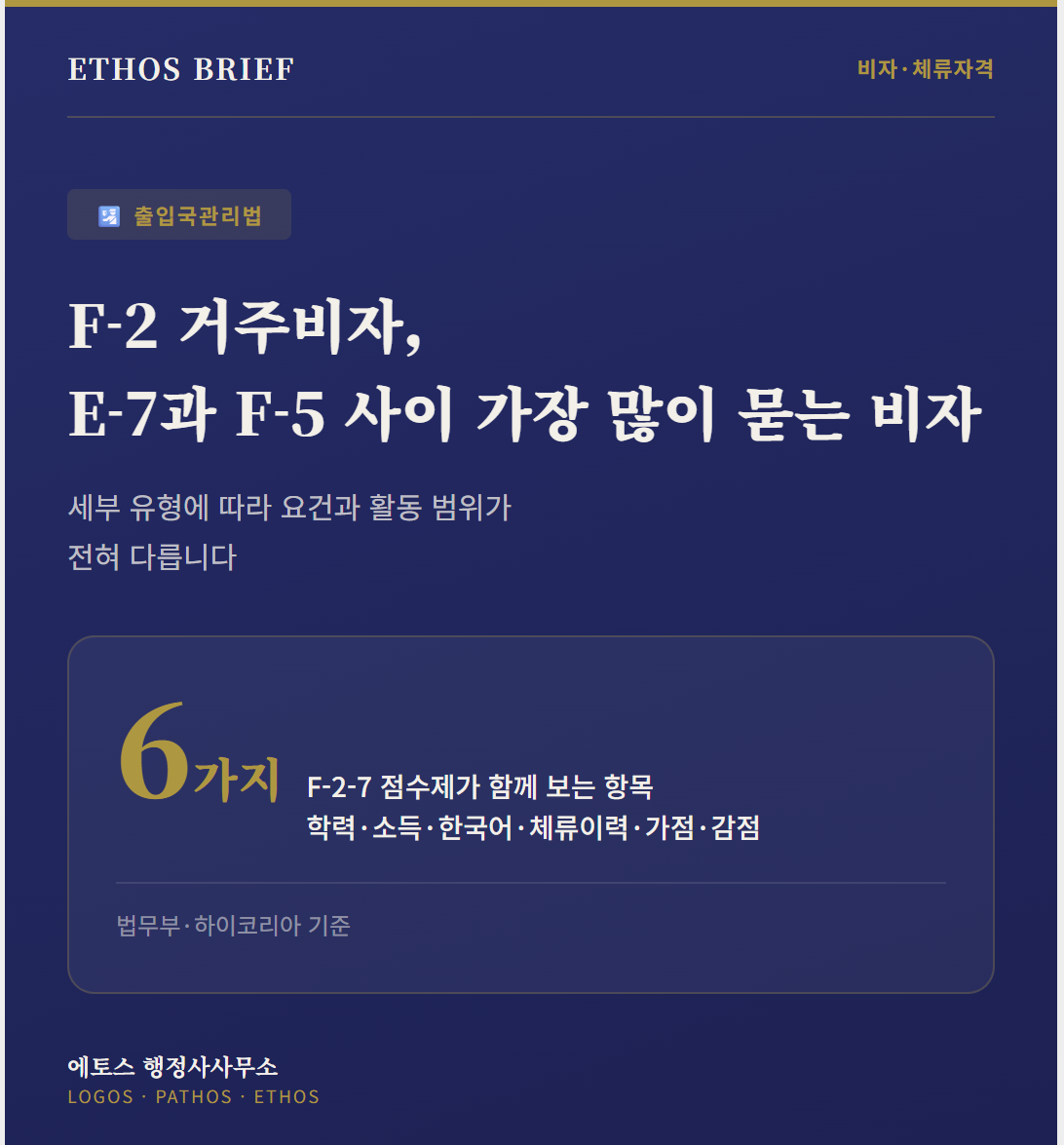
F-2 Residence Visa — The Long-Term Stay Visa Most Asked About Between E-7 and F-5
Hello, this is Administrative Agent Jean.
A while ago, I came across this concern online.
“I have been working in Korea for seven years, but every time I extend my visa, I feel anxious. I want to change jobs, but my visa makes that difficult. Is there a visa that lets me live a little more freely?”
If you are a foreign national living in Korea long term, you have probably had this thought at least once.
When you stay for years on an employment visa such as E-7, which is tied to a company and job duties, you start worrying about your status of stay whenever you want to change jobs, start a business, or freelance.
One possible answer to that concern is the F-2 residence visa.
F-2 is an important intermediate status for foreigners who want to keep living in Korea.
It generally gives broader activity options than employment visas such as E-7, and if certain requirements are met, it can lead to permanent residence F-5.
However, one point should be made first.
F-2 looks like one visa, but in practice, requirements and permitted activities differ by subtype.
So you should not simply assume, “If I have F-2, I can work or start any business without limits.” Requirements, documents, family eligibility, and the route to permanent residence differ depending on whether it is F-2-7, F-2-R, F-2-99, or another subtype.
This article is for people who are reviewing F-2 for the first time. We will cover:
- Why F-2 matters
- Main F-2 subtypes
- What the F-2-7 points system evaluates
- Documents and risks to check before applying
- Frequently asked questions
Why Is the F-2 Visa Important?
The F-2 residence visa is often reviewed by foreign nationals who want a more stable long-term stay in Korea.
It is especially common among people staying in Korea under E-7, D-8, D-2, D-10, or similar statuses who want a more stable residence base.
There are three main reasons F-2 matters.
1. It Reduces Dependence on a Specific Employer
The E-7 Specially Designated Activities visa is generally tied to an approved company, job duties, and workplace.
If you change jobs or your duties change, issues may arise regarding change of workplace, reporting, permission, or status adjustment.
F-2 still requires checking the specific subtype and scope of activities, but it generally provides broader activity options than employment visas.
That makes it an important option for foreigners planning job changes, startups, or freelance activity.
2. It Can Serve as a Step Toward Long-Term Residence and F-5
F-2 is not permanent residence.
But after staying stably under F-2 for a certain period and meeting F-5 requirements such as income, conduct, Korean language, and residence period, permanent residence may be reviewed.
F-2-7, the points-based residence status, is especially often discussed as an intermediate step toward F-5.
However, receiving F-2 does not automatically lead to F-5.
F-5 has separate requirements and review.
3. It Is Connected to Family Residence Planning
If the principal applicant obtains F-2, the residence status of the spouse and minor children should also be planned.
Whether family members can receive accompanying F-2 status, whether F-1 visiting family status should be considered, and whether income requirements are met can all change the documents and procedure.
In many cases, this is not only about one person’s visa. It is about the residence plan of the whole family.
Main Types of F-2 Visa
F-2 is divided into subtypes depending on the applicant’s situation.
Representative types include the following.
| Type | Target Applicant | Key Point | |---|---|---| | F-2-2 | Child of Korean parent, etc. | Family relationship evidence is central | | F-2-3 | Family of F-5 permanent resident | Spouse or minor child of F-5 holder, income requirement check needed | | F-2-7 | Points-based qualified talent | Evaluated by education, income, Korean language, age, bonuses, and deductions | | F-2-R | Regional specialized talent | Requires residence and employment in population-decline areas, local government recommendation, etc. | | F-2-15 | Foreign parent raising a Korean child | Korean child custody and stable residence are central | | F-2-99 | Other long-term resident | For long-term legal residents who may not fit other subtypes |
Among foreign professionals, the most popular subtype is F-2-7 points-based qualified talent.
Those considering regional settlement may also review F-2-R regional specialized talent.
F-2-7 Points System — What Is Evaluated?
F-2-7 is a points-based residence visa.
It is not granted simply because you have lived in Korea for a long time.
Education, income, Korean language ability, age, bonus points, and deductions are evaluated together, and the applicant must meet the required score.
As of 2026, F-2-7 reviews base evaluation items together with bonus and deduction items. The detailed scoring table may change under Ministry of Justice or HiKorea standards, so the latest criteria should be checked immediately before application.
The main evaluation items are as follows.
1. Education
Degree level is reviewed.
In general, a bachelor’s, master’s, or doctoral degree can affect the score, with higher degrees usually more advantageous.
But the issue is not only whether you have a diploma.
The following should also be checked:
- Whether the degree was obtained in Korea or overseas
- Whether diploma and transcript can be submitted
- Whether apostille or consular confirmation is required
- Whether the major connects to the current job
- Whether an expected graduate can apply at the intended time
Education documents can take time to issue and authenticate, so they should be prepared early.
2. Income
Income is one of the most important practical items in F-2-7.
Immigration usually does not rely only on the salary stated in an employment contract. It reviews officially documented income.
Representative documents include:
- Certificate of Income Amount
- Wage and salary income withholding receipt
- Payslips
- Certificate of employment
- Business income tax filing documents
- Tax payment or tax arrears documents
A common problem is this:
“My employment contract says KRW 50 million, but my Certificate of Income Amount shows less.”
In that case, immigration is likely to rely on official income evidence.
So when preparing F-2-7, what matters is not only what you actually received, but what appears in National Tax Service records.
3. Korean Language Ability
Korean language ability is often proven through TOPIK or the Social Integration Program, KIIP.
If you are preparing for F-2-7, it is better to work on Korean-language points early.
The reason is simple.
Income changes by year, and education is often already fixed.
Korean ability, however, can be improved more deliberately through exams or program completion.
You should check which route is more advantageous:
- Submitting TOPIK scores
- Completing KIIP stages
- Using KIIP comprehensive evaluation
- Checking validity period of existing scores
4. Current Status and Residence History
F-2-7 cannot be applied for from every status of stay.
You must first check whether your current status is eligible.
Statuses often reviewed include:
- E-1 Professor
- E-2 Foreign Language Instructor
- E-3 Research
- E-4 Technical Instructor
- E-5 Professional
- Some E-6 Arts and Entertainment categories
- E-7 Specially Designated Activities
- D-2 Study
- D-8 Corporate Investment
- D-10 Job Seeking, etc.
However, eligibility may differ depending on detailed subtype, residence period, Korean degree, employment status, and income evidence.
Do not judge based only on the visa code.
Residence history and actual activity must be reviewed together.
5. Bonus Points
Bonus points can be important when the base score is slightly short.
Factors that may be reviewed include:
- Korean degree
- Completion of Social Integration Program
- Korean language ability
- Volunteer work
- Recommendation or qualified talent-related factors
- Professional licenses
- Career in specific fields
For volunteer work, evidence matters.
It is not enough to say that you volunteered. The record should generally be verifiable through systems such as 1365 or VMS.
6. Deductions
For F-2-7, managing deductions is as important as earning points.
The following may result in deductions or refusal issues:
- Immigration Act violations
- Administrative fines or penalty payment history
- Overstay
- Tax arrears
- Health insurance arrears
- Criminal punishment history
- Submission of false documents
- Mismatch between actual activity and status of stay
Penalty payments, departure orders, or deportation-related history may work against the applicant for a certain period, so these records should be checked before application.
F-2-R Regional Specialized Visa Should Also Be Reviewed
F-2-7 is not the whole F-2 system.
Recently, many people also review the F-2-R regional specialized talent visa.
F-2-R is based on residence and settlement in population-decline areas, usually with local government recommendation.
The Ministry of Justice continues to expand policies that connect population-decline areas with foreign talent settlement. From May 2026, a pilot employment special rule has also been operating to make it easier for small businesses in population-decline areas to hire F-2-R talent.
When reviewing F-2-R, the following should be checked:
- Whether the region is a population-decline area
- Whether the applicant is eligible for local government recommendation
- Whether education or income requirements are met
- Whether Social Integration Program completion is required
- Whether actual residence in the region is possible
- Whether the employer satisfies requirements
- Whether there is a required local residence period
- Whether job change or moving to another region is restricted
F-2-R is based on regional settlement.
So it should not be understood simply as “F-2 means freedom.”
Region, employer, and residence obligations must be checked together.
Basic Documents
Detailed documents differ by F-2 subtype, but the following documents are commonly prepared.
- Application for change of status or extension of stay
- Passport
- Alien registration card
- Standard photo
- Fee
- Family relationship documents
- Income evidence
- Certificate of employment or business-related documents
- Proof of residence
- Lease agreement or residence confirmation
- Criminal record certificate
- Tax payment documents
- Health insurance payment documents
- KIIP completion certificate or TOPIK score report
- F-2-7 points table
- Additional evidence by subtype
The important issue is not only the “document list,” but the reference date of each document.
For example, for the Certificate of Income Amount, the latest tax year available at the application date matters.
TOPIK scores may have a validity period, and foreign criminal record certificates may require apostille, consular confirmation, or notarized translation.
So documents should not simply be gathered in large quantities.
They must be valid and aligned as of the application date.
Pre-Application Checklist
If you are preparing an F-2 application, check the following first.
- Is your current status eligible for F-2 application?
- Is there enough time before your current stay expires?
- Is your F-2-7 score at least 80?
- Does your Certificate of Income Amount support the required income?
- Are there any tax or health insurance arrears?
- Do you have TOPIK or KIIP points?
- Do you have any immigration violation or penalty history?
- Do you have any criminal history?
- Will family members apply together?
- How should the spouse and children’s status be planned?
- Are you planning the route from F-2 to F-5?
- Do your job, duties, income records, and status match one another?
If any of these are uncertain, it is better to review them before applying.
F-2 is not a visa where you simply submit documents and wait.
It must be designed around points and evidence.
Frequently Asked Questions
Q. Can I Change Jobs After Switching to F-2-7?
F-2-7 generally provides broader activity options than E-7, which is tied to a specific employer.
However, it should not be understood as unlimited permission for every activity. Depending on the subtype, previous status, planned activity, and other laws requiring professional licenses or permits, reporting or permission may still be needed.
Before changing jobs or starting a business, it is safer to check the permitted scope of activity.
Q. When Can I Apply for Permanent Residence After Receiving F-2-7?
In general, after staying under F-2-7 for a required period, F-5 permanent residence may be reviewed.
However, permanent residence is not automatic.
F-5 has separate requirements regarding residence period, income or assets, Korean language or social integration, conduct, tax and insurance payment, and criminal history.
It is better to plan F-5 requirements from the time you apply for F-2.
Q. Can My Spouse and Children Receive F-2 Together?
In some cases, yes.
However, it depends on the principal applicant’s F-2 subtype, income requirements, family relationship, children’s ages, and the current status of accompanying family members.
If income requirements are not met, the spouse or children may not be able to move directly to the same F-2 status, and another status such as F-1 visiting family may need to be reviewed.
Q. Is Income Based on the Employment Contract?
Usually, official income documents are more important than the employment contract.
Representative documents include Certificate of Income Amount, withholding receipt, and tax filing records.
You should check whether actual salary, reported income, and tax documents match.
Q. If I Score 80 Points, Is Approval Guaranteed?
No.
The score is only a basic requirement.
Current status, residence history, violation history, income evidence, reliability of submitted documents, and actual activity are all reviewed together.
Even if you exceed 80 points, problems may arise if documents do not match or if there are deduction or refusal grounds.
Where Do People Get Stuck When Preparing Alone?
The hardest part of F-2 is often not the score calculation itself.
In practice, people often get stuck in the following areas:
- Misjudging whether the current status is eligible
- Misunderstanding income based on the Certificate of Income Amount
- Missing TOPIK or KIIP score validity periods
- Preparing family documents too late
- Starting apostille or notarized translation of overseas documents too late
- Discovering tax or health insurance arrears right before applying
- Failing to calculate deductions for immigration violations
- Overinterpreting the scope of activities allowed after F-2
- Applying for F-2 without connecting it to future F-5 requirements
- Applying too close to the stay expiration date, leaving no time to respond to correction requests
F-2 is not simply a visa where you fill in a points table.
Points, documents, residence history, and future activity plans must all align.
What Changes When You Work With an Administrative Agent?
The important starting point in an F-2 application is deciding which F-2 subtype fits your situation.
An administrative agent can review the following flow:
- Current status and stay period
- Selection of F-2 subtype
- Preliminary F-2-7 score calculation
- Income and tax record review
- TOPIK or KIIP strategy
- Bonus and deduction items
- Family accompaniment possibility
- Residence, family relationship, and criminal record documents
- Application form and statement preparation
- Roadmap from F-2 to F-5 permanent residence
For F-2-7 in particular, the question is not only your current score.
It is also when applying is most advantageous.
Some applicants fall short using this year’s income evidence but become eligible when next year’s Certificate of Income Amount is issued.
Some cross the threshold with one TOPIK score.
Others need bonus points through volunteer work or KIIP completion.
So with F-2, deciding whether to apply now or after several months of preparation is important.
If You Are Preparing for F-2
F-2 is a very important status for foreigners planning long-term residence in Korea.
But it has many subtypes, and requirements and documents differ by type.
The first step is this:
Identify which F-2 subtype applies to you.
After that, you align points, income, Korean language ability, residence history, family accompaniment, and permanent residence planning one by one.
Before applying, check at least the following questions:
- Am I closer to F-2-7, F-2-R, F-2-99, or another subtype?
- Can I apply from my current status?
- Is my F-2-7 score at least 80?
- Is my income on the Certificate of Income Amount sufficient?
- Do I have TOPIK or KIIP points?
- Are there tax or health insurance arrears?
- Do I have immigration violations or penalty history?
- Can my spouse and children change status together?
- Am I planning from F-2 toward F-5 permanent residence?
If you begin collecting documents without answering these questions, you are likely to get stuck midway.
F-2 can be a good option for more stable residence and broader activity in Korea.
But that freedom starts with choosing the correct subtype and preparing the right evidence.
In the next article, we will explain the detailed scoring criteria for F-2-7 and strategies to increase your score.