
Korea’s 2030 Immigration Reform, Part 2 — E-7-M / K-CORE Visa, a New Work Route for International Junior College Graduates
This is the second article in the three-part series “Korea’s 2030 Immigration Reform.”
Part 1: When 39 Work Visa Categories Become 3 Levels
Hello, this is Administrative Agent Jean.
After lectures on foreign entrepreneurship and employment in Korea, some students quietly come up and ask the same question.
“I’m studying at a Korean junior college. After graduation, can I work in Korea?”
To be honest, this used to be a difficult question to answer clearly.
It was not the student’s fault. The system itself had a gap.
The existing E-7-1 Specially Designated Activities visa was mainly designed for professional workers and required a match between degree, job code, experience, employer requirements, and job duties. On the other hand, the E-9 Non-Professional Employment visa was mostly for non-skilled labor and operated under a separate employment permit structure with nationality, industry, and procedure restrictions.
In other words, international students who studied manufacturing-related technical skills at Korean junior colleges for 2 to 3 years often had limited visa options after graduation.
In 2026, a new visa route was introduced to fill that gap.
It is called E-7-M, also known as the K-CORE visa.
This article explains what E-7-M is, who may qualify, how it differs from E-7-1, and what international junior college students and employers should prepare now.
Key Summary
| Category | Details | | --- | --- | | Visa code | E-7-M | | Common name | K-CORE visa | | Meaning | Korea College-to-Regional Employment | | Policy purpose | Train and settle international junior college students as mid-skilled workers in regional manufacturing industries | | Main target | Foreign graduates of Ministry of Justice-designated technical departments | | Pilot scale | 16 junior colleges, 1 department per school as of 2026 | | Main fields | Automotive, machinery, electricity, textiles, agriculture-food technology, renewable energy, and other manufacturing-related fields | | Korean language requirement | TOPIK Level 5 or KIIP Stage 4 or higher | | Employment contract | Major-related company, annual salary of at least KRW 26 million, contract period of at least 1 year | | Long-term route | F-2 residence route may be available after continued employment | | Important caution | The key is not just the school, but the exact designated department |
Why Was the E-7-M Visa Created?
The short answer is that two problems met at the same point.
The first problem is the labor shortage in regional manufacturing.
Industries such as molds, casting, welding, automotive parts, machinery, electricity, and textiles have long struggled to find skilled workers. The shortage is especially serious for regional small and medium-sized manufacturers.
The second problem is the limited post-graduation pathway for international students trained at Korean junior colleges.
Many students learned technical skills in Korea, studied Korean, and wanted to work for local companies. But under the existing visa system, they often faced barriers such as:
| Existing Problem | Explanation | | --- | --- | | High E-7-1 entry barrier | Degree, experience, job code, and employer conditions had to match | | Disconnect from E-9 | E-9 was structured for non-professional employment, often unrelated to the student’s major | | Gap for junior college graduates | Technical training did not always lead to a direct work visa route | | Regional company labor shortage | Employers needed workers, but the correct visa route was unclear | | Weak settlement path | Employment and long-term residence were often disconnected |
E-7-M was created to connect these two sides.
Instead of bringing workers only from overseas, Korea is trying to train international students already studying in Korea and connect them to regional industries.
That is the core idea of E-7-M.
What Does K-CORE Mean?
K-CORE stands for Korea College-to-Regional Employment.
The name itself explains the policy direction: from Korean junior college education to regional employment.
The “M” in E-7-M reflects a mid-skilled level. It sits between professional E-7-1 employment and non-professional E-9 employment.
In practical terms:
| Previous Model | E-7-M Model | | --- | --- | | Bring workers from overseas | Train international students in Korea | | Use short-term labor | Build regional settlement | | Focus on degree, experience, and job code | Focus on designated department, Korean ability, and major-related employment | | Employment and residence separated | Employment may connect to F-2 residence later |
E-7-M is not just “a visa for junior college graduates.”
It is a settlement-oriented employment route for international students trained in Korea’s manufacturing fields.
3 Core Requirements
The basic structure of E-7-M is relatively clear.
However, because the program is still a pilot system, detailed application practice should be checked against the latest Ministry of Justice notices and the competent immigration office’s guidance.
1. Graduation from a Ministry of Justice-Designated Technical Department
This is the most common misunderstanding.
Graduating from any Korean junior college does not automatically make you eligible for E-7-M.
You must graduate from a Ministry of Justice-designated technical department.
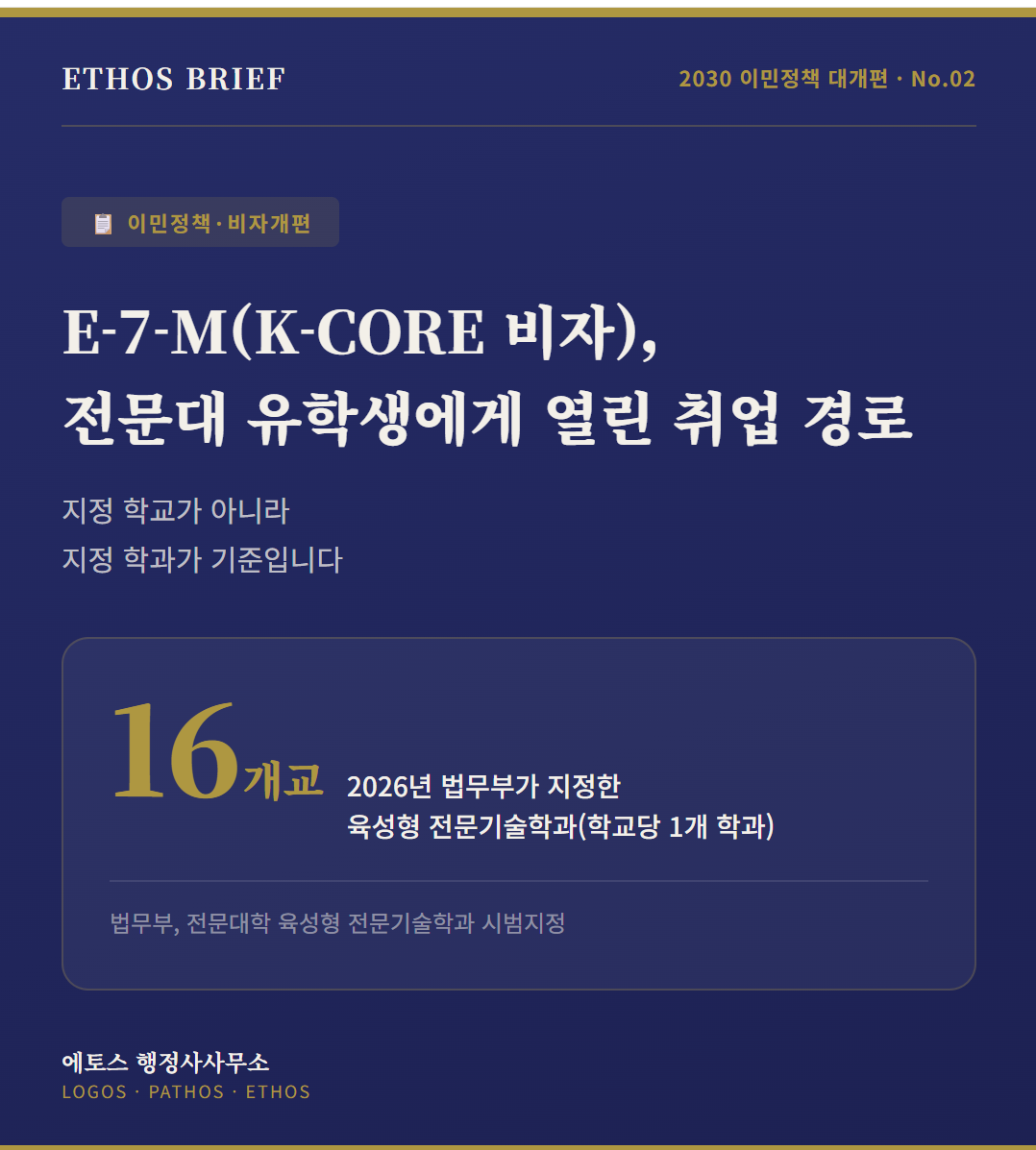
As of the 2026 pilot designation, 16 junior colleges were selected, with one designated department per school.
Also, the designation applies to a specific department, not the entire school.
For example, if College A is designated, that does not mean all graduates of College A qualify. The exact department must match.
16 Designated Colleges and Departments in 2026
| Region | College | Designated Department | | --- | --- | --- | | Gyeonggi | Gyeonggi University of Science and Technology | Future Electric Vehicle Department | | Gyeonggi | Daelim University College | Future Automotive Engineering Division | | Gyeonggi | Bucheon University | Textile Fashion Business Department | | Gyeonggi | Seojeong University College | Global Textile Fashion Business Department | | Gyeonggi | Osan University | Electrical Engineering Department | | Gyeonggi | Yongin University of Arts and Science | Automotive Machinery Department | | Daegu/Gyeongbuk | Yeungjin University | Smart CAD/CAM Department | | Daegu/Gyeongbuk | Gumi University | Special Construction Machinery Engineering Division | | Busan | Kyungnam College of Information and Technology | Mechanical Engineering Department | | Busan | Dong-eui Institute of Technology | Mechanical Engineering Department | | Busan | Busan Institute of Science and Technology | Automotive Department | | Gyeongnam | Koje College | Mechanical Engineering Department | | Ulsan | Ulsan College | Mechanical Engineering Division | | Jeonbuk | Kunjang University College | Smart Agri-Food Department | | Jeonbuk | Jeonju Vision College | Future Mobility Department | | Jeonnam | Mokpo Science University | Renewable Energy Electrical Department |
This list is based on the 2026 pilot designation. Before applying, always confirm the latest Ministry of Justice notice and the school’s official guidance.
2. Korean Language Requirement
E-7-M places strong emphasis on Korean language ability.
After graduation, applicants are generally expected to meet one of the following:
| Korean Requirement | Details | | --- | --- | | TOPIK | Level 5 or higher | | KIIP | Stage 4 or higher completion |
While E-7-1 often focuses on degree and experience, E-7-M focuses heavily on whether the student can adapt to a Korean workplace.
This is because manufacturing sites require Korean communication for safety, instructions, teamwork, quality control, equipment handling, and attendance management.
If you are currently enrolled, do not wait until right before graduation. TOPIK or KIIP preparation should begin early.
3. Employment Contract with a Major-Related Company
Graduation alone is not enough.
The applicant must sign an employment contract with a company related to the applicant’s major.
The basic points to check include:
| Item | Requirement | | --- | --- | | Employer | Major-related manufacturing company or related business | | Salary | At least KRW 26 million per year | | Contract period | At least 1 year | | Job duties | Work related to the designated department major | | Employer review | Business type, actual job duties, and employment feasibility may be reviewed |
The key issue is not simply “the student got hired.”
The issue is whether the company’s industry and the job duties are connected to the student’s designated major.
For example, if a graduate of an automotive machinery department signs a contract for an unrelated service job, it may not match the purpose of E-7-M.
How Is E-7-M Different from E-7-1?
This is the question people ask most often.
The biggest difference is the role of work experience and policy purpose.
| Category | E-7-1 | E-7-M | | --- | --- | --- | | Nature | Professional employment | Mid-skilled technical employment | | Main target | Professional and technical foreign workers | Graduates of designated technical departments | | Education | Usually bachelor’s degree or higher | | Junior college route | Possible in some cases, but requirements can be complex | | Experience | May require relevant experience depending on job and education | | E-7-M experience feature | Designed to reduce the experience barrier for designated department graduates | | Job scope | Based on designated occupational codes | | Manufacturing link | Depends on occupation | | Korean requirement | Varies by type | | E-7-M Korean requirement | TOPIK Level 5 or KIIP Stage 4 or higher | | Long-term residence | F-2 route under separate requirements | | E-7-M long-term route | F-2 residence route may be considered after continued employment |
For junior college graduates who were blocked by the “1 year of experience” or “occupational code” issue under E-7-1, E-7-M may become a new option.
However, E-7-M is not a general work visa for all junior college graduates.
The three pillars must match:
designated department, Korean language ability, and major-related employment contract.
Can E-7-M Lead to F-2 Residence?
According to Ministry of Justice announcements, E-7-M graduates may be able to pursue F-2 residence status after maintaining employment for a certain period.
The direction currently known is:
| Route | Details | | --- | --- | | General route | Continued employment for at least 5 years under E-7-M | | Population-declining region route | At least 3 years of continuous employment at the same company in a population-declining region | | Goal | Possible F-2 residence application route |
This is important.
E-7-M is not only a post-graduation work visa. It is designed as a settlement route that may connect to F-2 residence.
However, the detailed F-2 criteria, required documents, income standards, stay history, and violation history rules should be checked through the latest notices and guidance.
If you are planning for E-7-M, you should manage the following from the beginning:
- Employment contract
- Salary payment records
- Income reporting records
- Social insurance or employment-related records
- Workplace change history
- Stay extension history
- Immigration or unauthorized work history
- Continuous employment in a population-declining region, if applicable
With E-7-M, management after approval is just as important as the first application.
What Should Current Students Prepare?
E-7-M should not be considered only after graduation.
If you are currently enrolled, start checking now.
| Stage | What to Check | | --- | --- | | Admission/enrollment | Whether your school and department are designated | | First year | TOPIK or KIIP preparation plan | | During study | Major-related internship, project, or certificate records | | Before graduation | Potential employment with a major-related company | | Right before graduation | Employment contract, salary, job duties | | Before application | D-2 expiration date and E-7-M application timing |
D-2 status and graduation date are especially important.
Even if time remains on your D-2 visa after graduation, your basis for D-2 stay may weaken once your student status ends. That is why E-7-M or another status change option should be reviewed before graduation.
What Should Employers Check?
E-7-M is important not only for students.
It can also become an important hiring route for regional manufacturing companies and HR managers.
Employers should check:
| Employer Checklist | Explanation | | --- | --- | | Applicant’s department | Whether the applicant graduated from a designated technical department | | Job relevance | Whether the job is related to the applicant’s major | | Salary | At least KRW 26 million per year | | Contract period | At least 1 year | | Actual workplace | Whether the contract workplace matches the actual workplace | | Business type | Whether the company’s industry can be connected to the applicant’s major | | Future management | Extension, workplace change, and possible F-2 route |
In foreign hiring, the key is not only hiring the person.
The key is confirming whether that person can legally work for that company, in that role, under that status.
Because E-7-M is a new route, the employment contract and job description should be prepared carefully from the beginning.
3 Things to Be Careful About Now
E-7-M is still a pilot program as of 2026.
A new system creates opportunity, but also uncertainty.
Be especially careful about these three points.
1. The Designated Department Matters More Than the School Name
This is the biggest misunderstanding.
Being enrolled at a designated junior college does not mean every department qualifies.
You must confirm the exact Ministry of Justice-designated department. Similar department names, different campuses, and related majors should be checked separately.
2. The Job Must Match the Major
E-7-M is designed to connect mid-skilled manufacturing talent to regional companies.
A job unrelated to the major, a simple office role, a service-centered position, or a contract that does not match actual work may create problems.
The employment contract should clearly state:
- Job title
- Job duties
- Workplace
- Salary
- Contract period
- Relationship between major and job
- Company’s business type and actual operations
3. Avoid a Visa Gap After Graduation
D-2 international students must manage their status carefully after graduation.
If employment is delayed, Korean requirements are not yet met, or company documents are not ready, a stay gap may occur.
In that situation, D-10 job-seeking status, E-7-M, general E-7, or another status change route should be compared.
The riskiest approach is:
“I’ll figure it out after graduation.”
Visa planning should begin before graduation.
Documents to Prepare Before Consultation
To review E-7-M eligibility, prepare the following materials.
| Category | Documents or Information | | --- | --- | | Student identity | Passport, alien registration card, current D-2 stay period | | School records | Certificate of enrollment, expected graduation certificate, department name | | Designation check | Whether the school and department are Ministry of Justice-designated | | Korean language | TOPIK score report, KIIP completion stage | | Major records | Transcript, courses, practical training, project records | | Employment records | Draft employment contract, company name, job duties, salary | | Company documents | Business registration, industry type, workplace, job description | | Stay plan | Graduation date, D-2 expiration date, desired application timing | | Long-term goal | Whether F-2 residence is part of the plan |
With these materials, it becomes much easier to determine not only whether E-7-M may be possible, but also when preparation should begin.
Frequently Asked Questions
Q. Can any Korean junior college graduate apply for E-7-M?
No. The applicant must graduate from a Ministry of Justice-designated technical department. The designation applies to specific departments, not the entire school.
Q. Is TOPIK Level 5 mandatory?
The program presents TOPIK Level 5 or KIIP Stage 4 or higher as an important Korean language requirement. Which route is better depends on the applicant’s preparation status.
Q. What is the salary requirement?
The basic structure requires an employment contract of at least KRW 26 million per year with a major-related company, for at least 1 year.
Q. Is E-7-M easier than E-7-1?
Not necessarily. E-7-M may reduce the work experience barrier, but it has its own requirements: designated department graduation, high Korean language ability, and major-related employment.
Q. Can E-7-M lead to F-2?
The Ministry of Justice has indicated that F-2 residence may be available after 5 years of continued E-7-M employment, or after 3 years at the same company in a population-declining region. However, detailed criteria should be checked through the latest official guidance.
Q. Can a company in the Seoul metropolitan area hire under E-7-M?
The key issues are designated department graduation and major-related employment. However, because the policy aims to support regional manufacturing, workplace location, business type, and company requirements should be reviewed individually.
How an Administrative Agent Can Help
E-7-M is a new opportunity.
But with a new visa route, document strategy matters from the first step. Designated department status, Korean language proof, employment contract wording, major-job relevance, and post-graduation stay timing all need to be reviewed together.
Ethos Administrative Office can assist with:
- Checking whether your school and department qualify for E-7-M
- Reviewing D-2 expiration and graduation-based application timing
- Checking TOPIK or KIIP requirements
- Reviewing employment contracts and job descriptions
- Organizing the relationship between major and job duties
- Preparing student and company-side documents before application
- Comparing D-10, E-7-1, and E-7-M routes
- Designing a long-term plan from E-7-M to F-2 residence
Knowing the visa name is not enough.
The real question is whether the visa applies to your exact situation.
Even among junior college students, the answer can change depending on school, department, graduation timing, Korean language score, employer, job duties, salary, and current stay period.
Closing
E-7-M, the K-CORE visa, is an important new work route for international junior college students in Korea.
It fills a gap that existed for students who learned technical skills in Korea but struggled to connect graduation to employment status. It also helps regional manufacturers find mid-skilled workers who are already trained in Korea.
But opportunity does not mean automatic approval.
The three core points are:
designated department graduation, Korean language requirement, and major-related employment contract.
If you are currently enrolled or preparing to graduate, do not wait until after graduation. Start checking now.
If your company is considering hiring an international junior college graduate, confirm visa eligibility before finalizing employment.
In the final article of this series, we will discuss why the Ministry of Justice specifically mentioned the activation of certified application agencies in its policy documents.
We will explain why preparing immigration applications through an administrative agent has become even more important under the new policy direction.