
Foreign Employment Information Online Report — What Employers Must Check After Hiring Foreign Staff
Hello, this is Administrative Agent Jean of Ethos Administrative Office.
A few weeks ago, I visited Sokcho and stopped by the central market.
The market was crowded, lively, and full of food stalls. But one thing stood out to me.
Many of the staff working there were foreign nationals.
Some were taking orders.
Some were cooking.
Some were helping customers at the counter.
Scenes like this are no longer unusual in Korea.
Foreign workers are no longer found only in large factories or major companies. They are now part of local markets, restaurants, cafes, lodging businesses, tourist areas, logistics sites, and small businesses.
As the number of foreign employees grows, business owners must pay attention to one important immigration procedure.
That procedure is the Foreign Employment Information Online Report.
Key Summary
| Category | Details | |---|---| | System | Foreign Employment Information Report | | Major change | Online reporting expanded from January 2, 2026 | | Transition | Online and paper reporting were operated together in the first half of 2026; after July 2026, reporting shifted to an online-centered process | | Reporting party | In principle, the foreign national | | Employer risk | Unreported employment information or visa issues can affect workforce management | | Reported items | Job category, industry, annual income, and related information | | Reporting deadline | Within 15 days after the reason for change occurs | | Main visa categories | E-series, F-2, F-4, F-6, H-2, D-7, D-8, D-9, and others | | Method | HiKorea e-Application or online entry during visit reservation | | Employer checklist | Status of stay, expiration date, reporting status, job and income changes |
What Changed in 2026?
On December 16, 2025, the Ministry of Justice announced the expanded implementation of the Foreign Employment Information Online Report system.
The purpose was to allow foreign residents in Korea to report employment information online through HiKorea without visiting an immigration office.
| Period | Reporting Method | |---|---| | January to June 2026 | Online and paper reporting operated together | | After July 2026 | Online-centered reporting process |
Since the July 2026 transition has already taken effect, businesses hiring foreign staff should now be familiar with the online process.
If your business previously relied on paper forms or in-person immigration office visits, it is time to check whether your foreign employees have HiKorea accounts and whether reporting records are properly stored.
What Is the Foreign Employment Information Report?
The Foreign Employment Information Report is a system for reporting employment-related information when a foreign resident in Korea engages in income-earning activity or when their employment information changes.
Reported information may include:
- Job category
- Industry
- Annual income
- Employment or business-related information
- Changes in employment information
For employers, this should not be treated as a minor administrative formality.
When hiring a foreign employee, the employer should confirm:
- What status of stay the employee holds
- Whether that status allows the job
- Whether employment information has been reported
- Whether any job, income, or work-related change must be reported
Who Must Report?
In principle, the reporting obligation belongs to the foreign national.
However, employers should not ignore the issue.
If a foreign employee does not know about the obligation and remains unreported, it can affect the employee’s stay management, extension, change of status, and eventually the employer’s staffing operations.
Foreign nationals engaging in income-earning activity under the following statuses may be subject to reporting.
| Category | Status of Stay | |---|---| | Professional and specialized work | E-1 Professor, E-2 Foreign Language Instructor, E-3 Research, E-4 Technical Instructor, E-5 Professional, E-6 Arts and Entertainment, E-7 Specific Activities | | Field and labor-related work | E-8 Seasonal Work, E-9 Non-Professional Employment, E-10 Vessel Crew | | Residence, overseas Korean, family | F-2 Residence, F-4 Overseas Korean, F-6 Marriage Migrant | | Working visit | H-2 Working Visit | | Corporate, investment, trade | D-7 Intra-Company Transfer, D-8 Corporate Investment, D-9 Trade Management |
Self-employed foreign nationals may also be subject to reporting if they engage in income-earning activity.
This includes not only employees but also foreign nationals running their own businesses.
What Information Is Reported?
The core reported items include:
| Item | Meaning | |---|---| | Job category | The actual work performed | | Industry | The business category of the workplace | | Annual income | Annual income amount or income range | | Employment or business information | Information required depending on status of stay | | Changes | Changes in job category, industry, income, or related information |
Employers should pay attention when the foreign employee’s duties or income range change.
Examples include:
- Kitchen assistant changes to store management duties
- Simple work changes to specialized work
- Annual income range changes
- Business industry changes
- A self-employed foreigner changes business activity
- A new report is needed after change of status
This report may look procedural, but it can become part of the record showing whether the foreign national’s actual activity matches their status of stay.
When Must It Be Reported?
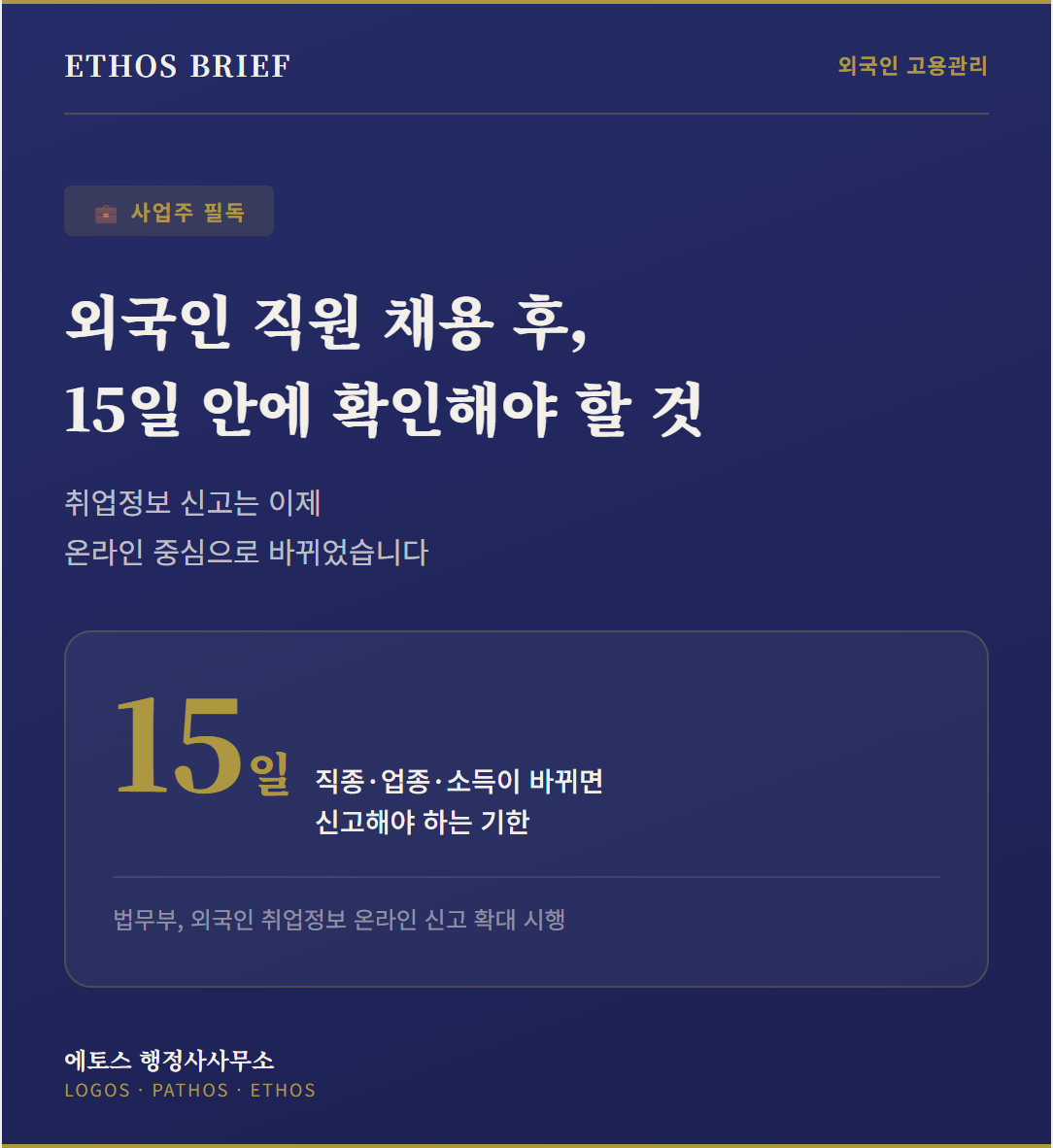
When employment information changes, the report should generally be filed within 15 days from the date the reason for reporting occurs.
Fifteen days is shorter than many employers expect.
Check immediately if:
- A foreign employee is newly hired
- Job duties change
- Income changes
- Status of stay changes
- Extension of stay is approaching
- The person starts self-employment
- Business details change
- Prior reporting was done on paper and online status is unclear
Missing the deadline may not simply be a paperwork issue. It may affect stay management or later immigration review.
Method 1 — Reporting During Visit Reservation
If the foreign national needs to visit an immigration office, employment information may be checked or updated during the HiKorea visit reservation process.
The general flow is:
- Access HiKorea
- Select visit reservation
- Enter foreign national information
- Check existing employment information
- If there are changes, enter updated employment information
- Enter job category, industry, annual income, and other required details
- Complete visit reservation and employment information report
This route may be useful when the foreign employee is preparing for extension of stay, change of status, alien registration, or another immigration office visit.
Method 2 — Standalone e-Application
If only employment information needs to be initially reported or changed, the report may be filed through HiKorea e-Application without a separate office visit.
The general flow is:
- Access HiKorea
- Log in
- Select civil application
- Select e-Application
- Choose employment information report or change report
- Enter job category, industry, and income information
- Submit the report
- Confirm and save the report certificate or result
If the report is filed online, the certificate or result should be stored.
If an administrative agent or another authorized representative assists with the report, ask for a copy of the report certificate after completion.
Visit Reservation Report vs. Standalone e-Application
| Category | Visit Reservation Process | Standalone e-Application | |---|---|---| | When used | When an immigration office visit is already planned | When only employment information needs to be reported | | Main purpose | Check employment information together with another immigration matter | Initial or change report only | | Advantage | Can be reviewed together with stay-related matters | Faster online filing | | What to check | Appointment date, office, civil application type | Report certificate and completion result | | Employer tip | Check information before the employee visits immigration | Ask employee to save proof of completion |
Which route is better depends on the employee’s situation.
If extension or change of status is coming up, it may be better to review employment information together with the visit reservation. If only the job or income information changed, standalone e-Application may be more efficient.
Employer Risk: Why Business Owners Should Care
The legal reporting obligation may primarily belong to the foreign national.
But employers still face practical risk.
If an employer hires a foreign national without confirming visa status or work eligibility, the business may be exposed to immigration risk.
The Immigration Act restricts employment of foreign nationals who do not have a status allowing employment activity.
Employers should avoid:
- Hiring a foreign national after their stay period has expired
- Hiring someone with a status that does not allow work
- Having a foreign national work at an unauthorized workplace
- Assigning work outside the permitted scope of status
- Ignoring missing employment information reports
- Failing to check alien registration or domestic residence report status
- Not confirming HiKorea reporting results
From a business perspective, “the employee will handle it” is not enough.
At minimum, employers should have an internal checklist.
What Employers Should Check Immediately After Hiring
After hiring a foreign employee, check the following.
| Item | Why It Matters | |---|---| | Status of stay | Confirms whether the person can perform the job | | Expiration date | Working after expiration creates serious risk | | Alien Registration Card or Residence Card | Basic identity and stay confirmation | | Scope of permitted work | Work scope differs by status | | Workplace restrictions | Important for many E-series statuses | | Employment information report | Prevents missing job, industry, or income reporting | | HiKorea account | Needed for online reporting and applications | | Change events | Determines whether 15-day reporting applies |
These checks should be repeated not only after hiring, but also before extension, before duty changes, and before income changes.
Check the HiKorea Account Now
Since online reporting is now central, the first thing to check is whether the foreign employee has access to HiKorea.
Use this checklist internally.
- [ ] Does the foreign employee have a HiKorea account?
- [ ] Can the employee log in properly?
- [ ] Has the initial employment information report been completed?
- [ ] Has job category, industry, or income range changed?
- [ ] If there was a change, was it reported within 15 days?
- [ ] Is the report certificate or completion result saved?
- [ ] Has the status of stay and work eligibility been checked?
- [ ] Has the expiration date recently been confirmed?
- [ ] Is the next extension date being tracked?
If your business has relied on paper-based procedures, now is the time to adapt to online reporting.
Self-Employed Foreign Nationals Should Also Check
The reporting issue is not limited to employees.
Self-employed foreign nationals may also be subject to reporting when engaging in income-earning activity.
Examples include:
- A foreign national running a restaurant
- A foreign national operating an online shopping mall
- An F-4 Overseas Korean doing self-employment
- An F-6 marriage migrant starting a business
- An F-2 resident working as a freelancer or sole proprietor
- A D-8 or D-9 holder changing business details
If a foreign national operates their own business, employment information reporting should still be checked.
Common Employer Misunderstandings
1. “Checking the Alien Registration Card Is Enough”
The Alien Registration Card is only a starting point.
It does not automatically tell you whether the person can perform the exact job.
Employers should also check status of stay, permitted work scope, workplace restrictions, and expiration date.
2. “F-4 or F-6 Means No Management Is Needed”
F-4 and F-6 often allow broader employment activity.
But they may still be subject to employment information reporting. Job category, industry, income changes, and F-4 restricted occupations should still be reviewed.
3. “The Reporting Obligation Belongs to the Employee, So the Employer Has Nothing to Do With It”
In principle, the foreign national reports.
But if reporting issues, expired stay, unauthorized work, or work-scope problems arise, the employer’s operations can be affected directly.
If the employee suddenly cannot continue working, the business faces a staffing problem.
4. “A Small Duty Change Does Not Matter”
Job or duty changes may trigger reporting or even status review.
This is especially important for specialized work visas, workplace-restricted visas, or statuses with industry limitations.
5. “We Do Not Need to Save the HiKorea Result”
Online filing must be verifiable.
The completion result, report certificate, receipt number, or submission screen may later be useful during extension, change of status, or a dispute.
When an Administrative Agent Can Help
Administrative support can be useful if:
- You are hiring a foreign employee for the first time
- You have multiple foreign employees
- You are unsure what work each visa allows
- Your employees have mixed statuses such as F-4, H-2, E-9, or E-7
- You need to check whether reports were missed
- HiKorea online reporting is unfamiliar
- Employment reporting and extension of stay must be prepared together
- The employee’s job duties or income changed
- You need to check whether a self-employed foreigner must report
- Immigration filing support is needed
Foreign employee management is not just a hiring document issue.
Status of stay, work eligibility, reporting deadlines, expiration dates, and online immigration filings should be managed together.
Employer Checklist for Foreign Staff Management
Use the following checklist regularly.
Before Hiring
- [ ] Check status of stay
- [ ] Confirm work eligibility
- [ ] Check expiration date
- [ ] Verify Alien Registration Card or Residence Card
- [ ] Confirm whether the job matches the status of stay
After Hiring
- [ ] Check initial employment information reporting
- [ ] Confirm HiKorea account access
- [ ] Save report certificate or submission result
- [ ] Prepare employment contract
- [ ] Organize salary payment method
During Employment
- [ ] Check job category changes
- [ ] Check industry changes
- [ ] Check income range changes
- [ ] Track extension date
- [ ] Check residence or workplace changes
When a Change Occurs
- [ ] Confirm the date of change
- [ ] Check whether 15-day reporting applies
- [ ] Check whether HiKorea e-Application is available
- [ ] Save proof of reporting
- [ ] Review whether extension or change of status is affected
Frequently Asked Questions
Q. Does the employer file the foreign employment information report?
In principle, the foreign national is responsible for the report.
However, employers should confirm the employee’s status of stay, work eligibility, and reporting status because problems can affect business operations.
Q. Is paper reporting still available after July 2026?
From January to June 2026, online and paper reporting were operated together. After July 2026, the process shifted to online-centered reporting.
Any exception or local handling practice should be confirmed through HiKorea or the Immigration Contact Center 1345.
Q. Are F-4 or F-6 employees subject to reporting?
They may be, if they engage in income-earning activity.
F-4 and F-6 often allow broad employment, but employment information reporting and changes in job, industry, or income may still need to be managed.
Q. Do self-employed foreign nationals need to report?
They may need to.
If a foreign national operates a business, works as a freelancer, or engages in income-earning activity, reporting should be checked.
Q. What happens if the report is missed?
It depends on the case.
The result may differ depending on whether it was a simple omission, whether it connects to a status violation, whether the activity was unauthorized, and whether the reporting deadline was missed.
The important point is not to ignore the issue once it is discovered.
Q. Can an administrative agent help with HiKorea reporting?
Yes, within the permitted scope.
An administrative agent can help review status of stay, organize documents, assist with online reporting, keep proof of reporting, and connect the reporting issue with extension or change of status planning.
Closing — Hiring a Foreign Employee Is Not the End. It Is the Beginning of Compliance Management.
More Korean businesses are hiring foreign employees.
But foreign employment does not end with hiring.
The real management begins afterward.
Employers should track:
- Status of stay
- Work eligibility
- Employment information reporting
- Changes in job, industry, or income
- Expiration date
- HiKorea online filings
- Extension or change timing
Since July 2026, foreign employment information reporting has shifted to an online-centered process. Employers and foreign staff should both become familiar with HiKorea procedures.
If you currently employ foreign staff, check these three questions now:
Has the employment information report been completed?
Has there been any job, industry, or income change?
When does the employee’s stay period expire?
These three checks can prevent avoidable risk.