
What Can Ethos Administrative Agent Office Help With? Scope of Services for Middle East Expansion, Arabic Documents, Visas, and Administrative Procedures
Hello, this is Administrative Agent Jean.
Since I began operating this blog more actively, I have started receiving inquiries related to the Middle East and Arabic-speaking regions.
Recently, I received questions like these:
“Can you handle company formation in Saudi Arabia for us?”
“Can you handle halal certification in the GCC region?”
The short answer is: Ethos cannot directly handle local company formation or local halal certification procedures.
But this is not because I am an administrative agent.
Even Korean attorneys cannot independently handle Saudi company formation directly.
Saudi company formation, MISA investment licenses, commercial registration, local permits, and halal certification review are matters handled by Saudi, UAE, or other local authorities and locally qualified professionals.
However, there are many things Ethos can help with.
Within the scope of Korean administrative agent services, Ethos can review and prepare Korea-side documents, apostille and consular legalization, powers of attorney, contracts, visa and immigration matters, foreign startup procedures, Arabic and English administrative documents, and explanations of Middle Eastern official materials.
This article is a guide for first-time visitors who are wondering:
“Is this something I can contact Ethos about?”
It explains the scope and limits of Ethos Administrative Agent Office.
How Is an Administrative Agent Different From an Attorney?
In simple terms, the roles are different.
An attorney handles litigation, legal disputes, legal advice, and legal services.
An administrative agent assists with documents submitted to administrative agencies, translation of administrative documents, submission, permits, reports, applications, and other administrative procedures.
Article 2 of the Korean Administrative Agent Act defines administrative agent work to include:
- Preparing documents submitted to administrative agencies
- Preparing documents concerning rights, obligations, or factual certification
- Translating documents related to administrative agency work
- Submitting prepared documents on behalf of clients
- Acting on applications, petitions, reports, and similar procedures for permits, licenses, and approvals
- Responding to consultations or inquiries about administrative laws and administration
- Conducting factual investigations and confirmations entrusted under laws
However, there is an important limitation.
Administrative agents cannot perform work restricted by other laws.
For example, litigation representation, legal advice on legal cases, tax representation, customs advice, and local legal representation overseas belong to the relevant licensed professionals.
I often explain the difference this way:
Attorneys handle disputes and legal judgment.
Administrative agents design administrative procedures and submission documents.
If the core issue is not litigation but administrative submission, visas, permits, administrative documents, factual confirmation, translation, or authentication, an administrative agent may be the right professional.
Why Can’t Korean Attorneys Directly Handle Saudi Company Formation?
A Korean attorney’s license is primarily a qualification under Korean law.
Saudi company formation follows Saudi law and Saudi authority procedures.
For example, Saudi company formation or foreign market entry may involve:
-
MISA, Ministry of Investment of Saudi Arabia
Foreign investment license -
Ministry of Commerce, وزارة التجارة
Commercial Registration, CR -
MHRSD, Ministry of Human Resources and Social Development
Employment, Saudization, Nitaqat, Qiwa -
ZATCA
Tax, VAT, and customs matters -
Local municipalities or sector-specific authorities
Licenses, operating permits, and activity approvals
Korean law firms usually work with Saudi attorneys, local law firms, MISA-registered agents, accountants, and tax professionals when handling Saudi market entry matters.
A Korean attorney does not use a Korean license alone to represent a client directly before Saudi government authorities for company formation.
The same applies to administrative agents.
This is not a matter of which profession is superior.
It is a matter of jurisdiction.
Korean administrative procedures are handled by Korean-qualified professionals.
Saudi local procedures are handled by Saudi local professionals and competent authorities.
Ethos does not cross that line.
Instead, Ethos organizes the Korea-side documents and administrative structure accurately.
What Does Ethos Administrative Agent Office Do?
Ethos Administrative Agent Office can be summarized in one sentence:
Korean administrative procedures + Middle East and Arabic administrative information + Korea-side document structuring
The main service areas are as follows.
1. Visa and Immigration Matters
Ethos handles administrative procedures related to foreign nationals’ stay in Korea.
Representative matters include:
- Change of visa status
- Extension of stay
- Change of workplace reports
- Alien registration-related documents
- Response after visa refusal or denial
- Review of departure orders or stay-related administrative dispositions
- Document structuring for D-8, D-9, E-7, F-6, and other visa statuses
Before becoming an administrative agent, I worked in visa and immigration screening at a foreign embassy in Korea.
From the screening side, I saw that even with the same facts, outcomes can differ depending on how documents are organized, which evidence is emphasized, and what explanation is missing.
For example, even for the same E-7 visa, required documents may differ depending on company size, occupation code, wage, education and experience, and past immigration history.
Search results provide average explanations.
But actual screening is based on individual facts.
2. Foreign Startup, Investment, and Permits in Korea
When a foreign national starts a business or establishes a company in Korea and connects it to D-8 or D-9 visa status, sequence matters.
A typical structure may involve:
Foreign investment report
→ Investment remittance
→ Corporate registration
→ Industry-specific permits
→ Business registration
→ Foreign-invested company registration
→ D-8 visa review
Under Korea’s foreign investment laws, the general thresholds of KRW 100 million or more and at least 10% of voting shares or equity are important.
But that is not the end.
A D-8 visa does not look only at whether money was invested.
It also reviews source of funds, business substance, office space, business plan, the applicant’s role, and the company’s actual operational capacity.
If the sequence becomes tangled, the entire structure may need to be reorganized from the beginning.
That is why foreign startup work is not just company registration.
It is the work of designing investment, permits, business registration, and visa status as one connected procedure.
3. Incorporated Associations and Foundations
Nonprofit legal entity formation is another administrative procedure handled by Ethos.
Representative work includes:
- Reviewing the purpose of establishment
- Identifying the competent authority
- Drafting articles of incorporation
- Organizing inaugural meeting documents
- Preparing director-related documents
- Applying for establishment permission
- Guidance on post-registration obligations
For example, suppose you want to establish a nonprofit entity for both “supporting multicultural families” and “Korean language education.”
Depending on the purpose and project scope, the competent authority may involve the Ministry of Health and Welfare, Ministry of Education, or a local government.
Writing a broad purpose may look helpful, but it can make the competent authority more complicated and increase the chance of supplementation requests.
For nonprofit entities, one sentence in the articles of incorporation can affect both approval likelihood and future operational obligations.
That is why the purpose and project scope should be organized carefully from the beginning.
4. Contracts, Powers of Attorney, and Factual Statements
Ethos handles Korean, English, and Arabic administrative documents and contract-related documents.
Representative documents include:
- Contracts
- Powers of attorney, POA
- Factual statements
- Declarations
- Company confirmation letters
- Arabic and English submission materials
- Korean documents for overseas submission
For Middle Eastern submission documents, name and company-name consistency is especially important.
For example, a Korean company may be a “주식회사” in Korean but casually write “Ltd.” in an English document.
However, depending on the jurisdiction, “Ltd.” may be understood as a limited company, which can make the company form look different.
In Middle Eastern submission documents, such differences can lead to supplementation requests or rejection.
Name spelling matters as well.
Arabic names often do not have a fixed Korean transliteration in the same way as English, Chinese, or Japanese names.
The same name may appear differently across documents:
- Mohammed
- Muhammad
- Mohamed
- 모하메드
- 무함마드
The problem is that administrative authorities do not simply treat these as “probably the same person.”
If identity cannot be confirmed consistently across passports, powers of attorney, contracts, corporate documents, and translations, supplementation may be requested.
Translation is therefore not merely replacing words.
It is the work of consistently connecting the same person and the same company across multiple documents.
5. Administrative Appeals and Administrative Dispositions
Visa refusals, permit denials, and administrative dispositions may require review of administrative appeal or objection procedures.
However, this area requires particular attention to scope and deadlines.
Administrative appeals generally involve a deadline of 90 days from the date the person became aware of the disposition.
If the deadline passes, it may become procedurally difficult to challenge the matter, even if the substance feels unfair.
Ethos reviews the administrative disposition, notice, deadline, and possible objection route, and supports document preparation and procedures within the scope of administrative agent services.
However, litigation, legal advice on legal cases, and work restricted under the Attorney-at-Law Act belong to attorneys.
What Can Ethos Do for Middle East and Arabic-Related Matters?
Explaining Middle Eastern administrative information in Korean is different from directly handling local company formation overseas.
Ethos does the former.
In other words, Ethos is not a firm that directly represents clients before Middle Eastern local authorities for local permits.
Instead, it helps Korean companies and Arabic-speaking clients understand and prepare the documents and administrative structure they need.
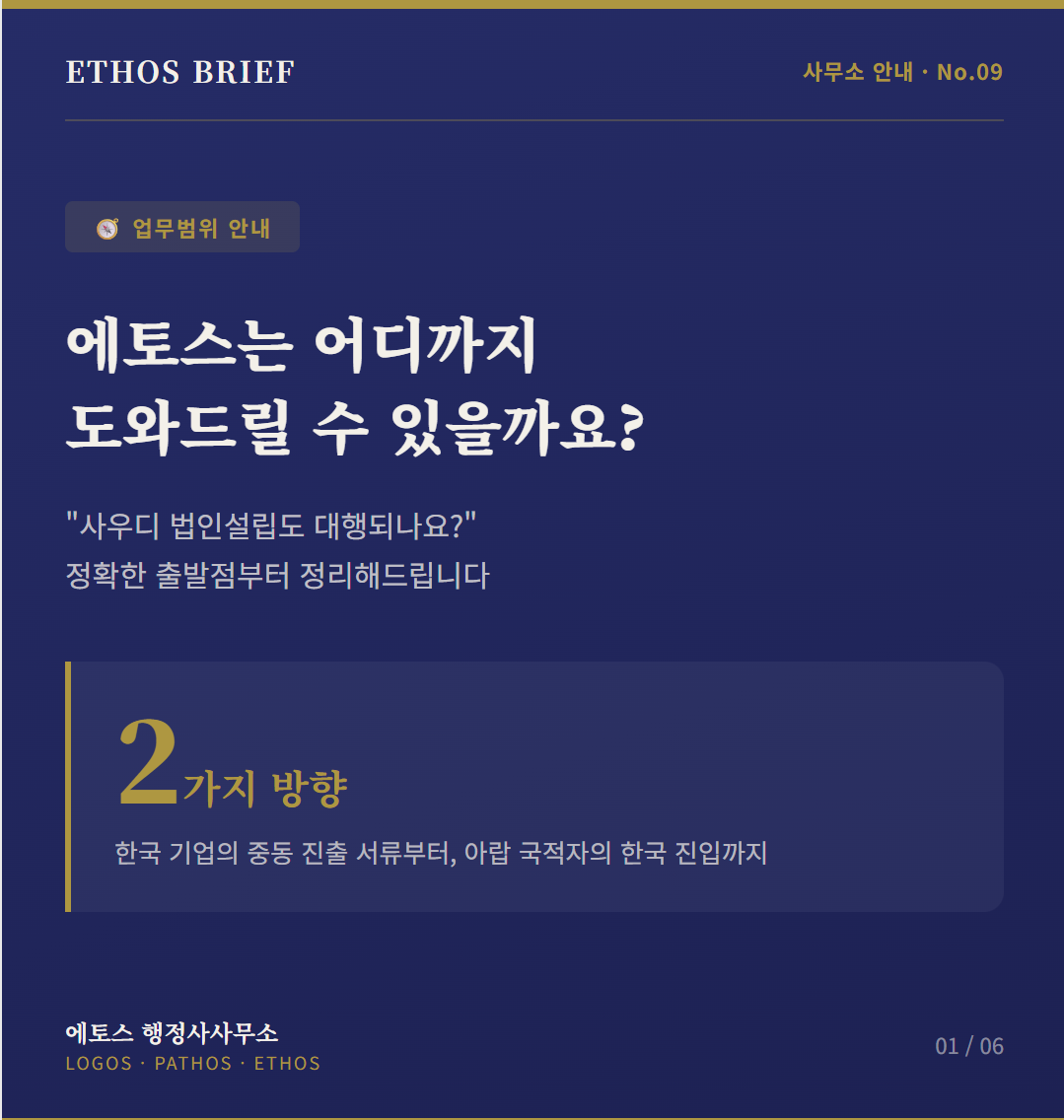
There are two main directions.
Direction 1 — Korean Companies Preparing Documents for Middle East Expansion
Ethos organizes Korea-side documents needed when Korean companies transact with or prepare to enter Saudi Arabia, the UAE, Qatar, Kuwait, and other Middle Eastern countries.
| Possible Work | Details | |---|---| | Apostille and consular legalization preparation | Review apostille availability for Saudi Arabia and consular legalization or embassy attestation structure for the UAE | | Contract and POA drafting | Korean, English, and Arabic contracts, powers of attorney, factual statements | | Korean documents for overseas submission | Business registration certificates, corporate registry documents, board resolutions, POAs | | Explanation of Arabic official regulations | Review Arabic source materials from MHRSD, MISA, Qiwa, etc., and organize them in Korean | | Middle East transaction factual statements | Document facts related to investment, contracts, dispatch, and transaction history | | Local expert direction guidance | Distinguish when Saudi or UAE attorneys, accountants, certification bodies, or agents are needed |
For example, Korean materials may summarize Saudi Nitaqat simply as “Saudization quotas have been strengthened.”
But MHRSD Arabic originals or Qiwa materials may show detailed requirements such as profession-specific criteria, minimum wages, Qiwa electronic contracts, and SCE certification.
These details matter.
Ethos does not merely translate Middle Eastern official materials into Korean.
It organizes which documents and questions Korean companies should prepare.
Direction 2 — Arabic Nationals Entering Korea
Ethos can also assist Arabic-speaking foreign nationals preparing for stay, startup, investment, company formation, or marriage-related visa procedures in Korea.
| Possible Work | Details | |---|---| | Korean investment visa, D-8 | Review investment amount, source of funds, business substance, and company operation structure | | Startup and company formation in Korea | Design the sequence of foreign investment report, remittance, registration, business registration, and foreign-invested company registration | | Korean stay for Middle Eastern company employees | Review visa status for employees dispatched from Saudi or UAE headquarters to Korean branches or entities | | Submission of Arabic documents in Korea | Translate Arabic originals, organize name spelling, and prepare administrative submission documents | | Marriage and family-related documents | Review links between nikah or Islamic marriage contracts and Korean visa procedures | | Arabic consultation | Review Arabic source documents and explain Korean administrative procedures |
For example, if an Arabic national wants to start a business in Korea, simply forming a company first is not enough.
The following must be reviewed together:
- Investment remittance
- Source of funds
- Business plan
- Office
- Business registration
- Visa status
- Whether family members will accompany the applicant
Ethos connects Arabic documents with Korean administrative procedures so that the visa structure and business structure fit together.
What Ethos Cannot Do
It is also important to define the limits clearly.
Ethos cannot perform the following work.
| Work Ethos Cannot Do | Reason | Appropriate Professional | |---|---|---| | Direct Saudi or UAE local company formation | Requires local qualification and local authority procedures | Local attorney, MISA-registered agent, local consultant | | Local halal certification review or approval | Certification body review and local registration matter | Halal certification body, local importer, local professional | | Litigation and legal advice | Attorney-at-law work | Attorney | | Tax and customs advice | Tax accountant or customs broker work | Tax accountant, customs broker | | Representation before local courts or authorities overseas | Requires local qualification | Local attorney or local representative | | Investment judgment or financial advice | Financial advisory area | Financial professional | | Guarantee of visa or permit approval | Competent authority decision | Relevant authority |
This table is not meant to refuse inquiries.
It is meant to identify the correct starting point.
When work requiring local professionals is separated from work that can be prepared in Korea, time and cost can be reduced.
Frequently Asked Questions
Q. I am looking for someone to help with Saudi company formation or halal certification. Can I contact Ethos?
Yes, you may contact Ethos.
However, Ethos does not directly handle Saudi local company formation or halal certification review.
Saudi company formation requires Saudi local attorneys, MISA-registered agents, and accounting or tax professionals.
Halal certification requires the relevant certification body, target country recognition system, and local registration procedure.
Ethos can help with:
- Korean headquarters documents
- Powers of attorney
- Contracts
- Apostille and consular legalization
- Arabic and English submission materials
- Organizing facts for local professionals
Q. Can Ethos prepare Arabic contracts?
Yes.
Ethos can prepare or organize Korean, English, and Arabic contracts, powers of attorney, factual statements, declarations, and similar administrative documents.
However, the legal effect under local law, local litigation risk, and final legal review of documents submitted to local courts should be confirmed by local attorneys.
Q. I am an Arabic national and want to start a business in Korea. Is that possible?
Yes.
But the following should be checked first:
- Whether the investor is an individual or a corporation
- Whether the investment amount is at least KRW 100 million
- Whether the structure includes at least 10% voting equity
- Whether source of funds can be proven
- Whether there is an actual place of business
- Whether the business plan is concrete
- Whether it can be connected to D-8 visa status
Ethos can provide Arabic-language consultation and explain Korean administrative procedures to design the sequence of investment, company formation, and visa application together.
Q. My visa was refused. Can an administrative agent help?
Depending on the case, yes.
First, the refusal notice, documents submitted at the time of application, stay history, company documents, and deadline must be reviewed.
It may be possible to review administrative appeal, reapplication, or preparation of supplementary materials.
However, if the matter becomes litigation or a legal case, attorney review is required.
Q. How much is the consultation fee?
Initial review of whether the matter can be handled may be provided free of charge.
Detailed consultation is paid, and the fee may vary depending on the matter.
If consultation leads to engagement, the consultation fee may be deducted from the service fee.
Materials Helpful Before Contacting Ethos
You do not need to prepare every document perfectly before contacting Ethos.
However, review can proceed faster if the following materials are available.
For Korean Companies Preparing Middle East Expansion
- Target country
- Purpose of transaction or establishment
- Whether there is a local partner
- List of documents to be submitted
- Korean headquarters corporate documents
- Whether a power of attorney is needed
- Required language: Korean, English, Arabic
- Submission deadline
For Arabic Nationals Preparing to Enter Korea
- Nationality
- Current place of stay
- Purpose of entering Korea
- Investment amount
- Business item
- Whether a Korean company has been established
- Whether family members will accompany the applicant
- Previous visa applications or refusal history
For Visa or Administrative Disposition Response
- Disposition notice
- Reason for refusal
- Documents submitted at the time of application
- Stay history
- Deadline
- Additional materials that may be obtained
Summary — Ethos Is Not a Local Overseas Agent, but a Korean Administrative Procedure Designer
Ethos Administrative Agent Office does not directly handle Saudi company formation on the ground.
It does not represent clients in UAE courts.
It does not grant halal certification on behalf of certification bodies.
But Ethos can do the following:
Organize documents to be prepared in Korea,
design apostille and consular legalization procedures,
prepare contracts, powers of attorney, and factual statements,
connect Arabic and English documents with Korean administrative procedures,
structure Korean visa, startup, and investment procedures for foreign nationals,
and explain Middle Eastern official materials in a way Korean companies can understand.
The most dangerous assumption in Middle Eastern business is believing that everything can be solved by one provider.
Local law should be handled by local professionals.
Korean administrative documents should be handled by Korean administrative professionals.
Tax and customs should be handled by qualified specialists.
Visas and permits should be prepared according to the criteria of the competent authority.
Ethos helps identify the starting point for Korea-side administrative documents and procedures.
Contact
If you need help with Middle East expansion, Arabic documents, Korean visas, foreign startup procedures, apostille or consular legalization, powers of attorney, or contract preparation, please contact Ethos.
References
- Korean Administrative Agent Act, Article 2
- Attorney-at-Law Act, Article 109
- Invest KOREA, Types of Foreign Direct Investment
- Enforcement Decree of the Foreign Investment Promotion Act, Article 2
- Ministry of Government Legislation interpretation on administrative agency applications and administrative agent scope
This article is not intended to provide legal advice under the Attorney-at-Law Act, tax or customs advice, local overseas legal representation, or any guarantee of specific permit or visa approval.