
Caught Doing Delivery Work in Korea — What Is the Difference Between a Penalty Payment, Departure Order, and Deportation Order?
Hello, this is Administrative Agent Jean.
In the previous articles, we looked at why foreign nationals in Korea should check their status of stay before doing delivery work, and what additional issues can arise when a foreign rider uses a delivery account registered under a Korean person's name.
But once someone has already been caught doing delivery work by Korean immigration authorities, the questions change.
“If I pay the penalty, is the case over?”
Or:
“I received a departure order. Is that the same as a deportation order?”
The answer is no.
More importantly, not every foreign national caught doing unauthorized delivery work receives the same immigration disposition.
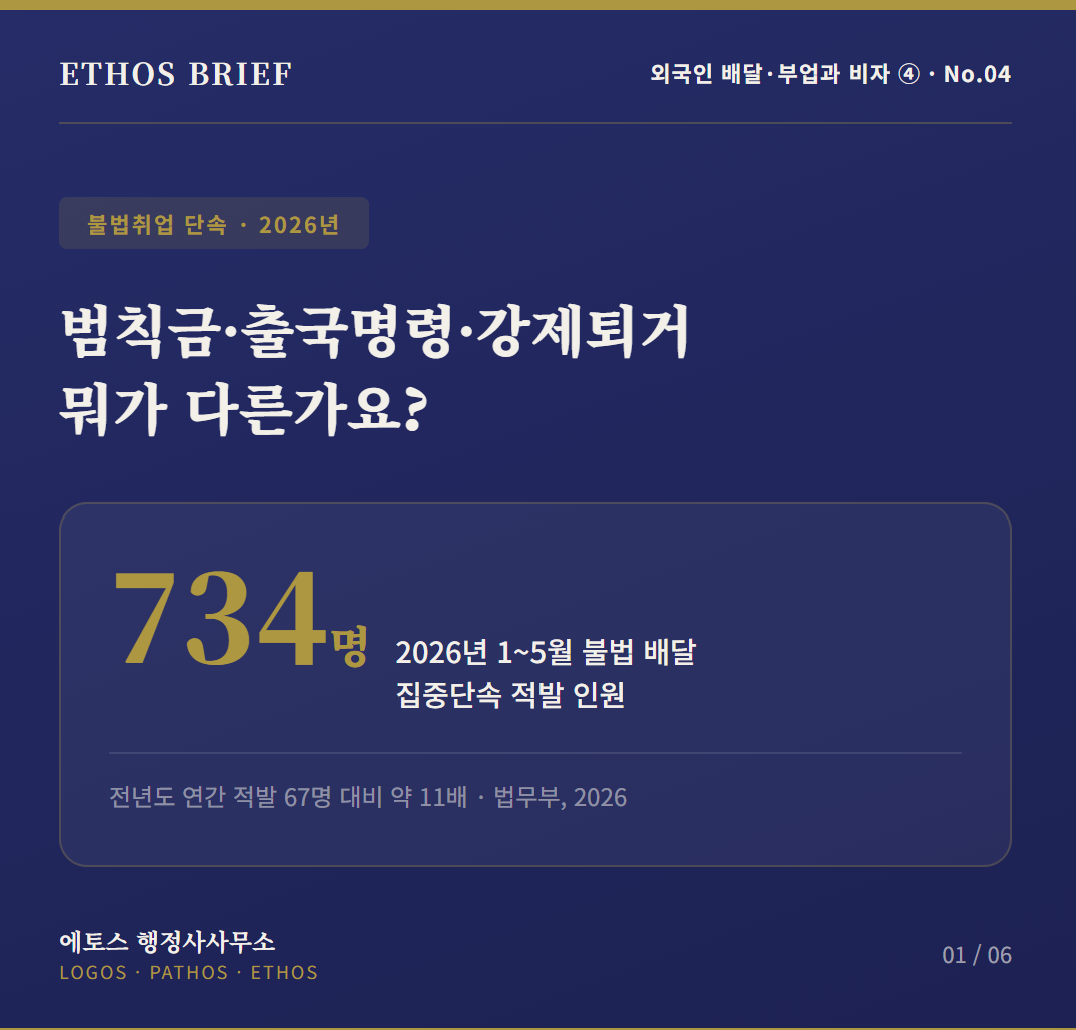
From January through May 2026, the Korean Ministry of Justice conducted an intensive crackdown on foreign nationals working illegally as delivery riders and detected 734 people.
Among them, 643 were subject to penalty payments totaling KRW 1.6287 billion, while 68 were subject to departure-related measures, including deportation.
Another 20 cases remained under investigation, two people were referred for criminal prosecution, and one person who was already wanted by the authorities was handed over to the police.
The Ministry of Justice also stated that 15 foreign nationals found to have been driving without a valid license were expected to be separately referred to the police for investigation.
In other words, the outcome is not simply:
Caught → Pay a penalty
Cases can branch into different procedures, including penalty payments, departure measures, continued investigation, criminal referral, or police investigation for separate violations.
In this article, we will focus on three concepts that often cause confusion:
penalty payments, departure orders, and deportation orders.
We will also look at what you should check first if Korean immigration authorities have already contacted you or issued documents in your case.
How Much Has Enforcement Against Unauthorized Foreign Delivery Riders Increased?
From January through May 2026, 734 foreign delivery riders were detected during the Ministry of Justice enforcement campaign.
According to the Ministry, 67 people had been detected during the entire previous year.
That means the number detected in just five months of 2026 was approximately 11 times the previous year's annual figure.
The breakdown by status of stay is also notable.
410 people were D-2 international students, representing approximately 56% of the total.
They were followed by:
- 149 F-4 Overseas Koreans
- 99 D-10 job seekers
- 76 people under other statuses of stay
The D-2 students detected in the crackdown came from 96 different universities.
This was therefore not an issue limited to only a few schools or one specific status of stay.
The broader issue of unauthorized foreign employment in delivery and parcel-related work also did not suddenly appear in 2026.
According to Seoul Metropolitan Government data citing Ministry of Justice statistics, the number of foreign nationals detected for unauthorized work in delivery and parcel services increased from 117 in 2023 to 486 in 2025.
However, the scope of those statistics is not necessarily identical to the Ministry of Justice's 2026 figure of 734 foreign riders detected in connection with unauthorized delivery work and third-party accounts.
The figures should therefore not be treated as one perfectly continuous statistical series.
Still, the overall direction is clear.
Unauthorized foreign employment in delivery-related work has become a growing immigration enforcement issue in Korea, and the authorities have been increasing enforcement activity.
A Penalty Payment, Departure Order, and Deportation Order Are Not the Same Thing
The first step is to distinguish the three.
A penalty payment (범칙금) is part of the disposition procedure for immigration offenses under Article 102 and the following provisions of the Immigration Act.
It involves an immigration authority notifying the person to pay a specified amount.
Receiving a penalty payment does not, by itself, automatically mean that the foreign national must leave Korea.
A departure order (출국명령) is different.
Under Article 68 of the Immigration Act, immigration authorities may order a foreign national to leave Korea within a specified period.
It is not primarily a monetary measure.
It is an immigration disposition requiring the person to depart from Korea by the specified deadline.
A deportation order (강제퇴거명령) is another distinct measure.
Under Article 46, Article 59, and related provisions of the Immigration Act, a deportation order may be issued when a foreign national is found to fall within one of the statutory grounds for deportation.
Depending on the case, a separate criminal referral or accusation may also arise.
Therefore, it is not accurate to think of the system as a fixed three-step ladder:
Penalty payment → Departure order → Deportation order
Different administrative and criminal procedures may apply in different combinations depending on the facts.
That is why, if you have received paperwork from immigration authorities, the first question should not simply be:
“How much do I have to pay?”
The more important question may be:
“What is the exact name of the document I received?”
A Penalty Payment Is Not Simply the Same as a Criminal Fine
In immigration consultations, people often say:
“Immigration gave me a KRW 2 million fine.”
But legally, a penalty payment under the Immigration Act is not the same thing as a criminal fine imposed by a court.
It is also different from an administrative fine.
In other words:
Penalty payment (범칙금) ≠ Criminal fine (벌금) ≠ Administrative fine (과태료)
Under Article 102 of the Immigration Act, when the head of a regional immigration office determines through an immigration-offense investigation that there is sufficient evidence of an offense, the authority may issue written notice requiring the person to pay an amount equivalent to a criminal fine as a penalty payment.
This is generally referred to as a notification disposition (통고처분).
Once such notice has been issued, the person is generally required to pay within the statutory period.
The Immigration Act also provides that when the penalty payment is paid as notified, the person is not punished again for the same offense.
This is where another common misunderstanding appears.
“Then if I pay the penalty, my immigration problem is over, right?”
Not necessarily.
A penalty payment and a separate immigration disposition concerning whether the person may continue staying in Korea can be different legal issues.
The Basic Penalty Standard Can Vary According to the Period of Unauthorized Employment
The current Enforcement Rule of the Immigration Act sets out basic penalty standards for people who engage in employment without a status of stay permitting employment, in violation of Article 18(1) of the Immigration Act.
The basic standards vary according to the period of unauthorized employment.
The current basic standards are:
Less than 1 month: KRW 2 million
1 month or more but less than 3 months: KRW 3 million
3 months or more but less than 6 months: KRW 4 million
6 months or more but less than 1 year: KRW 7 million
1 year or more but less than 2 years: KRW 10 million
2 years or more but less than 3 years: KRW 15 million
3 years or more but less than 5 years: KRW 20 million
5 years or more but less than 7 years: KRW 25 million
7 years or more: KRW 30 million
This reveals an important point.
A person should not assume:
“I worked only for one day, so the penalty will probably be a few hundred thousand won.”
For unauthorized employment falling under Article 18(1), the current basic standard begins at KRW 2 million even when the period is less than one month.
As we will see below, there is an actual case in which a D-2 international student worked illegally for only one day and received a KRW 2 million penalty payment.
At the same time, this does not mean that someone can simply look at the table and conclude:
“I worked for 20 days, so my final penalty will definitely be KRW 2 million.”
Actual cases may involve reductions or other considerations depending on the type of violation and the specific circumstances.
In the 2026 delivery enforcement campaign, for example, the Ministry of Justice reported penalty payments ranging from KRW 1 million to KRW 10 million per person.
The duration of unauthorized employment is therefore an important factor, but it does not by itself determine the entire immigration outcome.
They Worked for Only Two or Three Days — The Penalty Was Reduced, but the Departure Orders Were Still Upheld
A 2024 administrative appeal illustrates this clearly.
A Vietnamese couple entered Korea under F-1-5 dependent-family status to help their daughter, who was a marriage immigrant, after childbirth and to assist with childcare.
However, they engaged in employment even though their status of stay did not permit them to work.
The husband worked for three days, while the wife worked for two days.
The agreed daily wage was KRW 120,000.
Immigration authorities reduced the basic penalty amount by 30% and notified each person to pay KRW 1.4 million.
Both paid the penalty on the same day.
But that was not the end of the case.
They were also issued departure orders.
The couple argued that they had entered Korea to help care for their grandchild, that the unauthorized employment lasted only two or three days, and that requiring them to leave Korea was excessively harsh.
The Central Administrative Appeals Commission rejected their claims.
This was Central Administrative Appeal 2024-08402, decided on August 27, 2024.
The decision noted that although they could fall within the statutory grounds for deportation, immigration authorities had considered factors including their admission of the unauthorized work, their willingness to leave voluntarily, and their family relationship with a marriage immigrant.
The authorities had reduced the penalty and issued a departure order rather than the more severe measure of deportation.
This case demonstrates something important.
The fact that:
the unauthorized employment lasted only a few days
and
the penalty payment was reduced
did not automatically mean:
“Then they can continue staying in Korea.”
One Day of Unauthorized Work Still Led to a KRW 2 Million Penalty and a Departure Order
There is another important case from 2025.
A foreign national staying in Korea under D-2 student status worked at a demolition site.
The unauthorized work lasted only one day.
The agreed wage was KRW 150,000.
Immigration authorities notified the student to pay a KRW 2 million penalty payment and issued a departure order at the same time.
The student filed an administrative appeal.
The student argued, among other things, that only one semester remained before completing the degree, that the time and effort already invested in the course of study would be lost, and that issuing a departure order in addition to the penalty payment was excessively harsh.
The appeal was dismissed.
This was Central Administrative Appeals Commission Case 2025-14310, decided on November 18, 2025.
The decision considered that the student could have been subject to deportation but that immigration authorities had taken the person's willingness to depart voluntarily into account and issued the comparatively less severe measure of a departure order.
The point is not that:
“One day of unauthorized work always results in a departure order.”
Rather, the case shows that:
“I worked only for one day.”
may be an important circumstance, but it does not by itself guarantee that the case will end with only a penalty payment.
Why Can Immigration Issue a Departure Order Even After the Penalty Has Been Paid?
This is one of the most confusing parts of the system.
The Immigration Act provides that once a person pays the penalty amount notified in the disposition, the person is not punished again for the same offense.
This may lead someone to ask:
“If I already paid the penalty, isn't a departure order a second punishment?”
However, Article 68 of the Immigration Act separately provides for situations in which immigration authorities may issue a departure order even after a notification disposition under Article 102 where departure is considered appropriate.
In other words, the legal framework allows both:
a penalty-payment disposition
and
a departure order
to exist in the same case.
The 2025-14310 case discussed above is an actual example in which a KRW 2 million penalty payment and a departure order were imposed together.
Therefore, it is not safe to assume:
“I paid the entire penalty, so my right to continue staying in Korea is now resolved.”
The penalty issue and the immigration decision concerning continued stay must be examined separately.
If the Penalty Payment Is Wrong, Can You Simply File an Administrative Appeal?
There is another important distinction here.
For many administrative dispositions, a person may naturally think:
“If I disagree with the disposition, I can file an administrative appeal asking for its cancellation.”
But a penalty-payment notification under the Immigration Act has a different procedural structure.
In Central Administrative Appeal Case 2013-06979, a person sought cancellation of a penalty-payment notification.
The appeal was dismissed as procedurally inadmissible.
The reasoning was that the Immigration Act already provides a separate procedural framework.
If the person accepts the notification disposition, the penalty payment is paid and the procedure concludes.
If the person disputes the notification and does not pay the penalty, the matter may, in principle, proceed through a criminal referral and formal criminal procedure.
Therefore, the Central Administrative Appeals Commission concluded that an ordinary administrative appeal seeking cancellation of the penalty-payment notification itself was not an appropriate procedure.
This means it is not accurate to assume:
“The penalty is unfair, so I should simply file an administrative appeal.”
But the opposite conclusion can also be dangerous:
“If administrative appeal is unavailable, I will just refuse to pay.”
Failure to pay within the statutory period can, in principle, lead to criminal referral and criminal proceedings.
The correct approach is therefore to distinguish between the penalty-payment notification and other immigration measures, such as a departure order, because the available procedures for challenging them are not necessarily the same.
What Exactly Is a Departure Order?
Article 68 of the Immigration Act allows immigration authorities to issue a departure order in specified circumstances.
For example, a person who falls within grounds that could otherwise lead to deportation but who intends to leave Korea voluntarily at their own expense may be issued a departure order.
A departure order may also be issued after a penalty-payment notification where immigration authorities determine that departure from Korea is appropriate.
This is why administrative appeal decisions sometimes describe a departure order as a:
“less severe disposition than deportation.”
However, “less severe” does not mean insignificant.
A departure order specifies a deadline by which the foreign national must leave Korea.
If the person fails to leave by the deadline or violates conditions attached to the departure order, the case may proceed to a deportation order.
Therefore, if you have received a departure order, the first things to check are:
the date the departure order was issued or received
and
the deadline for departure.
Aren't a Departure Order and a Deportation Order Basically the Same Because Both Mean Leaving Korea?
Both are connected to leaving Korea, but they are legally different.
A departure order generally gives the foreign national a period in which to leave Korea voluntarily.
A deportation order, on the other hand, is a separate disposition issued following an immigration examination when the person is found to fall within statutory deportation grounds.
A deportation order also has a separate objection procedure under the Immigration Act.
A person who receives a deportation order may file an objection with the Minister of Justice through the relevant regional immigration office within seven days from the date of receiving the deportation order.
Therefore, if the document in your hand says:
“Deportation Order”
you should not simply treat it as an ordinary administrative disposition and allow time to pass.
The seven-day objection procedure will be discussed in more detail in a separate article.
Why Does One Person Receive Only a Penalty While Another Faces a Departure Measure?
For someone who has actually been caught doing unauthorized delivery work, this is probably the most important question.
It would be convenient if there were a simple formula such as:
“Less than 10 days means a penalty only, and more than one month means a departure order.”
But the Ministry of Justice has not published such a single formula.
When announcing the results of the 2026 delivery enforcement campaign, the Ministry stated that dispositions were determined by considering factors such as the degree of the violation, the duration of unauthorized employment, and the person's stay circumstances.
The actual outcomes were also different.
Among the 734 foreign nationals detected:
643 received penalty payments
68 were subject to departure-related measures, including deportation
20 remained under investigation
2 were referred for criminal prosecution
1 was handed over to the police
This means that an actual case may require review of factors including:
- the person's current status of stay
- whether the status permits the relevant work
- the actual duration of delivery work
- the frequency and scale of the delivery activity
- whether a third-party delivery account was used
- any prior immigration violations
- the person's current circumstances of stay
- facts confirmed during the immigration investigation
- statements already made to immigration officers
- whether other violations, such as unlicensed driving, are involved
- the exact immigration document or disposition already issued
No single one of these factors automatically calculates whether the outcome will be a penalty payment, departure order, or deportation order.
Once a Departure Order Is Issued, Is It Almost Impossible to Cancel?
This requires a balanced answer.
As discussed above, there are cases in which departure orders were upheld even though the unauthorized employment lasted only one, two, or three days.
But that does not mean a departure order can never be cancelled.
There are also cases in which departure orders were cancelled.
A Departure Order Was Cancelled Because the Authorities Calculated the Period Incorrectly
Consider Central Administrative Appeals Commission Case 2021-12772.
A foreign national staying under E-9 status had received several extensions of a departure deadline during the COVID-19 period.
The final extension expired on Sunday, August 22, 2021.
The foreign national submitted another extension request the following day, Monday, August 23.
Immigration authorities concluded that the deadline had already expired and issued a departure order.
However, the Central Administrative Appeals Commission reviewed the rules governing calculation of periods and concluded that the deadline should legally have extended to the following business day.
In other words, the factual premise behind the departure order —
“The person had already overstayed by one day.”
— was incorrect.
The departure order was therefore cancelled.
The significance of this case is not that the person was excused because the circumstances were sympathetic.
The disposition was cancelled because the legal premise underlying it was wrong.
A Court Has Also Cancelled a Departure Order for Abuse of Discretion
There is also relevant court precedent.
In Incheon District Court, November 5, 2015, Case 2015Guhap50805, a Pakistani national holding D-9 status was denied an extension of stay and issued a departure order in connection with a criminal record and other circumstances.
This was not a delivery-work case.
The court nevertheless examined the specific nature and circumstances of the criminal matter, the person's actual business activities, and his marital life with a Korean spouse.
The court concluded that, compared with the public interest sought by the departure order, the disadvantage imposed on the individual was excessively severe.
It therefore found an abuse or excess of administrative discretion and cancelled the departure order.
The lesson from this case is not:
“If you have a Korean spouse, your departure order will be cancelled.”
Nor does it mean:
“If you paid a penalty, the order should be cancelled.”
Rather, the case demonstrates that even where immigration authorities exercise administrative discretion, that discretion is not unlimited.
The specific facts of the case and the balancing of public and private interests may still be subject to judicial review.
In 2026, There Was Also a Case Where a Penalty Was Reduced by 90% and Continued Stay Was Allowed
A more recent example was reported in August 2026.
The Seoul Immigration Office reviewed a number of cases involving humanitarian and individual circumstances through its council for the protection of foreign nationals' rights and interests.
One case involved an international student who had been born in Korea and was attending university in Seoul.
The student had been teaching children from vulnerable backgrounds at a study center and received compensation, resulting in a violation of the Immigration Act.
The person voluntarily reported the violation.
According to reports, factors including the person's long record of volunteer activity were considered, and the penalty payment was reduced by 90% while continued stay in Korea was permitted.
This was not a delivery case.
It was also not a court precedent or a Central Administrative Appeals Commission decision.
Therefore, it would be incorrect to generalize this case by saying:
“If a delivery rider voluntarily reports the violation, the penalty will be reduced by 90%.”
What the case does show is that, depending on the circumstances, immigration authorities may consider more than the mere fact that a violation occurred.
Factors such as voluntary reporting, the nature of the conduct, the person's background in Korea, and humanitarian circumstances may sometimes be relevant.
Again, the analysis comes back to the individual facts.
Is It Enough to Say, “The Disposition Is Too Harsh”?
Usually, that alone is not enough.
Comparing actual cases makes the distinction clearer.
In Case 2025-14310, a D-2 student engaged in unauthorized employment for only one day.
The agreed wage was KRW 150,000, and the student received a KRW 2 million penalty payment.
The student argued that only one semester remained before graduation.
Nevertheless, the request to cancel the departure order was dismissed.
In Case 2024-08402, the F-1-5 couple worked illegally for only two or three days.
Their penalties were reduced to KRW 1.4 million each, and they also had family reasons for remaining in Korea.
Nevertheless, their requests to cancel the departure orders were dismissed.
By contrast, in Case 2021-12772, the departure order was cancelled because the immigration authority's calculation of the relevant period was legally incorrect.
And in Incheon District Court Case 2015Guhap50805, the court found an abuse of administrative discretion after reviewing the circumstances of the criminal matter, actual business activity, and marital life with a Korean spouse.
These cases show why an administrative challenge should not rest only on:
“I want to stay in Korea.”
The more important questions can include:
Were the facts underlying the disposition correct?
Was the correct law applied?
Were significant circumstances overlooked?
Was there a problem with the proportionality or exercise of administrative discretion?
Immigration Cases Should Not Always Be Treated the Same as Ordinary Administrative Cases
There is another technical distinction worth understanding.
Arguments that may apply in ordinary administrative proceedings do not necessarily apply in exactly the same way to immigration matters.
In the 2024-08402 case discussed earlier, the applicants argued that they had not been given an adequate opportunity to present their views before the departure orders were issued and that the legal grounds had not been sufficiently explained.
They therefore argued that the dispositions violated Korea's Administrative Procedures Act.
The argument was rejected.
Under the current Administrative Procedures Act, matters concerning the entry and departure of foreign nationals are subject to exclusions from certain general administrative-procedure requirements.
Therefore, a person should not simply assume:
“I read about another administrative case where the disposition was cancelled because there was no prior notice, so the same argument should work in my immigration case.”
In immigration cases, it is necessary to examine first the specific procedures established under the Immigration Act, including investigation, examination, notification dispositions, departure orders, deportation orders, and objections.
If Immigration Has Already Issued Documents, Check This Before Asking Why You Were Caught
Once immigration authorities contact someone, several questions usually arise at the same time.
“How much will the penalty be?”
“Will my university or employer find out?”
“Can I continue staying in Korea?”
“Can I cancel the departure order?”
But the first thing to check is the exact name and date of the document you received.
If You Have Only Received a Summons or Investigation Notice
The case may still be at the fact-finding stage.
At this point, it can be important to organize your actual period of delivery work, status of stay, account used, settlement records, and statements you have already made.
If You Have Received a Penalty-Payment Notification
Check the contents of the notification, the date it was served, and the payment deadline.
You should also determine whether you received only a penalty-payment notification or whether a separate departure order was issued as well.
If You Have Received a Departure Order
Check the departure deadline immediately.
Failing to leave within the specified deadline can lead to a deportation order.
If You Have Received a Deportation Order
The date you actually received the deportation order becomes particularly important.
The Immigration Act provides a separate seven-day objection period for deportation orders.
Therefore, two people who both say:
“I received a document from Korean immigration.”
may actually be at completely different procedural stages.
If You Have Already Received a Departure-Related Document
At this stage, continuing to search endlessly for similar cases online may be less useful than identifying:
the exact document + the date received + your current status of stay + the actual period of delivery work
A summons, penalty-payment notification, departure order, and deportation order each have different legal meanings and may lead to different next steps.
If Korean immigration authorities have already issued documents in your case, reviewing even the first document can help identify the current procedural stage and what needs to be checked next.
Free initial review · Paid consultation · Consultation fee deductible upon engagement
If Other Violations Were Detected During Delivery Work, the Case May Become More Complicated
Among the foreign nationals detected during the 2026 enforcement campaign, 15 were found to have been driving without a valid driver's license and were expected to be referred to the police for investigation.
In such a case, there may be both:
an immigration issue concerning unauthorized employment
and
a separate criminal or administrative issue concerning unlicensed driving.
Therefore, describing the entire situation simply as:
“I was caught because of delivery work.”
may leave out an important part of the case.
Issues involving unlicensed driving, insurance, and traffic-related violations will be discussed separately.
If You Have Already Been Caught, Try Organizing the Case in One Timeline
For example, one case might look like this:
D-2 international student
↓
Delivery work for two months using another person's account
↓
Immigration investigation
↓
Unauthorized employment confirmed
↓
Penalty-payment notification received
↓
Departure order also received
↓
Departure deadline currently running
Another case may look like this:
D-10 status
↓
Delivery activity detected
↓
Only a summons received
↓
Investigation has not yet taken place
↓
No penalty or departure disposition issued yet
Both people may search online for:
“Foreign national caught doing delivery work in Korea.”
But what they need to do next may be completely different.
For that reason, it is useful to organize the case in the following order:
status of stay → actual delivery period → account used → payment flow → investigation → penalty-payment disposition → departure-related disposition → current deadline
What Documents and Information Should You Organize After Being Detected?
If you have already been investigated or received a disposition in connection with delivery work, it may be useful to organize the following:
- Your Residence Card and exact status of stay
- Every document received from immigration authorities
- The date each document was actually received
- The first and last dates of actual delivery work
- The delivery platform and the name registered on the account
- Delivery earnings and settlement records
- The penalty-payment notification and proof of payment, if already paid
- Questions asked during the immigration investigation and what you answered
- Any prior Immigration Act violations or immigration dispositions
- Your current circumstances in Korea, including university, employment, spouse, or children
- Any additional issues such as unlicensed driving or accidents
- The exact receipt date and deadline if you received a departure order or deportation order
The goal is not simply to collect as many documents as possible.
The purpose is to determine what procedural stage the case is currently in.
What Can an Administrative Agent Review in a Case Like This?
Once a case has already occurred, the role of an administrative agent is not simply to say:
“This was illegal.”
or:
“You have to leave Korea.”
The case first needs to be organized chronologically:
current status of stay
↓
actual delivery activity and duration
↓
contents of the immigration investigation
↓
whether a penalty-payment notification was issued
↓
whether a departure order was issued
↓
whether a deportation order was issued
↓
what administrative procedures may currently be available
The next step is to examine matters such as:
- the legal basis for the disposition
- whether the facts relied upon by immigration authorities match the actual evidence
- whether the period of unauthorized employment was calculated correctly
- whether statements made during the investigation are consistent with objective records
- what deadlines are currently running
- what documents and circumstances may need to be submitted
- whether there is practical value in considering an administrative remedy concerning a departure order or other disposition
It is particularly important to understand that a penalty-payment notification and a departure order do not necessarily follow the same objection or appeal procedure.
If immigration authorities have handed you several different documents, each document should therefore be identified separately.
In Summary — Before Asking “How Much Do I Have to Pay?”, Ask “What Disposition Did I Receive?”
Being caught doing unauthorized delivery work does not produce one automatic result.
During the Ministry of Justice's 2026 enforcement campaign, among 734 foreign nationals detected, 643 were subject to penalty payments and 68 were subject to departure-related measures, including deportation, while some cases remained under investigation or proceeded to criminal or police procedures.
A penalty payment is a notification disposition under the Immigration Act.
Under the current basic standards for unauthorized employment, even a period of less than one month begins at KRW 2 million.
But paying the penalty does not automatically eliminate the possibility of a separate departure order.
There is an actual administrative appeal case involving:
one day of unauthorized employment + KRW 2 million penalty + departure order
where the departure order was upheld.
There is another involving:
two to three days of unauthorized employment + reduced penalty payments + departure orders
where the departure orders were also upheld.
On the other hand, there are cases where a departure order was cancelled because the legal premise behind it was incorrect, as well as court precedent where a departure order was cancelled because the exercise of administrative discretion was found to be excessive.
Therefore, the fact that:
“I was caught doing delivery work.”
is not enough by itself to predict the final immigration outcome.
If immigration authorities have already contacted you, begin by organizing:
your status of stay + actual delivery period + exact name of the document received + date of receipt + statements already made
If you have received a departure order or deportation order in particular, check the applicable deadline first.
If you already have documents from Korean immigration authorities, the current procedural stage can be reviewed starting with those documents.
Free initial review · Paid consultation · Consultation fee deductible upon engagement
If you have received a deportation order, you should not focus only on the ordinary time limits commonly associated with administrative appeals.
The Immigration Act provides a separate objection procedure that must generally be initiated within seven days from the date the deportation order is received.
In the next article, we will examine why this seven-day period may need to be checked before focusing on the commonly discussed 90-day administrative appeal period, and how objections to deportation orders work under Korean immigration law.