
E-6 Arts and Entertainment Visa — What to Prepare Before Inviting a Foreign Artist to Korea
Hello, this is Administrative Agent Jean of Ethos Administrative Office.
As K-pop, K-drama, K-beauty, fashion, and Korean advertising continue to grow globally, more foreign nationals are participating in Korean entertainment projects.
Foreign idol members, overseas models, actors, dancers, musicians, performance teams, and advertising models are now frequently invited to Korea for projects.
But in practice, many teams face the same problem.
The venue is already booked.
The shoot date is fixed.
The campaign launch is scheduled.
The artist’s flight is being discussed.
Then the visa issue appears.
Sometimes the visa preparation starts too late. Sometimes the contract says “performance,” but the actual project includes advertising shoots and promotional events. Sometimes the contract period, payment structure, and schedule do not match each other.
The E-6 visa should not be treated simply as a “foreign entertainer visa.”
The key is this:
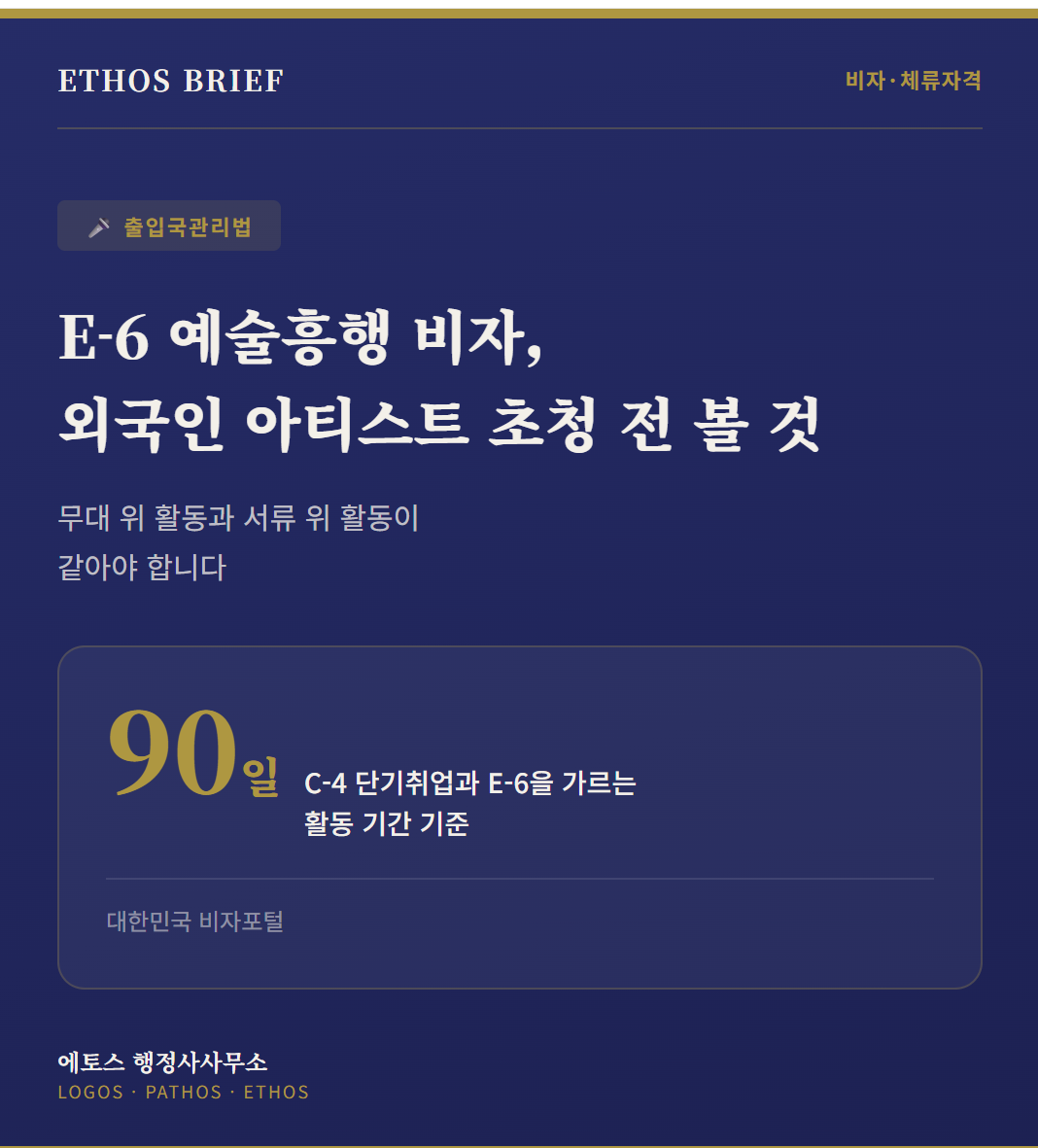
The activity on stage must match the activity on paper.
This article explains what entertainment agencies, advertising agencies, production companies, event organizers, and project managers should organize before preparing an E-6 visa for a foreign singer, actor, model, performer, broadcast guest, or artist.
Key Summary
| Category | Details | |---|---| | Visa type | E-6 Arts and Entertainment | | Main applicants | Foreign singers, actors, models, dancers, performers, broadcast entertainers, professional athletes | | Main activities | Performance, broadcast appearance, advertising shoot, modeling, artistic activity, entertainment activity | | Short-term activity | C-4 short-term employment may be reviewed for income-earning activity of 90 days or less | | Long-term activity | E-6 may be reviewed for activities exceeding 90 days or continuing projects | | Key issue | Consistency between actual activity and contract, invitation letter, schedule, and application | | Main risks | Inconsistent activity description, unclear payment structure, unclear sponsor, late timeline | | Application route | Overseas visa application or domestic change of status must be reviewed separately | | Before consultation | Organize activity, sponsor, schedule, payment, current status, and career documents |
What Is the E-6 Visa?
The E-6 visa is generally reviewed for arts, entertainment, performance, and related income-earning activities in Korea.
It may be relevant when a foreign national plans to participate in:
- Performances
- Music activities
- Broadcast appearances
- Advertising shoots
- Modeling
- Acting
- Art exhibitions or artistic activities
- Dance or performance projects
- Sports activities
- Other profit-generating arts or entertainment activities
However, not every foreign entertainment activity automatically requires E-6.
Depending on the duration, income structure, contract, activity location, sponsor, and current status of stay, the correct route may be C-4, E-6, or another status.
Main Types of E-6 Visa
E-6 is generally divided into the following categories.
| Type | Name | Main Applicants | |---|---|---| | E-6-1 | Arts and entertainment | Music, fine arts, literature, broadcast, acting, advertising and fashion models, professional arts and entertainment activities | | E-6-2 | Hotel and entertainment | Performance or entertainment activities in tourist hotels or entertainment establishments | | E-6-3 | Sports | Professional athletes, coaches, managers, and related sports personnel |
The fact that a foreign entertainer is coming to Korea is not enough.
Immigration review focuses on more specific questions.
- What exactly will this person do in Korea?
- Who is inviting or contracting with them?
- What is the activity period?
- Will they be paid?
- If paid, who pays and how?
- Where will the activity take place?
- Is the person overseas or already in Korea?
The starting point of E-6 preparation is not the visa name.
It is the actual activity.
C-4 vs. E-6
One of the first questions is whether the case should be reviewed as C-4 short-term employment or E-6 arts and entertainment.
| Category | C-4 Short-Term Employment | E-6 Arts and Entertainment | |---|---|---| | Basic nature | Short-term income-earning activity | Arts and entertainment status of stay | | Period | Usually 90 days or less | Activities exceeding 90 days or continuing projects | | Common example | Short performance, short shoot, short event appearance | Long-term project, continuing contract, extended broadcast, performance, or modeling activity | | Key documents | Short schedule, invitation letter, contract materials | Contract, activity plan, sponsor documents, recommendation or proof documents, career materials | | Practical point | Clear short-term purpose and schedule | Consistency of activity, documents, sponsor, and payment structure |
For example, a one-day performance or a few days of advertising shooting may first require C-4 review.
But if the artist signs with an agency for several months and participates in performances, shoots, promotions, and broadcast appearances, E-6 may need to be reviewed.
Why the Activity on Stage Must Match the Activity on Paper
E-6 problems often occur not because there are no documents.
They occur because the documents tell different stories.
Examples include:
- The contract says “performance,” but the application focuses on advertising shoots.
- The schedule shows three months of activity, but the contract period is one month.
- The activity is paid, but the payment method is not clear in the contract.
- The invitation letter is issued by an agency, but the actual shoot is run by an advertising agency.
- The activity plan includes broadcast appearances, but the contract only mentions modeling.
- The actual activity location differs from the documents.
These inconsistencies can lead to document supplementation or additional explanation.
If the performance, shoot, or campaign schedule is already fixed, the time needed for supplementation becomes a real business risk.
The first task in E-6 preparation is not collecting many documents.
The first task is writing one clear sentence:
Who is inviting whom, for what activity, during what period, under what conditions?
Once that sentence is clear, the contract, invitation letter, schedule, profile, and company documents can be aligned.
Six Things to Organize Before Consultation
E-6 consultation should begin with facts, not document collection.
1. Current Location and Status of the Foreign National
First, confirm where the person is.
- Are they currently overseas?
- Are they already in Korea?
- What is their current status of stay?
- How much stay period remains?
- Do they have prior stay history in Korea?
If the person is overseas, an overseas visa application or Confirmation of Visa Issuance process may be reviewed.
If the person is already in Korea, change of status or another procedure must be reviewed separately.
2. Exact Activity in Korea
Separate the activity clearly.
- Performance
- Broadcast appearance
- Advertising shoot
- Modeling
- Music video or content shoot
- Fan meeting
- Fashion show
- Art exhibition
- Sports activity
- Promotional event
If several activities are combined, organize the schedule and proportion of each activity.
3. Inviting or Contracting Party
Identify who is actually inviting and contracting.
- Entertainment agency
- Performance organizer
- Advertiser
- Advertising agency
- Broadcasting company
- Production company
- Modeling agency
- Brand company
- Event agency
- Sports club
If the sponsor is unclear, the document structure becomes unstable.
4. Activity Period and Schedule
The schedule should be as specific as possible.
- Planned entry date
- Rehearsal schedule
- Shooting schedule
- Performance dates
- Promotion schedule
- Travel schedule
- Planned departure date
If parts are not yet confirmed, separate confirmed items from items still under negotiation.
5. Income and Payment Structure
Payment structure matters.
- Is the activity unpaid?
- Is there an appearance fee?
- Is there a performance fee?
- Is there a modeling fee?
- Who pays?
- Is payment made in Korea or overseas?
- When and how is payment made?
- How will withholding tax or tax treatment be handled?
If the activity is paid but the payment structure is not visible in the documents, the explanation may become weak.
6. Career and Activity Evidence
The file should show that the foreign national is qualified for the activity.
Useful materials may include:
- Profile
- Portfolio
- Performance history
- Broadcast appearance records
- Advertising shoot history
- Modeling records
- Awards
- Music or video links
- SNS or official pages
- Agency or management documents
“Famous” is not enough.
Evidence should be organized.
Pre-Consultation Preparation Table
| Category | Details | |---|---| | Foreign national information | Nationality, current location, passport validity, current status of stay | | Activity | Performance, shoot, broadcast, advertisement, modeling, artistic activity | | Schedule | Entry date, rehearsal, performance or shoot date, departure date | | Sponsor | Agency, organizer, management company, advertiser, broadcaster, production company | | Contract materials | Contract, invitation letter, agreement, email negotiation records | | Payment structure | Whether payment exists, payer, payment method | | Career materials | Profile, portfolio, performance, appearance, award records | | Company or organization materials | Business registration, project overview, event materials | | Stay history | Previous Korean entries, status of stay, activity history in Korea | | Unconfirmed items | Pending schedule, contract, payment, location, or activity details |
If this table is prepared before consultation, the review becomes much faster.
The goal is not only to ask, “Which visa is this?”
The goal is to find what is still unclear and which documents do not yet match.
Overseas Visa Application or Domestic Change of Status?
One commonly missed issue is the application route.
If the foreign national is still overseas, an overseas visa application through a Korean diplomatic mission or a Confirmation of Visa Issuance process may be reviewed.
If the person is already in Korea, it must be checked whether change of status to E-6 is possible from the current status, or whether another procedure is required.
E-6 cases often involve fixed project dates, so the timeline must be planned early.
Depending on the consulate, nationality, activity type, sponsor, and required recommendation documents, preparation and review may take several weeks or longer.
Some consular guidance notes that for E-6-2, nationals of certain countries may be required to apply only from the consulate in their home country. Nationality and consular jurisdiction must be checked early.
Documents Often Reviewed in E-6 Cases
Documents vary by case, but the following materials are often reviewed.
Foreign National Documents
- Passport
- Photo
- Visa application form
- Profile
- Portfolio
- Career evidence
- Performance, broadcast, or modeling history
- Prior Korean stay history
- Current status documents, if already in Korea
Sponsor Documents
- Business registration certificate
- Company or organization introduction
- Invitation letter
- Employment, appearance, or performance contract
- Activity plan
- Schedule
- Project overview
- Event or shoot materials
- Payment-related documents
- Recommendation letter or supporting proof, if required
Project Documents
- Venue contract or rental documents
- Shooting plan
- Broadcast or production materials
- Advertising campaign materials
- Modeling shoot concept materials
- Promotion schedule
- Rehearsal and travel schedule
- Revenue or payment structure materials
In E-6 cases, the document titles matter less than how well the documents connect.
Common Misunderstandings
1. Thinking the Performance Schedule Is Enough
A schedule is important.
But it does not explain the whole activity.
The file should also show who is inviting the artist, under what contract, how payment works, and how long the activity lasts.
2. Thinking One Contract Is Enough
A contract is important.
But the contract must match the actual activity schedule.
If the contract, invitation letter, schedule, and activity plan point in different directions, supplementation becomes more likely.
3. Treating Overseas Visa Application and Domestic Change of Status as the Same
The route changes depending on whether the foreign national is overseas or already in Korea.
Current status should be checked at the beginning.
4. Not Distinguishing Short-Term and Long-Term Activity
A short shoot or performance may be reviewed under C-4.
A continuing paid project may require E-6 review.
Duration and activity structure should be separated first.
5. Ignoring Past Korean Stay History
Prior stay history, past activity in Korea, and compliance with stay periods may affect review depending on the case.
If there is prior history, organize it accurately from the beginning.
6. Assuming the Actual Activity Can Differ From the Approved Activity
This is the most dangerous misunderstanding.
If the approved activity and the actual activity differ, it may lead to unauthorized activities outside status, illegal employment, denial of extension, departure order, or deportation.
Entertainment projects can change quickly, so any activity change should be reviewed before it happens.
If the Project Schedule Is Fixed, Visa Preparation Has Already Started
E-6 moves with the project schedule.
If you wait until after all entertainment or production arrangements are finalized, it may be too late.
Start checking immediately if:
- A foreign artist has been selected
- A venue or shooting location has been reserved
- An advertising campaign launch date is fixed
- Broadcast scheduling exists
- The artist’s planned entry date is being discussed
- Draft contracts have been exchanged
- Appearance, performance, or modeling fees are being discussed
- A foreign national already in Korea will change activities
If visa preparation is delayed, the impact is not limited to paperwork.
It can affect the performance date, shoot date, advertising launch, contract performance, flights, accommodation, and staff scheduling.
How an Administrative Agent Helps
For E-6, the key is not simple filing.
The key is structuring the case correctly.
An administrative agent can help review:
- Whether the activity fits E-6 or C-4
- Whether the correct type is E-6-1, E-6-2, or E-6-3
- Whether the route should be overseas visa application or domestic change of status
- Whether the contract matches the actual activity
- Whether the sponsor is clear
- Whether the schedule matches the stay period
- Whether the payment structure is explained
- Whether recommendation or additional proof is required
- Whether past stay history may become an issue
- Whether the project timeline leaves enough time for visa preparation
Entertainment projects move fast.
But in visa work, one thing matters more than speed:
getting the structure right from the beginning.
E-6 Preparation Checklist
Before starting, check:
- Is the foreign national overseas or already in Korea?
- What is their current status of stay?
- Is the activity 90 days or less, or longer?
- Is the activity performance, shooting, broadcasting, modeling, or artistic work?
- If multiple activities are included, are the schedule and proportion organized?
- Does the sponsor match the contracting party?
- Is the payment party and method clear?
- Do the contract, invitation letter, and schedule describe the same activity?
- Does the actual activity location match the documents?
- Are profile and career materials ready?
- Is there prior Korean stay history?
- Is there enough time before the project date for visa review?
- If activities may change, has that been reviewed in advance?
Frequently Asked Questions
Q. If a foreign artist performs in Korea for one day, is E-6 required?
Not always.
If the activity is income-earning and 90 days or less, C-4 short-term employment may be reviewed first. The correct route depends on activity details, payment, sponsor structure, and consular standards.
Q. Can advertising models be covered by E-6?
Possibly.
Advertising and fashion modeling activities may fall under E-6-1 review. However, whether C-4 or E-6 is more appropriate depends on whether the activity is short-term or part of a longer contract, and how payment is structured.
Q. Can a foreign national already in Korea join a paid shoot?
It depends on their current status of stay.
Tourism, study, job-seeking, or other statuses may not allow paid shooting or entertainment activity. Participating without proper permission may create unauthorized activity or illegal employment issues.
Q. Is a contract enough for the application?
A contract is important, but it may not be enough.
The contract, invitation letter, schedule, activity plan, company documents, and career materials should be consistent.
Q. How long does E-6 processing take?
It depends on nationality, consulate, activity type, sponsor, and whether Confirmation of Visa Issuance or recommendation documents are required.
If a performance or shoot date is already fixed, prepare as early as possible.
Closing — E-6 Is Not Just a Visa. It Is Part of the Project Timeline.
The E-6 visa for foreign entertainers, models, and performers is not just a document checklist.
It is a review of whether the project structure makes sense.
If the artist performs on stage, the contract and application should not describe something else.
If the project is an advertising shoot, the payment structure and sponsor should be clear.
If the actual project organizer differs from the inviting party, that should be explained.
When the performance, shoot, advertisement, or broadcast schedule is already fixed, visa preparation should not be left until the end.
Before preparing an E-6 case, organize these five points:
- Current status of the foreign national
- Exact activity in Korea
- Inviting and contracting party
- Activity period and schedule
- Payment structure and career materials
Once this structure is clear, it becomes much easier to identify what is missing, what does not match, and which route should be reviewed.
In entertainment, timing is everything.
For E-6, visa preparation is the first administrative step that protects that timing.