
K-STAR Visa Track for D-2 Students — F-2 Before Employment, F-5 After 3 Years
Hello, this is Administrative Agent Jean.
If you are studying in Korea on a D-2 student visa, you may already have asked yourself these questions:
“What happens to my visa after graduation?”
“If I do not find a job immediately, do I have to leave Korea?”
“I completed a master’s or Ph.D. in Korea. Is there a realistic path to permanent residence?”
These are not small worries.
A D-2 visa is generally tied to your student status. Once graduation, completion, or the end of enrollment approaches, the basis for your stay can become unstable. For international researchers in science and engineering fields, the period between thesis completion, graduation, job search, postdoctoral research, and visa change can be especially stressful.
The Ministry of Justice introduced the K-STAR Visa Track to address exactly this problem.
K-STAR is a visa track designed to help outstanding international talent in science and technology fields continue their research and settle in Korea through cooperation between selected universities and the Ministry of Justice.
The core benefit is clear:
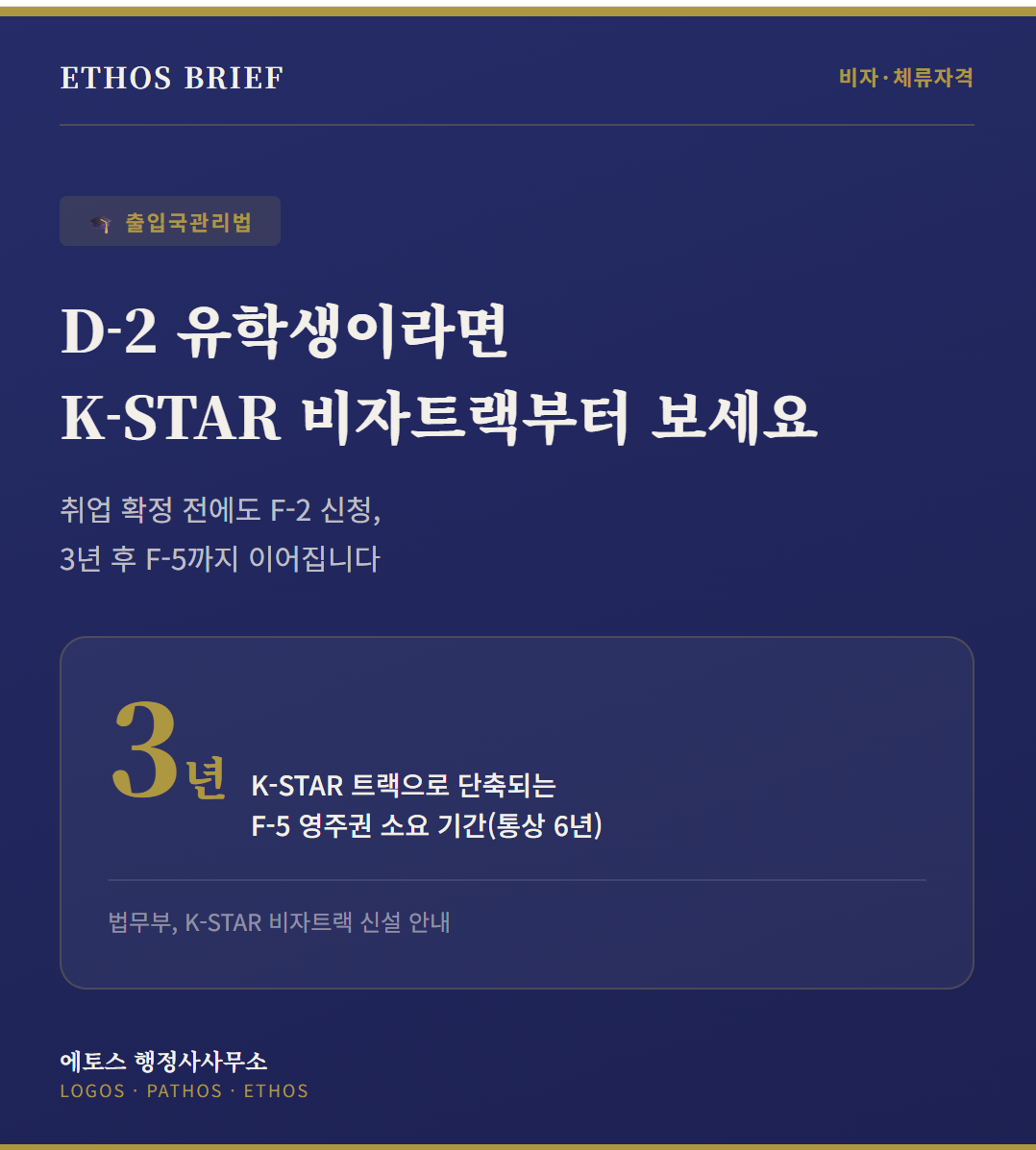
With a recommendation from the president of a selected university, eligible applicants may apply for F-2 residence status even before employment is confirmed, and may later pursue F-5 permanent residence after 3 years if the required conditions are met.
Key Summary
| Category | Details | | --- | --- | | Program | K-STAR Visa Track | | Target | Outstanding international master’s and doctoral talent in science and technology | | Typical current status | D-2 student visa | | First immigration goal | F-2-7S residence status | | Long-term path | F-5-S1 permanent residence or special naturalization | | Key document | Recommendation from the president of a selected university | | Main benefit | F-2 application may be possible before employment is confirmed | | Permanent residence timeline | May be shortened from the usual 6-year route to 3 years | | Participating universities | 5 existing science and technology institutes + 27 general universities, total 32 | | Important caution | A university recommendation does not mean automatic approval |
Why the K-STAR Visa Track Matters
The biggest value of K-STAR is that it helps reduce the immigration gap between graduation and employment.
Under the usual international student route, a graduate may need to consider D-10 job-seeking status, E-7 employment status, F-2 points-based residence, or another pathway after graduation. In that process, employment contracts, salary, job codes, points, and timing can all become difficult issues.
K-STAR creates a separate settlement route for outstanding science and technology talent.
It is especially important for:
- International students close to completing a master’s or doctoral degree in science and technology
- Ph.D. students, candidates, or graduates who want to continue research in Korea
- Researchers whose employment is not yet confirmed but who plan to remain in Korea
- Graduates looking for a more stable status than D-10
- Applicants who are considering long-term residence, F-5 permanent residence, or special naturalization
K-STAR is not just a visa change option.
It is a long-term immigration strategy for researchers who want to build their future in Korea.
What Is the K-STAR Visa Track?
The Ministry of Justice operates the K-STAR Visa Track to prevent the outflow of outstanding foreign talent in science and technology and to help them settle in Korea.
The previous fast-track system for outstanding science and technology talent was mainly operated through 5 specialized science and technology institutions. The system was later expanded to include 27 additional general universities, bringing the total number of participating universities to 32.
The major benefits announced by the Ministry of Justice include:
| Benefit | Explanation | | --- | --- | | F-2 before employment | Eligible applicants recommended by a university president may apply for F-2 residence status even before employment is confirmed | | Faster permanent residence path | The usual permanent residence timeline may be shortened from about 6 years to 3 years | | Special naturalization | Applicants with outstanding research achievements may apply for special naturalization | | Expanded universities | The program expanded from 5 institutions to 32 participating universities |
32 Participating Universities
K-STAR does not apply to every university in Korea.
The applicant must be connected to a university selected by the Minister of Justice.
| Category | Universities | | --- | --- | | Existing 5 institutions | KAIST, DGIST, UNIST, GIST, UST | | Expanded 27 universities | Kangwon National University, Kyungpook National University, Gyeongsang National University, Kyung Hee University, Korea University, Korea University Sejong Campus, Dong-A University, Pukyong National University, Pusan National University, Sogang University, Seoul National University, Sungkyunkwan University, Soonchunhyang University, Ajou University, Yonsei University, Yonsei University Mirae Campus, Inha University, Chonnam National University, Jeonbuk National University, Jeju National University, Chung-Ang University, Chungnam National University, Chungbuk National University, POSTECH, Korea Maritime & Ocean University, Hanyang University, Hanyang University ERICA Campus |
But the university name alone is not enough.
Each university may operate its own recommendation process. Depending on the school, applicants may need to go through departmental review, academic evaluation, faculty recommendation, interview, or a university recommendation committee.
K-STAR in 3 Steps
The K-STAR route can be understood in three stages.
| Stage | Route | Key Point | | --- | --- | --- | | Step 1 | University recommendation | Obtain a recommendation as outstanding science and technology talent | | Step 2 | F-2-7S | Apply for residence status even before employment is confirmed | | Step 3 | F-5-S1 or special naturalization | Pursue permanent residence or special naturalization after meeting the required conditions |
Step 1 — The University President’s Recommendation Is the Starting Point
The most important document in the K-STAR track is the recommendation from the president of a selected university.
Applicants generally fall into one of the following categories:
- Expected master’s degree recipient in a science and technology field at a selected university
- Master’s degree holder within 1 year after degree acquisition
- Ph.D. student or completed doctoral coursework student
- Ph.D. degree holder within 1 year after degree acquisition
- Postdoctoral researcher conducting research at the same university after earning a Ph.D. there
- Integrated master’s and doctoral program student who has completed master’s-level coursework and is enrolled in doctoral-level coursework
Students on leave may be excluded at the university recommendation stage or at the F-2-7S application stage, so academic status should be checked first.
Step 2 — F-2-7S May Be Possible Before Employment Is Confirmed
The most powerful feature of the K-STAR track is that eligible applicants may apply for F-2 residence status even before employment is confirmed.
In many immigration routes, long-term stay in Korea depends heavily on employment, salary, job category, and workplace. K-STAR is different because it focuses on research capacity and university recommendation first.
At the F-2-7S stage, the following points are usually important:
| Review Item | Practical Point | | --- | --- | | Degree requirement | Science and technology master’s or doctoral requirements at a selected university | | Recommendation | University president’s recommendation | | Current status | Lawful stay in Korea, usually under D-2 or a related status | | Disqualification grounds | Criminal history, immigration violations, restricted employment history, etc. | | Health-related issues | Tuberculosis, infectious disease, drug-related issues, etc. | | Family accompaniment | Additional documents may be needed for spouse or minor children |
The key point is this:
The recommendation is a strong starting document, but it is not the whole application.
The immigration application still needs to be prepared separately, including status documents, timing, family documents, disqualification review, and supporting materials.
Step 3 — F-5-S1 Permanent Residence May Be Reviewed After 3 Years
After staying under F-2-7S and meeting the required conditions, applicants may be able to apply for F-5-S1 permanent residence.
The Ministry of Justice explains that the K-STAR track may shorten the permanent residence timeline from the usual 6-year route to 3 years.
However, permanent residence is not automatic.
At the F-5-S1 stage, a separate points-based evaluation and supporting evidence may be required.
Important factors may include:
| Evaluation Item | Practical Evidence | | --- | --- | | Education | Master’s or doctoral degree from a K-STAR participating university | | Research career | Research institute, university, or project participation | | Research achievements | Papers, patents, awards, research outputs | | Korean language ability | TOPIK, Korea Immigration & Integration Program, etc. | | Annual income | Income documents and objective proof | | Recommendation | University or institutional recommendation | | Volunteer activities | Verifiable volunteer records | | Regional residence | Residence or work outside the Seoul metropolitan area | | Legal compliance | Immigration violations or criminal penalties may affect the review |
At the permanent residence stage, the question is not only “Have 3 years passed?”
The stronger question is:
What research, income, residence, and compliance record have you built during those 3 years?
Special Naturalization May Also Be Possible
K-STAR may also open the possibility of special naturalization for applicants with outstanding research achievements.
Special naturalization is highly individualized. It may require a persuasive explanation of research output, national contribution, professional value, recommendation materials, and public benefit.
If special naturalization is part of your long-term plan, your papers, patents, projects, awards, technology transfer, industry cooperation, and institutional recommendation records should be organized from the F-2-7S stage.
How Is K-STAR Different from the Usual Route?
| Category | Usual International Student Route | K-STAR Visa Track | | --- | --- | --- | | After graduation | D-10, E-7, F-2 points-based route, etc. | F-2-7S based on university recommendation | | Employment | Employment confirmation often becomes critical | F-2 may be possible before employment is confirmed | | Permanent residence timeline | Usually requires a longer residence period | 3-year path may be available | | Key evidence | Employment contract, income, points, workplace | Degree, research capacity, president’s recommendation | | Main risk | Immigration gap after graduation | Recommendation and application timing | | Strategy | Employment-centered | Research and settlement-centered |
K-STAR does more than buy time after graduation.
It helps outstanding researchers secure a more stable foundation to continue their career in Korea.
Eligibility Does Not Mean Automatic Approval
This is the most important practical point.
K-STAR is a valuable system, but it is not an automatic approval track.
“Selected university + degree + recommendation” does not guarantee approval.
In practice, issues may arise when:
- The applicant is a degree candidate, not yet a degree holder
- The 1-year window after degree acquisition is missed
- Academic status such as leave of absence, completion, or expected graduation is unclear
- The university recommendation is issued, but immigration documents are incomplete
- Family documents for a spouse or minor child are prepared too late
- Research achievements exist, but objective evidence is poorly organized
- F-5-S1 points-based evidence is insufficient
- Past immigration violations, fines, criminal penalties, or unauthorized work history become an issue
It is easy to search the eligibility list.
The harder part is deciding when to apply, what to submit, how to explain your record, and how to connect F-2 to F-5 later.
Documents to Prepare Before Consultation
If you want to review your K-STAR eligibility, prepare the following information first.
| Category | Documents or Information | | --- | --- | | Basic identity | Passport, alien registration card, current status, stay expiration date | | Academic status | Certificate of enrollment, expected graduation certificate, completion certificate, degree certificate | | University information | Whether your university is a K-STAR participating university, department, major field | | Recommendation | Faculty recommendation possibility, university recommendation schedule | | Research achievements | Papers, patents, awards, research projects, conference presentations | | Career record | Research experience, project participation, postdoctoral status | | Korean language | TOPIK, Korea Immigration & Integration Program, other proof | | Family | Spouse or minor child accompaniment, family documents | | Risk factors | Immigration violations, fines, criminal record, unauthorized work history | | Long-term goal | F-2 only, F-5 permanent residence, or special naturalization |
K-STAR is not just a document checklist.
It is a timeline-based immigration strategy that connects graduation, university recommendation, stay expiration, research achievements, and long-term residence.
Frequently Asked Questions
Q. Can I apply for F-2-7S even without confirmed employment?
Yes. This is the key advantage of the K-STAR track. Eligible applicants recommended by a selected university may apply for F-2 residence status even before employment is confirmed.
Q. Can every D-2 student apply?
No. K-STAR is for outstanding master’s and doctoral-level talent in science and technology fields, and the applicant must meet the requirements connected to a Ministry of Justice-selected participating university.
Q. Does the university president’s recommendation guarantee approval?
No. The recommendation is a core document, but immigration screening is separate. Current stay status, disqualification grounds, application timing, and supporting documents must still be reviewed.
Q. Can I really apply for permanent residence after 3 years?
The K-STAR track may allow eligible applicants to pursue F-5 permanent residence after 3 years, instead of the usual longer route. However, the applicant must still satisfy F-5-S1 requirements and points-based criteria.
Q. Is special naturalization possible?
It may be possible for applicants with outstanding research achievements. However, special naturalization is highly individualized and requires careful review of research output, recommendation materials, and national contribution.
How an Administrative Agent Can Help
K-STAR is a promising pathway, but the actual application depends on timing and document strategy.
Ethos Administrative Office can assist with:
- Reviewing whether your university and major fall within K-STAR scope
- Checking your D-2 stay period and graduation timeline
- Reviewing F-2-7S eligibility
- Organizing documents before and after university recommendation
- Preparing spouse or minor child accompaniment documents
- Structuring research achievements and Korean language evidence
- Designing a long-term plan toward F-5-S1 permanent residence
- Preliminary review of special naturalization possibility
Immigration options become narrower when preparation starts too late.
If you are close to graduation, the safest time to review K-STAR is before your student status ends.
Closing
The K-STAR Visa Track is one of the most important pathways for international science and technology students in Korea.
It may allow eligible applicants to apply for F-2 residence status before employment is confirmed, pursue F-5 permanent residence after 3 years, and in exceptional cases consider special naturalization.
But it is not automatic.
Your selected university status, academic record, university president’s recommendation, stay period, disqualification review, research achievements, Korean language ability, and family situation must all be organized together.
If you are studying or researching in Korea on a D-2 visa and want to remain in Korea after graduation, the first step is not collecting random documents.
The first step is to confirm whether K-STAR applies to you, when you should apply, and what evidence you should build from F-2 to F-5.