
D-10 Job-Seeking Visa — Staying in Korea Legally While Preparing for Employment After Graduation
Hello, this is Administrative Agent Jean.
You studied in Korea for four years, earned your degree, and are now ready to find a job.
But here is the problem: once graduation is complete, your D-2 student visa may no longer match your actual status. If you have not yet signed an employment contract, how can you legally remain in Korea while continuing your job search?
That is where the D-10 Job-Seeking Visa comes in.
The D-10 visa is one of the most important bridge visas for international students and foreign professionals who want to move from study or job search into employment in Korea. However, it is not simply a “stay longer after graduation” visa. Immigration officers look at your eligibility, job-seeking plan, financial ability, past immigration record, and whether your activities actually match the purpose of D-10.
Below is a website-ready guide to the D-10 visa: its types, eligibility, required documents, permitted activities, and common mistakes.
Key Summary
| Category | Details | |---|---| | Visa code | D-10 | | Main purpose | Job-seeking, internship, or technology startup preparation | | Common applicants | Korean university graduates, foreign professionals, certain E-series visa holders | | Main route | D-2 student visa → D-10 job-seeking visa → E-7 or other work visa | | Points requirement | Generally 60+ total points, including 20+ basic points | | Points exemption | Available for certain Korean university graduates with TOPIK Level 4 or equivalent | | Part-time work | May be possible only if strict requirements are met | | Internship | Must be reported or approved according to current immigration rules | | Application | HiKorea reservation, then visit the competent immigration office | | Official inquiry | Immigration Contact Center 1345 |
What Is the D-10 Visa?
The D-10 visa is a status of stay that allows eligible foreigners to remain in Korea while preparing for employment, participating in certain internship activities, or preparing for a technology startup.
In practical terms, D-10 is often used by international students after graduation when they have not yet secured a full-time job but want to continue job-seeking activities in Korea legally.
It is especially important for those planning to move into:
- E-1 to E-7 employment visas
- E-7 Specific Activities visa
- F-2-7 points-based residence visa
- Long-term employment and residence in Korea
D-10 is not a work visa by itself. It is a preparation-stage visa, so any paid work, internship, or side activity must be checked carefully before starting.
Main Types of D-10 Visa
D-10-1 General Job-Seeking
This is the most common type.
It applies to foreigners who are looking for employment in a field that may lead to professional employment status, such as E-1 to E-7.
Typical applicants include:
- Graduates of Korean universities
- Foreign degree holders legally staying in Korea
- Professionals preparing to change into an employment visa
- International students moving from D-2 to D-10 after graduation
D-10-2 Technology Startup Preparation
This type is for foreigners preparing a technology-based startup in Korea.
It may apply to applicants involved in:
- Patent or intellectual property preparation
- Startup immigration education programs
- OASIS or K-Startup related programs
- Technology startup planning connected to D-8 startup/investment status
D-10-3 High-Tech Internship
This category is connected to certain high-tech internship activities.
Because this type is more specific and may depend on Ministry of Justice guidelines, the applicant should confirm eligibility directly through HiKorea or the Immigration Contact Center before applying.
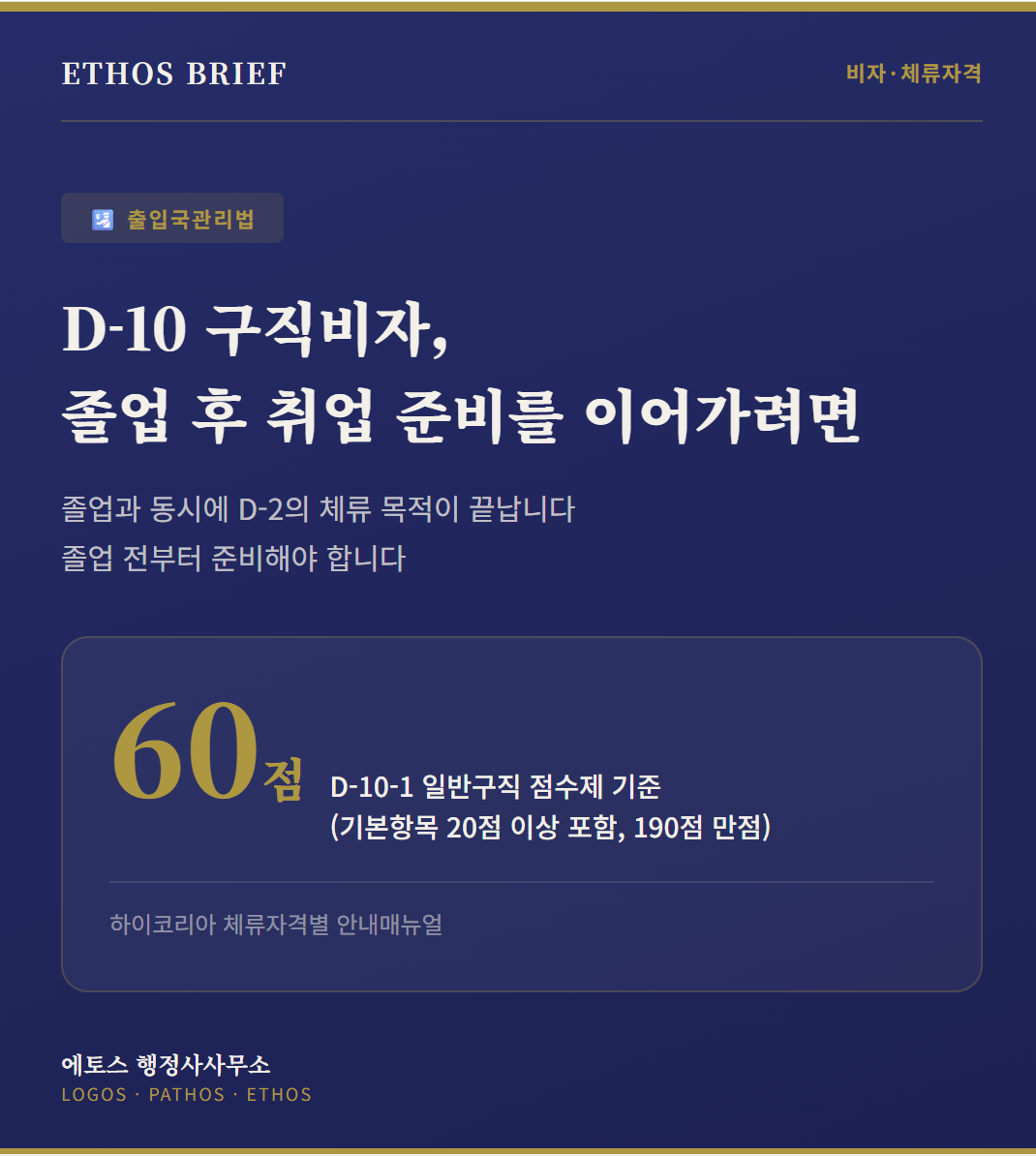
D-10-1 General Job-Seeking — The Points System
For most D-10-1 applicants, the points system is the starting point.
The general requirement is:
- At least 20 points in basic items
- At least 60 points in total
- Total possible score: 190 points
The points table may include factors such as:
| Item | Notes | |---|---| | Age | Certain age groups receive higher scores | | Education | Bachelor’s, master’s, and doctoral degrees may be reflected | | Korean language ability | TOPIK or KIIP may help | | Work experience | Relevant professional experience may be counted | | Global company experience | Experience at major global companies may help | | Korean study history | Korean university graduates may have advantages | | Immigration violations | Violations can result in deductions or ineligibility |
The points system is not just a formality. If your score is weak, or if the supporting documents do not clearly prove the score you claim, the application may be delayed or denied.
Points Exemption for Korean University Graduates
This is one of the most important rules for D-2 international students.
Certain graduates of Korean universities may be exempt from the D-10 points system if they meet the required conditions.
In general, the exemption may apply if the applicant:
- Graduated from a regular Korean university with an associate degree or higher
- Has not exceeded the required period after graduation
- Holds TOPIK Level 4 or higher, or
- Passed KIIP Level 4 midterm evaluation, or
- Was assigned to KIIP Level 5 through the pre-test
If you graduated from a Korean university, this exemption route should be checked first. It can be much simpler than calculating points from scratch.
When D-10 Applications May Be Restricted
Not everyone can change to D-10.
An application may be difficult or restricted if the applicant has:
- Recent immigration law violations
- Unauthorized employment history
- Significant fines, penalties, or departure orders
- Repeated D-10 applications without meaningful job-seeking progress
- Unclear financial ability
- A weak or unrealistic job-seeking plan
- Income deposits that suggest unauthorized work
For international students, unauthorized part-time work during D-2 status can become a serious issue when applying for D-10.
Period of Stay and Extension
D-10 is usually granted in units defined by current immigration guidelines, and the maximum period may differ depending on the applicant’s background and visa subtype.
Recent Ministry of Justice announcements indicate that support for foreign graduates of Korean universities has been expanded, including longer job-seeking support periods and improved internship rules.
However, the exact period granted in an individual case depends on:
- Current visa status
- Graduation background
- D-10 subtype
- Job-seeking activity records
- Immigration office review
- Updated Ministry of Justice guidelines at the time of application
Because this area changes, applicants should confirm the latest period and extension rules through HiKorea or 1345 before filing.
Required Documents
The exact list may vary depending on visa type and immigration office practice, but the following documents are commonly prepared.
Common Documents
- Application form
- Passport
- Alien Registration Card
- Passport-style photo
- Application fee
- Proof of residence
- Job-seeking activity plan
Documents for Points-Based Applicants
- Degree certificate or graduation certificate
- Academic transcript
- TOPIK or KIIP certificate, if applicable
- Career certificate, if applicable
- Proof of professional experience, if applicable
- Proof of financial ability
- Documents supporting claimed points
Documents for Korean Graduate Exemption Route
- Graduation certificate or degree certificate
- Transcript
- Valid TOPIK Level 4 or higher certificate, or KIIP equivalent document
- Job-seeking activity plan
- Other documents requested by the immigration office
Financial Proof
Financial proof is often reviewed carefully.
For D-10 extension, immigration may request bank statements or proof that the applicant can support themselves during the job-seeking period.
Applicants should be especially careful if their bank account shows unclear deposits, regular payments from unknown sources, or income that may look like unauthorized work.
What You Can Do on D-10
Job-Seeking Activities
D-10 allows job-seeking activities related to future employment in Korea.
This may include:
- Applying to companies
- Attending interviews
- Preparing employment documents
- Participating in recruitment processes
- Searching for positions connected to E-series visas
Internship Activities
Certain internship activities may be allowed, but they must follow immigration reporting or permission procedures.
Do not assume that an internship is automatically allowed just because it is temporary or paid at a low rate. Internship activity should be connected to the applicant’s job-seeking purpose and must comply with the current reporting rules.
Part-Time Work
Part-time work on D-10 may be possible only under strict conditions, such as Korean language requirements and permitted work categories.
Before starting any paid work, applicants should confirm:
- Whether their D-10 subtype allows it
- Whether TOPIK or KIIP requirements are met
- Whether the workplace and job type are permitted
- Whether prior permission or reporting is required
- Whether working hours are limited
Starting work first and asking later can create an unauthorized employment issue.
Next Visa Options After D-10
D-10 is usually a bridge, not the final destination.
After securing employment, many applicants move from D-10 to:
- E-7 Specific Activities visa
- E-1 to E-6 employment visas
- F-2-7 points-based residence visa, if eligible
- Other work or residence statuses depending on qualifications
The most common route is:
D-2 Student Visa → D-10 Job-Seeking Visa → E-7 Work Visa → F-2 or F-5 Long-Term Residence
If you are planning to stay in Korea long term, D-10 should be prepared as part of a broader visa strategy.
Common Mistakes to Avoid
1. Applying Too Late After Graduation
A D-2 student visa is tied to study. Once graduation is complete, your actual activity may no longer match D-2 status.
Even if your card still shows remaining stay period, you should prepare the D-10 change promptly after graduation.
2. Leaving Korea During Visa Change Review
If you leave Korea before the change of status is completed, the pending process may be affected or canceled.
Applicants should avoid overseas travel during the review period unless they have confirmed the consequences with immigration.
3. Receiving Unclear Income Deposits
During D-10 extension, bank statements may be reviewed.
If deposits suggest unauthorized employment, the applicant may face visa denial, fines, investigation, or even departure measures.
4. Doing an Internship Without Reporting
Internship activity may require reporting within a specific period.
Missing the report deadline can create a problem even if the internship itself was related to job-seeking.
5. Assuming D-10 Guarantees E-7 Approval
D-10 only allows job-seeking. It does not guarantee that a future E-7 visa will be approved.
For E-7, the employer, job code, salary, education, experience, and job relevance must all be reviewed separately.
Frequently Asked Questions
Q. When should I change from D-2 to D-10 after graduation?
You should apply while your current stay period is still valid. Because graduation changes your actual status, it is safer to prepare immediately after graduation or even before the graduation season begins.
February and August are busy periods at immigration offices, so making a HiKorea reservation early is recommended.
Q. Can I apply for D-10 without TOPIK?
It may be possible depending on the route, but TOPIK can be very important.
For the Korean graduate points-exemption route, TOPIK Level 4 or an equivalent KIIP result is generally required. TOPIK may also affect part-time work eligibility and future visa planning.
Q. Can I work part-time on D-10?
Possibly, but only if the current requirements are met.
D-10 is not a free work visa. You must confirm Korean language requirements, permitted job types, working hour limits, and whether prior permission or reporting is required.
Q. Can I do an internship on D-10?
Yes, certain internships may be possible, but the activity must comply with current reporting or permission rules.
Before starting, confirm the required documents and reporting deadline with HiKorea or 1345.
Q. Can D-10 lead to permanent residence?
Not directly.
D-10 is usually a bridge to employment status such as E-7. After maintaining qualified employment and meeting long-term residence requirements, the applicant may later consider F-2 or F-5 routes.
Where Applicants Usually Get Stuck
D-10 applications often fail not because the applicant is unqualified, but because the file does not tell a clear story.
Common weak points include:
- Vague job-seeking plan
- Missing proof of graduation
- Unclear TOPIK or KIIP evidence
- Insufficient financial documents
- Bank history suggesting unauthorized work
- Poor explanation of career direction
- Applying too late after graduation
- No plan for transition to E-7 or another visa
Immigration review is document-based. A strong application should show not only that you want to stay in Korea, but also that your stay matches the purpose of D-10.
Preparing a Strong D-10 Application
A well-prepared D-10 application should answer three questions clearly:
- Why do you need to stay in Korea now?
- What kind of job or career path are you preparing for?
- Can you support yourself legally during the job-seeking period?
For international students, it is especially helpful to organize:
- Graduation timeline
- Current visa expiration date
- TOPIK or KIIP status
- Job application records
- Internship or interview plans
- Financial documents
- Future E-7 or F-2 strategy
D-10 is not just an extension of student life. It is the first step in your professional immigration pathway in Korea.
Closing
The D-10 job-seeking visa fills the legal gap between graduation and employment.
It can give eligible applicants time to search for a job, attend interviews, prepare for employment, and in some cases participate in internship activities. But it also requires careful management. Extensions may involve proof of job-seeking activity, financial records, and review of whether the applicant has followed immigration rules.
If you recently graduated in Korea, are preparing to change from D-2 to D-10, or are planning a later E-7 visa, it is best to prepare early.