
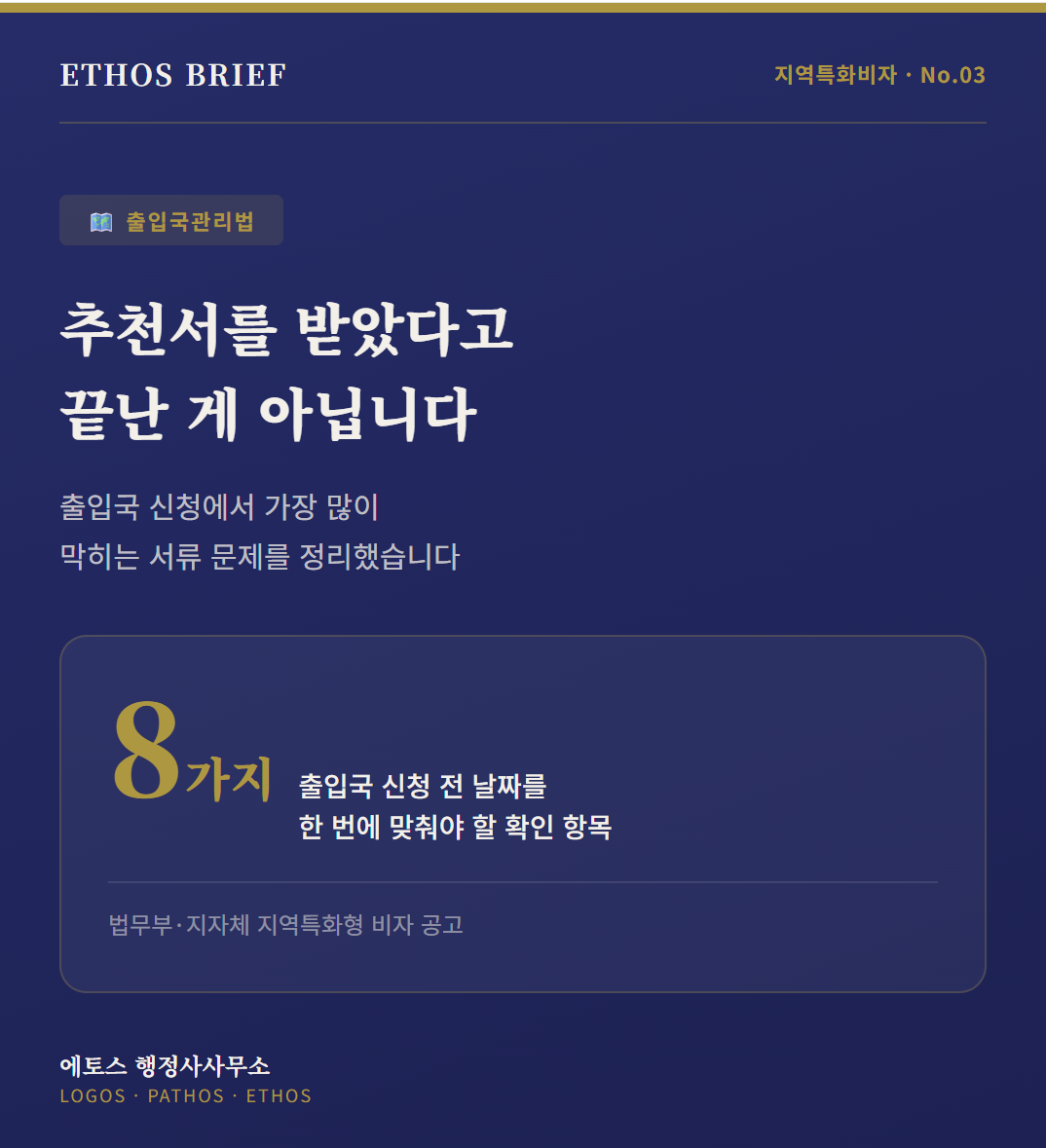
Regional Specialized Visa, Part 3 — How to Avoid Problems at the Immigration Filing Stage
Hello, this is Administrative Agent Jean from Ethos Administrative Office.
If you have been working in a regional area of Korea for several years, you may have wondered:
What happens when my current visa expires?
Can I stay longer through a Regional Specialized Visa?
I received the recommendation letter. What should I submit to immigration now?
This is the final article in a three-part series on Korea’s Regional Specialized Visa.
- Eligibility and visa-type comparison
- Local government recommendation process and common traps
- Immigration filing and document preparation
In Part 1, we reviewed the differences between F-2-R, E-7-4R, and F-4-R.
In Part 2, we discussed how to receive the local government recommendation.
In this final article, we will focus on what happens after the recommendation letter is issued and how to avoid delays, supplement requests, or refusal at the immigration stage.
The recommendation letter is not the final approval.
Your status changes only after the immigration office grants permission.
Key Summary
| Category | What to Check | What Can Go Wrong | |---|---|---| | HiKorea Appointment | Visit reservation at the competent immigration office | Delayed appointment may create visa-expiration risk | | Current Stay Period | Expiration date of your current visa | Filing after expiration may create unlawful stay issues | | Recommendation Letter | Local government recommendation and issuance date | Recommendation alone does not change your visa | | Income or Education | Income certificate or education documents | Outdated or insufficient proof may trigger supplement request | | Korean Language | KIIP or TOPIK documents | Expired TOPIK score may require re-test | | Residence Proof | Lease or accommodation confirmation | Missing period, signature, or provider information may delay filing | | Tuberculosis Test | Whether your nationality is subject to TB document requirement | Missing test result may delay acceptance | | F-4-R Documents | Overseas criminal record certificate and related proof | Long issuance period may cause deadline problems |
The key is simple:
Your recommendation letter, HiKorea appointment, visa expiration date, and document issuance dates must all align.
Why Can an Application Fail After Recommendation?
A local government recommendation is a crucial step, but it is not the final visa approval.
It is a required supporting document for the immigration application. The final change-of-status decision is made by the competent immigration office.
Common problems at the immigration stage include:
- Expired or outdated documents
- Insufficient residence proof
- Mismatch between employment contract and actual workplace
- Unclear income or education proof
- Invalid TOPIK or KIIP document
- Missing tuberculosis test result for a high-risk-country national
- Delayed overseas criminal record certificate for F-4-R
- Current status being excluded under the local government notice
Many applicants think, “I already received the recommendation, so the visa is almost done.”
In practice, the most time-sensitive stage often begins after the recommendation is issued.
What Happens If You Leave It Too Late?
The real problem is time.
After receiving the recommendation, your HiKorea appointment may not be immediately available. While waiting, some documents may become outdated.
For example, suppose you received the recommendation in June, but your HiKorea appointment is in August.
At the immigration counter, the officer may check your income certificate and find that it was issued in May. A more recent document may be requested. If your accommodation confirmation form is missing the stay period, you may need to ask your employer to rewrite it. If you are subject to tuberculosis testing but did not prepare the result, you may need to visit a public health center or designated hospital.
One supplement request can delay the process by one to three weeks.
Two supplement requests can put your current stay period at risk.
Your change-of-status application should be filed before your current period of stay expires. If you move after expiration, you may face unlawful stay issues, administrative fines, and future immigration disadvantages.
For Regional Specialized Visas, “almost complete” is not enough.
At the immigration counter, one missing document can stop the entire timeline.
Three Possible Paths
1. Prepare for a One-Time Filing
This is the safest and fastest option.
If you prepare the immigration filing documents before or while receiving the recommendation, you can file promptly once the recommendation is issued.
If your current visa expires within one to three months, this approach is usually the safest.
2. Respond After a Supplement Request
If documents are incomplete, immigration may request supplementation.
This can work if you have enough time.
However, reissuing documents, obtaining employer signatures, making another reservation, and waiting for review can take weeks.
If your current visa expiration is close, this is risky.
3. Consider Administrative Appeal After Refusal
If a refusal decision is issued, an administrative appeal may be considered.
Under the Administrative Appeals Act, an appeal generally must be filed within 90 days from the date you became aware of the disposition and within 180 days from the date of the disposition.
However, appeals take time and cost. Also, because the Regional Specialized Visa system is relatively new, accumulated case precedents are still limited.
In most cases, it is better to reduce the risk of supplement or refusal before the first filing.
Self-Check Before Immigration Filing
Review the following before visiting immigration:
- Have you already received the recommendation letter?
- Do you have at least three months before your current visa expires?
- Have you booked a HiKorea appointment?
- Is the immigration office the correct one based on your address?
- Are your income or education documents recently issued?
- Is your TOPIK score still valid?
- Do you have valid KIIP completion or placement proof?
- Does your residence document include address, period, provider signature, and ID copy if needed?
- Have you checked whether your nationality is subject to tuberculosis testing?
- If applying for F-4-R, have you started the overseas criminal record certificate process?
- Do you have any planned departure from Korea before or during the review?
If any answer is unclear, check before filing.
Immigration Filing Procedure
After receiving the recommendation, the general process is:
- Make a HiKorea visit reservation
- Visit the competent immigration office on the reservation date
- Submit the change-of-status application documents
- Wait for review
- Respond to any supplement request if issued
- Receive approval or refusal decision
- If approved, update your alien registration or status information
Many immigration services operate by reservation. Without a reservation, filing may be difficult or impossible.
If your visa expiration date is close, contact the 1345 Immigration Contact Center or the competent immigration office before visiting.
Basic Documents for F-2-R Filing
Documents differ by region and visa type, but F-2-R applicants commonly prepare the following.
Common Documents
| Document | Note | |---|---| | Integrated Application Form | Form No. 34 | | Passport and copy | Check passport validity | | Alien Registration Card | Prepare front and back copy | | Standard photo | If required | | Application fee | Change-of-status fee is generally KRW 100,000 | | Local government recommendation | Check visa type and issuance date |
Applicant Documents
| Document | Practical Note | |---|---| | Certificate of Alien Registration Facts | Address history may be reviewed | | Income certificate or education proof | Check local standard | | KIIP certificate or TOPIK score report | Check validity | | Local education completion certificate | Required only in some regions | | Residence proof | Must show actual ability to reside | | Tuberculosis test result | If applicable based on nationality | | Overseas criminal record certificate | Especially relevant for F-4-R |
Employer Documents
| Document | Practical Note | |---|---| | Employment contract | Workplace, job duties, wage, and period must be clear | | Business registration certificate | Employer information | | Employment or hiring confirmation | If required locally | | Accommodation confirmation | Period, address, provider signature required | | Employer ID copy | May be required if employer provides housing |
Accommodation confirmation is one of the most common sources of supplement requests.
If the address is unclear, the period is too short, the provider’s signature is missing, or the employer’s ID copy is not attached, you may need to prepare it again.
Residence Proof Is Not Just an Address
Regional Specialized Visas are based on local settlement.
Residence proof is therefore not merely an address document. Immigration may look at whether you can actually continue living in the recommended region.
Common residence documents include:
- Lease agreement
- Real estate registry document
- Accommodation provision confirmation
- Dormitory confirmation
- Employer-provided housing documents
If the employer provides housing, the period of accommodation is especially important. Some local notices may require a certain period of stable residence. The confirmation should clearly show the address, provider, period, signature, and identity document if required.
If your recommendation is based on regional settlement but your residence proof is unclear, the application becomes weaker.
Some Regions Allow a Residence Grace Period
Some local notices may allow applicants to complete relocation and address reporting within a certain period after status change.
However, this should not be treated as a nationwide rule.
Whether immediate relocation is required, how long the grace period is, and when address reporting must be completed depend on the local notice, recommendation conditions, and immigration office practice.
With Regional Specialized Visas, the recommended region follows the case until after approval.
Who Needs a Tuberculosis Test?
Not every foreign national needs a tuberculosis test.
In general, nationals of countries designated by the Ministry of Justice as high-risk for tuberculosis may be required to submit a TB-related medical certificate or test result when applying for a long-term stay exceeding 90 days.
Because F-2-R is a long-term residence-type status, nationals of high-risk countries should confirm whether TB documents are required.
Three points matter:
- Public health centers and designated hospitals may have different processing times.
- If the chest X-ray shows abnormal findings, additional sputum testing may be required.
- TB results may also have a validity issue based on issuance date.
Do not wait until the day before your immigration appointment.
Confirm the requirement and testing location at least one week in advance.
F-4-R Applicants Should Prepare Overseas Criminal Records Early
F-4-R, the regional overseas Korean route, may require overseas documents that take longer to obtain.
For overseas Korean visa-related procedures, Korean language proof and overseas criminal record documents may be required. For U.S. applicants, this may involve an FBI Identity History Summary Check. Other countries have different issuance, apostille, or consular authentication procedures.
Do not wait until after receiving the local recommendation to begin this process.
Some countries take weeks or months to issue the document.
If you start after the recommendation is issued, the local filing or recommendation deadline may pass before the document arrives.
This is one of the most dangerous documents to postpone.
Common Supplement Requests at Immigration
| Issue | Example | Practical Problem | |---|---|---| | Income document date | Old income certificate | Reissuance required | | Residence proof defect | Missing period or signature on accommodation form | Employer must rewrite | | Expired TOPIK score | More than two years since score issuance | Re-test may be needed | | Missing TB test | High-risk-country national did not prepare test | Test and revisit required | | Recommendation mismatch | Recommended region differs from address or workplace | Additional explanation required | | Unclear employment contract | Job duties, wage, or period not specific | Employer document supplement | | Current status limitation | Excluded under local notice | Application route must be reconsidered |
TOPIK requires special attention.
Some documents can be reissued within days, but TOPIK is tied to exam schedules and may take months.
What If the Application Is Refused?
If your change-of-status application is refused, you will receive a refusal notice.
The first step is to analyze the reason for refusal.
1. Requirement-Based Refusal
This includes missing documents, expired documents, or failure to prove a specific requirement.
In this case, refiling after supplementation may be faster than an administrative appeal, provided that you still have valid stay period remaining.
2. Discretionary Refusal
This includes refusal based on purpose of stay, immigration history, violation history, public interest, or overall suitability.
In this case, an administrative appeal may be considered. The general filing deadline is 90 days from awareness of the disposition and 180 days from the disposition date.
The key is not simply saying the decision is unfair.
The key is identifying whether the refusal reason can be legally challenged.
Cost Considerations
The change-of-status application fee is generally KRW 100,000.
However, the actual amount may vary depending on filing method, status type, and possible fee reduction rules. Always check HiKorea and the competent authority’s current guidance.
Administrative agent consultation and representation fees depend on the complexity of the case.
The review scope becomes wider if:
- Your current visa is close to expiration
- You received the recommendation but have not organized documents
- You need overseas criminal record documents for F-4-R
- You have a prior immigration violation
- Employer documents and actual workplace do not match
- You already received a supplement request or refusal
At Ethos Administrative Office, consultation fees may be credited toward representation fees if the case proceeds. Exact fees are provided after reviewing your current status, region, recommendation status, and document condition.
What Changes After Receiving F-2-R?
F-2-R is not merely a short extension of stay.
It can open a more stable long-term residence path based on regional settlement.
| Category | After F-2-R Approval | |---|---| | Period of Stay | Long-term stay and extension may be possible | | Employment | Must be reviewed within local and status conditions | | Family | Spouse and minor children may be reviewed for accompanying status | | Permanent Residence | F-5 may be reviewed after meeting residence requirements | | Regional Settlement | Residence and workplace conditions must continue to be managed |
However, do not assume that F-2-R means you can work anywhere without restriction.
Regional Specialized Visas are based on settlement in a specific region.
Even after approval, residence, workplace, and extension requirements must be managed.
Special Note for Jeonbuk Applicants
Jeonbuk State provides relatively detailed guidance on its Regional Specialized Visa program.
According to Jeonbuk’s guidance, F-2-R recommendation areas include population-declining cities and counties such as Jeongeup, Namwon, Gimje, Jinan, Muju, Jangsu, Imsil, Sunchang, Gochang, and Buan. Specific target areas and requirements may change under updated local notices.
Jeonbuk also lists certain excluded status categories.
The guidance includes restrictions for holders of statuses such as D-3, D-4, E-6-2, E-8, E-9, E-10, G-1, H-1, and certain D-10 cases depending on prior status.
This means a person who appears eligible in one region may be restricted in Jeonbuk, and Jeonbuk’s standard should not automatically be applied to other regions.
Regional Specialized Visa applications must always be checked against the specific local notice.
How I Would Organize the Case as an Administrative Agent
After the recommendation is issued, I would not send the applicant to immigration immediately.
First, I would organize the dates:
- Current visa expiration date
- Recommendation issuance date
- Available HiKorea appointment date
- Income document issuance date
- TOPIK validity period
- TB test availability date
- Expected overseas criminal record issuance date
- Employer document preparation date
Next, I would divide the documents by source:
- Documents prepared by the applicant
- Documents prepared by the employer
- Documents issued by the local government
- Documents issued overseas
- Documents issued by Korean public offices
Finally, I would check whether all documents tell the same story.
If the recommendation says one region, the employment contract shows another worksite, and the residence proof lists a third address, the application becomes risky.
For Regional Specialized Visas, the direction of the documents matters more than the number of documents.
Final Checklist Before Visiting Immigration
Before your immigration appointment, check the following:
- Is your HiKorea appointment confirmed?
- Is the immigration office competent for your address?
- Can you file before your current visa expires?
- Do you have the local recommendation document?
- Are you using the latest integrated application form?
- Do you have your passport and alien registration card?
- Do you have income or education proof?
- Is your Korean language proof valid?
- Is your residence proof complete?
- Is your employment contract clear on company, workplace, wage, and period?
- Have you checked whether a TB test is required?
- If F-4-R, have you prepared the overseas criminal record document?
- Will any planned departure affect the review?
Only after this checklist is complete should you consider yourself ready to visit immigration.
Closing
The Regional Specialized Visa can be an important opportunity for foreign nationals who want to work and settle in regional Korea.
But the recommendation letter is not the end.
HiKorea appointment, visa expiration date, document validity, tuberculosis testing, overseas criminal record documents, residence proof, and employer documents must all align before the status can actually change.
One outdated document, one missing sentence in a confirmation form, or one address mismatch can trigger a supplement request. If supplements repeat, your stay period becomes the real risk.
If you are preparing for a Regional Specialized Visa, do not stop at the recommendation stage.
Plan the immigration filing timeline together with the recommendation process.
This concludes the three-part series on Korea’s Regional Specialized Visa.
If this series was helpful, you can follow the blog for future updates or add our Kakao channel for short visa practice tips.