
Korea Digital Nomad Visa, Part 2 — Timing Is Everything When Changing from B-1, B-2, or C-3 to F-1-D
Hello, this is Administrative Agent Jean from Ethos Administrative Office.
You want to stay in Korea longer while working remotely.
A 90-day tourist stay is not enough.
A Korean work visa does not fit because you are not employed by a Korean company.
That is why many foreign remote workers search for Korea’s Digital Nomad Visa, officially the F-1-D Workation Visa.
But the real question is not only whether the visa exists.
The real question is:
When should you start preparing?
This is especially important for people already in Korea under short-term status such as B-1, B-2, or C-3.
This is Part 2 of the Digital Nomad Visa series.
- Permanent launch and common traps when applying alone
- Timing when changing from short-term status to F-1-D
- Practical FAQ and overlooked issues
In this article, we will focus on what must be prepared before the stay period expires and what can happen if the timing is missed.
Key Summary
| Category | Main Point | |---|---| | Change Possibility | A change to F-1-D may be possible from short-term status if requirements are met | | Most Important Deadline | Filing before the current stay period expires | | Slowest Document | Overseas criminal record certificate and apostille or consular confirmation | | Common Mistake | Thinking 90 days is enough | | Main Risk | Current stay expires before documents are ready | | Cost Risk | Translation, authentication, insurance, fees, flight tickets, and refiling costs | | Best Strategy | Prepare overseas documents before entry and book HiKorea early after entry |
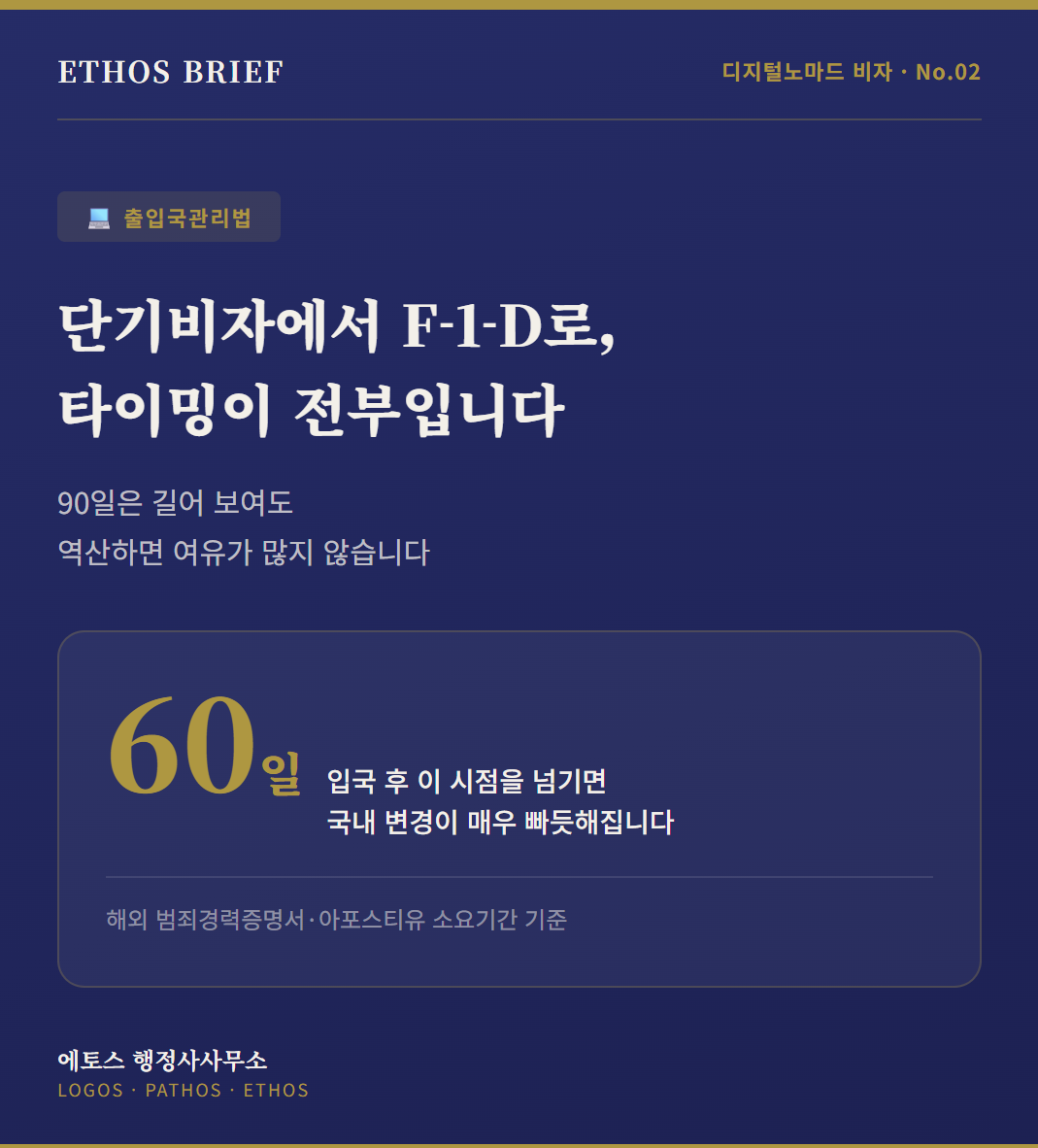
In short, if you begin after day 60 of a 90-day stay, domestic change becomes very tight.
Two Routes to Change Status
There are two main ways to move from short-term stay to the Digital Nomad Visa.
1. Leave Korea and Apply Through a Korean Embassy or Consulate
You may leave Korea and apply for an F-1-D visa at the Korean embassy or consulate in your country of residence or nationality.
This can take longer, but it gives you more room to prepare without being pressured by a short-term stay deadline.
2. Apply for Change of Status Inside Korea
If you are already in Korea under B-1, B-2, C-3, or another short-term status, you may apply for change of status at the competent immigration office if you meet the requirements.
The advantage is that you do not need to leave Korea.
But there is one critical condition:
You must be able to file before your current stay period expires.
If your documents are delayed and you pass the expiration date, this is no longer just a late filing issue. It becomes an overstay issue.
Why 90 Days Is Not as Long as It Looks
A 90-day stay sounds generous.
But once you work backward from the required documents, the timeline becomes tight.
| Preparation Item | Estimated Time | Practical Issue | |---|---:|---| | Overseas criminal record certificate | Several days to several months | Depends heavily on country and method | | Apostille or consular confirmation | 1 to 4+ weeks | Non-Apostille countries may take longer | | Korean translation and notarization | Several days to several weeks | Depends on source language | | Income proof organization | 1 to 2+ weeks | Freelancers and business owners need more time | | Medical insurance review | Several days to 1 week | Repatriation wording must be checked | | HiKorea appointment | Varies by office | Metropolitan offices may be booked out | | Review after filing | Several weeks to months | Supplement requests may delay the case |
The biggest bottleneck is usually the criminal record certificate and authentication process.
Receiving the certificate itself is not the end.
If the issuing country is an Apostille Convention country, the document may need an apostille. If not, foreign ministry authentication and Korean consular confirmation may be required. Korean translation and translation notarization may follow.
In practice, 90 days can disappear very quickly.
Family Accompaniment Takes Even Longer
The F-1-D Workation Visa may allow accompaniment by a spouse and minor children.
But family accompaniment multiplies the document burden.
Each family member may need separate identity, family relationship, criminal record, and insurance-related documents.
If family relationship documents are issued overseas, the process may include:
- Original issuance
- Apostille or consular confirmation
- Korean translation
- Translation notarization or confirmation
- Verification of family relationship consistency
If one family member’s document is delayed, the entire application can be delayed.
For family cases, pre-entry preparation is usually essential.
Scenario 1 — The U.S. Engineer Who Decides on Day 80
A U.S. software engineer enters Korea under B-2 status.
After enjoying life in Korea, he decides on day 80 that he wants to change to the Digital Nomad Visa.
Only 10 days remain.
The problem is that he has not yet applied for the FBI criminal record certificate. Even if he uses a fast electronic process, apostille, translation, and document organization will likely not be completed within 10 days.
A HiKorea appointment may also not be immediately available.
The result is that filing before expiration may be impossible, and he may need to leave Korea and apply through a Korean embassy or consulate.
The lesson is simple:
Day 80 is too late.
Scenario 2 — The Applicant Who Starts on Day 40 but Consular Confirmation Takes Too Long
An Egyptian freelance marketer enters Korea under B-2 status and starts preparing on day 40.
About 50 days remain. It looks manageable.
The criminal record certificate arrives in two weeks. But Egypt is not an Apostille Convention country, so consular confirmation may be required.
Foreign ministry authentication, Korean consular confirmation, Arabic-to-Korean translation, and translation notarization can make the remaining 50 days very tight.
Two risks appear:
- Filing before expiration may become impossible.
- Even if filing is barely possible, supplement response time may be insufficient.
For many countries, authentication takes longer than issuance.
Scenario 3 — Filing Before Expiration but Receiving a Supplement Request
An Australian UX researcher starts preparation on day 30.
Australia is an Apostille Convention country, so document preparation moves relatively quickly. She files the change-of-status application on day 85.
This is important:
Filing is not approval.
After filing, immigration reviews the documents. A supplement request may still be issued.
Common supplement issues include:
- Employment letter does not clearly state remote work approval
- Insurance certificate does not mention repatriation
- Income documents and bank deposits do not match
- Accommodation period is shorter than the intended stay
- Criminal record authentication method is unclear
If the requested supplement is not submitted within the given deadline, the case may be returned or refused.
Filing near the expiration date may technically be possible, but it is risky.
Scenario 4 — Leaving Korea During Review
You file the change-of-status application and the review is pending.
Then an overseas business trip or family emergency comes up.
A change-of-status application is generally based on the applicant being physically present in Korea. If you leave Korea during review, the application may be treated as withdrawn or the process may be interrupted depending on the case.
You may need to re-enter and file again. If previously prepared documents expire, they may need to be reissued.
A new filing fee may also apply.
If you are applying for F-1-D inside Korea, planned travel during review must be checked before filing.
What Costs Arise If You Miss the Timing?
Missing the timing does not simply mean being a few days late.
You may lose already-paid costs, pay new costs, and create immigration risk.
1. Direct Costs
| Item | Estimated Cost | |---|---:| | Criminal record translation and notarization | KRW 100,000 to 300,000 | | Apostille or consular confirmation | KRW 50,000 to 200,000+ | | Change-of-status filing fee | Generally KRW 100,000 | | Medical insurance | Refund may be limited depending on plan | | Document reissuance | Varies by country and authority |
2. Overstay Risk
If your stay period expires, overstay issues arise.
Overstay is a violation of Korean immigration law and may lead to an administrative fine, departure order, deportation, or future entry restrictions depending on the facts.
In practice, the result may vary depending on length of overstay, prior violation history, voluntary appearance, departure plan, and immigration discretion.
The key point is:
Even one day of overstay may create a record.
3. Refiling Costs
If domestic change becomes impossible and you must leave Korea to apply overseas, additional costs may include:
- Flight ticket
- Overseas accommodation
- Embassy or consulate visa fee
- Reissued documents
- Insurance adjustment or re-enrollment
- Korean housing or contract cancellation costs
- Remote work schedule disruption
Trying to save a small consultation fee can sometimes lead to losses of hundreds or thousands of dollars.
“If I File Before Expiration, Am I Safe?”
This is a common question.
If a stay-related application is filed before expiration, there may be certain administrative practices regarding lawful stay during review.
However, extension of stay and change of status are not identical.
Extension continues an existing status.
Change of status moves to a different status.
Therefore, it is not safe to say that filing always solves everything.
This is especially important when changing from short-term stay to long-term F-1-D status. Confirmation with the competent immigration office may be necessary.
What is clear:
- Filing before expiration is the minimum safety step.
- Filing after expiration is dangerous.
- Filing right before expiration leaves little room for supplement response.
- Leaving Korea during review creates a separate risk.
If your expiration date is close, contact 1345 or the competent immigration office before filing.
Can You Start Remote Work Before Approval?
Be careful.
Submitting an F-1-D change-of-status application while on B-1, B-2, or C-3 status does not automatically grant F-1-D activity rights.
Until the change is approved, you remain within the scope of your current status.
You should also be especially careful about providing services to Korean companies or Korean clients for compensation.
Even after F-1-D approval, the visa is not a domestic employment visa. It is for remote work for an overseas employer or overseas business.
Before approval, you should take an even more conservative approach.
When Domestic Change May Be Better
Domestic change may be worth considering if:
- You have enough time before your current stay expires
- Your criminal record certificate is already issued or quickly available
- Apostille or consular confirmation process is clear
- Income documents are mostly ready
- Medical insurance requirements can be confirmed
- HiKorea appointment is available in time
- You have no travel plans during review
- You are applying alone or family documents are already ready
In this situation, domestic change may save time and travel costs.
When Overseas Application May Be Better
Leaving Korea and applying through a Korean embassy or consulate may be safer if:
- Less than 30 days remain
- Criminal record certificate has not been requested
- The issuing country is not an Apostille Convention country
- Consular confirmation will take several weeks
- Freelance income proof is complex
- Family accompaniment documents are extensive
- HiKorea appointment is not available before expiration
- You may need to leave Korea during review
Forcing a domestic change when documents cannot physically be completed can create more risk than leaving and applying properly.
The Gray Zone
The hardest cases are in the middle.
For example:
- 35 to 50 days remain
- Criminal record certificate has been requested but not received
- Apostille process is possible but timing is uncertain
- Income documents exist but need freelance-structure explanation
- Insurance is purchased but repatriation wording is unclear
- HiKorea appointment is available but close to expiration
In these cases, the answer is not simply yes or no.
You must calculate remaining stay period, document issuance date, authentication timeline, appointment availability, and supplement risk together.
A wrong decision here can cause both domestic change and overseas application to be delayed.
When Should You Start?
The best time is before entering Korea.
Before entry, you can start:
- Criminal record certificate request
- Apostille or consular confirmation planning
- Income document collection
- Remote work approval letter request
- Medical insurance comparison
- Accommodation planning
- Family document review
Immediately after entry, you should:
- Check HiKorea appointment availability
- Complete translation and notarization
- Confirm insurance certificate wording
- Organize income documents and exchange-rate basis
- Prepare accommodation documents
- Confirm the competent immigration office
- Final-review the filing package
With this approach, filing within 30 to 40 days after entry may be possible.
If you begin after day 60, one delayed document can break the entire schedule.
Timing Checklist Before Filing
Check the following first:
- Are you currently in Korea under B-1, B-2, C-3, or another short-term status?
- How many days remain before your stay period expires?
- Have you already received your criminal record certificate?
- If not, how long will issuance take?
- Is the issuing country an Apostille Convention country?
- Do you know the apostille or consular confirmation process?
- Is Korean translation and notarization required?
- Can income be proven with payslips alone?
- If freelance or business income, do you need tax returns, bank statements, and client contracts?
- Does medical insurance include medical treatment and repatriation?
- Does insurance cover the full intended stay period?
- Have you checked available HiKorea appointment dates?
- Are family members accompanying you?
- Do you need to leave Korea during review?
If any point is unclear, first decide whether domestic change is realistic before collecting more documents.
How I Would Assess the Case as an Administrative Agent
First, I would check the remaining stay period.
Then I would calculate the expected completion date of the slowest document: the criminal record certificate and authentication.
Next, I would check HiKorea appointment availability.
After that, I would review income proof, medical insurance, remote-work confirmation, and family documents.
Finally, I would compare two routes:
- Can the applicant file inside Korea before expiration?
- Is leaving Korea and applying through a Korean mission safer?
This decision cannot be made from a document checklist alone.
It must be made from the calendar.
F-1-D change of status is partly a document issue, but more precisely, it is a timing issue.
What a Preliminary Review Can Check
A preliminary review can help determine:
- Whether domestic change is realistic at this stage
- Whether overseas application is safer
- Whether filing before expiration is possible
- Whether criminal record issuance and authentication can finish in time
- Whether income proof can be explained clearly
- Whether medical insurance meets the requirement
- Whether family-accompaniment timing is feasible
- Which documents are likely to trigger supplement requests
Exact fees can be provided after reviewing current status, remaining stay period, nationality, income structure, family accompaniment, and available documents.
Closing
The F-1-D Digital Nomad Visa can be a strong option for remote workers who want to stay in Korea longer.
But if you are changing from short-term status inside Korea, timing is everything.
Ninety days may look long, but once you include criminal record certificates, apostille or consular confirmation, Korean translation, income proof, medical insurance, and HiKorea appointment scheduling, there may not be much room left.
Starting on day 80 is too late.
Starting on day 60 may still be risky.
The safest start is before entering Korea.
Domestic change is not always the best route.
If documents cannot physically be completed before expiration, leaving Korea and applying through a Korean embassy or consulate may be safer.
Before preparing the F-1-D application, organize these three dates:
- Current stay expiration date
- Expected criminal record and authentication completion date
- Earliest available HiKorea appointment date
If those dates do not align, the strategy needs to change.
In the next article, we will answer the 10 most common questions about the Digital Nomad Visa, including family accompaniment, Korean company setup, what happens after three years, health insurance, and tax issues.