Game Production Business Korea, Game Distribution Business Korea, Game Business Change Registration, Game Production Business Change Registration, Game Distribution Business Change Registration, Game Company Representative Change, Game Company CEO Change Korea, Game Business Address Change, Game Business Location Change, Game Company Office Relocation Korea, Game Production Items Change, Game Distribution Items Change, Game Business Succession Korea, Game Business Transfer Korea, Game Company M&A Korea, Game Business Registration Korea, Game Business Registration Certificate, 30 Day Change Registration Korea, Korean Game Licensing, Korean Game Industry Act, Game Regulatory Compliance Korea, Game Company Compliance Korea, Game Publishing Business Korea, Game Industry Regulation Korea
BySangjin Ji, Administrative Attorney3 years of embassy visa practiceLinkedIn
Hello, I'm Jean Ji, a Certified Administrative Agent in Korea.
A game company receives new investment and undergoes a major internal restructuring.
Its representative director changes.
The company moves its office from Seongnam to Seoul.
It also decides to expand the scope of its game production and distribution activities.
The corporate registry is updated.
The business registration information is corrected.
A new office lease is signed.
Internally, the company believes that all administrative procedures have been completed.
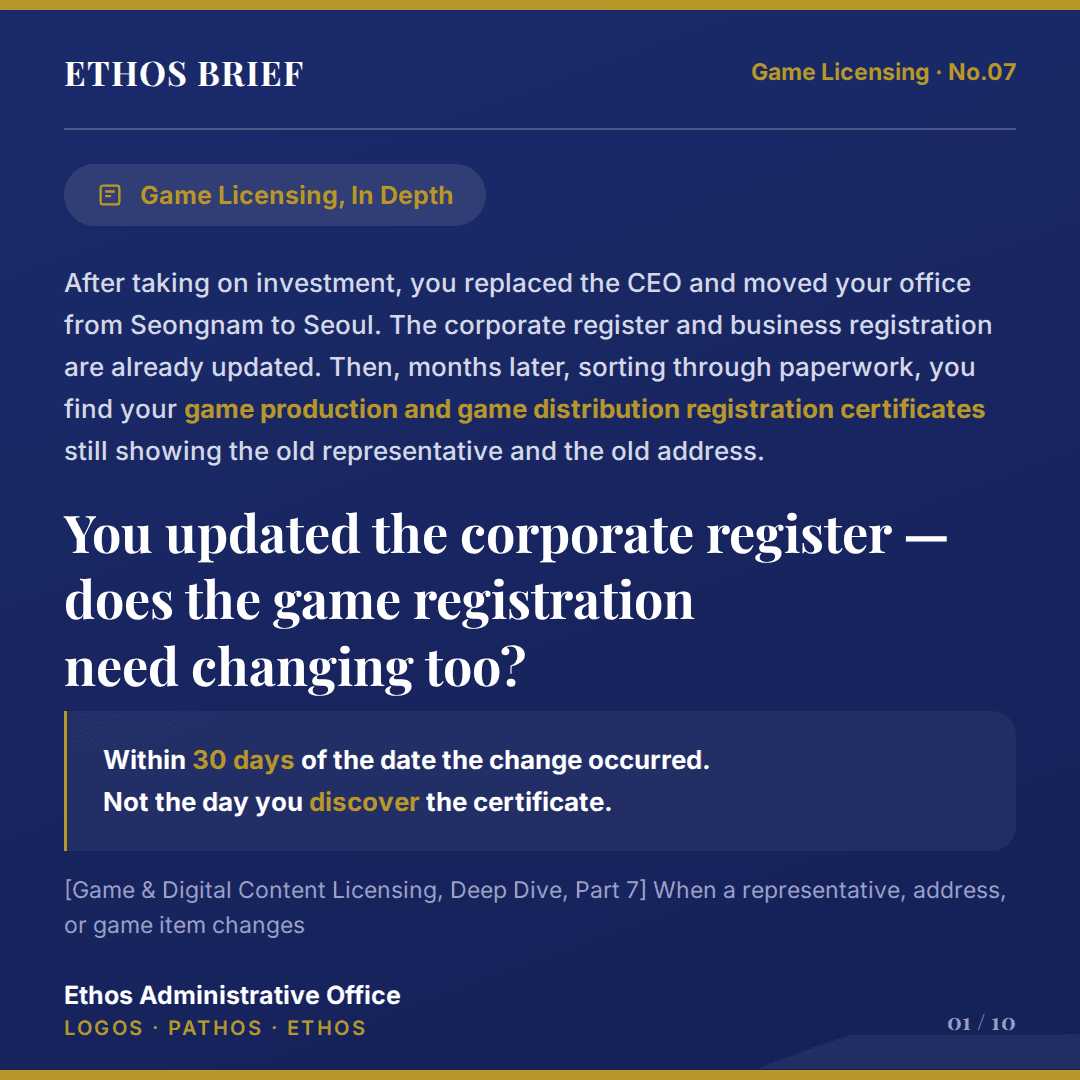
Several months later, however, someone reviews old corporate documents and finds the company’s game production business registration certificate and game distribution business registration certificate.
The former representative and old business address are still listed.
The person in charge asks:
“We already updated the corporate registry and business registration. Do we also need to amend our game production or game distribution business registration?”
There is one number to check first.
30 days.
Under the current Enforcement Rule of Korea’s Game Industry Promotion Act, where certain important registered information changes, an application for change registration generally must be filed within 30 days from the date the relevant change occurred.
This means that even if the company has already completed:
corporate registry update → business registration correction → completion
the registration maintained under the Game Industry Promotion Act may still need to be reviewed separately.
More importantly, not every change involving a representative, address, or business activity is handled through the same procedure.
A company must distinguish whether:
the representative director alone has changed,
the game business itself has moved to another legal entity,
only the corporate head office has moved,
the registered game-business premises have also moved,
an individual game has simply been updated,
or the company’s registered production or distribution items have actually changed.
In this article, we will examine which changes may require change registration, how the 30-day period works, how change registration differs from business succession, and which documents should be compared before filing.
Game & Digital Content Licensing Deep Dive Series
- Do game developers and distributors need separate business registrations?
- When should a game rating be obtained in Korea?
- Where should you apply for a Korean game rating?
- Do game updates require a new rating?
- What must be disclosed when a game includes probability-based items?
- Who handles Korean regulatory procedures when an overseas-developed game is launched in Korea?
- What happens when the representative, address, or registered game business items change? — This article
- Is closing a game business as simple as cancelling the business registration?
- What happens to existing registrations when acquiring a game company or game business?
1. Game Production and Distribution Registrations Are Not “Register Once and Forget” Licenses
Article 25 of the Game Industry Promotion Act generally requires a person operating a game production business or game distribution business to register the business separately.
If certain important information changes after registration, a change registration may be required.
This is where the first misunderstanding often occurs.
A company may assume that because it has already updated its corporate registry and business registration, its game-business registration has also been updated automatically.
But these systems serve different regulatory purposes and are based on different legal frameworks.
A corporate change therefore should not be assumed to update every other registration automatically.
Under the rules currently in effect in October 2026, the relevant changes for game production and distribution businesses include:
- a change of the business operator, including a change of representative in the case of a corporation,
- a change in the location of the business premises,
- a change in factory location or production items for a game production business,
- a change in distribution items for a game distribution business.
The correct question is therefore not simply:
“What changed in the company?”
It is:
“Which information previously registered for the game business has changed?”
2. If the Representative Director Changes, the Game-Business Registration Should Also Be Checked
The first change at Company A is its representative director.
The corporation itself continues to exist.
Company A remains the same legal entity.
Only the representative director changes from one person to another.
The Enforcement Rule expressly includes a change in the representative of a corporation within the relevant category of changes.
Accordingly, completing the representative-director amendment in the corporate registry does not necessarily mean that the game production or distribution registration has also been updated.
A practical mismatch may look like this:
The corporate registry shows the new representative.
The business registration information has also been updated.
But the game production business registration certificate still lists the former representative.
The company’s actual corporate information and its game-business registration no longer match.
For this reason, when a representative changes, one of the first things to review is the existing game production or distribution registration certificate and compare it with the current corporate registry.
3. A Change of Representative and a Change of Business Operator Are Different Issues
This is one of the most important distinctions in this article.
A company must determine whether the representative changed or the business operator itself changed.
If the same corporation continues operating and only its representative director changes, the issue may be handled as a change registration.
But if the game business itself is transferred to another company, a different procedure may apply.
The Enforcement Rule treats a change of business operator as a change-registration matter but excludes changes arising through business succession under Article 29 of the Game Industry Promotion Act.
Article 29 addresses situations such as the transfer of a business, inheritance, or corporate merger, where another person or entity may succeed to the existing operator’s legal status.
A separate business-succession report may then be required.
Consider two examples.
Company A continues to exist, but its representative director changes.
→ Review change registration for the representative.
Company A transfers its entire game business to Company B.
→ First determine whether the transaction constitutes business succession, rather than merely amending the name or representative shown on the registration certificate.
These are not simply two different forms.
The legal operator itself may be different.
This distinction becomes particularly important in investment transactions, M&A, mergers, and business transfers.
Do not look only at the fact that a name changed. Determine why the representative or business operator changed.
4. If the Office Moves, Check the Registered Game-Business Premises — Not Only the Corporate Head Office
The second issue is location.
Company A closes its Seongnam office and moves to Seoul.
Its registered corporate head office is changed to Seoul.
The business registration address is also corrected.
Does the game production or distribution registration need to be changed as well?
The relevant rule focuses on a change in the location of the registered business premises.
For game production businesses, a separate change in factory location may also be relevant.
This means the corporate head office and the game-business premises should be distinguished.
For example, a company could move its registered head office to a management office in Seoul while continuing to operate its actual game production business from the existing Seongnam location.
In that case, the mere fact that the corporate head office changed may not answer the entire question.
On the other hand, if the game production business was registered at the Seongnam office and the actual development and operating teams have moved to Seoul, a change in the registered business premises should be reviewed.
The first question is therefore not:
“Where is the corporate head office now?”
It is:
“What location was registered for the game business, and where is that business actually being operated now?”
5. Changing an Address May Involve More Than Replacing One Line on a Certificate
Under the current Enforcement Rule, a change-registration application may require the existing license, registration certificate, or notification certificate to be submitted.
If the location of the business premises or factory changes and the new location is leased, a lease agreement may also need to be submitted.
Other documents proving the relevant change may also be required.
In practice, an office relocation should therefore be reviewed by comparing at least:
existing game-business registration → current corporate registry → new lease agreement → actual place of business
Suppose the lease agreement shows Company A as the tenant.
The game-business registration still lists the old address.
The business registration contains the new address.
But the development team is actually working from a third location.
What initially looked like a simple address amendment may require closer review.
This is why the actual business structure should be organized before filling out the change-registration form.
6. “The Game Changed” Can Mean Two Very Different Things
The third issue is game-related items.
This is particularly easy to misunderstand because companies often use the same expression:
“The game changed.”
That statement can describe two entirely different situations.
The first is an update to an existing released game.
A new character is added.
The payment function changes.
Combat effects or other game content are modified.
Those issues may relate to content modification reporting or game-rating procedures.
The second situation concerns the company’s registered business items.
Under the current rules, a change in production items may be relevant for a game production business.
A change in distribution items may be relevant for a game distribution business.
Accordingly, the fact that a company begins developing a new game does not automatically answer the legal question.
The company should compare what was originally registered as its production or distribution items with what it actually plans to produce or distribute now.
The key distinction is:
Did the content of one game change?
Or:
Did the registered scope of the company’s game production or distribution business change?
Confusing these two issues can lead a company to focus on business-registration amendments when a game-content procedure is actually relevant, or vice versa.
7. The 30-Day Period Does Not Begin When Someone Finally Finds the Old Certificate
Assume Company A discovers its old registration certificate two months after changing its representative director.
Someone might think:
“We only realized this today, so don’t we have 30 days from today?”
That is not how the rule is written.
The filing period generally runs from the date the relevant change occurred.
It does not begin simply when someone rediscovers the registration certificate or learns that a change-registration requirement may exist.
For that reason, companies should include game-business registrations in their broader corporate-change checklist.
Relevant dates may include:
the date the new representative takes office,
the date the business premises move,
or the date a registered production or distribution item actually changes.
If different changes occur on different dates, each relevant date should be identified separately.
Game-business change registration should be treated as part of the corporate change process itself, not as an administrative task to remember months later.
8. The Numbers 30 Days, 15 Days, and 3 Days Mean Different Things
When researching a game-business change registration in Korea, several different numbers may appear.
30 days.
15 days.
And sometimes 3 days in government service information.
They do not necessarily conflict.
They refer to different procedural periods.
30 days generally refers to the period within which the business operator must apply after the relevant change occurs.
15 days refers to the statutory period under Article 25 within which the competent authority must notify the applicant whether the change registration has been accepted.
Under certain circumstances, if neither a decision nor an extension notice is issued within that period, the law also contains provisions concerning deemed registration after the period expires.
Meanwhile, Korea’s Government24 service information may display a 3-day administrative processing period for the relevant civil-service application.
In short:
30 days = applicant’s filing deadline
15 days = statutory notification period for the authority
3 days = processing period indicated for the relevant Government24 service
Where the amendment is connected to a game launch, investment due diligence, publishing agreement, or office relocation, it is generally more practical to prepare the supporting documents early rather than planning around the final day of the filing period.
9. Failing to Update the Registration Is More Than a Minor Typographical Error
It would be excessive to suggest that every missed change registration automatically results in business closure.
But it would also be inaccurate to treat the issue as a harmless clerical mistake.
The Game Industry Promotion Act includes failure to complete required change registration among the grounds for administrative measures applicable to registered game production and distribution businesses.
The law provides a basis for measures including suspension of business for a specified period or closure, although the actual measure depends on the nature of the violation, the number of violations, and the applicable administrative standards.
There is also a more practical risk.
Imagine an investor conducting due diligence.
The corporate registry lists the new representative.
The business registration shows the Seoul address.
But the game distribution registration still lists the former representative and the old Seongnam address.
The company’s own documents now appear to describe different versions of the same business.
That mismatch may create additional questions in contracts, administrative procedures, or corporate due diligence.
The purpose of change registration is therefore not merely to avoid penalties.
It is to keep the company’s actual operating information consistent with the information registered with the competent authority.
10. After Investment or M&A, Reviewing Only the Representative Change May Not Be Enough
Assume Company A’s changes occurred as part of an investment or M&A transaction.
A new representative takes office.
At the same time, a specific game business division is transferred to another affiliate.
The office moves.
The distribution rights for certain games are also transferred to a new entity.
In that situation, the conclusion:
“The representative changed, so we only need a change registration.”
may be too simple.
A representative change can occur while the same legal operator continues the business.
But a business transfer or merger may raise a business succession issue under Article 29 of the Game Industry Promotion Act.
The law also contains rules under which certain effects of previous administrative measures or violations may follow the succeeded business in specified circumstances.
Therefore, in a game-company acquisition, merger, or business transfer, the review should not stop at the name printed on the registration certificate.
The company should determine:
what business is being acquired, who will continue operating it, and which registrations and legal positions are involved in the transfer.
This issue will be examined in more detail in Article 9 of this series: “Do Existing Registrations Follow When a Game Company or Game Business Is Acquired?”
11. What Documents Should Be Compared in a Change-Registration Review?
The change-registration form itself may not appear particularly complicated.
The more important issue is consistency among the supporting documents.
A practical review can be organized in the following sequence.
Step 1 — Confirm the Existing Registration
First review what is currently stated on the game production or distribution registration certificate.
Check items such as:
the representative,
the registered business premises,
factory location,
production items,
or distribution items.
Step 2 — Identify What Actually Changed
Review documents such as:
the corporate registry,
lease agreements,
business-related registration information,
documents concerning business transfers or mergers,
and the current operating plan.
Determine what changed and when.
Step 3 — Separate the Applicable Procedures
Determine whether the issue involves:
a simple change registration,
business succession,
or a separate game-content modification or rating procedure.
Step 4 — Match Each Change With Its Date and Evidence
Identify when each relevant change occurred.
Then connect the representative change with supporting corporate documents, the address change with location documents, and the item change with documents explaining the revised business scope.
Step 5 — Check Whether All Post-Change Information Points in the Same Direction
Compare:
the game-business registration,
corporate registry,
business information,
lease documents,
and actual operating structure.
They should not describe materially different versions of the business.
This process does more than prepare an application form.
It first determines what actually needs to be changed and which issues belong to a different administrative procedure.
12. How Should Company A Organize Its Changes?
Return to Company A.
Its representative changed.
It moved from Seongnam to Seoul.
Its business scope is expanding.
The company should begin with its existing game production and distribution registration certificates.
Representative
Determine whether the same legal entity remains in place and only the representative director changed.
If so, review the representative change-registration requirement.
If the business operator itself changed through a business transfer or merger, review whether a business-succession procedure applies.
Address
Determine whether only the corporate head office moved or whether the registered game-business premises also moved to Seoul.
If new premises are leased, compare the lease agreement with the registered information.
Game Business Items
Determine whether the company merely modified the content of an existing game or whether the registered production or distribution items themselves changed.
Deadline
Identify the date on which each relevant change occurred.
If change registration is required, assess the status of the procedure against the 30-day filing period.
By separating these four questions, what initially looks like one corporate event:
representative change → address change → business-item change
becomes a series of separate administrative issues.
What Can the Company Handle Internally, and When Is Additional Review Useful?
Where the same legal entity remains in place and only the representative director changes, or where the registered game-business premises simply move to a new office and the supporting documents are clear, the company may be able to prepare the change registration internally by comparing the existing certificate with the corporate registry, lease agreement, and official procedural guidance.
More detailed review may be useful where the representative change occurs together with a merger or business transfer, where the corporate head office and actual game-business premises are different, where several locations are used, where production or distribution items have changed significantly, or where released games are also being modified at the same time.
In those situations, the existing game-business registration, corporate registry, lease documents, dates of change, and actual operating structure should be reviewed together to distinguish change registration, business succession, and any separate game-content or rating procedures.
Conclusion: Updating Corporate Information Is Not the Same as Updating a Game-Business Registration
Return to the original question from Company A:
“We already updated the corporate registry and business registration. Do we still need to amend our game production or distribution registration?”
If an important matter registered under the Game Industry Promotion Act has changed, a separate change registration may need to be reviewed.
For game production and distribution businesses, the key changes include:
a change of business operator, including the representative of a corporation,
a change in the location of the business premises,
a change in factory location or production items for a game production business,
and a change in distribution items for a game distribution business.
Where the change-registration requirement applies, the 30-day period from the date the change occurred should also be checked.
But a change in a representative’s name does not always lead to the same procedure.
Changing the representative of the same corporation is different from business succession through a transfer or merger.
A corporate head office should be distinguished from the registered game-business premises.
And a change to an individual game should be distinguished from a change to the company’s registered production or distribution items.
Ultimately, the central question is not whether a form has been reissued.
It is whether the company described on the existing game-business registration still matches the company that is actually operating the game business today.
If your company’s representative, business premises, production items, or distribution items have changed, a free initial review can help determine whether a change registration is sufficient or whether business succession or another game-related administrative procedure should also be considered.